

Wudu (ablution) serves as the primary gateway to prayer, acting as a spiritual and physical ritual of purification (thaharah) from minor ritual impurity. While fulfilling the obligatory components (fardhu) ensures the legal validity of the act, performing the Sunnah acts of wudu elevates the worshiper’s reward and mirrors the perfection of the Prophetic tradition. By understanding the linguistic and technical definition of wudu, a believer recognizes that every detail in this ritual carries profound spiritual significance. This guide outlines the sunnah practices according to the Shafi’i school, providing a roadmap to a more meticulous and rewarding ablution.
Preparatory Sunnah Acts Before Beginning Wudu
Before the water reaches the skin of the obligatory limbs, several preparatory actions are highly recommended to prime the heart and body for worship.
1. The Use of the Miswak (Siwak)
Using a tooth-stick or siwak is one of the most emphasized traditions. The primary objective is to ensure the mouth is clean and fresh before standing in front of Allah SWT. According to the classical text al-Muqaddimah al-Ḥaḍramiyyah:
“وسننه السِّوَاك”
“And its (wudu’s) sunnah acts include using the miswak.”
While the traditional Salvadora persica branch is superior, a modern toothbrush serves as a valid substitute in achieving basic cleanliness.
2. Reciting the Basmalah (Tasmiyah)
The ritual should ideally begin by reciting the “Tasmiyah” (Bismillāhir-raḥmānir-raḥīm). This act should coincide with the initial intention (niyah) and the first washing of the hands. Regarding the legal ruling on reciting the Basmalah, scholars note:
“ثمَّ التَّسْمِيَة مقرونة بِالنِّيَّةِ مَعَ أول غسل الْكَفَّيْنِ”
“Then reciting the basmalah (Bismillāh) coupled with the intention during the first washing of the two palms.”
If one forgets at the start, it is sunnah to recite Bismillāhi awwalahu wa ākhirahu before the wudu is completed.
Core Sunnah Rituals During Execution
Once the process begins, the following actions refine the physical washing and ensure every area is reached by the purifying water.
3. Washing the Palms to the Wrists

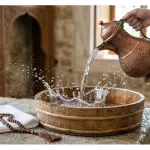


It is sunnah to wash both hands up to the wrists three times before proceeding to the face. This is particularly important after waking from sleep; if one is uncertain of the hands’ cleanliness, it is disliked (makruh) to dip them into a small container of water before washing them separately.
4. Rinsing the Mouth (Madmadhah) and Nasal Aspiration (Istinsyaq)
These two acts involve cleansing the internal cavities. In the Shafi’i madhhab, it is most virtuous to combine them using three handfuls of water. For each handful, use a portion for the mouth and the remainder for the nose. Unless one is fasting, it is sunnah to be thorough in these actions.
5. Combing the Beard and Interlacing Fingers (Takhlil)
- Beard: For men with thick beards, it is sunnah to run wet fingers through the hair to ensure moisture reaches the skin.
- Fingers/Toes: One should interlace the fingers (tasybik). For the toes, use the pinky finger of the left hand, starting from the small toe of the right foot and ending with the small toe of the left. This thoroughness is vital, even in complex cases such as ablution for amputees.
6. Wiping the Entire Head and Both Ears
While wiping a portion of the head is obligatory, wiping the entire head is a confirmed sunnah. Following this, one should wipe the interior and exterior of the ears, including the ear canals, using fresh water rather than the moisture left over from wiping the head.
Methods to Perfect the Washing
The following techniques ensure that the washing is done with excellence and precision.
| Practice | Description |
| Tayamun | Always begin with the right limb before the left (hands and feet). |
| Tatslith | Performing each wash, wipe, and interlacing three times. |
| Ad-Dalk | Scrubbing the limbs with the hand to ensure water is distributed evenly. |
| Ithalatul Ghurrah | Extending the wash area (e.g., washing slightly above the elbows/ankles). |
Essential Etiquettes for a Complete Ablution
To reach the pinnacle of thaharah, a Muslim should observe these secondary etiquettes:
- Continuity (Muwalat): Washing the next limb before the previous one dries.
- Conservation: Avoiding waste and ensuring the water remains pure. Ideally, the volume used should not be less than one mud (approx. 0.6 liters).
- Direction: Facing the Qibla if circumstances permit.
- Minimal Assistance: Not asking for help in pouring water unless there is a valid excuse (uzur).
Post-Wudu Supplication (Dua)
The spiritual journey of wudu concludes with a specific supplication. Observing the proper adab of dua after purification is highly virtuous.
أَشْهَدُ أَنْ لاَ إِلَهَ إِلاَّ اللَّهُ وَحْدَهُ لاَ شَرِيكَ لَهُ وَأَشْهَدُ أَنَّ مُحَمَّدًا عَبْدُهُ وَرَسُولُهُ. اللَّهُمَّ اجْعَلْنِي مِنَ التَّوَّابِينَ وَاجْعَلْنِي مِنَ الْمُتَطَهِّرِينَ وَاجْعَلْنِي مِنْ عِبَادِكَ الصَّالِحِينَ.
سُبْحَانَكَ اللَّهُمَّ وَبِحَمْدِك أَشْهَدُ أَنْ لاَ إِلَهَ إِلاَّ أَنْتَ أَسْتَغْفِرُكَ وَأَتُوبُ إِلَيْكَ.
Transliteration:
Ashhadu an lā ilāha illā llāhu waḥdahu lā sharīka lah, wa ashhadu anna Muḥammadan ʿabduhu wa rasūluh.
Allāhumma ijʿalnī mina al-tawwābīn, wa ijʿalnī mina al-mutaṭahhirīn, wa ijʿalnī min ʿibādika al-ṣāliḥīn.
Subḥānaka Allāhumma wa bi-ḥamdik, ashhadu an lā ilāha illā anta, astaghfiruka wa atūbu ilayk.
Translation:
“I bear witness that there is no god but Allah, the One, who has no partner. And I bear witness that Muhammad is His servant and His Messenger. O Allah, make me among those who repent, make me among those who are purified, and make me among Your righteous servants. Glory be to You, O Allah, and with Your praise, I bear witness that there is no god but You, I seek Your forgiveness and I turn to You in repentance.”
Conclusion
The Sunnah acts of wudu are not merely extra steps; they are the “spirit” of purification that prepares the believer for a more focused and sincere prayer. By implementing these practices—from the siwak to the final dua—we honor the legacy of Prophet Muhammad ﷺ and ensure our thaharah is performed with the highest degree of excellence.
Frequently Asked Questions (FAQ)
1. Is wudu valid if I skip the Sunnah acts?
Yes, wudu is legally valid if you fulfill the obligatory (fardhu) pillars. However, you lose significant rewards and the spiritual perfection associated with the Sunnah.
2. Can I use a regular toothbrush instead of a siwak?
Yes, Shafi’i scholars generally agree that a toothbrush can fulfill the sunnah of cleansing the teeth if a traditional siwak is unavailable.
3. Is it mandatory to wash exactly three times?
Washing once is the minimum requirement for validity. Washing three times is the Sunnah. Exceeding three times without reason is considered disliked (makruh).
References:
Bā Faḍl al-Ḥaḍramī, al-Muqaddimah al-Ḥaḍramiyyah (Masāʾil al-Taʿlīm), ed. Mājid al-Ḥamawī (Damascus: al-Dār al-Muttaḥidah, 1992), 29-32.


