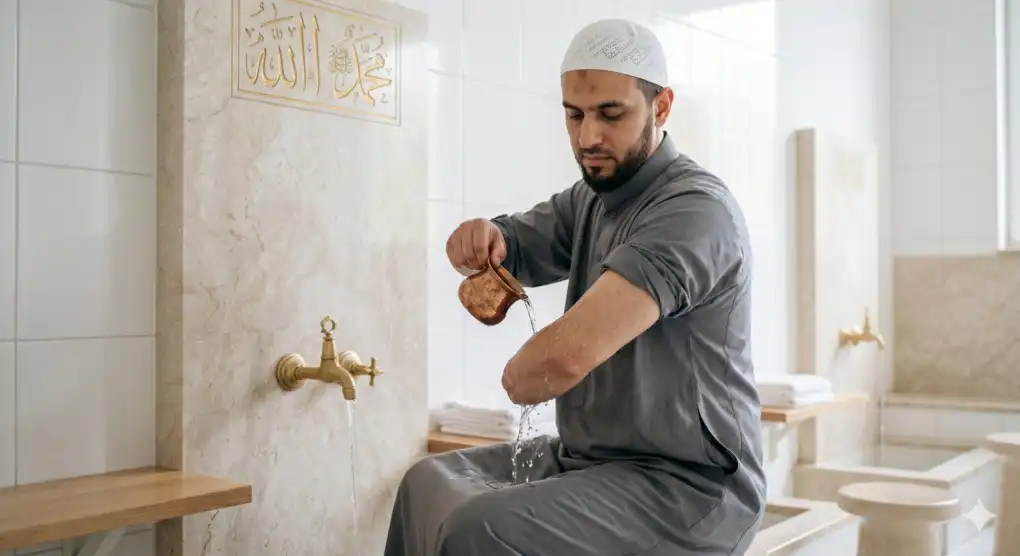
Performing ablution is a fundamental prerequisite for prayer, but how does one approach Wudu for amputees? In Islamic jurisprudence, or fiqh, physical limitations do not entirely absolve a believer from their religious obligations. Within the Shafi’i madhhab, the core principle applied to this condition is al-maysūr lā yasquṭ bil-ma‘sūr (what can be accomplished is not waived by what is difficult).
This article explores the precise definition and rulings of ablution for individuals with amputated or missing limbs. By examining authoritative classical texts such as al-Iqnāʿ fī Ḥall Alfāẓ Abī Shujāʿ, we provide a comprehensive, academic, and accessible guide for Muslims navigating these circumstances.
The Foundational Principle of Wudu for Amputees
In the Shafi’i school of thought, individuals with physical disabilities or amputated limbs remain obligated to perform Wudu to the best of their ability. This legislation is firmly rooted in a widely transmitted Hadith of Prophet Muhammad (PBUH):
“If I command you to do a thing, then do as much of it as you can.” (Narrated by Bukhari and Muslim)
This Hadith dictates that believers must wash whatever remains of the obligatory limbs specified in Surah Al-Ma’idah (5:6). The boundaries of the obligatory acts of ablution (fardhu wudu) are strictly defined, and the obligation only falls upon the physical body parts that still exist.
Classical Rulings from Al-Iqnāʿ
To fully grasp the Shafi’i perspective, we must refer to al-Iqnāʿ fī Ḥall Alfāẓ Abī Shujāʿ (Vol. 1, p. 43) by the eminent scholar Al-Khatib ash-Shirbini. The classical text outlines the legal framework for amputation:
Original Arabic Text:
فَإِن قطع بعض مَا يجب غسله من الْيَدَيْنِ وَجب غسل مَا بَقِي مِنْهُ لِأَن الميسور لَا يسْقط بالمعسور وَلقَوْله صلى الله عَلَيْهِ وَسلم إِذا أَمرتكُم بِأَمْر فَأتوا مِنْهُ مَا اسْتَطَعْتُم أَو قطع من مرفقيه بِأَن سل عظم الذِّرَاع وَبَقِي العظمان المسميان بِرَأْس الْعَضُد فَيجب غسل رَأس عظم الْعَضُد لِأَنَّهُ من الْمرْفق أَو قطع من فَوق الْمرْفق ندب غسل بَاقِي عضده كَمَا لَو كَانَ سليم الْيَد وَإِن قطع من مَنْكِبه ندب غسل مَحل الْقطع بِالْمَاءِ كَمَا نَص عَلَيْهِ
English Translation: If a portion of the limbs required to be washed—such as the hands—is amputated, it remains obligatory to wash the remaining part. This is because what is feasible is not waived by what is difficult, based on the saying of the Prophet (PBUH): “If I command you to do a thing, then do as much of it as you can.”
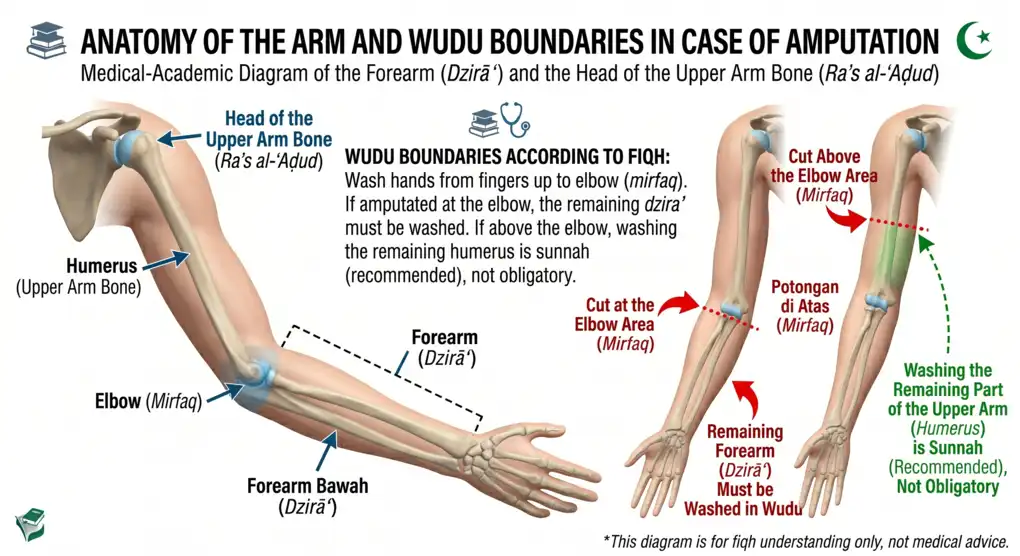
If the hand is amputated from the elbow—for instance, the forearm bone (dzirā‘) is detached and only the bone known as the “head of the upper arm bone” (ra’s al-‘aḍud) remains—it is obligatory to wash this head of the bone because it is still considered part of the elbow.
If the amputation occurs above the elbow, it is recommended to wash the remainder of the upper arm, just as if the hand were intact. If it is amputated from the shoulder, it is recommended to wash the site of the amputation with water, as has been explicitly stated.
Detailed Guidelines for Wudu with Amputated Limbs
The text above provides a robust legal foundation. The obligation to wash is strictly tied to the presence of the limb within the legally defined boundaries. Here is the practical application of these rulings:
When the Arm is Amputated
- Amputation at the Elbow: In the Shafi’i madhhab, the “elbow” (mirfaq) includes the area up to the head of the upper arm bone (ra’s al-‘aḍud). If the forearm is gone but the joint’s base remains, washing this remaining nub is obligatory.
- Amputation Above the Elbow: If the arm is severed above the elbow, washing the remaining upper arm is no longer obligatory. However, it is highly encouraged as one of the sunnah acts of ablution to maintain spiritual and physical cleanliness.
- Amputation at the Shoulder: If the entire arm is missing up to the shoulder, the believer is recommended (sunnah) to wash the amputation site or scar with water.
When the Leg is Amputated
The rulings for amputated legs mirror those of the arms, revolving around the obligatory boundary of the ankles (ka’bain):
- Amputation at the Ankle: If the foot is amputated but the ankle area or lower calf remains, washing the remaining portion up to the ankle boundary is obligatory.
- Amputation Above the Ankle: If the leg is severed at the calf or thigh, washing the remaining limb transitions from an obligatory act to a recommended (sunnah) practice.
- Complete Amputation: If the leg is missing up to the hip, it is a recommended sunnah to wash the site of the amputation.
Step-by-Step Procedure of Wudu for Amputees
The methodology for ablution remains largely unchanged for those with disabilities. To ensure you are ready for any acts of worship requiring purification, follow these structured steps, keeping the general principles of Wudu in mind:
- Intention (Niyyah): The intention resides in the heart and is unaffected by physical disability. For example: “I intend to perform Wudu to remove minor impurity for the sake of Allah the Almighty.” (Read more: Understanding Intention in Worship).
- Washing the Face: Obligatory washing from the hairline to the chin, and from earlobe to earlobe.
- Washing the Arms: Wash whatever remains of the arms up to the elbows. If completely amputated, lightly wash the shoulder site (sunnah).
- Wiping the Head: Wiping a portion of the head is obligatory. If the individual has no hands, they may use an assistive device or have someone else assist them.
- Washing the Feet: Wash whatever remains of the feet up to the ankles.
- Sequence (Tartib): The chronological order must be maintained based on the limbs that are present.
Conditions for Validity
For the purification to be accepted, the individual must ensure that the core conditions for a valid Wudu are met. These include using pure and purifying water, removing any barriers (like waterproof medical tape over a healed wound, unless medically necessary to keep on), and washing the existing obligatory parts thoroughly. The absence of a limb does not invalidate the ablution of the remaining limbs.
Conclusion
Amputation or physical disability does not hinder a Muslim from achieving spiritual purity and performing valid acts of worship. According to the Shafi’i school of jurisprudence, Wudu for amputees is facilitated through divine mercy and logical legal principles. Believers are only required to wash the anatomical parts that remain within the obligatory boundaries.
By understanding these rulings, Muslims with physical limitations can perform their ablution with confidence and tranquility. Always be mindful to maintain your state of purity by avoiding actions that invalidate Wudu once it has been completed.
Frequently Asked Questions (FAQ)
Is my Wudu valid if I have no arms or legs at all?
Yes, your Wudu is entirely valid. In the complete absence of limbs required for washing, the obligation falls only on the remaining mandatory parts, such as washing the face and wiping the head.
Do I need to wash my prosthetic limbs during Wudu?
No. Wudu is an act of purification tied to the physical human body. You do not need to wash prosthetic arms or legs. If the prosthetic covers a remaining part of an obligatory limb (like an elbow stump), you should remove the prosthetic to wash the skin, provided it does not cause harm or immense hardship.
Can someone else help me perform Wudu if I cannot do it myself?
Absolutely. If an amputee is unable to wash their own face or wipe their head, it is completely permissible to seek assistance from another person (such as a spouse, family member, or caretaker) to help pour the water and wash the limbs.
Reference:
Muḥammad ibn Aḥmad al-Khaṭīb ash-Shirbīnī, al-Iqnāʿ fī Ḥall Alfāẓ Abī Shujāʿ, ed. Maktab al-Buḥūth wa ad-Dirāsāt (Beirut: Dār al-Fikr, n.d.), 1:43.


