
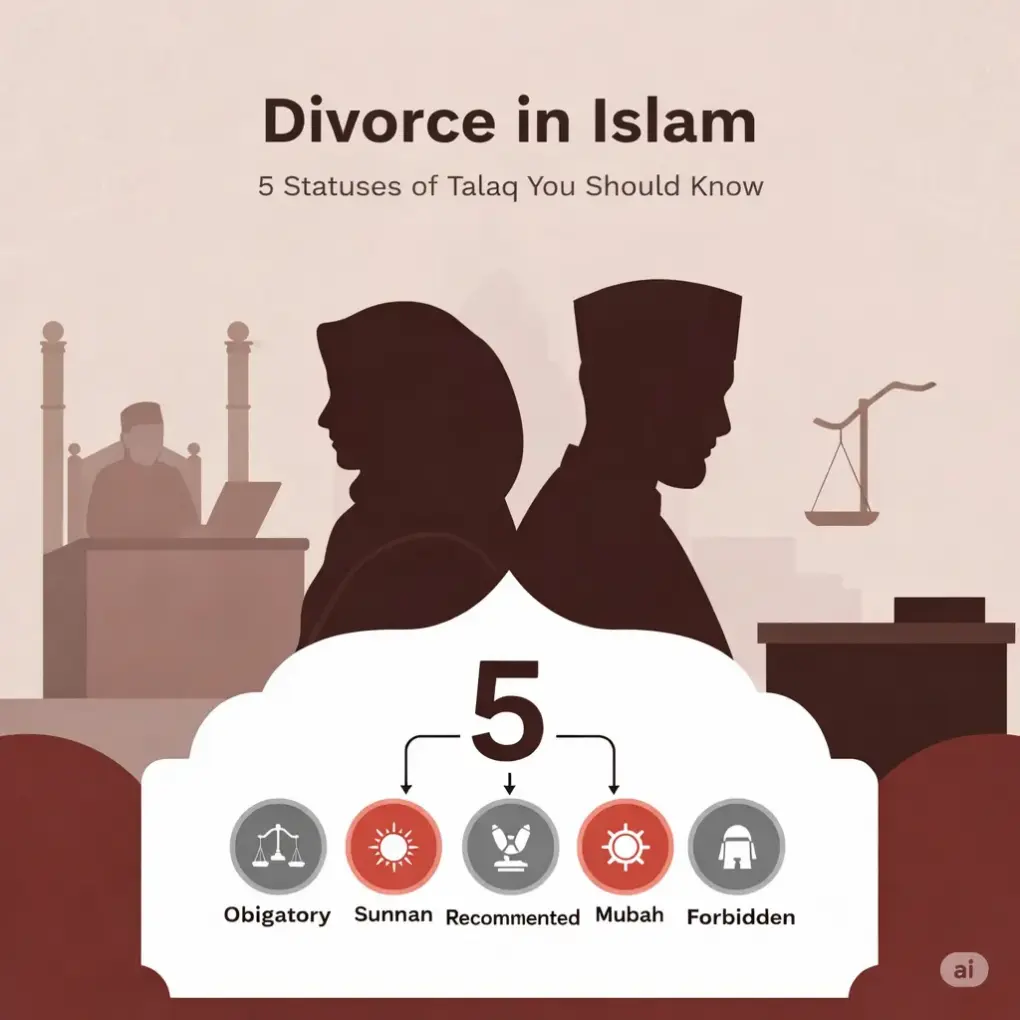
When discussing marriage and separation, many immediately recall the popular hadith stating that divorce is the most despised lawful act by Allah. While this understanding is correct, it does not paint the complete picture. The Islamic divorce rulings are profoundly detailed and cannot be generalized for every situation.
Within the study of fiqh, divorce is not merely a black-and-white dead end; rather, it serves as an emergency exit regulated with immense precision. Divorcing means dissolving the sacred marital bond, a serious action whose legal status can shift from obligatory to forbidden, depending on the underlying reasons and circumstances. Let us delve deeper into the comprehensive rules of separation in Islam.
Evidences for Divorce in Islam: Understanding the Popular Hadith
One of the most frequently cited scriptural evidences regarding divorce in Islam is the profound statement of Prophet Muhammad ﷺ:
Abghaḍu al-ḥalāli ilā Allāhi aṭ-ṭalāq. “The most despised of lawful things to Allah is divorce.” (Sunan Abu Dawud)
This hadith often serves as the primary foundation to deter unnecessary separation. Its meaning is profoundly deep. The word “lawful” (halal) indicates that divorce is permissible and constitutes a valid legal solution derived from the primary sources of Islamic law. However, the phrase “most despised” emphasizes that Allah disapproves of this act due to its severe consequences: severing a sacred marital tie, potentially disrupting lineage, and inflicting emotional pain upon spouses, children, and extended families. Therefore, the foundational ruling of talaq (divorce initiated by the husband) is makruh (disliked) if executed without a valid, compelling reason.
The 5 Legal Statuses of Talaq (Islamic Divorce Rulings)
To comprehend the Islamic divorce rulings entirely, we must examine the classical expositions within authoritative Shafi’i fiqh literature. A prominent scholar of the archipelago, Shaykh Nawawi al-Bantani, elaborated in his renowned treatise, Nihayat az-Zayn, that talaq can fall under five distinct legal categories depending on the context.
1. Obligatory Divorce (Talaq Wajib)
Under specific circumstances, maintaining a marriage generates sin or severe harm (mudarat). In these instances, initiating a divorce becomes an obligation. Examples include:
- The Case of Ila’: When a husband swears an oath not to engage in intimate relations with his wife for more than four months and refuses to resume relations after the period expires. The judge (qadi) will obligate the husband to issue a talaq to end the wife’s suspended state.
- The Case of Shiqaq (Severe Discord): When an irreconcilable marital conflict arises. If two appointed arbitrators (hakam) from both families conclude that separation is the only viable solution, then the divorce becomes mandatory.
2. Forbidden Divorce (Talaq Haram)
Certain methods or timings of divorcing a wife are explicitly forbidden, rendering the husband sinful, even though the talaq is still legally enacted.
- Divorce During Menstruation (Talaq Bid’i): Divorcing a wife while she is menstruating is haram (forbidden). The primary rationale is that it unjustly prolongs her waiting period (‘iddah). Similarly, it is forbidden to divorce her during a state of purity (tuhr) in which intimate marital relations have already occurred.
- Malicious Intentions: Issuing a divorce while the husband is terminally ill with the malicious intention of depriving the wife of her rightful inheritance.
- Injustice in Polygyny: Divorcing a wife before fulfilling her rightful turn for overnight stays fairly.
3. Recommended Divorce (Talaq Mandub)




Occasionally, separation represents a superior and recommended alternative to continuing a marriage fraught with harm. Divorce is recommended if:
- The husband is entirely incapable of fulfilling the wife’s fundamental rights.
- The husband lacks any inclination or desire toward his wife.
- The wife exhibits severely poor character and behaviors that the husband can no longer endure.
- The wife fails to guard her chastity, provided that divorcing her will not lead to greater moral corruption.
4. Disliked Divorce (Talaq Makruh)
This is the default legal status of talaq. If a couple faces no severe issues and the wife is of upright character (mustaqimat al-hal), divorcing her without a sound justification is makruh. This aligns perfectly with the hadith stating it is “the most despised lawful act.”
5. Permissible Divorce (Talaq Mubah)
Divorce transitions to mubah (merely permissible—neither recommended nor disliked) when a husband no longer harbors complete desire for his wife and feels burdened by providing for her without experiencing marital satisfaction. In this neutral scenario, parting ways is an allowable choice.
References from Classical Fiqh Texts
The detailed categorization of these five legal statuses is not a modern construct; it is deeply rooted in the rich heritage of Islamic scholarship. The following is an excerpt from Nihayat az-Zayn fi Irshad al-Mubtadi’in (pages 320-321) by Shaykh Nawawi al-Bantani, which forms the academic basis of this discussion:
فصل فِي الطَّلَاق وَهُوَ حل عقد النِّكَاح بِلَفْظ طَلَاق وَنَحْوه وتعتريه الْأَحْكَام الْخَمْسَة فَيكون وَاجِبا كَطَلَاق الْمولي والحكمين فِي الشقاق وَيكون حَرَامًا كالبدعي وَهُوَ طَلَاق مَدْخُول بهَا فِي حيض بِلَا عوض مِنْهَا أَو فِي طهر جَامعهَا فِيهِ وكطلاق من لم يسْتَوْف قسمهَا وكطلاق الْمَرِيض بِقصد حرمَان الزَّوْجَة من الْإِرْث وَيكون مَنْدُوبًا كَطَلَاق الْعَاجِز عَن الْقيام بِحُقُوق الزَّوْجِيَّة أَو من لَا يمِيل إِلَيْهَا بِالْكُلِّيَّةِ… وَيكون مَكْرُوها كَطَلَاق مُسْتَقِيمَة الْحَال… وَيكون مُبَاحا كَطَلَاق من لَا يشتهيها شَهْوَة كَامِلَة وَلَا تسمح نَفسه بمؤنتها من غير تمتّع بهَا1
It is evident that the subject of divorce is meticulously detailed. Islam provides an exit strategy through divorce but regulates it strictly to ensure it is only utilized when absolutely necessary, preventing it from becoming an instrument of oppression.
Conclusion
In conclusion, while divorce is a legally valid action within the Sharia, it must never be executed recklessly. The Islamic divorce rulings are highly context-dependent, shifting among obligatory, disliked, permissible, recommended, or even forbidden statuses. For individuals navigating marital turbulence, grasping these nuances and consulting with religious authorities is imperative. A valid divorce is one executed according to the guidance of the Sharia, not driven by fleeting emotions.
Frequently Asked Questions (FAQ)
What is the default ruling of divorce in Islam?
The default ruling of divorce (talaq) in Islam is makruh (disliked). This is based on the prophetic tradition stating that it is the most despised lawful act by Allah. It remains disliked unless there is a compelling and valid reason to separate.
When does a divorce become forbidden (haram)?
A divorce becomes forbidden (Talaq Bid’i) if a husband divorces his wife while she is menstruating or during a state of purity in which they have had intimate relations. This is prohibited because it unjustly prolongs the wife’s waiting period (‘iddah).
Can divorce ever be considered obligatory?
Yes. Divorce becomes obligatory (wajib) in specific scenarios, such as unresolved Ila’ (where a husband swears off intimacy for over four months) or in severe cases of Shiqaq (irreconcilable marital discord) where official arbitrators determine that separation is the only viable and safe solution.
Footnotes & References
- Muhammad bin Umar Nawawi al-Jawi, Nihayat az-Zayn fi Irshad al-Mubtadi’in, 1st ed. (Beirut: Dar al-Fikr, n.d.), pp. 320-321. ↩︎


