
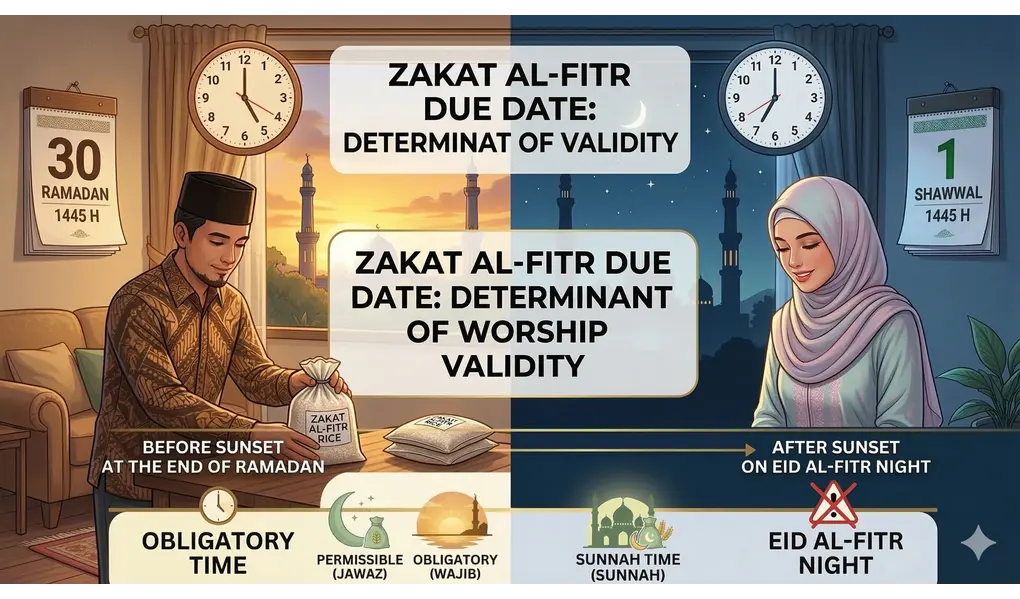
Fasting during the holy month and fulfilling financial obligations at its conclusion are deeply intertwined in Islamic practice. Muslims often inquire about the exact Zakat al-Fitr deadline from the perspective of classical jurisprudence. Determining this timing is essential, as shifting the payment schedule can alter the status of the worship from ada’ (timely fulfillment) to qada’ (making up for a missed obligation).
To unravel these time boundaries, the classical text Asna al-Matalib by Shaykh Zakariyya al-Ansari provides a highly detailed and precise foundation. This article will delve into the critical moments of this obligation, the rulings for individuals undergoing life transitions (like birth or death) at the turn of the month, and the underlying understanding of Islamic jurisprudence (fiqh). For a broader perspective, you can also consult our comprehensive zakat guide and the specific Shafi’i Zakat al-Fitr guide.
The Essence of Zakat al-Fitr: Purifying the Fast

Islamic law establishes Zakat al-Fitr not merely as an act of social generosity, but as a spiritual instrument that perfects the deficiencies of fasting. After a full month of self-restraint, as discussed in the fiqh of Ramadan fasting, a servant remains vulnerable to negligence, idle speech, or actions that tarnish the purity of their fast.
Shaykh Zakariyya al-Ansari defines the essence of this worship with concise yet profound phrasing:
قوله: (والفطرة) تطهيرا للنفس وتنمية لعملها
This means the worship is legislated as a purification for the soul (tathhiran lin-nafs) and a means to grow and bring blessings to one’s deeds (tanmiyatan li’amaliha). By distributing the designated measure of staple food, the spiritual impurities caused by idle deeds during fasting are expected to be erased, while simultaneously providing food security for the marginalized on the day of Eid.
The Critical Moment of Obligation: The Intersection of Ramadan and Shawwal
In the Shafi’i school of thought, determining the Zakat al-Fitr deadline falls upon a highly specific moment in time. This moment is not a broad span of days, but the exact intersection between the end of Ramadan and the beginning of Shawwal.
The jurisprudential text in Asna al-Matalib affirms this time-determination principle:
تجب بغروب الشمس ليلة الفطر من رمضان أي بإدراك آخر جزء منه وأول جزء من شوال لإضافتها إلى الفطر في الخبرين السابقين
The obligation falls precisely at sunset (ghurub ash-shams) on the eve of Eid al-Fitr. The reasoning is mathematically precise: a person must experience the final part of Ramadan and the first part of Shawwal. The Shari’ah attaches this obligation to the word “Al-Fitr” (breaking the fast or the festival), so the intersection between the fasting period and the non-fasting period witnesses the drop of the obligation.
Rulings for Newborns and the Deceased After Maghrib on the Eve of Eid
Because the point of obligation is extremely sharp, a person’s status transition occurring before or after sunset dictates whether they bear the legal burden or are exempt from it. This often raises questions in the community, especially regarding newborns or family members who pass away on the night of Takbiran (the eve of Eid).
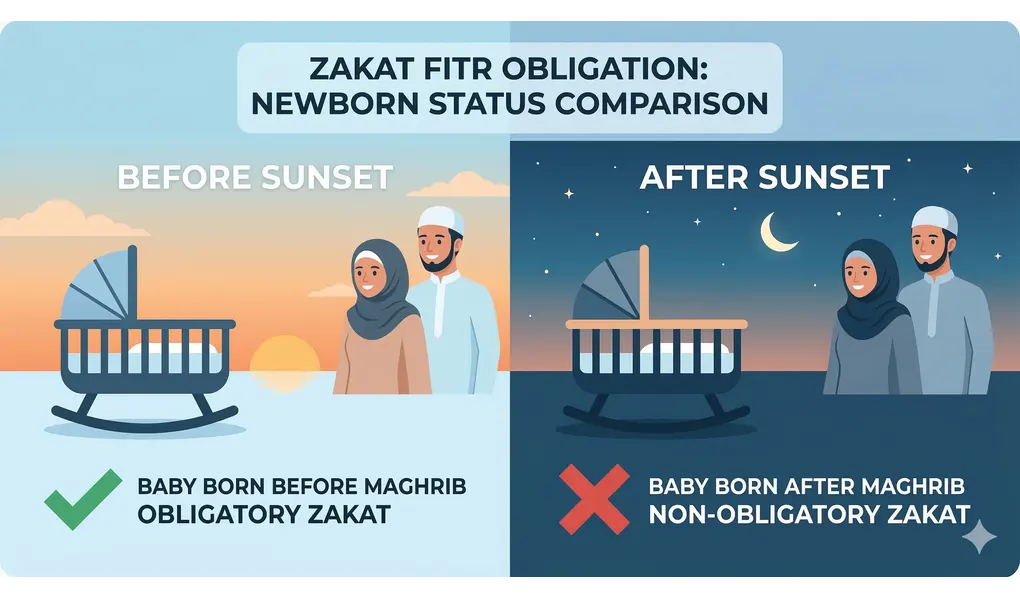
1. Events Occurring After Sunset If an event carrying legal consequences occurs after the entry of Maghrib time on the eve of Eid, it does not mandate Zakat al-Fitr for that year.
(فما يحدث بعد الغروب من ولد ونكاح وإسلام وملك رقيق وغنى لا يوجبها)
Everything that happens after ghurub (sunset)—such as the birth of a baby, a marriage contract, someone embracing Islam, the purchase of an enslaved person, or a poor person suddenly attaining wealth—does not obligate Zakat al-Fitr upon them. A father is not obligated to pay zakat for a baby born after the Maghrib adhan on the eve of Eid for that Ramadan because the infant did not experience the final portion of Ramadan.
2. Death or Loss of Ownership After Sunset Conversely, if someone has reached the critical point of obligation (sunset) and then passes away moments later, the obligation is not nullified.
قوله: (أو) ما يحدث بعد الغروب (من موت وعتق) وغيرها مما يزيل الملك (وطلاق) ولو بائنا وارتداد وغنى قريب (ولو قبل التمكن من الأداء لا يسقطها عنه)
Events occurring after ghurub—such as death, emancipation, divorce (talaq), apostasy, or falling back into poverty—do not drop the established obligation. If a father passes away after Isha on the eve of Eid, his heirs remain obligated to pay the Zakat al-Fitr for the deceased, taken from his left-behind wealth (tirkah). The obligation has legitimately become a debt to Allah ﷻ.
Summary Table of Obligations Based on the Timing Point
| Transition Event | Occurred Before Maghrib (End of Ramadan) | Occurred After Maghrib (Entry of 1 Shawwal) |
| Birth of a Baby | Obligatory to pay their zakat (experienced both times). | Not obligatory to pay their zakat. |
| Marriage Contract | Husband is obligated to cover the wife’s zakat. | Husband is not obligated to cover it for that year. |
| Passing Away | Not obligatory (obligation drops). | Remains obligatory (taken from tirkah wealth). |
Sunnah Time (Before Eid Prayer) vs. Haram Time (After Eid Day)
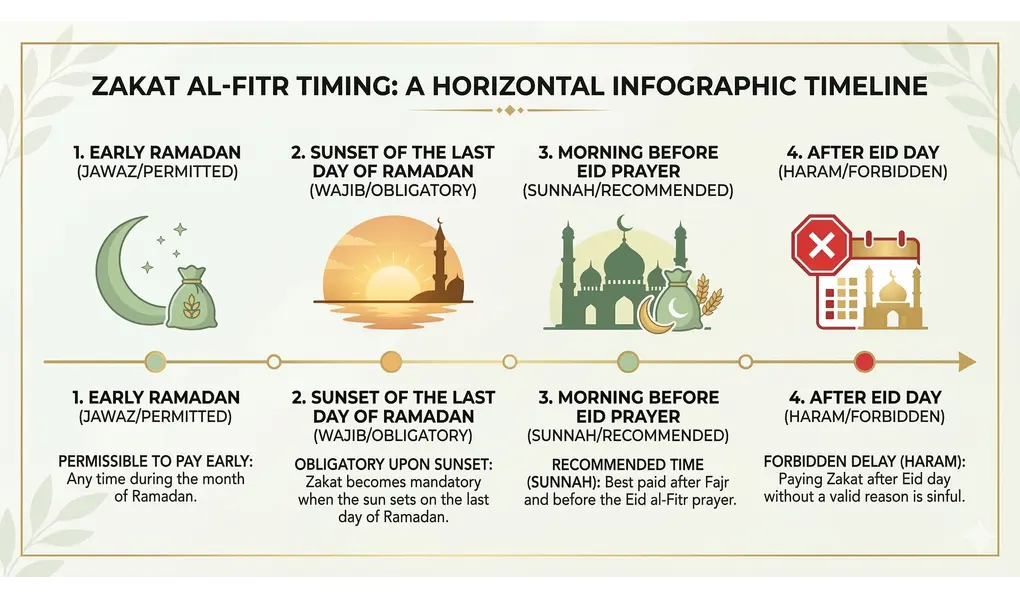
Although the obligatory point is at sunset, the Shari’ah provides a broad payment window to facilitate the Muslim community. Shafi’i fiqh categorizes these timeframes into several legal rulings:
1. Permissible Time (Ta’jil / Jawaz) An individual is permitted to pay it earlier, provided the holy month has commenced.
قوله: (وتعجل) جوازا (من أول رمضان كما سبق)
Expediting the payment is allowed starting from the first day of Ramadan. This action is legally valid and is frequently utilized by zakat management agencies (amil) to streamline distribution to the needy.
2. Recommended Time (Mustahabb) The most excellent Zakat al-Fitr deadline spans from the dawn of the festive day until right before the Imam ascends the pulpit for the Eid al-Fitr prayer.
قوله: (و) إذا لم يعجلها (يستحب) إخراجها (قبل الصلاة)
It is highly recommended (yustahabb) to disburse it before the Eid prayer. The objective is to ensure the poor and needy feel sufficient and do not need to beg on that day of victory.
3. Prohibited Time (Haram) Delaying the payment past the sunset of the 1st of Shawwal without a legally valid excuse (‘udhr shar’i) is a sinful act.
قوله: (ويحرم تأخيرها عن يوم العيد) بلا عذر كغيبة ماله أو المستحقين
It is strictly prohibited (haram) to delay the payment past the day of Eid without a valid reason, such as one’s wealth being inaccessible or the absence of eligible recipients (mustahiq) in the region. If a person intentionally delays it, they bear the sin of disobedience, and the status changes to an obligation that must be made up immediately (qada’).
(وتقتضي وجوبا فورا)
A delay without an excuse demands an immediate (fawran) makeup payment. The wealth remains a binding debt (in one’s dhimmah) until it is paid to the rightful recipients.
Frequently Asked Questions (FAQ)
What happens if I forget to pay Zakat al-Fitr until the day after Eid?
You are strictly obligated to pay it immediately the moment you remember. Delaying due to forgetfulness is an oversight, but the financial obligation is never erased. Any payment made after the day of Eid is legally considered a makeup payment (qada’).
Is it valid if the committee distributes the rice on the second day of Shawwal?
The obligation of the zakat payer (muzakki) is fulfilled once they hand it over to the recipient’s representative or the official committee (amil) before the Eid prayer. If a legitimate committee delays the distribution until the second day due to logistical or administrative constraints, it is permissible within reasonable administrative bounds, provided the payer’s initial handover was timely.
Can I pay my Zakat al-Fitr during the first week of Ramadan?
Yes. According to the Shafi’i school, it is completely permissible (jawaz) to expedite the payment (ta’jil) at any point once the month of Ramadan has officially begun.
Conclusion
Understanding the precise maturity point of this worship educates Muslims to be meticulous in managing their religious duties. The Zakat al-Fitr deadline is not merely a formality of wealth transfer, but a precise line connecting the validity of fasting with social happiness on the day of Eid. One should ideally fulfill this worship during the recommended time, or expedite it during Ramadan, while strictly avoiding any delay that leads to prohibition and sin.
References
Zakariyya al-Ansari, Asna al-Matalib fi Sharh Rawd al-Talib, with marginalia by Ahmad al-Ramli, edited by Muhammad az-Zuhri al-Ghamrawi (Cairo: al-Matba’ah al-Maymaniyah, 1313 AH; repr. Dar al-Kitab al-Islami), vol. 1, p. 388.


