

Every year, the question “how many days until Ramadan?” sparks widespread excitement and discussion. For Muslims worldwide, this month is not merely an annual routine, but a highly anticipated sacred period. However, beneath this enthusiasm, have we truly comprehended how the Fiqh of Ramadan Fasting governs our worship? From the methodology of sighting the crescent moon (Hilal) to the extensive history of why fasting became mandatory, there is much to uncover.
Based on the classical Shafi’i references Fath al-Mu’in and I’anah at-Talibin, let us comprehensively examine everything concerning this holy month. Before delving deeper into the jurisprudential details, it is highly recommended that you first understand the foundational meaning of fasting in Islam and grasp the broader concept by understanding Fiqh.
The Legal Basis and Evidence for Ramadan Fasting
The ruling for fasting during Ramadan is an individual obligation (Fard al-‘Ayn) for every Muslim who meets the stipulated conditions. This is an absolute mandate that cannot be compromised, as it constitutes the fourth pillar in understanding the pillars of Islam (or the third, depending on the Hadith narration, but universally recognized as a core pillar).
The primary foundation is the explicit Quranic evidence found in Surah Al-Baqarah, verse 183:
يَا أَيُّهَا الَّذِينَ آمَنُوا كُتِبَ عَلَيْكُمُ الصِّيَامُ كَمَا كُتِبَ عَلَى الَّذِينَ مِنْ قَبْلِكُمْ لَعَلَّكُمْ تَتَّقُونَ
“O you who have believed, decreed upon you is fasting as it was decreed upon those before you that you may become righteous.”
In the classical text Fath al-Mu’in, the author unequivocally states:
يجب صوم شهر ( رمضان ) إجماعا
“Fasting the month of (Ramadan) is obligatory by scholarly consensus (Ijma’).”
If anyone questions whether Ramadan fasting is obligatory or a recommended Sunnah, the answer is an absolute obligation. In fact, deliberately denying its mandatory nature can lead a person to disbelief (Kufr). Meanwhile, abandoning the fast out of laziness without a valid Islamic excuse (‘Udhur) is considered a major sin.
The History and Origins of Fasting
Did you know that the history of fasting involves a unique narrative regarding previous nations? In the Quranic exegesis cited within I’anah at-Talibin, scholars mention that fasting was indeed commanded to the nations before Prophet Muhammad ﷺ.
However, historical shifts occurred in how earlier nations practiced it. The original purity of the fast underwent human alterations. It is narrated that ancient Christians found it excessively burdensome to fast during the scorching summer heat. Consequently, their religious leaders decided to shift the fasting period to the spring season for a more comfortable climate. To compensate for altering the divine timing, they added a penalty (Kaffarah) of ten days. Later, their kings made vows that further extended the duration until it reached 50 days.
Unlike previous nations, the Fiqh of Ramadan Fasting for the Ummah of Prophet Muhammad ﷺ was restored to its original, unadulterated Shari’ah. It rigorously follows the lunar cycle, independent of solar seasons. You can learn more about this by exploring the history of the Hijri calendar.
How to Determine the Start of Ramadan?
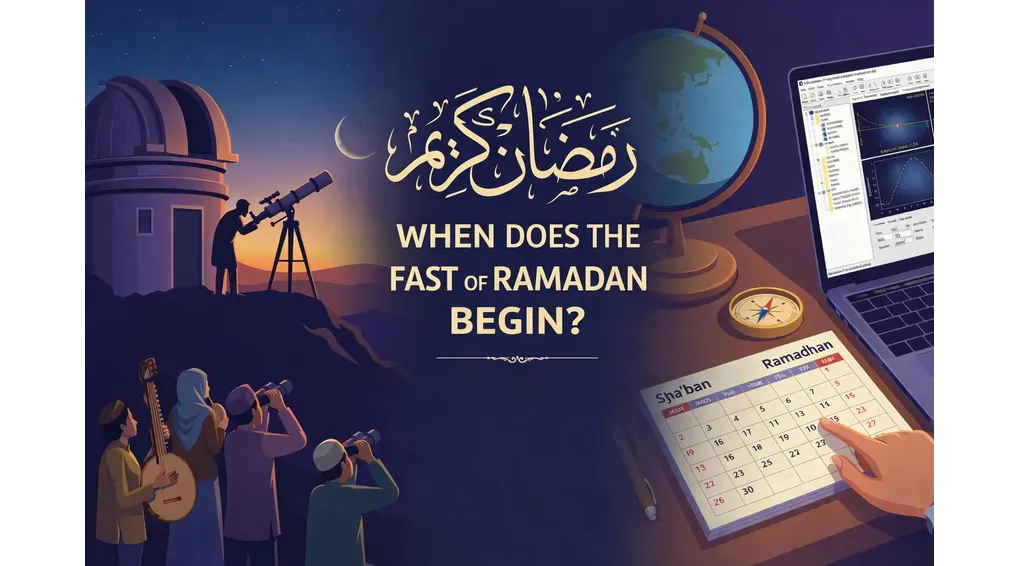
People are often confused about exactly when Ramadan begins—whether to follow the government, Islamic organizations, or calculated calendars. In Shafi’i jurisprudence, the methodology is clear:
- Completing Sha’ban (Ikmal): If the crescent moon is completely obscured, the month of Sha’ban is rounded out to 30 days.بكمال شعبان ثلاثين يوما
- Sighting the Crescent (Ru’yah): Visually confirming the new moon after sunset on the 29th of Sha’ban.
Interestingly, establishing the beginning of Ramadan requires slightly lighter conditions compared to determining its end (Eid al-Fitr / Shawwal). Fath al-Mu’in states:
أو رؤية عدل واحد , ولو مستورا هلاله بعد الغروب
“Or through the sighting of one upright person, even if he is Mastur (someone whose internal piety is unverified but outwardly appears good), who sees the crescent after sunset.”
Therefore, if a single honest individual testifies before a judge that they have seen the moon, fasting becomes obligatory for the entire population of that region.
What If You Live in a Different Region?
A frequent question arises: “If Saudi Arabia has started fasting, is it mandatory for those in Indonesia to follow suit?”
This introduces the concept of Ikhtilaf al-Matali’ (differing sighting zones). Distance plays a critical role. According to some scholars, the boundary for “far” is approximately 24 Farsakh (±133 km). The classical texts provide a fascinating rule regarding geographical directions:
- If the moon is sighted in the East, the residents in the West must follow (because if it is visible in the East, the moon will logically be higher and more visible in the West, where sunset occurs later).
- If the moon is sighted in the West, the residents in the East are not obligated to follow.
يلزم من الرؤية في البلد الغربي من غير عكس
“It is binding to follow the sighting in a Western land (for those situated to the West of the sighting location), but not the reverse.”
The Duration: 29 or 30 Days?
Many inquire about the exact number of days in Ramadan. Muslims fast for one complete month according to the Hijri calendar. A lunar month strictly consists of either 29 or 30 days; it never reaches 31 days.
قوله : ( في السنة الثانية من الهجرة ) أي فيكون – صلى الله عليه وسلم – صام تسع رمضانات … والتسع كلها نواقص إلا سنة فكاملة
“He (the author) said: (in the second year of Hijrah), meaning the Prophet ﷺ fasted nine Ramadans… and all nine were deficient (29 days) except for one year which was complete (30 days).”
Therefore, if you find yourself asking how many days are left until Ramadan ends, the definitive answer always depends on the moon sighting for Shawwal at the end of the month.
Mandatory Conditions for Fasting
Beyond confirming the arrival of Ramadan (via official announcement or personal sighting), an individual must meet specific criteria for the worship to be legally valid. According to Fiqh, this obligation falls upon someone who is:
- A Muslim.
- Baligh (Has reached puberty).
- Sane (‘Aqil).
- Physically capable of fasting (not severely ill or extremely elderly).
There is an intriguing jurisprudential point regarding an individual who personally sights the moon, but the judge rejects their testimony (e.g., if they are deemed unrighteous or, in the specific context of Hilal testimony, a woman). That individual is still personally obligated to fast based on their own sighting (‘Amal bi ru’yati nafsihi).
Comparison: Determining the Start vs. the End of Ramadan
To simplify the Fiqh of Ramadan Fasting regarding moon sighting testimonies, refer to the table below:
| Category | Start of Ramadan (Obligation to Fast) | Start of Shawwal (Eid/Breaking Fast) |
| Number of Witnesses | 1 male witness is sufficient | Minimum of 2 male witnesses |
| Quality of Witness | May be Mastur (outwardly good character) | Must be explicitly Upright (‘Adil) |
| Underlying Purpose | Precaution to enter the act of worship safely | Precaution before exiting the act of worship |
FAQ: Questions About Fasting in Ramadan
1. Is fasting in Ramadan an obligation or a Sunnah?
It is an absolute individual obligation (Fard al-‘Ayn) for every Muslim who meets the necessary conditions. It is a fundamental pillar of Islam.
2. How many days does the Ramadan fast last?
The fast lasts for one complete Hijri month, which will always be either 29 or 30 days, entirely dependent on the sighting of the new moon for Shawwal.
3. What is the ruling for someone who does not fast during Ramadan?
If abandoned without a valid Shari’ah excuse (like travel or illness), it is strictly prohibited (Haram) and a major sin. If a person abandons it because they deny it is mandatory, it constitutes disbelief (Kufr).
4. When exactly does Ramadan start this year?
The exact date is determined through an official Itsbat (confirmation) session, which combines direct observation (Ru’yah) and astronomical calculation (Hisab). Typically, the Ministry of Religion announces this on the 29th of Sha’ban.
5. What is the primary Quranic evidence for fasting?
The foundational proof is Surah Al-Baqarah, verse 183, alongside multiple authentic (Mutawatir) Hadiths from the Prophet Muhammad ﷺ.
Conclusion
Understanding the detailed Fiqh of Ramadan Fasting ensures that our worship goes beyond merely abstaining from food and drink. It grounds our practices in authentic scholarly tradition. As the days count down to the sacred month, preparing ourselves with proper Islamic jurisprudence is just as important as spiritual readiness.
Reference
Shaṭṭā, ʿUthmān ibn Muḥammad, Abū Bakr (al-Mashhūr bi-al-Bakrī) ad-Dimyāṭī. Iʿānat aṭ-Ṭālibīn ʿalā Ḥall Alfāẓ Fatḥ al-Muʿīn (Commentary on Fatḥ al-Muʿīn with an explanation of Qurrat al-ʿAyn concerning the Essentials of the Religion). 1st ed. Beirut: Dār al-Fikr, 1997.


