

Witnessing a beloved family member lying weak on the threshold of death is an excruciatingly heavy moment. The heart feels suffocated, the mind becomes disoriented, and panic frequently ensues. We anxiously wonder, “Is this the final moment?” and “What exactly must I do to assist them?”
In Islamic terminology, this highly critical transitional phase is referred to as naza’ or the throes of death (sakarat al-mawt). It is the definitive gateway transferring a soul from the temporal world to the eternal Hereafter. As family members, we bear a monumental responsibility. Our role extends far beyond merely weeping; we must actively serve as spiritual guides to ensure the final phrase escaping their lips is the supreme declaration of faith (Tawhid).
This comprehensive article will elucidate both the physical and spiritual signs of death, alongside practical, jurisprudential guidelines on how to gently guide the dying person (talqin), entirely based on the authoritative text Asna al-Matalib by Shaykh al-Islam Zakariyya al-Ansari.
Recognizing the Signs of Death (Physical and Spiritual)
Frequently, we struggle to discern whether an individual is merely experiencing deep sleep, has fainted, or is actively undergoing naza’. Islamic jurisprudential scholars (fuqaha) have meticulously observed specific physical characteristics of a dying person that can serve as reliable indicators for the family to commence spiritual preparations.
In the book Asna al-Matalib, it is stated:
وأمارته أي منها استرخاء قدم وامتداد جلدة وجه وميل أنف وانخلاع كف وانخفاض صدغ وتقلص خصية مع تدلي جلدتها
“And its signs (of death), among them are: the relaxing (dropping) of the feet, the stretching (stiffening/pulling) of the facial skin, the slanting of the nose, the disengaging (loosening) of the wrists, the sinking of the temples, and the shrinking of the testicles accompanied by the sagging of their skin.”
Based on this precise explanation, families can actively observe physical changes such as:
- Flaccid Feet: The soles of the feet become completely relaxed and “drop” or droop, no longer able to remain upright.
- Facial Alterations: The nose appears slightly slanted or bent, and the temples (the sides of the forehead) become noticeably sunken or hollowed inward.
- Skin Slackening: The facial skin, which may have previously been taut, becomes remarkably loose or unusually stretched.
Beyond these physiological indicators, there is a profound spiritual sign. An individual approaching their final moments frequently stares intently at a specific, fixed point with a vacant yet piercing gaze, as if they are perceiving entities entirely invisible to us (the Angels).
Crucial Note: If these definitive signs emerge, the family is strongly encouraged to gather, intensify their supplications, and immediately commence the talqin process, rather than abandoning the dying person alone in their room.
The Procedure for Guiding the Dying (Talqin)
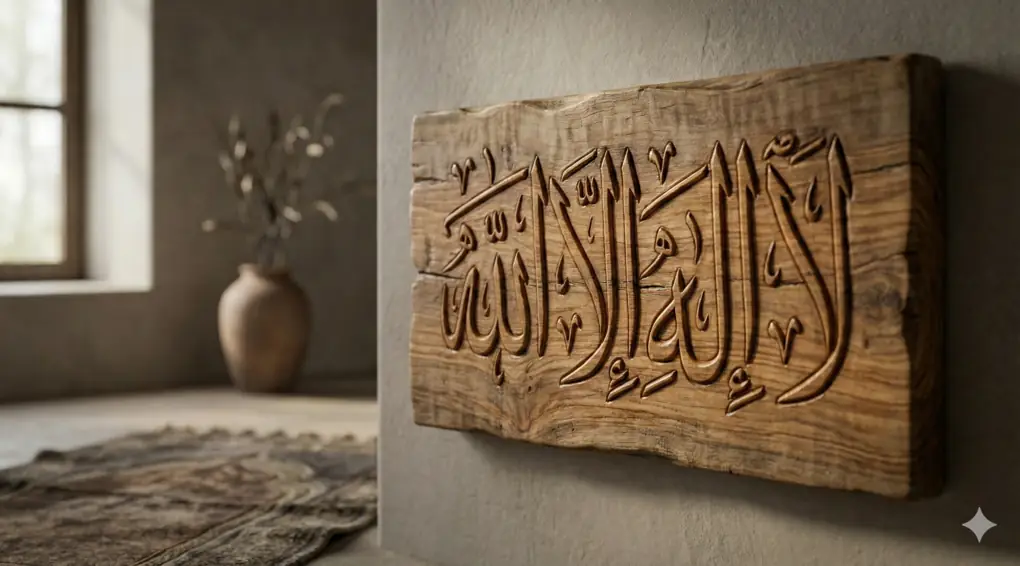
The absolute core of this final companionship is talqin. Talqin means to instruct, prompt, or guide. It serves one singular, paramount objective: ensuring the dying individual concludes their earthly life in a state of a good ending (Husn al-Khatimah).
The Messenger of Allah ﷺ explicitly commanded: “Prompt your dying ones to say: ‘La ilaha illallah’ (There is no deity but Allah).” (Narrated by Muslim).
Below are the step-by-step procedures on how to perform talqin for the dying, strictly adhering to the etiquette (adab) outlined in Asna al-Matalib:
1. Position the Body Facing the Qibla

If physically possible and it does not inflict pain upon the patient, position their body lying on the right side, directly facing the Qibla (like a corpse in the grave). If this proves too difficult, allow them to lie flat on their back, but ensure their feet are pointed towards the Qibla and slightly elevate their head with a pillow so their face looks towards the Qibla.
وبأن يوجه للقبلة إذا احتضر
“And the dying person is directed… towards the Qibla.”
2. Whisper Gently, Never Coerce
This is the most critical point. An individual undergoing sakarat al-mawt is enduring unimaginable agony and an intense, scorching thirst. Do not exacerbate their immense burden by shouting at them or aggressively forcing them to speak.
Lean in close, place your mouth near their ear, and pronounce “La ilaha illallah” with a soft, exceptionally clear, and soothing voice.
Asna al-Matalib clarifies:
قوله: (و) أن (يلقنه) الشهادة (غير الوارث)… (برفق)
“And it is (sunnah) that the one who prompts him with the Shahadah is a non-heir… (doing so) with gentleness.”
Why does the text specify a “non-heir”? The scholars exercised profound caution. They feared that if the prompter was a legal heir (someone anticipating an inheritance), the dying person—whose mind is distressed—might feel sudden suspicion or intense annoyance (“This child just wants me to die quickly to get the wealth”). Experiencing anger or resentment in these final, critical seconds is spiritually perilous.
However, if the relationship between the patient and the heir is known to be exceptionally excellent, built on pure love and trust, then there is absolutely no harm in a child or spouse gently guiding them.
3. A Brief, Concise Declaration of Faith




Must the prompt include the full phrase, extending to “Muhammad Rasulullah”? The text Asna al-Matalib provides a highly practical directive:
قوله: (بلا زيادة) عليها فلا تسن زيادة محمد رسول الله لظاهر الأخبار
“(Prompting) without any addition to it (La ilaha illallah).”
The primary objective is to facilitate ease for a tongue that is rapidly stiffening. A shorter, concise sentence is significantly easier to repeat. However, if they possess the strength to articulate the complete Shahadah, that is undeniably excellent.
4. Do Not Repeat Once It is Uttered
If you have gently guided them, and they successfully articulate “La ilaha illallah”, immediately stop. Remain completely silent. Do not instruct them to repeat it.
Allow that sacred declaration to be their absolute final utterance. You should only re-engage them in conversation or repeat the talqin ONLY IF they subsequently speak regarding a worldly matter (e.g., if they ask for a drink of water or call out someone’s name).
قوله: (فإن قالها لم تعد عليه حتى يتكلم) بغيرها من كلام الدنيا قاله الصيمري لكنه مخالف لظاهر كلامهم ولقول المصنف من زيادته على الروضة (ليكون آخر كلامه لا إله إلا الله)
“If he says it, it should not be repeated to him unless he speaks worldly words… so that his final words may be ‘La ilaha illallah’.”
Recommended and Prohibited Actions During the Throes of Death
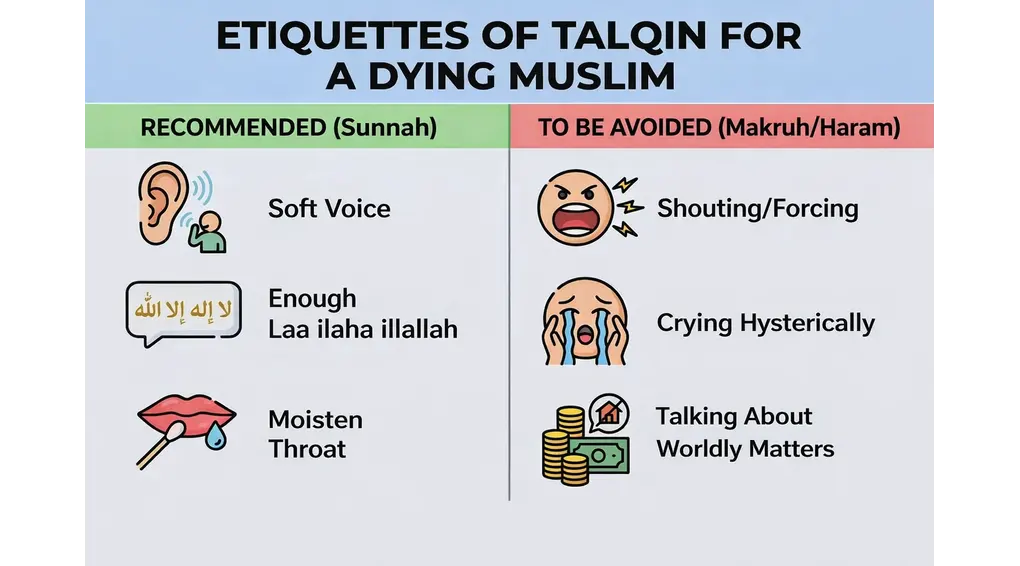
Beyond talqin, there are several other critical etiquettes (adab) the family must observe as part of the holistic preparation for death:
Highly Recommended (Sunnah) Actions
- Moistening the Throat: A person experiencing naza’ is typically consumed by severe thirst. Gently drip pure water or softly rub a damp cloth over their parched lips.
- Reciting Surah Yasin: It is a sunnah to recite Surah Yasin near them (but not so loudly that it disturbs their peace) to alleviate the agonizing pangs of death.
- Instilling Good Expectations (Husn al-Zan): Whisper words of profound hope regarding Allah’s mercy. “Father, Allah is the Most Forgiving,” or “Mother, the pain will vanish very soon; Allah loves you immensely.”
Actions to Strictly Avoid
- Hysterical Weeping: Natural crying is entirely permissible and human, but loud wailing (niyahah) or screaming hysterically beside the dying person can severely disrupt their crucial spiritual tranquility.
- Worldly Disputes: Strictly prohibit any arguments regarding inheritance, property, or hospital bills in the presence of the individual undergoing naza’.
Summary Table: Do’s and Don’ts of Talqin
To ensure these vital rules are easily remembered during a crisis, here is a rapid-reference guide for the companion:
| Action | Detailed Explanation |
| Voice Tone | Utilize a gentle, soft whisper filled with deep compassion. Never use a commanding tone. |
| Frequency | Pronounce it slowly. If the patient successfully repeats it, immediately STOP the talqin. |
| The Prompter | Ideally, the individual most beloved by the patient or a highly righteous person (ustadh). |
| Content | Focus exclusively on the phrase of Tawhid and Husn al-Zan (good hopes in Allah’s mercy). |
| Atmosphere | Create a remarkably serene environment, entirely free from noise or loud, disruptive weeping. |
FAQ: Questions Regarding the Throes of Death
Is a menstruating woman permitted to perform talqin?
Yes, it is permissible. There is no strict prohibition preventing a menstruating woman or a person in a state of major impurity (junub) from being near a dying person or guiding them to recite the Shahadah, although some scholars deem it slightly disliked (makruh). The paramount priority is maintaining proper etiquette, profound respect, and a serene environment.
What should be done if the patient is in a coma or completely unconscious?
You must persist in performing the talqin. Hearing is scientifically and spiritually recognized as the very last sense to cease functioning. Continuously whisper the phrase of Tawhid and prayers into their ear. We possess no knowledge of what their soul perceives, even while their physical body remains entirely unresponsive.
What is the definitive sign that the throes of death have concluded (death has occurred)?
It is typically marked by a total cessation of breathing, the eyes becoming vacant/glassy and staring fixedly upwards, the nose slanting slightly, and the joints beginning to go completely limp. When this definitively occurs, immediately close their eyes and pronounce: “Inna lillahi wa inna ilayhi raji’un” (Indeed we belong to Allah, and indeed to Him we will return).
Conclusion
Profoundly understanding the signs of death and flawlessly executing the method of guiding the dying (talqin) is our absolute most valuable final act of devotion to our loved ones. We are actively assisting them in winning their ultimate, decisive battle against Satan at the very precipice of their life.
If the divine decree of Allah has arrived and their final breath has ceased, do not merely abandon the corpse. There are highly specific “first aid” steps that are mandatory to perform so the body does not lock into stiffness (rigor mortis), which complicates the washing process. Discover these critical, immediate steps in: First aid for the deceased: 4 things to do immediately.
For those desiring a comprehensive understanding of the precise sequence of actions required immediately after a person is declared dead (from the ritual washing to the burial), please meticulously study the steps in our master guide: The complete procedures for preparing the deceased (Tajhiz al-Janazah) according to the Sunnah.
Furthermore, ensure you thoroughly comprehend the proper Islamic etiquette when facing illness long before this critical phase arrives. We have detailed these essential practices in our article: Etiquette of the sick and the obligation to repent before death approaches.
We pray that Allah grants immense ease to our tongues to pronounce “La ilaha illallah” at the very end of our lives. Amiin. Wallahu a’lam bish-shawab.
Reference
Zakariyā al-Anṣārī, Asnā al-Maṭālib fī Sharḥ Rawḍ al-Ṭālib, with a ḥāshiyah by Aḥmad al-Ramlī, edited by Muḥammad az-Zuhrī al-Ghamrāwī (Cairo: al-Maṭbaʿah al-Maymānīyah, 1313 H; repr. Dār al-Kitāb al-Islāmī), vol. 1, p. 296.


