
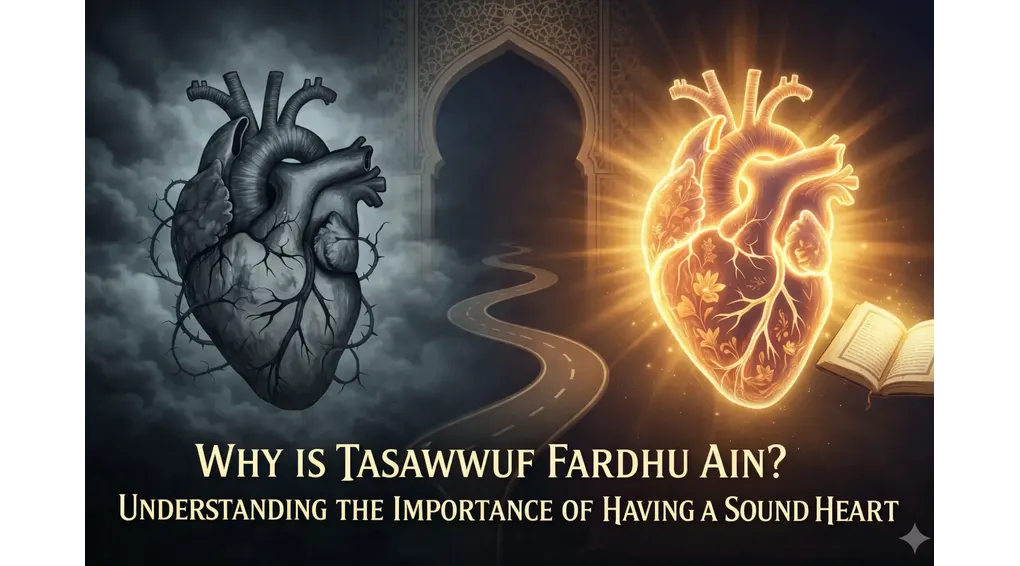
Have you ever felt that despite observing the five daily prayers, fasting regularly, and giving charity, your heart remains empty? Or perhaps you subtly feel “holier” than others after attending a religious gathering?
If so, you are not alone. We often hyper-focus on the physical movements of our worship—whether our bowing is perfectly straight or our recitation flawless. While these elements are undeniably crucial, we frequently neglect the “secret” dimension that determines whether Allah SWT accepts our deeds: the heart.
This is where the science of Tasawwuf comes into play. It is not some mystical obscurity or merely sitting quietly in a mosque corner, but rather the essential science of healing the heart. Let us explore the classical texts of the scholars to understand why maintaining spiritual health is not just recommended, but an individual obligation (Fard al-Ayn).
The Two Wings of Shari’ah: The Outward and the Inward
In Islam, the religious obligations (taklif) commanded by Allah are twofold. Scholars of Ahl al-Sunnah wal Jama’ah divide them into two inseparable domains.
As stated in classical reference texts:
إن التكاليف الشرعية التي أمر بها الإنسان في خاصة نفسه ترجع إلى قسمين : أحكام تتعلق بالأعمال الظاهرة , وأحكام تتعلق بالأعمال الباطنة
“Verily, the religious obligations commanded upon a person regarding themselves fall into two categories: rulings related to outward actions, and rulings related to inward actions.”
This means our obligations are divided into two spheres:
- Outward (Physical) Rulings: This concerns the limbs. Commands include the daily prayers, paying Zakat, and performing Hajj. Prohibitions include theft, adultery, and consuming intoxicants.
- Inward (Spiritual) Rulings: This concerns feelings and intentions. Commands encompass faith, sincerity (ikhlas), honesty, and reliance on Allah (tawakkul). Prohibitions include disbelief, hypocrisy, arrogance (kibr), showing off (riya’), and envy (hasad).
The problem arises when many of us excel in understanding fiqh regarding outward actions but remain illiterate in inward jurisprudence. We strictly avoid eating pork because it is haram, yet casually consume the “flesh of our brothers” through backbiting (ghibah) or harboring grudges for years.
Why the Heart is the Ultimate Determinant
Allah SWT does not judge us by the price of our garments or the aesthetics of our Islamic posts on social media. Allah examines the “engine” behind it all.
Prophet Muhammad ﷺ profoundly stated:
ألا وإن في الجسد مضغة إذا صلحت صلح الجسد كله , وإذا فسدت فسد الجسد كله , ألا وهي القلب
“Beware! There is a piece of flesh in the body; if it becomes good, the whole body becomes good, and if it gets spoilt, the whole body gets spoilt, and that is the heart.” (HR. al-Bukhari & Muslim)
If the heart is corrupted by spiritual diseases like envy, abundant physical deeds can easily lose their value. Outward worship is like the body, while the sincerity of the heart is its soul. A body without a soul is merely a corpse.
The Legal Status: Why the Science of Tasawwuf is Fard al-Ayn

You might wonder, “Isn’t the science of Tasawwuf only for established scholars or retirees?”
The answer is a firm no. Great Shafi’i scholars position the science of purifying the heart as a primary necessity for every Muslim. Imam Jalal al-Din al-Suyuti quotes the unequivocal stance of Hujjat al-Islam, Imam al-Ghazali:
وأما علم القلب ومعرفة أمراضه من الحسد والعجب والرياء ونحوها , فقال الغزالي : إنها فرض عين
“As for the knowledge of the heart and the recognition of its diseases such as envy, self-admiration (‘ujub), ostentation (riya’), and the like, Al-Ghazali stated: Verily, it is an individual obligation (Fard al-Ayn).”
Fard al-Ayn means it is mandatory for every single individual, carrying the exact same legal weight as understanding the pillars of Islam or grasping the meaning of fasting.
Why such a high status? Because no human being is free from diseases of the heart, except the Prophets. We all possess the latent potential for arrogance, seeking praise, or feeling envious. If we are obligated to learn the pillars of prayer so our Salah is valid, we are equally obligated to learn how to be sincere so our deeds are actually accepted.
The Danger of “Unfelt Sins”
A profound warning comes from the great Sufi master, Abu al-Hasan al-Shadhili. He said:
من لم يتغلغل في علمنا هذا مات مصرا على الكبائر وهو لا يشعر
“Whoever does not deeply delve into this science of ours (the purification of the soul) will die persisting in major sins without even realizing it.”
This statement might sound terrifying. How can someone pray and fast yet die carrying major sins?
Ibn ‘Allan al-Siddiqi explains the logic brilliantly: “Who among us, O my brother, fasts without feeling a sense of self-admiration (‘ujub) for their fast? Who prays without feeling ‘ujub with their prayer?”
Without studying the science of Tasawwuf, we lack the internal detection tools to realize that during a deeply focused prayer, our heart might secretly whisper, “I am amazing; others are asleep, yet I am praying Tahajjud.” That whisper is ‘ujub (vanity), the mother of arrogance. Unwittingly, we accumulate major sins right within our acts of worship. Just as we learn to meticulously clean severe impurities (najis mughallazah) from our clothes, we must learn to cleanse the severe impurities from our hearts.
Outward Diseases vs. Inward Diseases
To easily grasp the urgency of this science, consider the following comparison:
| Aspect | Outward Diseases (Physical) | Inward Diseases (Spiritual) |
| Examples | Theft, consuming alcohol, gambling | Ostentation (Riya’), vanity (‘Ujub), envy (Hasad) |
| Nature | Visible, easily detected | Hidden, subtle, often involves self-deception |
| Impact | Damages social and legal order | Erases spiritual reward, damages relationship with Allah |
| Remedy | Repentance, restitution, legal penalty | Purification of the soul (Tazkiyat al-Nafs), spiritual struggle (Mujahadah) |
| Ruling to Learn | Fard al-Ayn (the fundamentals) | Fard al-Ayn (recognizing and treating them) |
Understanding the True Essence of Tasawwuf
Many false stigmas are attached to the word “Tasawwuf.” Some deem it deviant, while others assume it only involves whirling dances. In reality, the essence of Tasawwuf is highly logical and deeply grounded in the Quran and Sunnah.
Ibn Zakwan defines Tasawwuf as:
علم به تصفية البواطن … من كدرات النفس في المواطن
“A science by which the inward is purified… from the turbidities of the ego in various states.”
Therefore, Tasawwuf is Islam’s curriculum for character education and mental transformation. Its primary goal is to change despicable traits into noble ones:
- From stinginess to generosity.
- From quick-temperedness to patience.
- From love of the worldly life to asceticism (zuhud).
Tasawwuf is not merely reciting litanies (wird) thousands of times; that is simply a method. The ultimate goal is noble character (Akhlaq Karimah). If someone studies Tasawwuf but their character worsens—becoming arrogant and belittling others—there is a fundamental flaw in how they are learning.
The Path to Healing: Do Not Walk Alone
Healing the heart is significantly more challenging than treating physical wounds. Our ego (nafs) is incredibly deceitful; it can manipulate us into feeling righteous when we are thoroughly flawed. Therefore, scholars advise one crucial step: Seek a righteous teacher (Murshid) and a supportive community.
Classical texts state:
لهذا نرى العلماء العاملين … ينصحون الناس بالدخول مع الصوفية والتزام صحبتهم
“This is why we see the practicing scholars… advising people to enter the ranks of the Sufis and commit to their companionship.”
We desperately need a mirror. Righteous companions and wise teachers serve as honest reflections. They reprimand us when we stray and guide us when we are utterly confused.
Golden Advice from Fudayl bin ‘Iyad




You might feel strange or alienated when you begin seriously nurturing your heart in this heavily materialistic era. While others are busy flaunting their wealth, you are busy concealing your good deeds. Do not worry; Fudayl bin ‘Iyad offers a comforting message:
عليك بطريق الحق , ولا تستوحش لقلة السالكين
“You must adhere to the path of truth, and do not feel lonely due to the scarcity of those walking it.”
Do not use the “majority” as your standard for truth. On the path to Allah SWT, quality always supersedes quantity.
FAQ: Questions About Tasawwuf and Spiritual Heart Diseases
1. Do I have to join a specific Tariqah to study the science of Tasawwuf?
Not necessarily. The core of Tasawwuf is tazkiyat al-nafs (purification of the soul). You can begin by studying foundational books on character, such as Bidayat al-Hidayah or Riyadh al-Salihin, under the guidance of a reliable, orthodox (Aswaja) scholar in your local community.
2. How can I detect diseases of the heart within myself?
Practice daily introspection (muhasabah) before bed. Ask yourself sincerely: “What was my true intention behind posting that charitable act? Was it to be seen as generous, or purely for Allah?” Feeling hurt or offended when you are not praised is a clear, early symptom of a spiritual disease.
3. Does Tasawwuf contradict the Shari’ah?
Absolutely not; true Tasawwuf is the perfecter of the Shari’ah. The Shari’ah governs the physical movements of prayer, while Tasawwuf governs the inner presence (khushu’). Both must operate simultaneously. Any so-called teaching that commands the abandonment of basic obligations, like the five daily prayers, is a deviation and must be strictly avoided.
Conclusion
Dear brothers and sisters, let us not allow our hearts to become dirty, neglected “empty houses.” The heart is the only vessel we will bring before Allah on the Day of Judgment, as He mentions concerning the Qalbun Salim (a sound heart).
Let us start today with small, consistent steps: rectify our intentions, forgive others’ mistakes before we go to sleep, and dedicate time to recognizing our own flaws. Ultimately, true success is not measured by what we hold in our hands, but by what we preserve in our hearts.
“You treat your mortal body so that it survives… yet you leave your eternal heart to suffer.”
May Allah guide us all toward pure, sincere, and tranquil hearts.
Reference
Al-‘Azīzī al-Ḥalabī al-Syādhilī, ‘Abd al-Qādir bin ‘Abd Allāh bin Qāsim bin Muḥammad bin ‘Īsā. Ḥaqā’iq ‘an al-Taṣawwuf. Aleppo, Syria: Dār al-‘Irfān, sixteenth edition, 1428 H/2007 CE.


