

When life’s overwhelming problems crash down relentlessly—whether it is crushing economic pressure, an illness that refuses to heal, or sudden, paralyzing anxiety—we frequently feel entirely alone. The world suddenly feels suffocatingly small. However, Islamic theology beautifully teaches that we have a Lord who is the Ever-Living and the Supreme Sustainer of His servants.
The Messenger of Allah ﷺ has bequeathed a spiritual “master key” for all complex, intertwined problems. That key is invoking the greatest names of Allah: Ya Hayyu Ya Qayyum. This specific dhikr is merely one of the numerous spiritual ‘weapons’ taught by the Prophet. For a comprehensive guide on other solutions to life’s profound hardships, please read our master article: Collection of prayers to remove sadness and life’s difficulties.
Within the monumental work Al-Adhkar by Imam al-Nawawi, specifically in the chapter concerning supplications during severe distress (Karb), this specific dhikr occupies an exceptionally privileged position. Let us thoroughly dissect the manifold benefits of the dhikr Ya Hayyu Ya Qayyum, how to practice it in accordance with the sunnah, and rectify our understanding of its true efficacy.
Why Must It Be “Ya Hayyu Ya Qayyum”?

Some of us might rationally ask, why did the Prophet ﷺ specifically choose these two names during critical moments? Linguistically, Ya Hayyu Ya Qayyum means, “O Ever-Living One, O Self-Sustaining One (who continuously sustains His creation).”
- Al-Hayy (The Ever-Living): This profoundly reminds us that our ultimate reliance is upon an Entity that will never experience death. Human beings pass away, wealth is depleted, and high positions vanish, but Allah is eternal.
- Al-Qayyum (The Self-Sustaining): Allah manages and sustains absolutely everything without the slightest fatigue. When we invoke Al-Qayyum, we humbly admit our absolute inability to manage our own lives and our desperate need for His divine intervention.
In the narration of At-Tirmidhi (quoted in Al-Adhkar no. 346), Abu Hurairah (may Allah be pleased with him) recounted the Prophet’s habit:
“That the Prophet ﷺ, if distressed by a matter, would raise his head to the sky… And if he supplicated earnestly, he would say: Ya Hayyu Ya Qayyum.”
This powerfully illustrates the virtue of the dhikr Ya Hayyu Ya Qayyum as a servant’s ultimate “emergency alarm” to their Lord.
Dhikr Ya Hayyu Ya Qayyum Bi Rahmatika Astaghith
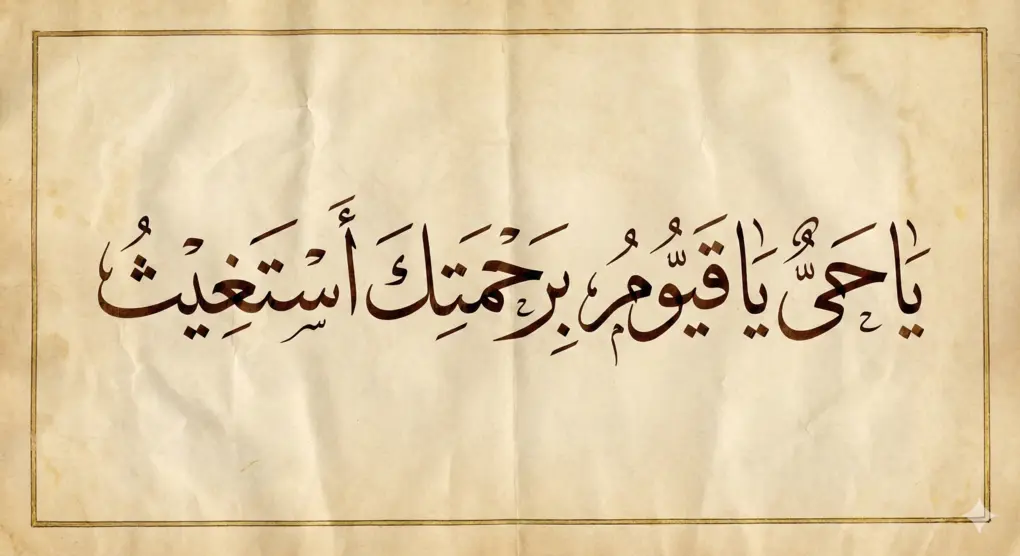
One of the most famous and authentic (sahih) supplications when facing severe difficulty is Istighathah—seeking urgent help through Allah’s mercy. Based on the hadith narrated by Anas bin Malik (may Allah be pleased with him) (no. 345 in Al-Adhkar), when the Messenger of Allah ﷺ was afflicted by severe distress (karb), he would supplicate:
يَا حَيُّ يَا قَيُّوْمُ، بِرَحْمَتِكَ أَسْتَغِيْثُ
Transliteration: Ya Hayyu Ya Qayyum, bi rahmatika astaghith.
Meaning: “O Ever-Living One, O Self-Sustaining One, by Your mercy I seek assistance.”
Al-Hakim graded the chain of this hadith as authentic (sahih). The phrase Ya Hayyu Ya Qayyum bi rahmatika astaghith teaches us a crucial theological lesson: we must never rely on our meager righteous deeds; instead, we must rely entirely on Allah’s mercy (rahmah). This is because only through His mercy can our seemingly insurmountable problems be resolved.
Variations with the Addition of Tawhid
Frequently, we hear a slightly extended recitation, such as Ya Hayyu Ya Qayyum bi rahmatika astaghith, la ilaha illa Anta. The addition of “La ilaha illa Anta” (There is no deity but You) is a powerful reinforcement of Tawhid (Islamic monotheism), remarkably similar to the profound supplication of Prophet Yunus inside the whale. Combining the absolute declaration of Allah’s oneness with a desperate plea for help represents the highest etiquette (adab) in supplication.
The Phrase of Tawhid: A Fortress During Disasters
Beyond the phrase Ya Hayyu Ya Qayyum, Imam al-Nawawi also includes the “Supplication of Distress” (Du’a al-Karb) narrated by Ibn Abbas (may Allah be pleased with them both) (no. 344). Uniquely, the core content of this prayer is not a request, but rather pure praise and magnification (Tawhid).
Here is the original Arabic text:
لاَ إِلَهَ إِلاَّ اللهُ الْعَظِيْمُ الْحَلِيْمُ, لاَ إِلَهَ إِلاَّ اللهُ رَبُّ الْعَرْشِ الْعَظِيْمُ, لاَ إِلَهَ إِلاَّ اللهُ رَبُّ السَّمَاوَاتِ وَرَبُّ اْلأَرْضِ وَرَبُّ الْعَرْشِ الْكَرِيْمِ
Transliteration: La ilaha illallahu al-‘Azhimu al-Halim, la ilaha illallahu Rabbu al-‘arshi al-‘azhim, la ilaha illallahu Rabbu al-samawati wa Rabbu al-ardhi wa Rabbu al-‘arshi al-karim.
Meaning: “There is no deity but Allah, the Most Great, the Most Forbearing. There is no deity but Allah, Lord of the Great Throne. There is no deity but Allah, Lord of the heavens and Lord of the earth, and Lord of the Noble Throne.”
The psychological and spiritual secret of this dhikr is brilliantly simple: When we busy ourselves praising the immense greatness of Allah, our monumental problems automatically appear microscopic. A heart previously constricted by terrifying fear becomes expansive and tranquil because it remembers that its Lord is the Most Great (Al-‘Azhim). This pairs beautifully with the protective power of other verses, such as using Ayatul Kursi for independent ruqyah.
Myths and Facts: Is this Dhikr for Wealth?

There are numerous internet searches questioning whether the dhikr Ya Hayyu Ya Qayyum can make one rich. Let us forcefully rectify this intention.
The primary objective of any dhikr is the remembrance of Allah. However, one of the inevitable fruits of remembering Allah is the opening of the doors of provision (rizq). When we routinely recite this during our morning dhikr, we inaugurate our day by completely surrendering our worldly affairs to the Supreme Manager (Al-Qayyum).
The true “wealth” acquired through this dhikr encompasses:
- Wealth of the Heart (Qana’ah): Feeling profoundly sufficient, tranquil, and entirely devoid of greed.
- Blessed Provision (Barakah): The money earned is enduring and inherently brings goodness.
- Facilitation of Affairs: If Allah has personally intervened to manage our business or career, positive financial results will naturally follow.
Therefore, do not treat this majestic dhikr as a “get-rich-quick spell,” but utilize it as a sacred medium to draw closer to the Ultimate Provider. It holds the same comprehensive power as the virtues of the Sapu Jagat prayer (Rabbana Atina).
How to Practice It in Daily Life
There are myriad ways to seamlessly integrate this dhikr into the fabric of our lives.
1. Morning and Evening Dhikr
You can readily incorporate Ya Hayyu Ya Qayyum bi rahmatika astaghith into your daily morning and evening dhikr routine. This is universally recognized as the optimal time for establishing spiritual protection.
2. During the Final Prostration (Sujud)



The Messenger of Allah ﷺ explicitly stated that the closest a servant is to his Lord is during prostration. Multiply this supplication while in sujud, particularly when you feel emotionally or situationally cornered.
3. Must it be Recited 1000 Times?
Many persistently inquire about the specific benefits of reciting the dhikr Ya Hayyu Ya Qayyum 1000 times. In the book Al-Adhkar which we are analyzing, Imam al-Nawawi does not restrict the recitation to any specific numerical limit.
The foundational principle is: the more, the better (Ilhah or persistence). However, reciting it 100 times with a fully conscious, weeping heart is infinitely superior to reciting it 1000 times with a negligent heart merely rushing to finish. The absolute quality of the heart’s presence (hudhur al-qalb) is the definitive key.
Comparison Table of Supplications for Distress
To effortlessly comprehend the nuanced differences between the narrations mentioned by Imam al-Nawawi, review the following table:
| Narration | Primary Phrase | Focus of Meaning | Condition of Use |
| Ibn Abbas (No. 344) | La ilaha illallahu al-‘Azhimu al-Halim | Tawhid & Magnification | During massive disasters or highly critical situations. |
| Anas bin Malik (No. 345) | Ya Hayyu Ya Qayyum bi rahmatika astaghith | Seeking Immediate Aid (Istighathah) | When the heart is profoundly sad or desperately needs a rapid solution. |
| Abu Hurairah (No. 346) | Subhanallahi al-‘Azhim & Ya Hayyu Ya Qayyum | Tasbih & Invoking Allah’s Names | When a matter becomes intensely complicated or difficult. |
FAQ (Frequently Asked Questions)
Is it permissible to recite Ya Hayyu Ya Qayyum Ya Maliku al-Haqqu al-Mubin?
Yes, it is entirely permissible. Al-Maliku al-Haqqu al-Mubin are among the beautiful names of Allah (Asma al-Husna). Combining them with Ya Hayyu Ya Qayyum is a valid form of tawassul (seeking means) through Allah’s majestic names. However, if your goal is to strictly follow the specific sunnah for eliminating deep sorrow, the narration bi rahmatika astaghith is the most precisely targeted (ma’thur).
What is the correct Arabic spelling of Ya Hayyu Ya Qayyum bi rahmatika astaghith?
The correct spelling is: يَا حَيُّ يَا قَيُّوْمُ، بِرَحْمَتِكَ أَسْتَغِيْثُ. Ensure you recite it with correct tajwid (pronunciation rules), particularly paying attention to the letter Ha ( ح ) in Hayyu and the letter Tha ( ث ) in Astaghith.
Can this prayer be used to pay off crushing debts?
It is highly effective for this. Debt is definitively a form of severe distress (Karb). By invoking Al-Qayyum, you are begging Allah to meticulously manage and resolve the settlement of those debts through unimaginable avenues.
Conclusion
Disasters and the crushing difficulties of life are Allah’s profound methods of calling us back to Him. Do not arrogantly rely on our severely limited human logic. Starting today, moisten your tongue constantly with Ya Hayyu Ya Qayyum bi rahmatika astaghith.
This is not a mere collection of words; it is a desperate proclamation that we are inherently weak, and Allah is the sole Ever-Living and Omnipotent entity. May Allah lift all your sorrows and replace them with enduring happiness.
In addition to invoking the name Al-Hayy, the Messenger of Allah ﷺ also taught a prayer of total surrender, ensuring we do not rely on ourselves even for the blink of an eye. Study its beautiful recitation in our article: The prayer of Rahmataka Arju for total surrender to Allah’s mercy.
Wallahu a’lam bi al-sawab.
Reference
Al-Nawawī, Yaḥyā ibn Sharaf. Al-Adhkār. Edited by ʿAbd al-Qādir al-Arnaʾūṭ. New revised edition. Beirut: Dār al-Fikr, 1994.


