

Observing the fast during the blessed month of Ramadan requires precise and profound knowledge. It is not merely about enduring hunger and thirst from the break of dawn until sunset; it fundamentally involves guarding oneself against all things that invalidate fasting (mufattirat). Frequently, doubts arise within the community: “Does picking my nose break the fast?”, “What is the ruling on brushing my teeth and swallowing saliva?”, or “Is my fast valid if I receive a medical injection?”.
Errors in understanding these boundaries can be fatal: our worship might become invalid without us realizing it, or conversely, we might unnecessarily burden ourselves regarding matters that the Shari’ah actually permits.
These doubts are rooted in a highly fundamental jurisprudential principle within the Shafi’i school: the rule of objects entering body cavities (jauf) and open passageways (manfadh). In the authoritative Shafi’i fiqh manual, Asna al-Matalib Syarah Rawd at-Talib authored by Shaykh al-Islam Zakariyya al-Ansari (Volume 1, pages 414-418), the regulations regarding this matter are explained in meticulous detail. He precisely distinguishes between orifices that “penetrate” deep into the body and those that are merely pores. Let us dissect his explanation so that our fasting is peaceful and legally valid according to Islamic law.
1. The Core Concept: What Invalidates the Fast?
Before delving into the specifics, we must comprehend the foundational rule. In the book Asna al-Matalib, the primary principle upheld is the entry of a physical object (‘ain) into a body cavity (jauf) through an open passageway (manfadh).
فصل: (ويفطر) الصائم بتعاطي المفطرات الآتي بيانها
Translation: “Chapter: And the fasting person invalidates [their fast] by engaging in the invalidators (mufattirat) whose explanation follows…”
The invalidators of fasting can be categorized into several main pillars:
- The entry of a physical object into a body cavity.
- Sexual activity (Jimak).
- The loss of intellect or consciousness.
Let us examine each of these profoundly.
2. Sexual Activity and Desires

The first and most severely ruled aspect regarding things that invalidate fasting relates to marital intimacy and the channeling of sexual desire. Fasting imposes strict rules regarding sexual interaction. Not only intercourse (jimak), but actions such as kissing a partner or masturbation also have specific rulings depending on the presence of desire and the emission of semen.
a. The Ruling on Intercourse (Jimak)
Engaging in sexual intercourse (jimak) during the daylight hours of Ramadan is a grave violation. The scholars are in consensus (Ijmak) that this activity absolutely invalidates the fast, regardless of whether semen is emitted or not.
فيفطر (بالجماع) ولو بغير إنزال (عمدا) بالإجماع
Translation: “Thus, he invalidates (the fast) through intercourse, even without ejaculation, (done intentionally) by scholarly consensus.”
If a person is engaging in marital intimacy and dawn breaks (the time for Subuh enters), he must withdraw immediately. If he stops and withdraws instantly, his fast remains valid even if semen is emitted afterward (because that semen is the result of a previously lawful act). However, if he recklessly continues despite knowing dawn has arrived, his fast is invalidated and he is obligated to pay a severe penalty (Kaffarah). You can study the details of these penalties and consequences in our specific discussion on the ruling on sexual intercourse while fasting.
b. Masturbation (Istimna’) and Physical Contact
Many ask, does masturbation invalidate the fast? The answer: Yes, if it is done intentionally and results in the emission of semen. Shaykh Zakariyya defines istimna’ as the emission of semen without intercourse, whether through a forbidden means (one’s own hand) or a permissible means (a wife’s hand).
قوله: (والاستمناء) وهو إخراج المني بغير جماع… (ولو بلمس وقبلة) بلا حائل
Translation: “And it is invalidated by istimna’… even if through touching or kissing without a barrier.”
It is important to note: If semen is emitted as a result of physical contact (such as a kiss, hug, or touching) accompanied by desire, the fast is invalidated. For further details on physical boundaries, please refer to the ruling on masturbation while fasting and physical contact.
c. Exceptions: Thoughts and Glances




Not every emission of semen invalidates the fast. Here are the excused conditions according to Asna al-Matalib:
- Wet Dreams (Ihtilam): Does not invalidate the fast because it occurs outside of conscious control.
- Merely Thinking/Fantasizing: If a person has lustful thoughts to the point of emitting semen without touching their genitals, their fast is NOT invalidated.
- Merely Looking: Looking at something that arouses desire until semen is emitted (without physical touch) also does not invalidate the fast.
قوله: (لا) بالاستمناء بنحو (فكر و) لا (نظر ولا ضم)… (بحائل)
Translation: “It is not invalidated by istimna’ caused merely by thinking, nor by looking…”
d. The Ruling on Kissing a Partner
Is it permissible to kiss one’s wife while fasting? The original ruling is Permissible (Mubah) on the condition that the person can control their desire. However, refraining from it is superior (Khilaful Aula). For a youth whose desires are easily stirred, the ruling can become forbidden (haram) if there is a fear it will lead to intercourse or masturbation.
3. Objects Entering Body Cavities (The Rule of Jauf & ‘Ain)
This point is frequently a subject of medical debate. The Shafi’i fiqh principle states: “What invalidates is what enters, not what exits.” But enter where?
a. Definition of an Open Passageway (Manfadz)
The fast is invalidated if a physical object (‘ain)—even as small as a sesame seed or pebble—enters a body cavity (jauf) through a naturally open passageway (manfadz). These passageways are:
- Mouth.
- Nose (up to the base/inner cavity).
- Ears.
- Front and back private parts (Qubul and Dubur).
قوله: (فرع يفطر) الصائم أيضا (بوصول عين)… (من الظاهر في منفذ) مفتوح… (إلى ما يسمى جوفا)
Translation: “The fasting person’s (fast) is also invalidated by the arrival of a physical object… from the outside through an open passageway… into what is called a cavity (jauf).”
b. The Rulings on Injections, IV Infusions, and Drops
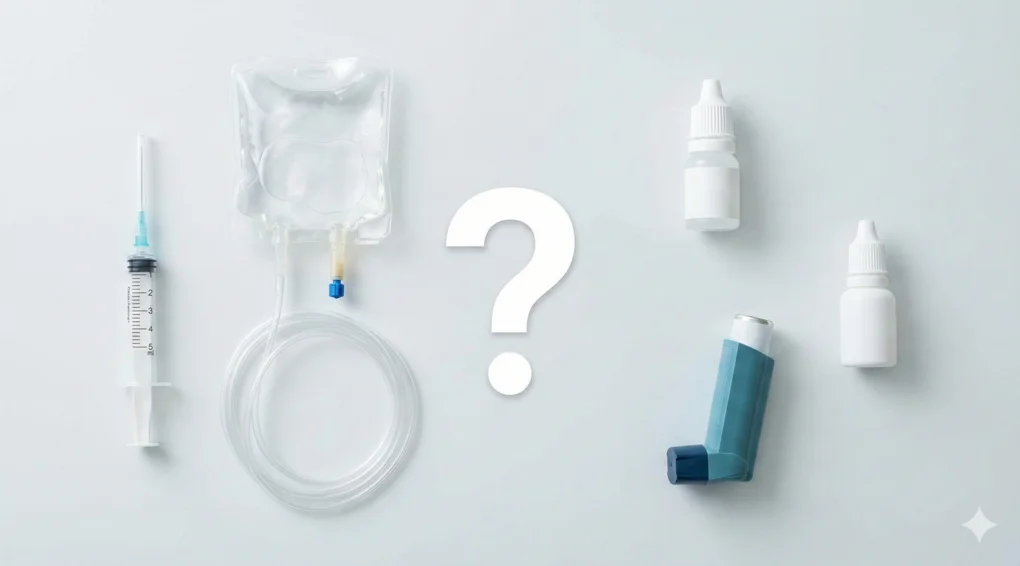
Understanding the difference between an open passageway (manfadz) and skin pores is vital to determine the rulings on modern medical treatments. Based on the rule above, we can map out the following:
- Ear & Nose Drops: If liquid medicine is dropped into the ear until it reaches the inner part (batin), or into the nose until it passes the base of the nasal cavity (khaisyum), it Invalidates the Fast.
قوله: (فرع لو أدخل) الصائم (في أذنه... شيئا فوصل إلى الباطن أفطر) - Injections and IV Infusions: What is the ruling on injections while fasting? Shaykh Zakariyya explains the concept of pores (masam). If something enters through the skin’s pores (not an open orifice), it does NOT invalidate the fast, even if its effects reach inside the body.
قوله: (وما) أي ولا بما (تشربته المسام)... (وإن وصل إلى الجوف).
Therefore, the majority of Shafi’i scholars rule that injections (intravenous/intramuscular) do not invalidate the fast because the needle does not enter through a natural orifice like the mouth or nose. - Huqnah (Enemas/Rectal Suppositories): Inserting medicine, whether liquid or solid (like hemorrhoid suppositories), through the rectum (anus) Invalidates the Fast.
- Cupping and Blood Donation: Performing cupping (hijamah) or blood donation (fashdu) DOES NOT invalidate the fast.
(ولا يفطر بالفصد والحجامة). However, the ruling on cupping during Ramadan is considered disliked (makruh) because it has the potential to physically weaken the fasting person.
For a highly specific discussion regarding modern medical procedures, please study our in-depth analysis on whether injections, IV drips, and ear/eye drops invalidate the fast from the perspective of Asna al-Matalib.
4. Oral Fluids: Saliva, Phlegm, and Vomit

The oral area is a critical zone. Many people harbor doubts regarding the rulings on swallowing saliva and phlegm. Here is the detailed explanation.
a. Swallowing Saliva (Air Liur)
Swallowing one’s own pure saliva is Valid (Does Not Invalidate), provided it meets three conditions:
- Pure: The saliva is not mixed with anything else (like food remnants, bleeding gums, or coloring agents).
- Ritually Pure (Suci): The mouth is not in a state of impurity (e.g., after vomiting, one must rinse their mouth first).
- Has Not Exited: The saliva is still within the boundaries of the lips.
فرع: لو (ابتلع ريقه الصرف)… (لم يفطر) لعسر التحرز عنه
Translation: “If he swallows his pure saliva… he does not invalidate (the fast) due to the difficulty of guarding against it.”
If the saliva has exited past the lips, or if you moisten a sewing thread with your mouth and then swallow the moisture back, the fast is invalidated.
b. The Ruling on Swallowing Phlegm (Nukhama)
Phlegm differs from saliva. Phlegm is a thick substance originating from the chest cavity or the head.
- If the phlegm is still in the inner throat: It is permissible to swallow.
- If the phlegm has reached the outer boundary (the articulation point of the letter Ha’ / ح) or the oral cavity: It Must Be Spat Out.
- If the phlegm is already in the mouth and you are capable of spitting it out but intentionally swallow it instead, your Fast is Invalidated.
قوله: (ولا قلع النخامة) من الباطن إلى الظاهر… (فإن جرت بنفسها)… (عاجزا عن المج) لها (فلا) يفطر
Except if the phlegm descends suddenly (swallowed unintentionally) and you do not have the ability to hold it back; in that case, it is excused. For comprehensive details, read our specific article on the ruling on swallowing saliva and phlegm while fasting.
c. Vomiting: Intentional vs. Unintentional
- Intentional Vomiting (Istiqa’a): Inserting a finger into the throat to induce vomiting Invalidates the Fast.
قوله: (و) يفطر (باستدعاء القيء) - Unintentional Vomiting (Ghalabah): If you suddenly feel nauseous and vomit, the fast is NOT invalidated, provided no vomit is swallowed back and the mouth is immediately purified by rinsing.
5. Factors of Ignorance, Forgetfulness, and Doubt
Islam is a religion that does not impose undue hardship. There are certain conditions where things that normally invalidate the fast are excused (ma’fu).
a. Eating and Drinking Out of Forgetfulness
A person who genuinely forgets that they are fasting, and then eats a full plate of rice or drinks a glass of water, their Fast is Not Invalidated. They do not need to make up (qadha) for that fast.
قوله: (ولا يفطر الناسي) للصوم… (بالأكل ولو كثر)
Translation: “And the one who forgets his fast is not invalidated… by eating, even if it is a lot.”
This also applies to a person who has newly embraced Islam (a convert) or lives far from scholars, who is genuinely ignorant (jahil) that a certain act invalidates the fast.
b. Road Dust and Food Remnants in Teeth
The entry of road dust (ghubar at-thariq) or sifted flour dust into the throat is excused because it is difficult to avoid. Similarly, food remnants between the teeth that are carried away by the flow of saliva unintentionally and are difficult to separate, do not invalidate the fast.
c. Doubts Regarding Time (Syak): Problems with Imsak & Maghrib
This is a crucial issue. What if we eat Suhoor while doubting whether dawn has broken?
- Doubt at the End of the Day (Maghrib): If you doubt “Is it Maghrib yet?”, then it is Haram to Eat. You must be absolutely certain the sun has set. If you recklessly eat and it turns out it is still daytime, you must make up the fast (qadha).
ويحرم أكل الشاك هجوما آخر النهار لا آخر الليل - Doubt at the End of the Night (Subuh): If you doubt “Is it Subuh yet?”, the original ruling is Permissible to Eat (because the base state is that it is still night). However, if after eating Suhoor it is proven that dawn had already broken while you were eating, then the fast for that day is Invalid and must be made up.
Therefore, exercising caution and paying close attention to prayer schedules is highly recommended. To ensure you do not fall into invalidating errors, carefully study the ruling on forgetting or doubting the fasting time.
Summary Table of Things That Invalidate Fasting
To facilitate your understanding, here is a quick summary of the legal status of various activities while fasting based on Asna al-Matalib:
| Activity / Matter | Fasting Status | Explanation / Condition |
| Intercourse (Intentional) | Invalid | Requires Kaffarah (severe penalty). |
| Masturbation (Intentional) | Invalid | If semen is emitted. |
| Wet Dream | Valid | Because there is no element of intent. |
| Injection / IV Infusion | Valid | Enters via pores/veins, not an open cavity. |
| Ear/Nose Drops | Invalid | If it reaches the inner parts. |
| Eye Drops (Kohl) | Valid | The eye is not a passageway to the stomach. |
| Swallowing Saliva | Valid | Condition: Pure & has not exited the lips. |
| Swallowing Phlegm | Invalid | If phlegm is in the mouth & can be spat out. |
| Unintentional Vomiting | Valid | Must rinse the mouth afterward. |
| Eating out of Forgetfulness | Valid | Considered provision (rizq) from Allah. |
FAQ: Frequently Asked Questions
Does swallowing the residual water after rinsing the mouth invalidate the fast?
No, as long as the water is merely “atsar” (residual wetness) that is difficult to avoid after the water has been spat out. However, if you rinse your mouth too excessively (mubalaghah) and water enters the throat, then it is invalid.
If I am eating Suhoor and I hear the Subuh adhan, what should I do?
You are obligated to immediately spit out the food that is in your mouth. If you spit it out, your fast is valid. If you swallow it instead, your fast is invalidated.
Does fainting all day invalidate the fast?
In broader fiqh discussions, if fainting occurs for the entire day (from Subuh to Maghrib) without any moment of consciousness, the fast is invalid. However, if one regains consciousness even briefly during the day, the fast remains valid.
Does a COVID-19 swab test (nasal swab) invalidate the fast?
Based on the text of Asna al-Matalib which states that inserting an object into the nose until it passes the base (khaisyum) invalidates the fast, a deep swab test textually has the potential to invalidate the fast.
Conclusion
This concludes the comprehensive guide regarding the things that invalidate fasting based on the profound analysis of the book Asna al-Matalib. Understanding the precise boundaries of jauf, ‘ain, and the management of human desires is absolutely crucial to ensure the validity of our worship.
However, from the perspective of Tasawuf (Sufism), true fasting is not merely about enduring hunger, thirst, and outward nullifiers. Fasting is a spiritual school meant to restrain the heart and the five senses from disobedience (Sawm al-Khawass). By harmonizing the meticulous precision of fiqh with the inner purity of the soul, we pray that Allah ﷻ accepts our fasting and grants us an upright understanding of the religion. Wallahu a’lam bish-shawab (And Allah knows best).
Reference
Zakariyā al-Anṣārī, Asnā al-Maṭālib fī Sharḥ Rawḍ al-Ṭālib, with the ḥāshiyah by Aḥmad al-Ramlī, edited by Muḥammad al-Zuhrī al-Ghamrāwī (Cairo: al-Maṭbaʿah al-Maymānīyah, 1313 H; repr. Dār al-Kitāb al-Islāmī), vol. 1, pp. 414-418.


