
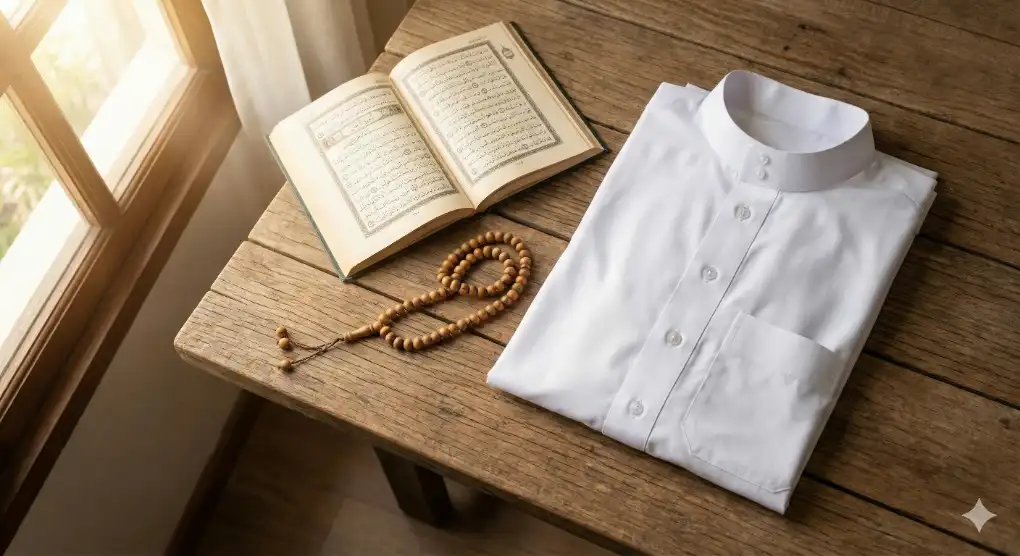
How many times do we change our garments in a single day? From sleepwear and professional uniforms to casual home attire, this activity often passes by as a mere mundane routine. However, within the Islamic tradition, this simple, repetitive moment can transform into a profound source of spiritual reward if we understand its underlying principles.
Imam al-Nawawi, in his renowned classical text Al-Adhkār, meticulously explains how the Prophet Muhammad ﷺ utilized the act of dressing as a means of divine remembrance. Let us systematically examine these practices, from the specific Dua for dressing to the etiquette of removing garments to ensure spiritual protection.
1. Initiating with the Basmalah
The most fundamental, yet frequently overlooked, step is the recitation of “Bismillah.” Imam al-Nawawi emphasizes a foundational juristic rule in the opening chapter concerning clothing:
يستحب أن يقول: بسم الله, وكذلك تستحب التسمية في جميع الأعمال.
“It is recommended to say: ‘Bismillah’ (In the Name of Allah). Likewise, pronouncing the Name of Allah is recommended at the beginning of all actions.”
This recitation serves as the key to unlocking divine blessings before we proceed to more specific supplications. To understand the deeper theological implications of this act, you can explore the legal rulings of reciting the Basmalah.
2. The Specific Dua for Dressing
The Prophet Muhammad ﷺ taught several variations of supplications for donning clothes. We are encouraged to alternate between them to enliven the Sunnah.
Supplicating for the Goodness of the Garment
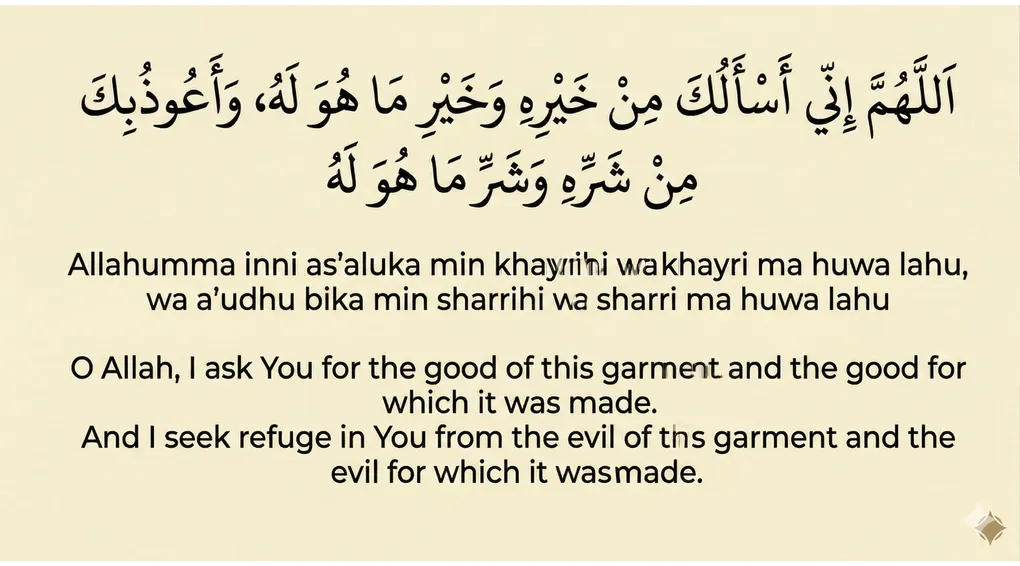
According to a narration from Abu Sa’id al-Khudri (Hadith No. 43), when the Messenger of Allah ﷺ put on a garment—whether a shirt, a cloak, or a turban—he would explicitly name the item and then recite:
اللَّهُمَّ إِنِّي أَسْأَلُكَ مِنْ خَيْرِهِ وَخَيْرِ مَا هُوَ لَهُ, وَأَعُوذُ بِكَ مِنْ شَرِّهِ وَشَرِّ مَا هُوَ لَهُ
Transliteration: Allāhumma innī as’aluka min khayrihi wa khayri mā huwa lahu, wa aʿūdhu bika min sharrihi wa sharri mā huwa lahu.
Meaning: “O Allah, I ask You for the goodness of this garment and the goodness of that for which it was made. And I seek refuge in You from the evil of it and the evil of that for which it was made.”
Supplicating for the Forgiveness of Sins
For those seeking a supplication that carries the virtue of expiating sins, the narration of Mu’adh ibn Anas (Hadith No. 44) is highly significant. The Prophet ﷺ stated that whoever wears a garment and recites the following:
الْحَمْدُ لِلَّهِ الَّذِي كَسَانِي هَذَا, وَرَزَقَنِيهِ مِنْ غَيْرِ حَوْلٍ مِنِّي وَلَا قُوَّةٍ
Transliteration: Alḥamdulillāhil-ladhī kasānī hādhā wa razaqanīhi min ghayri ḥawlin minnī wa lā quwwatin.
Meaning: “All praise is due to Allah who has clothed me with this and provided it for me without any might or power on my part.”
The prophetic promise for this specific recitation is that the individual’s past sins will be forgiven.
3. Sunnah Etiquette for Wearing New Clothes
Acquiring new clothing naturally elicits joy. The Prophet ﷺ taught us to channel this worldly happiness into profound spiritual gratitude.
In another narration from Abu Sa’id al-Khudri (Hadith No. 45), it is recorded that when the Prophet ﷺ acquired a new garment, he would name it and then declare:
اللَّهُمَّ لَكَ الْحَمْدُ، أَنْتَ كَسَوْتَنِيهِ، أَسْأَلُكَ خَيْرَهُ وَخَيْرَ مَا صُنِعَ لَهُ، وَأَعُوذُ بِكَ مِنْ شَرِّهِ وَشَرِّ مَا صُنِعَ لَهُ
Transliteration: Allāhumma lakal-ḥamdu anta kasawtanīhi, as’aluka khayrahu wa khayra mā ṣuniʿa lahu, wa aʿūdhu bika min sharrihi wa sharri mā ṣuniʿa lahu.
Imam al-Tirmidhi graded this hadith as Hasan (sound). This supplication embodies absolute submission, acknowledging that our attire is not merely the result of our financial capacity, but a direct provision from Allah. This aligns perfectly with studying the true essence of Hamdalah and gratitude in Islamic theology.
Do Not Forget to Donate Old Clothes



Having new clothes often makes the closet full. Don’t let old clothes pile up uselessly. There is an interesting story from Umar bin Khattab radhiyallahu ‘anhu (Hadith No. 46).
He heard the Messenger of Allah ﷺ say that whoever wears a new garment, praises Allah, then takes his old, worn garment and gives it in charity, then that person will be:
في حفظ الله وفي كنف الله عز وجل, وفي سبيل الله حيا وميتا
“In the safekeeping of Allah, under the protection of Allah the Almighty, and in the path of Allah, both in life and in death.”
4. Prioritizing the Right Side (At-Tayamun)
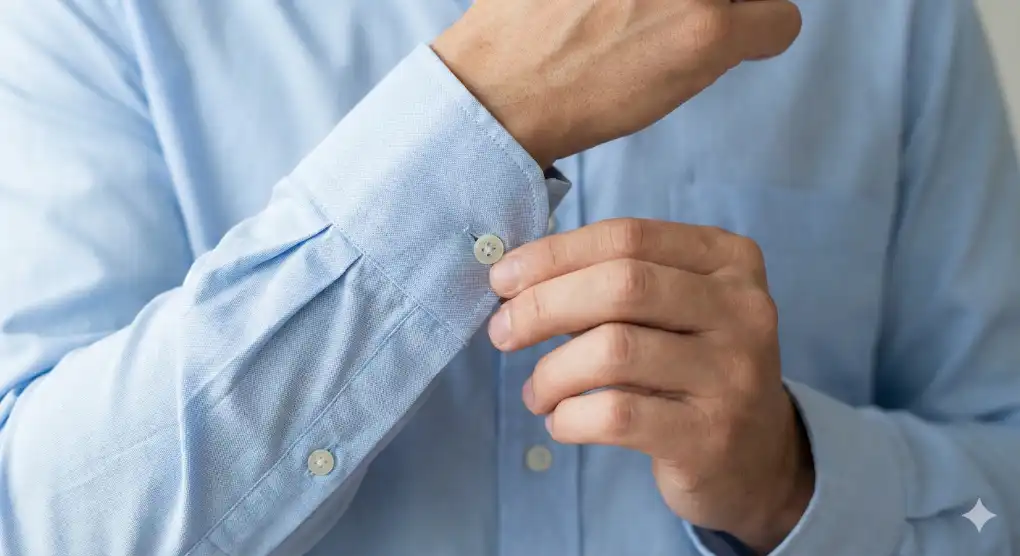
A distinct hallmark of the Prophetic Sunnah is prioritizing the right side for honorable actions. In his chapter on the methodology of dressing, Imam al-Nawawi states:
يستحب أن يبتدأ في لبس الثوب والنعل والسراويل وشبهها باليمين
“It is recommended to begin putting on a shirt, sandals, trousers, and similar items with the right side.”
The foundational rule is straightforward:
- Putting on: Begin with the right (the right sleeve, the right trouser leg).
- Taking off: Begin with the left.
Aisha (may Allah be pleased with her) narrated (Hadith No. 49) that the Prophet ﷺ loved to start with his right side (at-tayamun) in all his affairs, including purifying himself, combing his hair, and putting on his footwear. This holistic approach is a core component of the general etiquette of dressing in Islam.
5. Dua for Taking Off Clothes: A Shield from the Jinn
Are we ever truly alone in a dressing room? The unseen realm exists parallel to ours. Fortunately, the Prophet ﷺ provided a spiritual shield to ensure our ‘awrah (intimate parts) remains hidden from the Jinn.
According to Anas (may Allah be pleased with him) in Hadith No. 53, the Prophet ﷺ said:
سِتْرُ مَا بَيْنَ أَعْيُنِ الْجِنِّ وَعَوْرَاتِ بَنِي آدَمَ أَنْ يَقُولَ الرَّجُلُ الْمُسْلِمُ إِذَا أَرَادَ أَنْ يَطْرَحَ ثِيَابَهُ: بِسْمِ اللَّهِ الَّذِي لَا إِلَهَ إِلَّا هُوَ
“The screen between the eyes of the Jinn and the intimate parts of the children of Adam, when a Muslim intends to take off his clothes, is that he says: ‘Bismillahilladhī lā ilāha illā huwa’ (In the Name of Allah, other than whom there is no deity).”
This phrase is brief, yet its impact as an unseen barrier is profound.
6. The Etiquette of Supplicating for Others
Islamic etiquette extends beyond the self. When observing a friend, spouse, or child wearing new clothes, the Prophet ﷺ demonstrated specific supplications.
- For Children: When the Prophet ﷺ dressed a young girl named Umm Khalid in a new garment, he said: “Ablī, wa akhliqī” (Hadith No. 47). This translates to “Wear it until it is worn out and tattered,” functioning as a supplication for a long, blessed life.
- For Adults: Upon seeing Umar wearing a garment, the Prophet ﷺ asked if it was new or recently washed. Upon learning it was washed, he prayed (Hadith No. 48): Ilbas jadīdan, wa ʿish ḥamīdan, wa mut shahīdan “Wear the new, live purely (praiseworthy), and die as a martyr.”
Practical Summary of Dressing Etiquette
To facilitate the daily application of these practices, here is a summarized sequence of the Sunnah:
| Activity | Sunnah / Etiquette | Supplication (Transliteration) |
| Intending to Dress | Begin with the right side of the body. | Bismillah |
| Putting on Clothes | Praise Allah & ask for the garment’s goodness. | Allāhumma innī as’aluka min khayrihi… OR Alḥamdulillāhil-ladhī kasānī… |
| Wearing New Clothes | Give old clothing to charity. | Allāhumma lakal-ḥamdu anta kasawtanīhi… |
| Seeing Others Dress | Pray for their well-being and longevity. | Ilbas jadīdan, wa ʿish ḥamīdan, wa mut shahīdan |
| Taking off Clothes | Begin with the left side of the body. | Bismillahilladhī lā ilāha illā huwa |
FAQ (Frequently Asked Questions)
Must the Dua for wearing new clothes be recited in Arabic?
It is highly recommended to recite the supplication in Arabic to preserve the exact phrasing of the Hadith. However, if one has not yet memorized it, the core objective is to praise Allah and express gratitude. The shorter supplication, “Alḥamdulillāhil-ladhī kasānī hādhā…” (Hadith No. 44), is concise and relatively easy to memorize.
What should I do if I forget to recite the Dua while getting dressed?
If you remember halfway through dressing or immediately afterward, you may recite it then. There is no prohibition against this; the remembrance of Allah (Dhikr) is praiseworthy at any time, and the intention to revive the Sunnah is rewarded.
Why must we start with the left side when taking off our clothes?
This practice demonstrates respect for the right side of the body. As detailed in the hadith of Hafsah (Hadith No. 51), the Prophet ﷺ designated the right hand for eating, drinking, and dressing, while reserving the left side for removing items or cleaning impurities.
Is the supplication for protection from the Jinn only recited in the bathroom?
No. Hadith No. 53 explicitly states, “when a Muslim intends to take off his clothes.” Therefore, whether you are in the bathroom, your bedroom, or changing for exercise, you should recite this specific Bismillah to ensure your ‘awrah is shielded from the unseen realm.
Conclusion
By internalizing this comprehensive guide, our daily routine of dressing transcends physical necessity, becoming a manifestation of gratitude to the Supreme Provider. While the general supplications are highly rewarding, classical scholars note textual variations depending on the type of garment. For a more nuanced juristic discussion on this matter, you can read our comparative analysis regarding the Dua for new versus everyday clothes.
Reference
Al-Nawawī, Yaḥyā ibn Sharaf. Al-Adhkār. Edited by ʿAbd al-Qādir al-Arnaʾūṭ. New revised edition. Beirut: Dār al-Fikr, 1994.


