
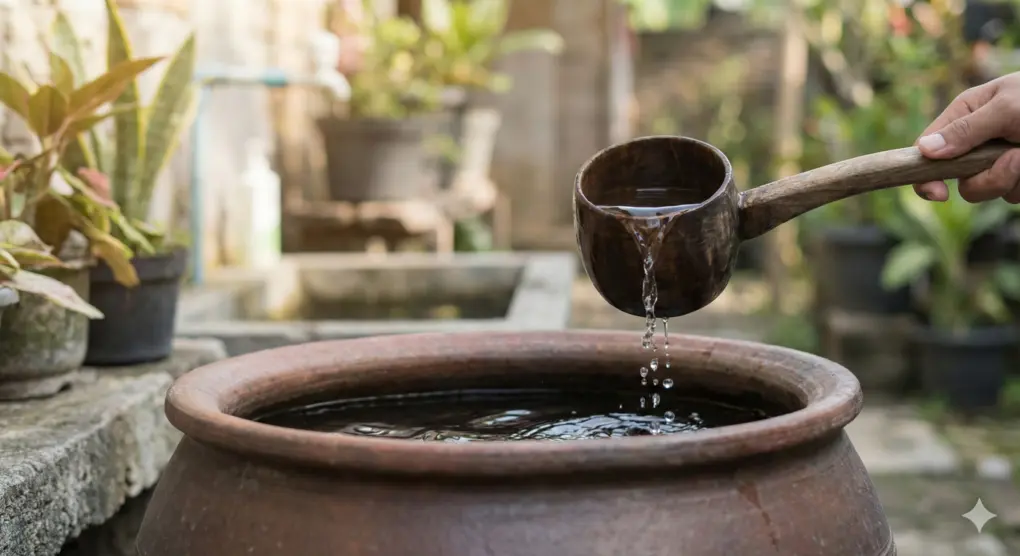
In our daily lives, we frequently perform wudu (ablution) using a small bucket or a modestly sized bathtub. Unbeknownst to many, that clear water might have transformed into Musta’mal water (one of the types of water in Islam and their usages). Consequently, our wudu or obligatory bath becomes invalid, and our prayers are not accepted.
Understanding the definition of Musta’mal water is not merely theoretical; it is highly practical. Many subtle details in Shafi’i fiqh manuals often go unnoticed, such as the status of water used by children or fatal mistakes when scooping water (ightiraf). Based on the authoritative text Asna al-Matalib Sharh Rawd al-Talib, let us thoroughly examine these issues to safeguard our worship.
What is Musta’mal Water Exactly?
Simply put, we often translate it as “used water.” However, Shaykh Zakariyya al-Ansari provides strict parameters. Not all used water is considered musta’mal.
In Asna al-Matalib (Vol. 1, p. 5), it is stated:
(لا قليل مستعمل في فرض)
Meaning: (Absolute water) is not a small amount of water that has been used for an obligatory (fard) purification.
From this text, two main conditions make water musta’mal:
- Small Volume: The volume is less than two qullahs (approximately 216 liters).
- Used for an Obligation: The water was previously used to lift a ritual impurity (wudu or obligatory bath) or to remove physical filth (understanding najis).
Why can’t this water be reused for purification? The underlying reason is that the water has “absorbed” or taken on the barrier to worship (ritual impurity) from our bodies. Early scholars (salaf) never collected used wudu water for reuse; instead, they opted for tayammum (dry ablution) if clean water was depleted.
Unique Cases: Children and Madhab Differences
You might ask, “Since children are not yet obligated to pray, does their used wudu water remain purifying?” Or, “What if someone performs wudu without an intention?”
1. Used Wudu Water from a Child (Sabi)
Interestingly, the used wudu water of a discerning child (mumayyiz—one who can distinguish right from wrong) is still ruled as musta’mal.
The original reference notes:
(ولو من حنفي بلا نية, وصبي)
Meaning: (The water becomes musta’mal even if used) by a Hanafi follower without intention, and by a child.
The reasoning is that although children do not sin by missing a prayer, their prayer is legally valid if they perform wudu. Because wudu is a condition for the validity of their prayer, the water they use holds the same status as an adult’s: it becomes musta’mal.
2. The Case of the Hanafi Follower
In the Hanafi madhab, the intention is not a condition for a valid wudu (it is merely a sunnah). However, for us Shafi’i followers, if a Hanafi friend performs wudu in front of us without an intention, we still consider their leftover water as musta’mal. We judge the water based on our jurisprudential convictions, not theirs.
The “Ightiraf” Trap: Be Careful When Scooping Water
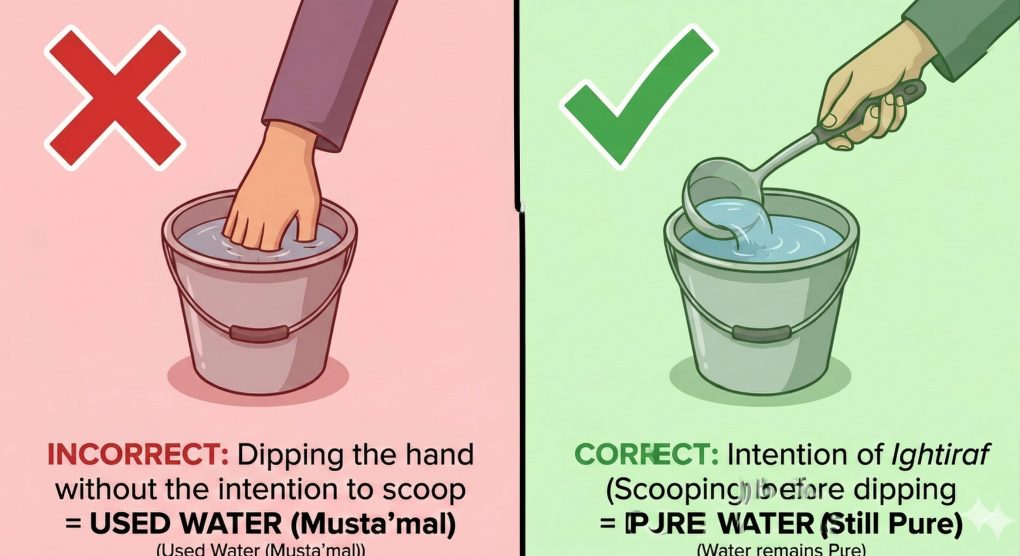
Ensure you formulate the intention to scoop (ightiraf) before inserting your hand into a small body of water. This is the most crucial point and a common violation when people perform wudu using a dipper or a small bucket. This issue is known as the ightiraf (scooping) problem.
Imagine you are performing wudu. After washing your face (which is the first of the obligatory acts of wudu), you dip your hand into the bucket to scoop water to wash your arms.
The Rule: The moment your hand touches the water in the bucket, you MUST formulate the intention to scoop (ightiraf).
If you dip your hand without the intention to scoop, the water in the bucket instantly becomes musta’mal. Why? Because it is legally time for your hands to be washed. When your hand enters the water without the explicit “scooping” intention, the Sharia considers it as “the hand being washed inside the bucket.” Consequently, the entire bucket is deemed as used water from washing the hand.
The text in Asna al-Matalib (p. 6) reads:
(ولو غرف بكفه جنب … محدث بعد غسل وجهه … من ماء قليل, ولم ينو الاغتراف صار مستعملا)
Meaning: If a person in a state of major impurity (junub) or minor impurity after washing his face scoops with his palm… from a small amount of water, and he does not intend to scoop (ightiraf), the water becomes musta’mal.
The Solution: Right before your fingers touch the water, firmly intend in your heart, “I am taking water,” not “I am washing my hand inside.”
Strategy for the Obligatory Bath: The Issue of Inghimas (Submerging)
For those who prefer performing the correct obligatory bath by submerging (inghimas) into a bathtub (containing less than 216 liters), pay close attention to the timing of your intention.
If you intend “Obligatory Bath” when only a part of your body (e.g., your foot) has entered the water, the remaining water will become musta’mal for the upper parts of your body that haven’t touched the water yet.
وإن (نوى جنب) رفع حدثه الأكبر (ولو قبل تمام الانغماس في ماء قليل أجزأه) الغسل به (في ذلك الحدث) لا في غيره
The water is only valid for the body parts already submerged when the intention was made. The rest of the body cannot be purified with that water because its status changed to musta’mal upon contact with the first body part.
The correct method: Enter the water until your entire body is submerged (or up to your neck), and then formulate the intention. Alternatively, intend to scoop every time you take water if you are not submerging.
When Can Musta’mal Water Become Pure Again?
Do not rush to throw away musta’mal water. Islamic jurisprudence offers a brilliant solution. If musta’mal water is collected in a large container until its volume reaches two qullahs (and its characteristics have not changed), the water reverts to being pure and purifying (thahur).
(فإن جمع … فبلغ قلتين صار طهورا)
Meaning: If (musta’mal) water is collected… until it reaches two qullahs, it becomes pure and purifying.
Summary Table: Musta’mal vs. Pure Water
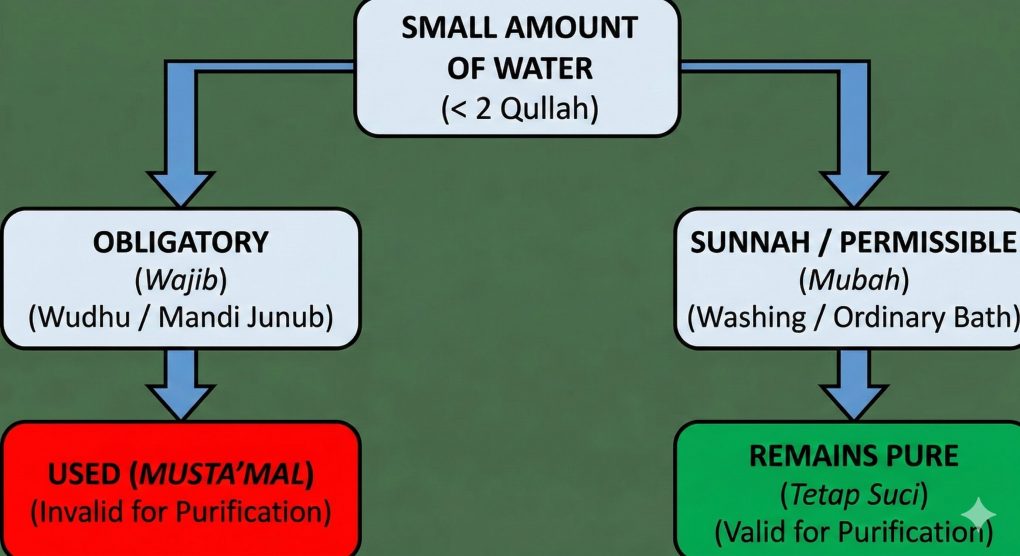
Here is a simple scheme to determine the purity status of leftover water based on its usage. To make it easier to differentiate, observe the following table based on Asna al-Matalib:
| Usage Condition | Status of Leftover Water | Reason |
| First wash of Wudu (Obligatory) | Musta’mal | Used for an obligatory (fard) purification. |
| Second & third wash of Wudu | Remains Pure | These washes are sunnah (nafl), not obligatory. |
| Sunnah bath (e.g., Friday bath) | Remains Pure | Not intended to lift an obligatory impurity. |
| Washing away physical impurity (najis) | Musta’mal | Removing najis is an obligation. |
| Wudu of a discerning child (Mumayyiz) | Musta’mal | It is a condition for their prayer’s validity. |
| Bathing a deceased person | Musta’mal | A communal obligation (fard kifayah). |
| Washing over a bandage (as a substitute) | Musta’mal | Acts as a substitute (badal) for an obligation. |
FAQ: Frequently Asked Questions
Is leftover water from a regular shower (with soap) considered musta’mal?
If it is a regular shower to refresh the body (not a ritual bath), the leftover water is not musta’mal. However, it might become mutaghayyir (altered water) if mixed with a large amount of soap. Musta’mal water only applies to ritual acts of worship.
What if I perform wudu for a sunnah prayer, is the water musta’mal?
If you perform wudu while in a state of minor impurity, that wudu is legally obligatory to lift the impurity, even if your end goal is a sunnah prayer. Thus, the water becomes musta’mal. However, if you already have wudu and are simply renewing it (tajdid), the water does not become musta’mal.
Can I use musta’mal water to wash my clothes?
Yes. Musta’mal water is legally Pure (Tahir), but it is Not Purifying (Ghayr Mutahhir). Therefore, it is valid to use it to wash dirty clothes (but not to purify clothes tainted with najis), drink it, or water plants. It simply cannot be used for wudu or ghusl again.
Conclusion
Hopefully, this explanation enlightens our understanding of Musta’mal water. Let us refine our purification methods, especially regarding the intention when scooping water, so that the prayers we establish are truly valid in the sight of Allah Subhanahu wa Ta’ala. Do not forget to send blessings upon the Prophet Muhammad ﷺ, exploring the virtues of shalawat. Allahumma salli ‘ala sayyidina Muhammad wa ‘ala ali sayyidina Muhammad.
Reference
al-Anṣārī, Zakariyā. Asnā al-Maṭālib fī Sharḥ Rawḍ al-Ṭālib. With a ḥāshiyah by Aḥmad al-Ramlī. Edited by Muḥammad az-Zuhrī al-Ghamrāwī. Cairo: al-Maṭbaʿah al-Maymānīyah, 1313 H. Reprinted by Dār al-Kitāb al-Islāmī.


