

For cat lovers, playing with their beloved pets is the most enjoyable time. However, there is one common problem that often causes concern: shedding fur everywhere.. On the sofa, on the bed, even sticking to the clothes you want to wear for worship.
This condition often raises a big question in our minds. What is the Islamic ruling on cat hair? Is our prayer still valid if one or two strands of cat hair cling to our clothes or prayer garment?
To address this doubt, we need to revisit the references in classical fiqh texts. We will dissect the legal basis from the book Asna al-Matalib and examine the concessions from Hashiyah al-Bujayrimi. Let’s discuss this thoroughly so that our hearts are more at peace when facing the Creator.
Understanding the Basic Rules: Animal Carcasses
Before directly judging the ruling regarding whether cat hair is impure or pure, we need to understand the main principle held by the Shafi’i scholars. This principle governs the purity status of body parts separated from a living animal.
In the book Asna al-Matalib (Volume 1, page 11), Shaykh Zakariyā al-Ansari explained the basic principle:
فرع : الفرع ما اندرج تحت أصل كلي الجزء ( المبان من حي , ومشيمته ) … ( كميتته ) أي كميتة ذلك الحي طهارة , ونجاسة لخبر « ما قطع من حي فهو ميت » رواه الحاكم
Meaning: “A part separated from a living animal… its ruling is like that of its carcass, both in terms of purity and impurity, based on the ḥadīth: ‘Whatever is cut from a living animal, then it is a carcass’.”
This is the main formula. If a part of the body (including fur or skin) detaches from a living animal, we must look at the status of the animal if it were to die as carrion.
- If its carcass is ritually pure (such as a human, fish, and locust), then a portion of its body while alive is also ritually pure.
- If its carcass is impure (such as a cow, goat, and cat), then parts of its body while alive are originally legally impure.
Then, what about cats? We know that if a cat dies without being slaughtered (and indeed cats are not slaughtered), it becomes a carcass that is impure. Based on this logic, the ruling regarding shed cat hair should be impure because it is part of an animal whose carcass is impure.
Read also: The Meaning of Impurity in Language and Terminology
Exceptions for Animals Whose Meat is Consumed
However, there is no need to panic. Islamic ruling is not rigid. The book Asna al-Matalib provides a clear exception for certain types of animals.
قوله : ( لا شعر مأكول , وريشه ) فطاهران ( ولو انتتف ) كل منهما أو نتف , وما في معناهما من صوف , ووبر قال تعالى { ومن أصوافها وأوبارها وأشعارها أثاثا ومتاعا إلى حين 1}
Meaning: “(Except for the hair of permissible animals and the feathers [of birds]), then both are pure (even if they fall out on their own) or plucked… based on the word of Allah: ‘…and from the wool of sheep, the wool of camels, and the wool of goats… [QS. An-Nahl: 80].”
Therefore, wool (from sheep), feathers (from chickens), or hair (from cows) that falls off the animal while it is alive is considered PURE. This is a special concession for halal animals (ma’kul al-lahm).
The problem is, cats are not livestock that are permissible to eat. Cats have fangs and are Ḥarām to consume. Since cats do not fall under the category of animals whose meat is lawful to consume, the ruling on detached cat hair returns to the original principle: it is considered ritually impure according to the Shafi’i school.
Fiqh Solutions: Excused Impurities (Ma’fu ‘Anhu)
If we were to stop reading only there, it would certainly be very difficult for cat owners. It is almost impossible to completely free a house from cat hair. This is where the breadth of mercy lies within the Shafi’i school of jurisprudence.
Although the ruling regarding cat hair is ritually impure (because it is separated from an animal whose meat is Ḥarām to consume), scholars have provided leniency. This is further clarified in another reference, namely Ḥashiyah al-Bujayrimi ‘ala Sharḥ al-Manhaj.
The book mentions a very relieving principle:
قوله : ( فنجس ) ويعفى عن يسيره من غير نحو كلب وعن كثيره من مركوبه . اه ـ. ح ل 2
Meaning: “His statement: (then it is impure), but a small amount of it is forgiven—from animals other than dogs [and pigs]—and a large amount is forgiven from riding animals.” (Hashiyah al-Bujayrimi ‘ala Syarh al-Manhaj)
This reference is of crucial importance for understanding the practical application of the ruling. This condition of being “excused” (ma’fu) applies with the following provisions:
- Not Dogs and Pigs: Cats are considered sacred animals during their lifetime (not najas mughalladzah), so their shed fur receives this concession.
- Small Quantity (Yasir): If the hairs adhering are only one, two, or three strands, this is considered a small quantity according to common practice (‘urf) and is excusable. Your prayer remains valid.
So, regarding the ruling of cat hair carried during prayer, if the amount is small and difficult to avoid, there is no need to worry. Its impurity is forgiven by Islamic ruling.
What to Do in Case of Doubt?
Often we find hairs on our clothes, but are unsure whether they are cat hair, thread fluff, or hairs from our own wool jacket. In such a doubtful situation, the book Asna al-Matalib once again provides guidance:
قوله : ( ولا مشكوك فيه ) أي في أن الشعر , ونحوه من مأكول أو غيره لأن الأصل الطهارة
Meaning: “(And not something doubtful [impure]) meaning the doubt whether the hair comes from an animal that is lawful to eat or not, because the original ruling is purity.”
If you are in doubt, revert to the original ruling: Purity. Doubt cannot overcome certainty. You do not need to check every inch of fabric with a magnifying glass before prayer.
Practical Tips for Worship for Cat Owners
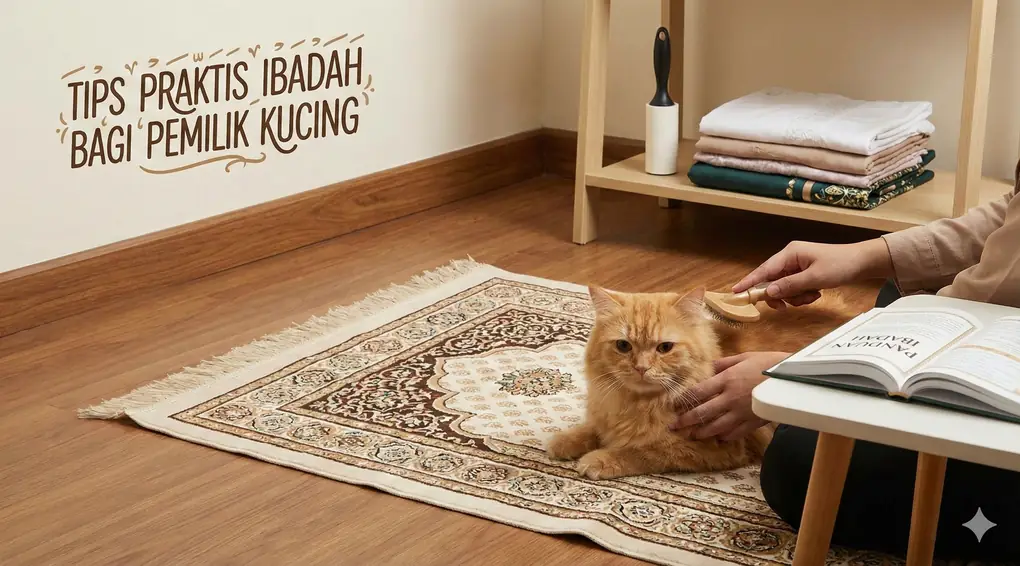
After understanding the ruling regarding cat fur in Islam, here are some practical steps to ensure worship remains peaceful and valid:
1. Prepare Special Prayer Garments
Try to have a set of clothes (sarong, koko shirt, or prayer gown) that is specifically used only for prayer. Store it in a closed cabinet or hang it in a high place that cats cannot reach.
2. Use a Clean Prayer Rug
Do not leave the prayer rug continuously spread on the floor, as cats like to sleep on it. Fold the prayer rug immediately after finishing prayers to avoid the accumulation of shed cat hair.
3. Provide a Lint Roller




A lint roller is a cat owner’s best friend. Before prayer, take a moment to clean the area around your knees or clothes. This is our effort to maintain cleanliness, and even a small amount is forgiven.
4. Maintain the Cleanliness of Cats
Regularly grooming and bathing your cat will reduce shedding. The less fur that sheds, the lower the risk of accumulation in noticeable quantities.
.
Conclusion
Answering the question of the ruling regarding cat hair being carried during prayer, the answer is not rigid.
In essence, cat hair that falls out is considered impure according to the Shafi’i school of thought because it is separated from an animal whose meat is not consumed. However, based on the explanation in Hashiyah al-Bujayrimi, this impurity is included in the category of ma’fu ‘anhu (excused) if the amount is small.
The main point is, don’t let the presence of a cat make you feel burdened in your worship. Islam is easy. Maintain cleanliness as best as you can, clean the fur that is clearly accumulated, and if a few strands remain that are difficult to avoid, your prayer will be valid, God willing.
References
- Zakariyā al-Anṣārī, Asnā al-Maṭālib fī Sharḥ Rawḍ al-Ṭālib, dengan ḥāshiyah oleh Aḥmad al-Ramlī, disunting oleh Muḥammad az-Zuhrī al-Ghamrāwī (Kairo: al-Maṭbaʿah al-Maymānīyah, 1313 H; repr. Dār al-Kitāb al-Islāmī), juz 1, hlm. 11. ↩︎
- Sulaimān bin Muḥammad bin ‘Umar al-Bujayrimī, al-Tajrīd li Naf‘ al-‘Abīd (Ḥāshiyah al-Bujayrimī ‘alā Syarḥ al-Manhaj) (Kairo: Maṭba‘ah al-Ḥalabī, tanpa cetakan, 1369 H/1950 M), jil. 1, hlm. 102. ↩︎


