
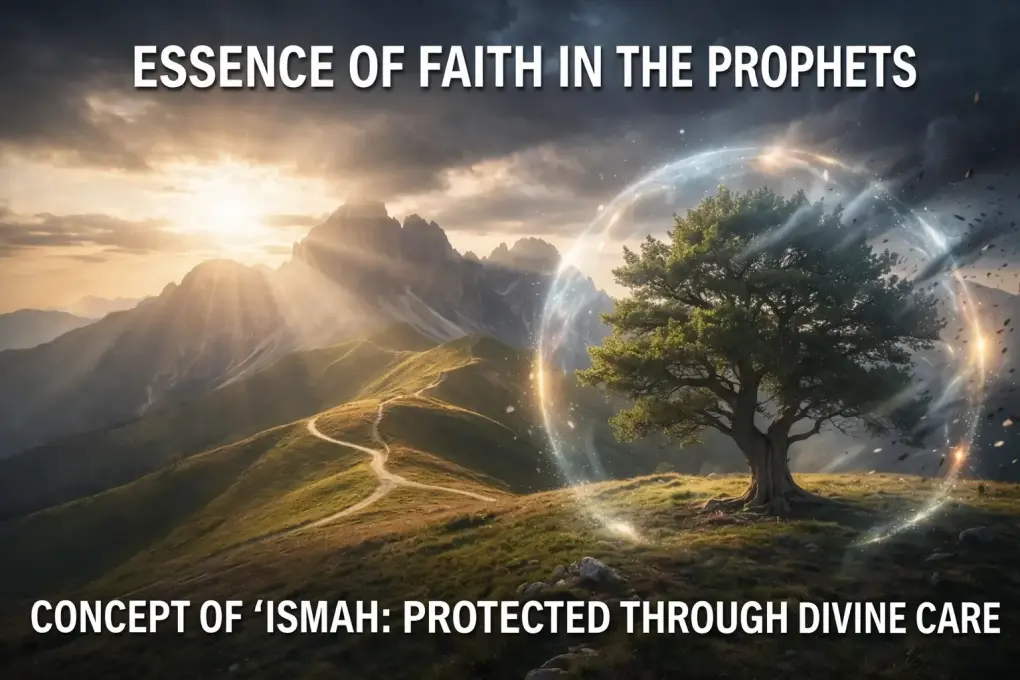
When discussing Islamic theology (‘Aqidah), we often stop at mere memorization from our school days. If asked about the belief in Allah’s Messengers, we universally recognize it as the fourth pillar of faith. But does our understanding truly end there? Is it sufficient to simply memorize the 25 names of the prophets without grasping the theological essence behind their selection?
Absolutely not. There is a fundamental foundation that is frequently overlooked, especially when we are confronted with critical questions: “Can a Prophet commit a sin?” or “How do we interpret Quranic verses that appear to reprimand a Prophet?”
Through this article, we will dissect the true meaning of the belief in Allah’s Messengers by referencing two authoritative (mu’tabar) classical texts: Al-Kawkab Al-Wahhaj Syarah Shahih Muslim and Al-Fath Al-Mubin Syarah Al-Arba’in. This academic explanation will align our perspective with the orthodox theology of Ahlus Sunnah wal Jama’ah. For a broader foundation, you can also review the definition and total number of the pillars of faith.
What Does Belief in Allah’s Messengers Truly Mean?
Many people ask about the exact definition of this belief. Is it merely acknowledging that they existed in the past as historical figures?
In the text Al-Kawkab Al-Wahhaj, Shaykh Muhammad Al-Amin Al-Harari provides a highly concise definition. He explains that believing in the messengers means you wholeheartedly affirm (tashdiq) that Allah SWT truly has truthful (shadiq) emissaries.
Therefore, this belief holds a much deeper significance than historical knowledge. Just as a profound belief in Allah demands total submission to His oneness, believing in His messengers demands absolute certainty that whatever they convey—whether it is news of Paradise and Hell, rulings on the lawful (halal) and unlawful (haram), or stories of past nations—is the absolute truth sourced directly from divine revelation. None of it is their own fabrication.
The Proof of Truth Through Miracles
How do we know they are not lying? Allah equipped these chosen individuals with tangible proofs in the form of miracles (Mu’jizat). A miracle is an extraordinary event that breaks the laws of nature, serving as a stamp of legitimacy from the Creator of the Heavens.
When a Messenger performs a miracle, it is as if Allah is stating: “My servant is truthful in what he conveys from Me.” Miracles are not meant to show off supernatural powers; rather, they serve as authentic evidence so humanity will not hesitate to follow their teachings.
The Concept of ‘Ismah: Are Prophets Truly Sinless?
This is the topic that most frequently sparks debate when discussing the belief in Allah’s Messengers. However, the book Al-Fath Al-Mubin by Ibn Hajar Al-Haytami provides a firm and reassuring theological answer.
The Prophets possess the attribute of being Ma’shum (infallible or divinely protected). This means Allah protects their physical and spiritual beings from the stain of sin. This divine protection encompasses:
- Protection from Major and Minor Sins: They are completely purified from any form of disobedience that could degrade their honorable status.
- Lifelong Protection: This attribute of ‘ismah applies not only after they are appointed as Prophets but also prior to their prophethood. This is the selected and most correct view (ash-shawab) among the majority of classical scholars.
The underlying logic is straightforward. If a prospective Prophet had a poor track record or was known as a sinner before his appointment, his followers would naturally find it difficult to trust him. Allah eliminates this vulnerability by keeping them pure from birth.
The Logical Superiority Over Angels
An intriguing argument is presented in Al-Fath Al-Mubin. The orthodox belief in the angels dictates that angels are pure creations, devoid of earthly desires, who never disobey Allah. Yet, our theology teaches that the spiritual rank of the Prophets is actually superior to that of the angels.
If the angels, who occupy a lower rank, are ma’shum (protected from sin), then it is an absolute certainty that the Prophets—who hold a higher rank—are even more deserving of the ma’shum attribute. It is logically impossible for the creations most beloved by Allah to be less pure than the angels.
Addressing Stories of “Sins” and Isra’iliyyat
You might have encountered history books claiming that Prophet Dawud (David) coveted another man’s wife, or that Prophet Yusuf (Joseph) succumbed to a woman’s temptation. We must be extremely cautious. If we truly understand that the belief in Allah’s Messengers entails absolute conviction in their purity, we must be vigilant against Isra’iliyyat (unreliable Judeo-Christian narratives that infiltrated Quranic exegesis).
Ibn Hajar Al-Haytami issues a stern warning regarding this. Narratives depicting a Prophet committing a despicable act or a sin—even if they are found in certain books of Tafsir or history (and even if cited by prominent scholars like Al-Baghawi or Al-Wahidi)—must not be accepted as truth. We are strictly forbidden from entertaining reports that tarnish the pristine image of the Prophets.
How Do We Understand Divine Reprimands in the Quran?




This raises a valid question: What about the Quranic verses detailing Prophet Adam eating from the forbidden tree? Was that not a sin?
Through the lens of advanced Islamic theology and Sufism, these actions by the Prophets are not classified as acts of disobedience (maksiat) or crimes as they would be for ordinary humans. Instead, they are termed Khilaf al-Awla, which translates to “leaving the optimal choice.”
The Prophets chose a “good” option when a “best” option was available. Because their spiritual station is so intimately close to Allah, a minor lapse in optimal judgment (which would be entirely normal for us) is considered a significant matter in the sight of Allah. Thus, Allah’s reprimands to them are manifestations of divine love and elevated instruction, not penal punishments for wickedness.
The Primary Mission of the Messengers: This World and the Hereafter
The Messengers were sent to guide us in two concurrent domains: Ma’ash (matters of worldly life) and Ma’ad (matters of the afterlife). Human intellect is inherently limited. We might be brilliant at organizing economic systems (the world), but without the guidance of a Messenger, we are completely blind regarding what occurs after death (the hereafter).
Furthermore, the belief in Allah’s Messengers compels us to revere all of them without exception. We are prohibited from discriminating between them—for instance, believing only in Prophet Isa (Jesus) while rejecting Prophet Muhammad SAW, or vice versa. To reject one Prophet is fundamentally equivalent to rejecting all of them.
Original Arabic References
To maintain academic validity, below are the original Arabic excerpts from the classical texts referenced in this article.
1. From Al-Kawkab Al-Wahhaj Syarah Shahih Muslim:
(و) الرابع أن تؤمن ب ـ (ـ رسله ) أي أن تصدق بأن لله سبحانه رُسلًا صادقين فيما أخبروا به عن الله تعالى مؤيدين من الله تعالى بالمعجزات الدالة على صدقهم وأنهم بلّغوا عن الله رسالاته ، وبينوا للمكلفين ما أمرهم الله ببيانه لهم ، وأنه يجب احترامهم وأن لا يفرق بين أحد منهم 1.
2. From Al-Fath Al-Mubin Syarah Al-Arba’in (p. 161):
قزله: (ورسله) أي: بأنه أرسلهم إلى الخلق؛ لهدايتهم وتكميل معاشهم ومعادهم، وأيدهم بالمعجزات الدالة على صدقهم… وأنه تعالى نزَّههم عن كل وصمةٍ ونقصٍ، فهم معصومون من الصغائر والكبائر قبل النبوة وبعدها على المختار، بل هو الصواب… وما جاء في القرآن من إثبات العصيان لآدم، ومن معاتبة جماعة منهم على أمورٍ فعلوها. . فإنما هو من باب أن للسيد أن يخاطب عبده بما شاء، وأن يعاتبه على خلاف الأولى معاتبةَ غيره على المعصية2.
FAQ (Frequently Asked Questions)
Where does the belief in Allah’s Messengers rank among the pillars of faith?
It is the fourth pillar of faith in Islam, following the belief in Allah, His Angels, and His Divine Books.
What is the difference between a Prophet (Nabi) and a Messenger (Rasul) in Islamic theology?
A Prophet (Nabi) receives divine revelation for himself, whereas a Messenger (Rasul) receives revelation and is explicitly commanded by Allah to propagate it to his people. However, within the pillars of faith, we are obligated to believe in the truthfulness of both.
If believing in the messengers means affirming all of them, are we allowed to follow the religious laws (Shari’ah) of previous messengers?
We are obligated to believe in the existence and truthfulness of all previous messengers. However, regarding religious jurisprudence and law (Shari’ah), we are strictly bound to follow the law brought by Prophet Muhammad SAW, as he is the final seal of the prophets whose message perfected and abrogated the previous dispensations.
Conclusion
Understanding the belief in Allah’s Messengers requires us to be more discerning and critical in our theology. It is not merely about acknowledging their historical existence, but about fiercely protecting their honor in our hearts and minds. By firmly affirming the infallibility (‘Ismah) of the Prophets, our hearts will find greater peace in adopting them as the absolute role models for navigating our worldly lives and preparing our provisions for the hereafter.
May this theological explanation from Al-Kawkab Al-Wahhaj and Al-Fath Al-Mubin enrich our Islamic understanding and strengthen our faith.
Referensi
- Muḥammad al-Amīn al-Hararī, Al-Kawkab al-Wahhāj wa-al-Rawḍ al-Bahhāj fī Sharḥ Ṣaḥīḥ Muslim ibn al-Ḥajjāj, ed. Hāshim Muḥammad ʿAlī Mahdī, 1st ed. (Jeddah: Dār al-Minhāj, 2009), 2:40. ↩︎
- Ahmad bin Muhammad bin Ali bin Hajar al-Haytami, Al-Fath al-Mubin bi Sharh al-Arba’in, ed. Ahmad Jasim Muhammad al-Muhammad, Qusay Muhammad Nawras al-Hallaq, dan Abu Hamza Anwar bin Abi Bakr al-Shaykhi al-Daghestani, cet. 1 (Jeddah: Dar al-Minhaj, 2008), 160–61. ↩︎


