5 Conditions for a Valid Prayer According to Fathul Qarib: A Complete Guide
Illustration showing the five conditions for valid prayer according to the classical fiqh book Fathul Qarib.

Have you ever felt doubtful after completing your worship, wondering, “Was my prayer valid?” or “Are my clothes truly pure?” These questions naturally arise because every Muslim profoundly desires their worship to be accepted by Allah SWT. Prayer (Salah) is not merely a sequence of standing, bowing, and prostrating. There is an essential “entry ticket” … Read more

The Complete Guide to Proper Sujud: Posture and Supplications in Prayer

Muslim man performing sujud in prayer illustrating the proper method and recitation according to the Shafi‘i school of Islamic jurisprudence.

Prostration (Sujud) is not merely the physical act of placing one’s forehead on the floor. Within Islamic prayer, it represents the most sacred moment where a servant is intimately close to their Lord. However, we often find ourselves wondering: are we performing a proper Sujud? Are the supplications we recite accurate? Understanding the correct methodology … Read more

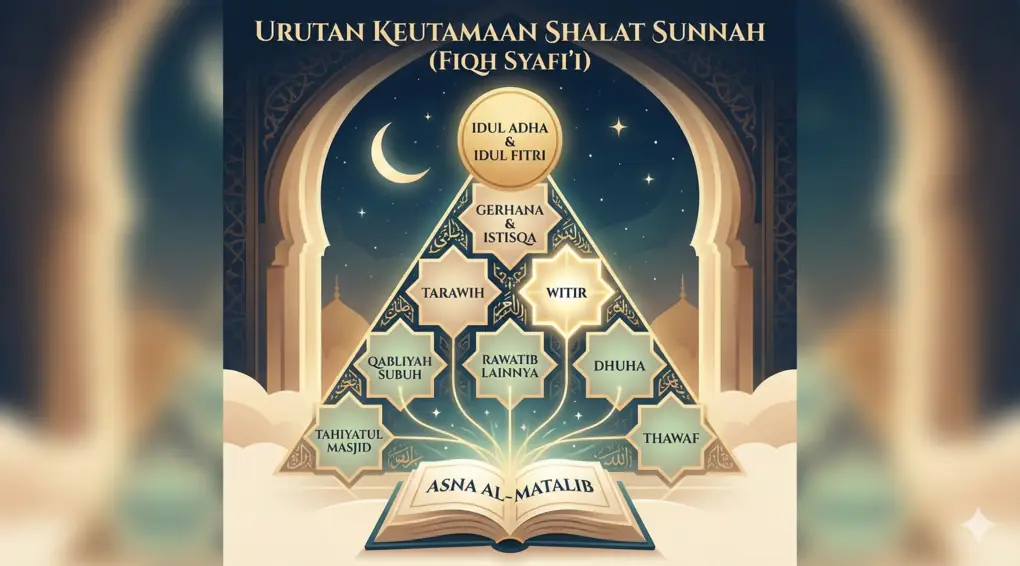
The Hierarchy of Sunnah Prayers: Priorities in the Shafi’i Madhhab

An infographic pyramid diagram displaying the hierarchy of merit for Sunnah prayers according to Shafi'i Fiqh, sourced from the book Asna al-Matalib. The highest rank at the peak features Eid al-Adha and Eid al-Fitr. The middle tier includes Eclipse prayers (Kusuf), Rain prayer (Istisqa), Tarawih, and Witr. The base level contains Qabliyah Subuh, other Rawatib, Duha, Tahiyatul Masjid, and Tawaf prayers. The background features Islamic architecture and a night sky.

Have you ever felt that time is too short while your desire to increase worship is immense? In our daily lives, we are often faced with choices. During Ramadan, for instance, should one prioritize Tarawih prayers or ensure the completion of the Ba’diyyah Isha (post-Isha sunnah)? Or in the morning, is the Dhuha prayer more … Read more

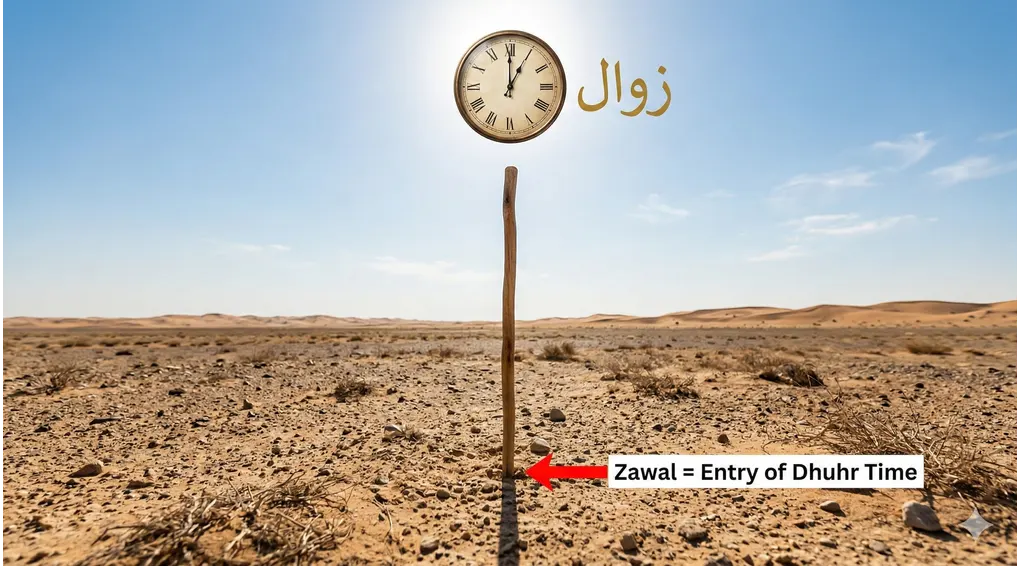
Dhuhr Prayer Time: From Natural Signs to the Final Limits

A realistic illustration of a wooden stick standing in an open field at high noon (zawal) with a shadow beginning to lengthen towards the east, featuring an analog clock and Arabic text "Zawal" in the sky.

Have you ever wondered if the Dhuhr prayer time has officially begun just by looking at the sun directly overhead? In our modern era, digital schedules are incredibly helpful. However, understanding the natural signs used to determine prayer times is a fundamental and invaluable skill. Relying on nature is not merely a backup plan for … Read more

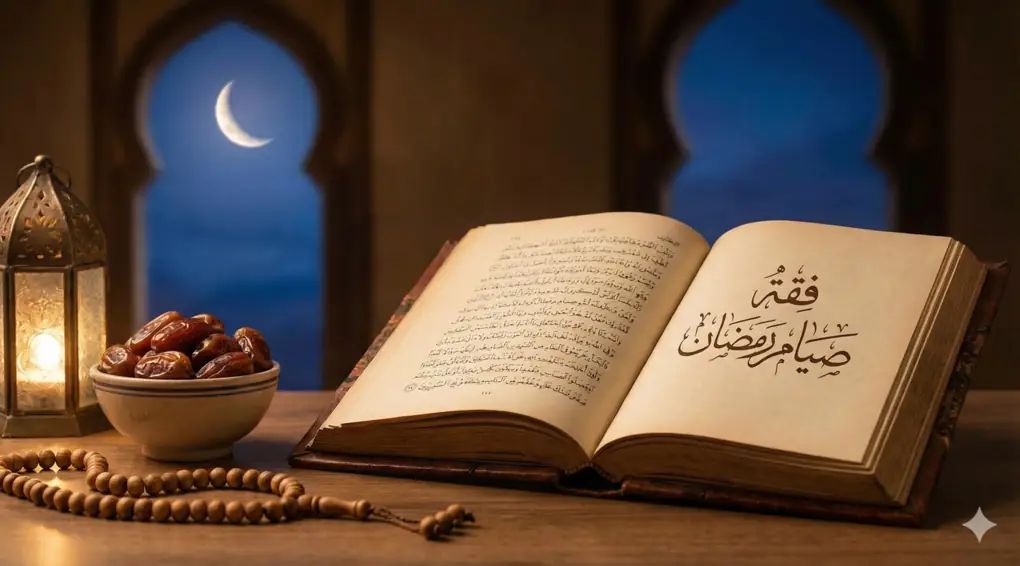
The Fiqh of Ramadan Fasting: History, Evidence, and Determining the New Moon

An illustration of the classical book Fathul Mu'in lying open on a wooden table, set against a background of a mosque window, a crescent moon, and dates, symbolizing the discussion of Fiqh and the laws of Ramadan fasting.

Every year, the question “how many days until Ramadan?” sparks widespread excitement and discussion. For Muslims worldwide, this month is not merely an annual routine, but a highly anticipated sacred period. However, beneath this enthusiasm, have we truly comprehended how the Fiqh of Ramadan Fasting governs our worship? From the methodology of sighting the crescent … Read more

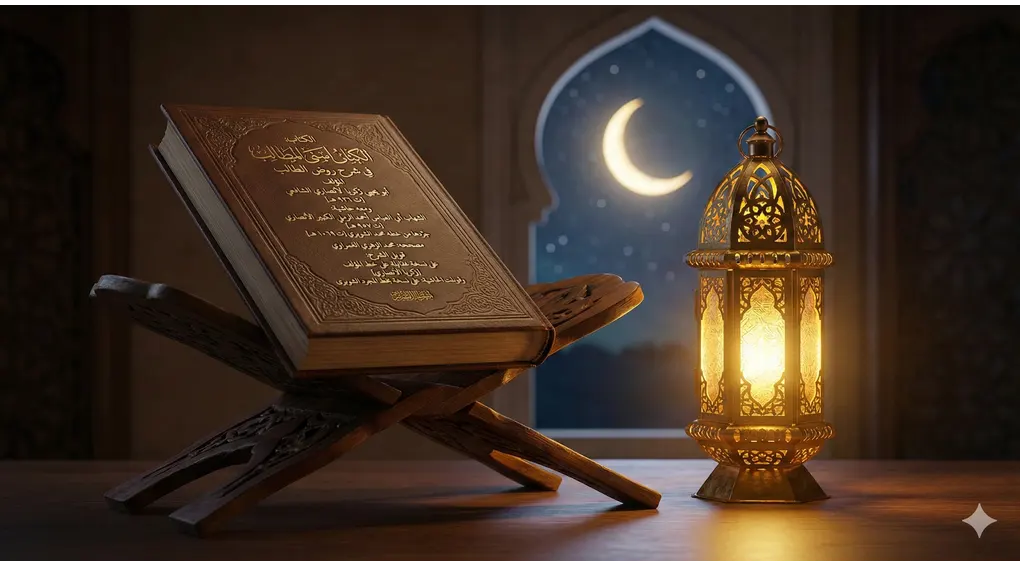
Complete Guide to the Ramadan Fasting Intention and Its Meanings: Arabic, Transliteration, and Fiqh Rulings

The closed Asna al-Matalib book on a rehal next to a lit fanoos lantern, against a backdrop of a crescent moon and night sky, symbolizing the night intention for fasting.

The holy month is fast approaching. For Muslims, ensuring that their acts of worship are legally valid is a primary priority. One of the most fundamental pillars of fasting in Ramadan is the intention (niyyah). Without the correct intention, a person’s fast may be deemed invalid, reducing their effort to merely enduring hunger and thirst. … Read more

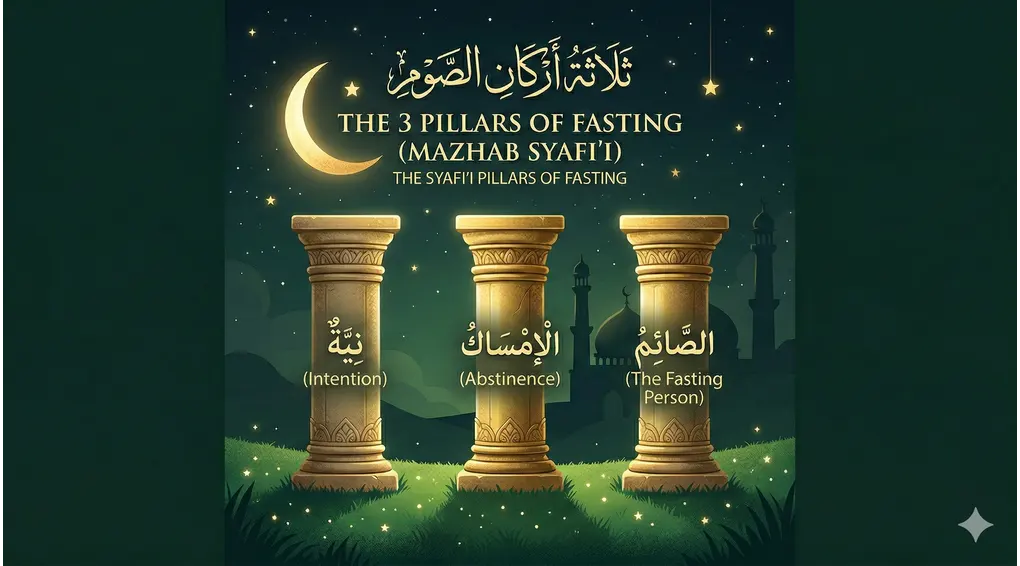
How Many Pillars of Fasting Are There? A Complete Guide According to Safinatun Naja (Shafi’i Fiqh)

An illustrated scene under a starry night sky with a mosque silhouette. Three golden classical pillars stand in a green field. Arabic text at the top says "ثَلاَثَةُ أَرْكَانِ الصَّوْمِ" with English translation: "THE 3 PILLARS OF FASTING (MAZHAB SYAFI'I)". Each pillar is labeled with Arabic text and an Indonesian translation in parentheses: (Niat), (Menahan Diri), (Orang yang Berpuasa). Smaller text says "Rukun Puasa Syafi'i".

The holy month of Ramadan or days of voluntary fasting often raise fundamental questions for us: exactly how many pillars of fasting are there? Is it enough simply to endure hunger and thirst? Or are there other foundational elements that determine the validity of our worship? Many people assume there are only two pillars of … Read more

Salah or Fasting: Which is the Best Physical Worship According to Fiqh?

Illustration comparing prayer and fasting as acts of worship in Islamic jurisprudence, symbolized by a balance scale with the Quran and dates.

Have you ever wondered, when you have free time, whether it is better to perform more voluntary prayers or observe more voluntary fasting? When seeking closeness to Allah, many believers wonder what constitutes the best physical worship. This question frequently arises in the minds of those who wish to elevate their spiritual rank but feel … Read more

Conditions of Taubat Nasuha: Imam Nawawi’s Guide to True Repentance

A silhouette of a Muslim praying with raised hands on a mountain at sunrise, symbolizing hope within the requirements of sincere repentance (taubatan nasuha).

In a servant’s (sālik) spiritual journey towards Allah SWT, human nature, prone to error, requires a path of return. This mechanism, in Islamic legal terminology, is known as repentance (taubat). Understanding the conditions for the validity of sincere repentance (taubat nasuha) is not merely theoretical knowledge, but an urgent need so that the process of … Read more

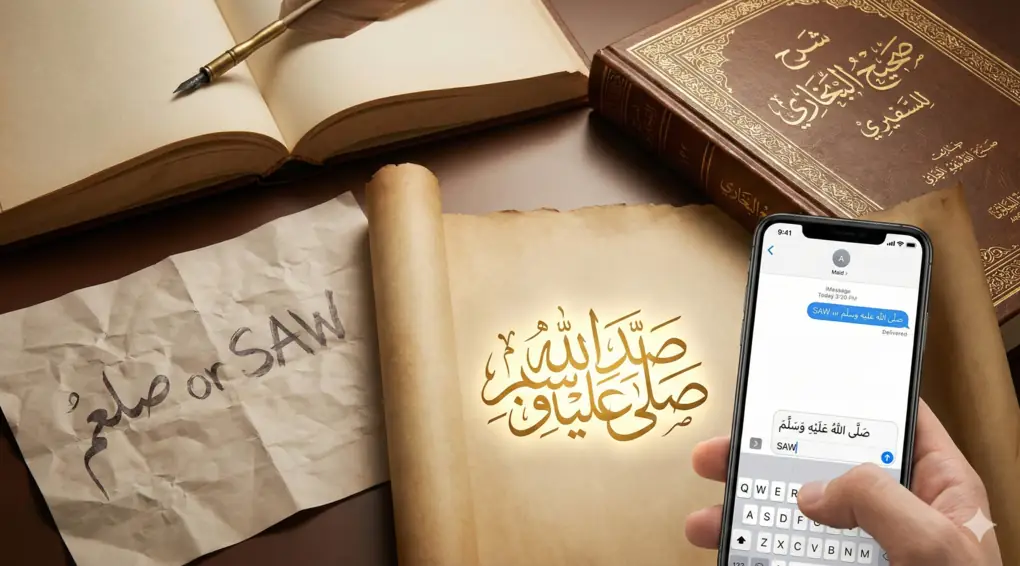
The Ruling on Abbreviating SAW: The Etiquette of Writing Salawat

A conceptual illustration contrasting the abbreviated writings “SAW” or “صلعم” on a worn piece of paper with the elegant Arabic calligraphy of **“Ṣallallāhu ʿalayhi wa sallam.”** A hand is seen holding a smartphone displaying a full *ṣalawāt* autotext option, set against a backdrop of the classical book **Sharḥ Ṣaḥīḥ al-Bukhārī** and a feather quill pen.

Have you ever found yourself in a rush while taking study notes or replying to a message, resorting to abbreviating the Salawat upon Prophet Muhammad ﷺ to “SAW,” “PBUH,” or simply “S.A.W”? This habit seems trivial and has become widespread in our society. The reason is usually simple: to save time and character counts. However, … Read more