
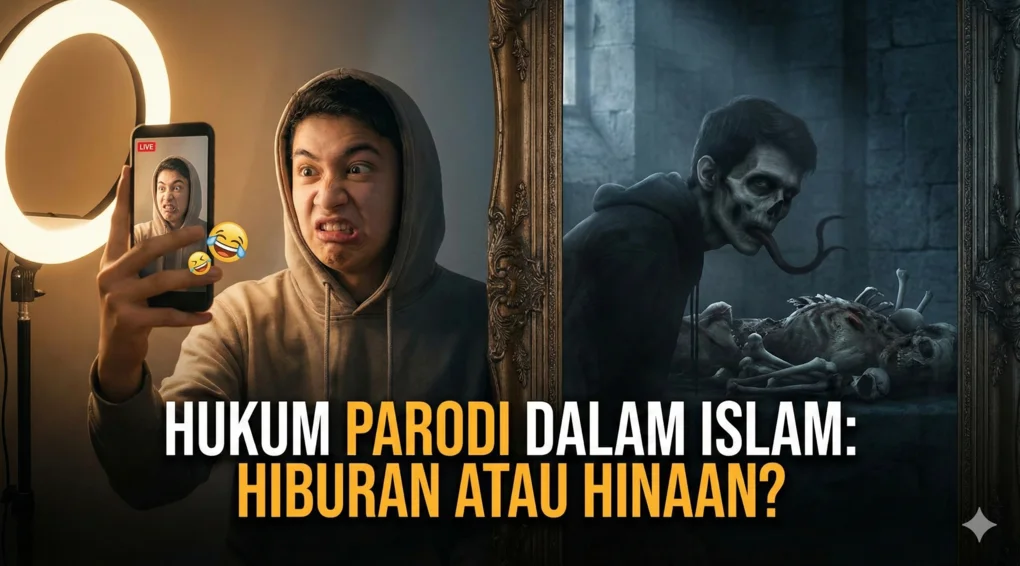
In the era of social media, parody and impersonation (imitating someone’s manner) are widespread. From imitating the way officials speak, parodying the unique gait of friends, to creating comedy sketches that highlight someone’s physical shortcomings. All for likes, laughter, and entertainment.
It can be amusing; we often laugh at the resemblance. But as Muslims, have we considered the ruling on parody in Islam? Is imitating someone’s style for the sake of ridicule permissible, or does it fall into the category of a major sin that we are unaware of?
This article will thoroughly examine the views of scholars, particularly Imam Al-Ghazali in his book Ihya’ ‘Ulumuddin, regarding the permissibility of creating and watching parody content.
Understanding al-muhākah (mimicry/parody) in Islamic Fiqh

In modern terms, we would call it parody or impersonation. However, hundreds of years ago, Imam Al-Ghazali already discussed this phenomenon with the term Al-Muhakah (imitation/mimicry).
The legal assessment of parody is closely related to ghibah (backbiting). Many mistakenly think ghibah only means “talking about people,” but it also includes mocking via gesture or imitation.
Imam Al-Ghazali gave a stern warning in Ihya’ ‘Ulumuddin:
وَمِنْ ذَلِكَ الْمُحَاكَاةُ يَمْشِي مُتَعَارِجًا أَوْ كَمَا يَمْشِي فَهُوَ غِيبَةٌ بَلْ هُوَ أَشَدُّ مِنَ الْغِيبَةِ
“And among (forms of ghibah) is Al-Muhakah (mimicry). A person walks with a limp (to mimic someone who limps) or imitates their manner of walking. Then that is ghibah, even it is worse than verbal ghibah.”
Why is it considered more severe? Because parody is visual. Imitating someone’s mannerisms with body movements or facial expressions provides a much stronger and more insulting depiction than simply recounting it with words.
Evidence of the Prohibition of Imitating Others’ Styles
The main basis for why parody intended to mock is prohibited originates from the hadith of the Prophet Muhammad ﷺ. Once, Aisyah Radhiyallahu ‘anha imitated someone’s mannerisms in the presence of the Messenger of Allah.
Seeing that, the Prophet ﷺ immediately rebuked him sternly:
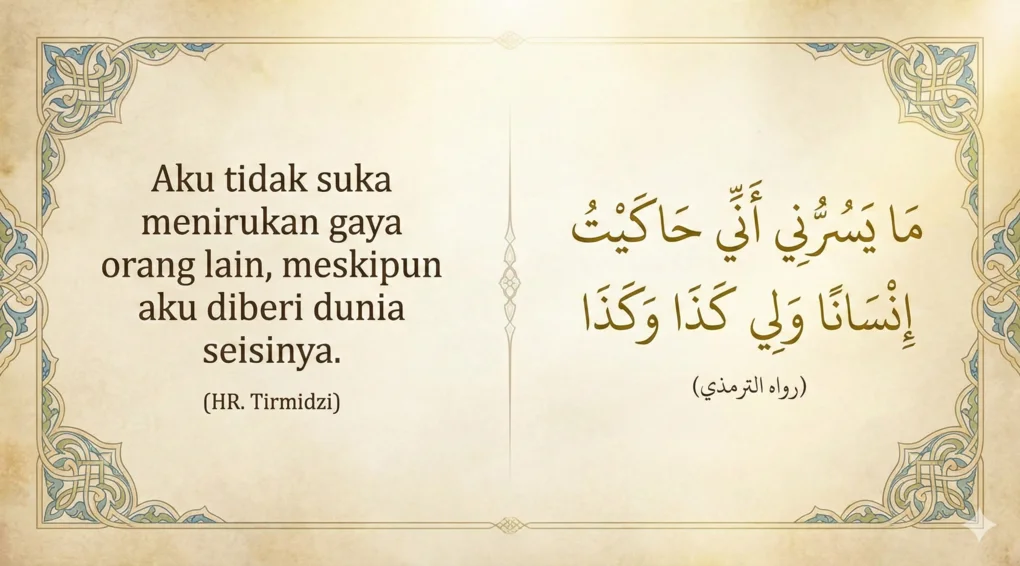
مَا يَسُرُّنِي أَنِّي حَاكَيْتُ إِنْسَانًا وَلِي كَذَا وَكَذَا
“I do not like to imitate the manner of others (to belittle them), even if I were given the world and all it contains (or given this and that wealth).” (Reported by Tirmidhi)
This hadith supports the view that impersonating someone to expose or mock their shame or flaws is prohibited. The Prophet ﷺ did not feel pleased to do it even if paid handsomely, because it injures the honor of fellow human beings.
Why Parody Can Be a Serious Sin?
Perhaps content creators will argue, “It’s just a joke, to entertain people.” However, in the view of Imam Al-Ghazali, there are several hidden heart diseases behind parody:
1. Falling into the Category of Sukhriyah (Mockery)
Parody usually works by exaggerating (hyperbole) the character of the person being imitated. If the target speaks a bit slowly, the parody is made very slow to be funny. If the target has slightly protruding teeth, the parody makes them more protruding.
This is addressed in the Qur’an (Surah al-Ḥujurāt 49:11):
يٰٓاَيُّهَا الَّذِيْنَ اٰمَنُوْا لَا يَسْخَرْ قَوْمٌ مِّنْ قَوْمٍ عَسٰٓى اَنْ يَّكُوْنُوْا خَيْرًا مِّنْهُمْ وَلَا نِسَاۤءٌ مِّنْ نِّسَاۤءٍ عَسٰٓى اَنْ يَّكُنَّ خَيْرًا مِّنْهُنَّۚ وَلَا تَلْمِزُوْٓا اَنْفُسَكُمْ وَلَا تَنَابَزُوْا بِالْاَلْقَابِۗ بِئْسَ الِاسْمُ الْفُسُوْقُ بَعْدَ الْاِيْمَانِۚ وَمَنْ لَّمْ يَتُبْ فَاُولٰۤىِٕكَ هُمُ الظّٰلِمُوْنَ ١١
“Let not a people mock another people (for) it may be that they (those being mocked) are better than them (those who mock)…”
2. Forms of Arrogance (Takabbur)
Those who parody often experience a subtle sense of superiority—takabbur—which Islamic ethics regards as spiritually dangerous. Al-Ghazali mentioned that one of the triggers for ghibah (backbiting) and mockery is the feeling of self-admiration and belittling others. We laugh because we feel silly seeing that person’s behavior, and the feeling of “feeling silly seeing another person” is a subtle form of arrogance.
3. Hurting Feelings (Iza’)




The criterion for ghibah is: would the person dislike it if they heard it? If yes, it falls under ghibah.
Imagine if that parody video reached the person being imitated. Would they be happy about their flaws, manner of speech, or physical shortcomings being made fun of by millions of people? If they were hurt by it, then the sin is valid as a sin of ghibah (backbiting).
When Is Parody Permissible?
Does Islam ban acting or comedy entirely? No — there are permissible forms, but strict boundaries apply. There are limitations as to where imitating other people’s characters is permissible, with strict conditions:
- Not Imitating Specific Individuals (Anonymous): If the parody imitates “Types of neighbors when shopping for vegetables” without specifically referring to Mrs. Siti or Mr. Budi, then this is permissible. This falls into the category of general social criticism. As the Prophet ﷺ often used the phrase: “Ma balu aqwam…” (What is the matter with the people who do this…). He criticized behavior, not individuals.
- Does Not Involve Physical Mockery: Imitating voice characters (e.g., robot voices or sounds of nature) for educational purposes or children’s storytelling, not to mock human physical disabilities.
- Permission & Respect: Imitating a respected figure to honor them (with permission and without ridicule) can be allowed, though scholars urge caution because the line to mockery is thin. However, scholars still advise caution because the line between imitation and ridicule is very thin.
Parody Content on Social Media: Risks of a Continuing Harm

In the time of Imam Al-Ghazali, parody was performed in limited gatherings. Only 5-10 people would watch. However today, parody videos are uploaded to TikTok, Instagram, or YouTube and watched by millions of people.
As Al-Ghazali warns:
“The pen is one of the two tongues.” (i.e., written ridicule can be as harmful as spoken ridicule.)
In the digital age, video recordings and typed statuses are modern “pens.” If we create parody content that insults someone’s physical appearance, and then that content is viewed by 1 million people, we are sharing “the flesh of our brother/sister” with those 1 million people.
The sin of ghibah (backbiting) which was originally personal, transforms into a Continuing Sin that continuously flows as long as the video still exists and is laughed at by people, even possibly after the creator has passed away. May Allah protect us.
The Difference Between Social Criticism and Insulting Parody
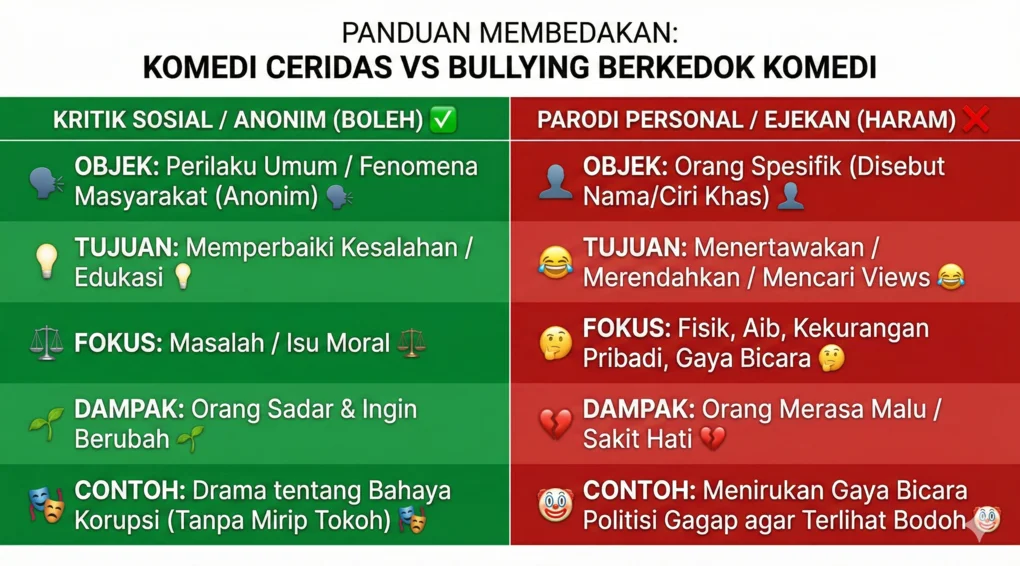
To be clearer, let’s differentiate between what is permissible and what is forbidden through the following table:
| Aspect | Social Criticism (Permissible/Recommended) | Forbidden Parody (Haram) |
| Object | General behavior / Social phenomena (Anonymous) | Specific person (Named or with distinctive characteristics) |
| Purpose | Correcting mistakes / Education | Ridicule / Belittle / Seeking Views |
| Focus | Moral issues / Problems | Physical appearance, Shameful acts, Personal flaws, Manner of speech |
| Impact | People become aware and want to change | The person being imitated feels ashamed/hurt |
| Example | Drama about the dangers of corruption (without resembling any specific figure) | Imitating the stuttering speech of politician X to appear foolish |
FAQ: Questions About the Law of Parody
What if the person being parodied laughs along?
If they genuinely consent and are not offended, the personal right (haqq al-adami) is likely removed — but caution remains regarding public dignity (muruʾah).
Is lip-syncing angry people on TikTok haram?
If the original voice reflects someone’s flaw or embarrassment (for example, people arguing, someone with uncontrollable speech, or unclear speech) and we imitate it with a mocking expression, this falls under al-muḥākāh, which is prohibited. It means we are laughing at another person’s moral misfortune.
Is it permissible to imitate a preacher’s style?
If the intention is to honor and convey knowledge using his distinctive style without exaggeration (caricature), some scholars consider it permissible. However, if the goal is merely to make the audience laugh at the resemblance, it is better to avoid it, out of concern that it may fall into sukhriyah (mockery), especially when the subject is a scholar who should be respected as a bearer of the Islamic tradition.
Conclusion
The ruling on parody is not trivial. Imam Al‑Ghazali reminds that al-muhākah can be more damaging than verbal backbiting because of its visual impact and persistence. (imitating someone’s mannerisms) can be more cruel than verbal backbiting because of its visual nature and lasting impression on memory.
As wise Muslims, let us be selective in choosing our entertainment. Let us not have our laughter in this world paid for with tears in the hereafter because we are “consuming the carcasses” of our own brothers and sisters through parody content.
If you have ever created content like this, delete it immediately before the sin continues to accumulate. If you enjoy it, stop liking and sharing it, because viewers are allies to the creators of parodies in sin.
Reference
Al-Ghazali, Abu Hamid. Ihya’ ‘Ulum ad-Din (The Revival of the Religious Sciences). Beirut: Dār al-Maʿrifah.


