

Have you ever stood in the middle of a bustling metropolis, gazing at rows of skyscrapers seemingly racing to pierce the clouds, only to realize that this very scene was foretold more than fourteen centuries ago? Or have you witnessed a child barking orders at his own mother as if she were a hired servant in his household?
For a Muslim, these are not ordinary expressions of changing times. The Hadith Jibril signs of the end times describe precisely such phenomena, and many Sunni scholars affirm that these prophecies have unfolded with remarkable accuracy in our era. Drawing upon Shaykh Ibn Hajar al-Haytami’s authoritative commentary al-Fath al-Mubin bi Sharh al-Arba’in, this article examines two minor signs of the Hour that the Prophet ﷺ disclosed in this monumental dialogue—signs that today serve as living proofs of his prophethood.
A Brief Overview of Hadith Jibril
Hadith Jibril stands as one of the most foundational texts in Islamic theology. Its grandeur lies in its capacity to encompass the entire architecture of the religion, from outward practice to inward spiritual realization.
Historical Context: The Narration of Umar ibn al-Khattab
The hadith was transmitted by the Commander of the Faithful, Umar ibn al-Khattab (may Allah be pleased with him), who recounted the arrival of a mysterious man bearing no traces of travel (athar al-safar), yet entirely unknown to any of the Companions. This stranger sat with his knees touching the knees of the Prophet ﷺ and posed a series of profound questions. At the conclusion of the encounter, the Prophet ﷺ revealed that the visitor was none other than the Angel Jibril, who had come to teach the believers their religion. For a deeper exploration of this remarkable encounter, you may benefit from this study on the mystery of the man in white in Hadith Jibril according to al-Fath al-Mubin.
Four Pillars: Islam, Iman, Ihsan, and the Signs of the Hour
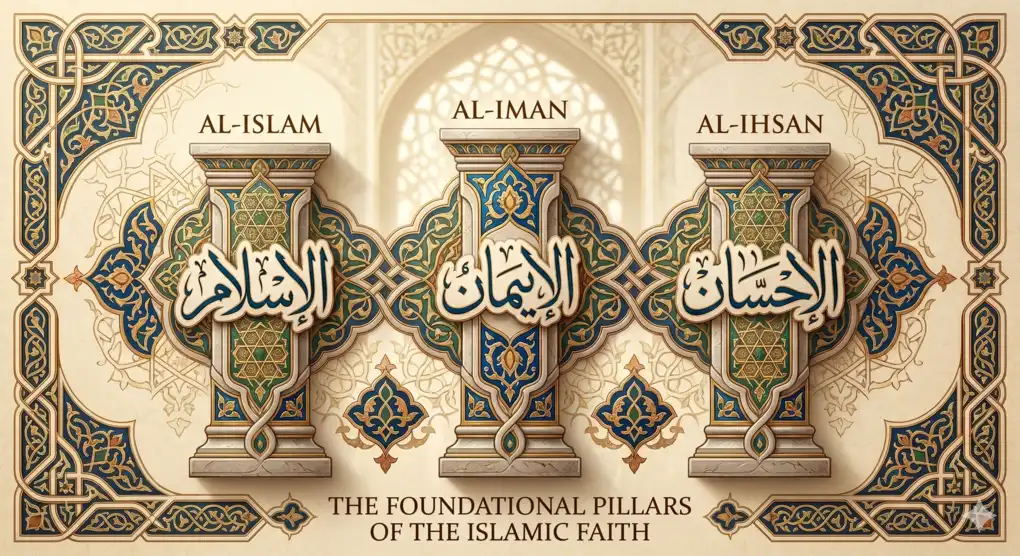
The dialogue is structured around four central themes. Jibril inquired about the outward pillars (Islam), the inward articles of belief (Iman), and the apex of spirituality (Ihsan). To appreciate the depth of these three foundations, you are warmly encouraged to study Hadith Jibril and the three levels of religion embraced by the early Sunni scholars.
For a more specific elaboration on bodily submission and outward worship, consult the detailed treatment of the meaning of Islam linguistically and legally along with its pillars. After these three foundations had been addressed, Jibril concluded with an eschatological inquiry concerning the Day of Judgment.
Status of Authenticity
Hadith Jibril carries the highest grade of authenticity, muttafaq ‘alayh, meaning it was transmitted by both Imam al-Bukhari and Imam Muslim. This designation renders it a qat’i (decisive) proof in the creed of Ahl al-Sunnah wa al-Jama’ah, beyond any reasonable dispute.
Two Signs of the End Times Mentioned in Hadith Jibril
When Jibril asked, “Inform me about the Hour (mata al-sa’ah)?” the Prophet ﷺ replied with characteristic humility:
ما المسؤول عنها بأعلم من السائل
“The one being asked knows no more than the one asking.”
The exact moment of the Greater Hour remains an absolute secret known only to Allah. Yet Jibril pressed further: “Then inform me about its signs (amarat)?” It was at this juncture that the Prophet ﷺ named two specific indicators.
The Arabic Text and Its Translation
The Prophet ﷺ said:
أن تلد الأمة ربتها، وأن ترى الحفاة العراة العالة رعاء الشاء يتطاولون في البنيان
“That you will see the slave woman giving birth to her mistress, and that you will see the barefoot, the naked, the destitute shepherds of sheep competing in raising up tall buildings.”
Their Position as Minor Signs of the Hour
These two events are classified as alamat al-sughra—the minor signs of the Hour. Such signs typically take the form of moral decay, social inversion, and economic transformation, all preceding the major signs (al-kubra) such as the appearance of the Dajjal or the descent of Prophet Isa (peace be upon him).
First Sign — The Slave Woman Giving Birth to Her Mistress





The phrase “the slave woman giving birth to her mistress” often perplexes contemporary Muslims, particularly given that physical slavery is no longer a common social institution.
Literal Versus Contextual Meaning
Earlier scholars interpreted this literally as a phenomenon arising from extensive Islamic conquests, in which numerous female captives were taken as concubines. When a master fathered a child by his concubine, the child—free by birth—would inherit the father’s status and effectively become the “master” of his own mother. However, the contextual reading carries a far more sobering and timely resonance.
Scholarly Interpretation by Shaykh Ibn Hajar al-Haytami
In al-Fath al-Mubin (pp. 179–180), Shaykh Ibn Hajar al-Haytami offers a strikingly sociological ta’wil concerning the erosion of family etiquette:
أو عن كثرة عقوق الأولاد لأمهاتهم، فيعاملونهم معاملة السيد أمته من الإهانة والسب
“Or [as a metaphor] for the prevalence of children’s disobedience toward their mothers, such that they treat their mothers as a master treats his slave girl—through humiliation and verbal abuse.”
Modern Realization: Disobedience Toward Parents
This is precisely one of the Hadith Jibril signs of the end times that has unmistakably manifested today. We inhabit an age where the natural order of family life has been inverted. Children no longer hold their mothers in reverence. The son lounges with his phone while his aging mother sweeps the floor, prepares his meals, and serves him as though she were a maid. Children command, raise their voices, and make harsh demands of the very women who bore them.
Empirical Evidence in Contemporary Society
This corruption of moral character (akhlaq) effectively annihilates the station of Ihsan. When a child enslaves his mother in spirit, he forfeits the spiritual rank (maqam) of birr al-walidayn—dutiful devotion to parents. Documented cases of children imprisoning their own mothers over inheritance disputes stand as living testimony to what the Prophet ﷺ described fourteen centuries ago.
Second Sign — Impoverished Shepherds Competing in Tall Buildings
The second sign shifts from the domestic sphere to the macro-sociological and economic order.
The Meaning of “al-Hufat al-‘Urat al-‘Alah Ri’a al-Sha”
The Prophet ﷺ described these people with four distinct attributes:
- Al-Hufat — those who walk barefoot
- Al-‘Urat — those who are naked, scantily or shabbily clothed
- Al-‘Alah — those who are extremely poor and dependent upon others
- Ri’a al-Sha — shepherds of sheep dwelling in remote regions
Classical and Contemporary Interpretation
Shaykh Ibn Hajar al-Haytami explains this prophecy as a kinayah (metaphorical expression) describing the inversion of power structures and economic hierarchy:
وهذا كناية عن كون الأسافل يصيرون ملوكا أو كالملوك… فتفرق هممهم إلى تشييد المباني
“This is a metaphor for the lowest of people becoming kings, or like kings… such that their aspirations become preoccupied with the construction of grand buildings.”
The image of shepherds erecting towering edifices points to peoples from the desert hinterlands—who once lacked access to formal education and urban civilization—suddenly acquiring vast material wealth. Tragically, that wealth is rarely directed toward the welfare of the ummah, but instead fuels ostentation (riya’) and a contest of prestige expressed through monumental construction.
Realization: The Transformation of the Arab World and the Skyscraper Race
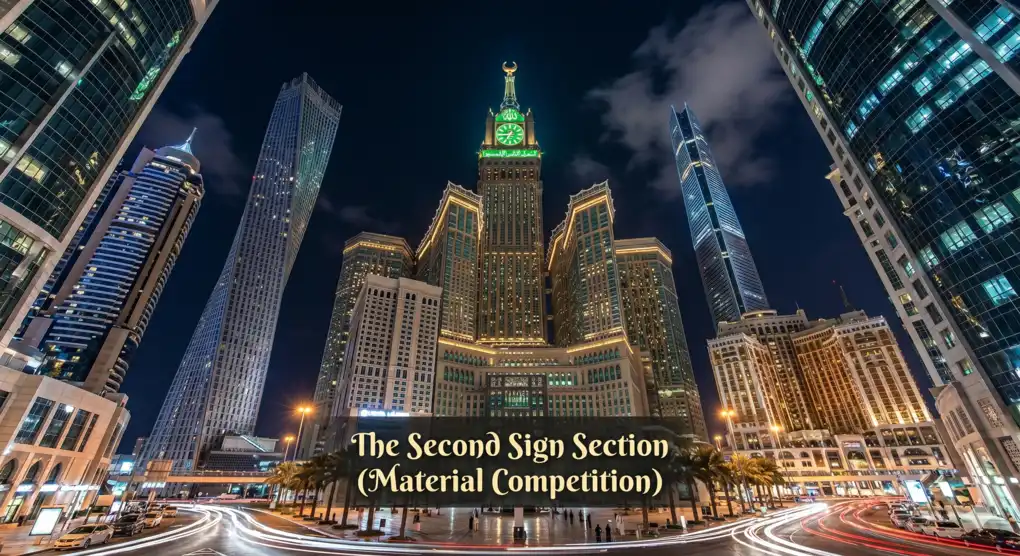
Many contemporary scholars regard this sign as having materialized literally on the Arabian Peninsula. The Bedouin tribes who, at the dawn of the twentieth century, still lived nomadic lives as shepherds in the desert, suddenly stumbled upon vast oil reserves and the petrodollar economy.
Today we witness an unprecedented competition to construct the world’s tallest buildings centered in that very region. The Burj Khalifa in Dubai, the Makkah Royal Clock Tower, and a host of other megaprojects stand as authentic confirmations of the prophetic foresight (nubuwwah) of the Messenger of Allah ﷺ.
Lessons on the Shifting Global Economic Order
This phenomenon teaches us that worldly wealth often arrives as a trial that quietly erodes sincerity (ikhlas). When laypeople with little grounding in religious knowledge gain control of economic power, life’s orientation drifts toward radical materialism, eclipsing inward and spiritual concerns.
Why These Signs Deserve Our Reflection
Recognizing the signs of the Hour that have already come to pass is not meant to provoke panic. Rather, this awareness serves a profound theological purpose.
Proof of the Prophetic Miracle (Nubuwwah)
No ordinary human being could have predicted, with such precision, the economic transformation of Arabia or the psychological collapse of family structure fourteen centuries in advance. This is a miracle granted by Allah, reinforcing our certainty in the messengership of Muhammad ﷺ.
A Reminder for Self-Examination (Muhasabah)
When a Muslim familiar with the complete content of Hadith Jibril witnesses a child rebuking his mother or a glittering tower piercing the sky, he lowers his gaze and engages in muhasabah. He audits the spiritual state (hal) of his own household and asks: “Do my children treat me as though I were a servant? Am I laboring merely to amass bricks of wealth?”
Preparation for the Major Signs
The minor signs of the Hour function as an alarm system preceding far weightier events. If these smaller indicators have already converged, then the gateway to the great tribulations of the end times stands very close indeed.
Other Signs Often Associated with Hadith Jibril
Beyond the two signs above, complementary hadith literature broadens our understanding of subsequent phases of the end times. Once the towers have raced upward, the ummah will face the major signs of the Hour. These include the appearance of the Dajjal, who will bring the greatest trial in human history; the descent of Prophet Isa (peace be upon him) at the white minaret in Damascus; and the emergence of Imam al-Mahdi, who will restore justice on earth. Such momentous unseen realities require a firmly anchored creed so that we are not swept away by mass deception.
How a Muslim Should Respond to the Signs of the End Times
How, then, should we react to all that unfolds before our eyes? The Sufi tradition and Ash’ari creed of Ahl al-Sunnah teach several practical steps for spiritual resilience.
1. Strengthen Iman and Righteous Deeds
In an age where wealth has become the de facto deity and adab has lost its currency, we must cling firmly to tawhid. Ensure that the heart possesses tasdiq (absolute affirmation) of Allah, and perform righteous deeds with utmost ikhlas.
2. Withdraw from the Allurements of the World
Do not be ensnared by the lifestyle race—the modern echo of “competing in tall buildings.” Wealth is a means of worship, not a destination. Avoid riya’, which corrodes the reward of every good deed from within.
3. Multiply Supplication and Istighfar
The trials of the end times produce inner ailments such as futur (spiritual lethargy) and heedlessness. Therefore, make tawbah nasuha (sincere repentance) habitual, and recite the supplication seeking refuge from the trial of the Dajjal in the final tashahhud of every prayer.
Conclusion
The complete content of Hadith Jibril concerning the end times offers Muslims a remarkably accurate roadmap. The two principal indicators—the unraveling of familial adab (the slave woman giving birth to her mistress) and the materialism of the once-impoverished masses (shepherds erecting towers)—are no longer mere predictions. They are historical realities we live within today.
The Hadith Jibril signs of the end times are an admonition delivered with prophetic compassion. Rather than being dazzled by the world’s grandeur, let us return to refining the quality of our worship, restoring our manners toward our parents, and educating the next generation so that they may be preserved from the swirling trials of the latter days. Wallahu a’lam bi al-sawab.
Summary Table of the Signs of the Hour in Hadith Jibril
| Sign of the Hour | Metaphorical Meaning (Tafsir of Ibn Hajar) | Contemporary Reality |
|---|---|---|
| The slave woman giving birth to her mistress | The collapse of children’s etiquette toward their mothers (‘uquq al-awlad) | Children command, rebuke, and exploit their elderly parents |
| Impoverished shepherds raising tall buildings | Lowly and unlettered people suddenly attaining wealth and power | Formerly nomadic tribes who discovered oil now compete to erect skyscrapers (Burj Khalifa, Makkah Clock Tower) |
Frequently Asked Questions
What are the signs of the end times mentioned in Hadith Jibril?
In Hadith Jibril, the Prophet ﷺ named two principal signs: first, that a slave woman will give birth to her mistress; and second, that barefoot, naked, destitute shepherds will compete with one another in raising tall buildings.
What does “the slave woman giving birth to her mistress” mean?
Sunni scholars have offered several interpretations, including: a disobedient child treating his own mother like a slave, the widespread proliferation of slavery during the early Islamic conquests, or the collapse of children’s adab toward their parents in the latter days.
What does “shepherds competing in tall buildings” signify?
It signifies that people who once lived in poverty and isolation will become enormously wealthy and engage in a race to construct the highest skyscrapers. This is widely understood to have materialized in the Gulf states such as the United Arab Emirates and Saudi Arabia.
Is Hadith Jibril authentic?
Yes. Hadith Jibril is sahih and was transmitted by leading hadith masters, including Imam Muslim, Imam al-Bukhari (in abridged form), Abu Dawud, and al-Tirmidhi. It serves as a primary reference for Sunni scholars when discussing the foundational principles of the religion.
What is the difference between the minor and major signs of the Hour?
The minor signs (al-sughra) emerge long before the Day of Judgment, and many have already occurred—including those mentioned in Hadith Jibril. The major signs (al-kubra) appear immediately before the Hour itself, such as the appearance of the Dajjal, the descent of Prophet Isa, and the emergence of Ya’juj and Ma’juj.
Does the appearance of these signs mean the Hour will arrive within a few years?
No one knows with certainty when the Hour will come. The hadith refers to signs (sughra), which serve as long-range warnings. The Hour must still pass through the stage of the major signs before its actual onset.
Is it sinful to construct tall buildings?
Constructing buildings for the welfare of the ummah—hospitals, schools, and mosques—is a praiseworthy endeavor. What the hadith censures is the race of ostentation rooted in pride, social vanity, and reckless squandering of wealth, particularly by those who once lived in poverty and have since forgotten the Hereafter.
Conceptual References:
Ibn Hajar al-Haytami, Ahmad ibn Muhammad. al-Fath al-Mubin bi Sharh al-Arba’in. Edited by Ahmad Jasim Muhammad al-Muhammad, Qusayy Muhammad Nurus al-Hallaq, and Abu Hamzah Anwar ibn Abi Bakr al-Shaykhi al-Daghistani. 1st ed. Jeddah: Dar al-Minhaj, 2008. The discussion concerning the metaphorical reading of the slave woman and the shepherds appears at pp. 179–180.


