

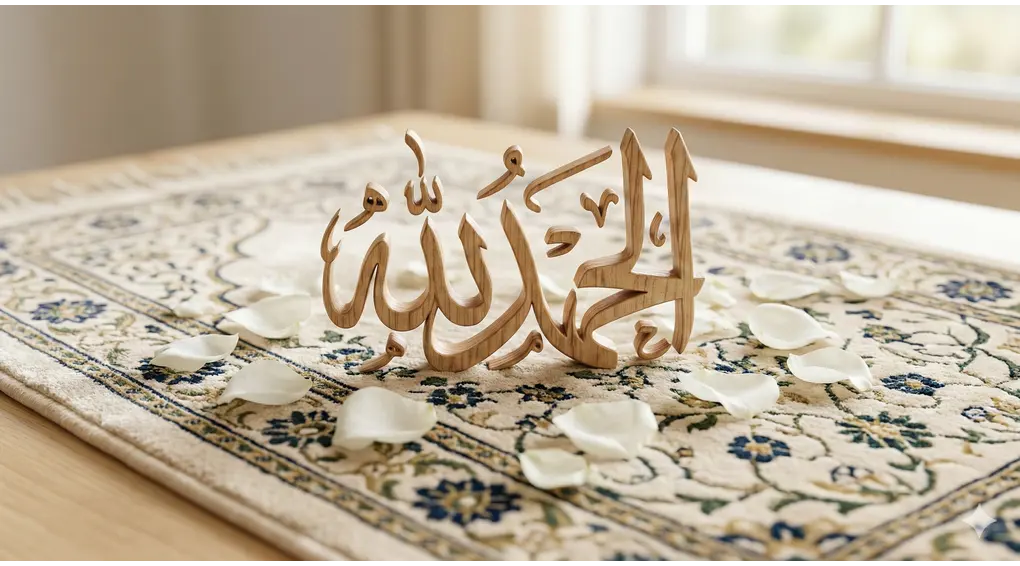
We all frequently say “Alhamdulillah” (All praise is due to Allah). Whether after a satisfying meal, upon receiving joyful news, or when escaping a calamity, this phrase is deeply ingrained in the daily lives of Muslims. But have we ever paused to ask: what is the true, profound meaning of Hamdalah and Shukr? Is merely uttering it on our lips sufficient to be categorized as a grateful servant?
In the rich tradition of classical Islamic literature, particularly within Islamic jurisprudence (fiqh), this topic is dissected with remarkable academic precision. One of the most authoritative references utilized by students and scholars of the Shafi’i school is the I’anah at-Talibin. This esteemed commentary (syarh) authored by Sheikh Abu Bakar Syatha offers spiritual and legal insights that can radically transform our understanding of gratitude toward the Divine.
Before we delve into the jurisprudential depths of the text, it is essential to establish the foundational, linguistic definition of the term “Hamdalah” that we utilize so often.
What is Hamdalah? A Linguistic Overview
Before navigating the ocean of meaning within fiqh texts, we must first understand the term “Hamdalah” from a morphological perspective. We hear this term constantly, but what are its exact linguistic origins?
Simply put, Hamdalah is a condensed nomenclature for the act of reciting the phrase Alhamdulillah. In the structural mechanics of the Arabic language, this is a unique phenomenon known as manhut—where a complete, multi-word sentence is “carved” or compressed into a single, new verb or noun.
Referencing authoritative Arabic dictionaries, we find the following definitions:
- Al-Mu’jam al-Wasit explains that the verb Hamdala (حَمْدَلَ) translates to “He said Alhamdulillah.”
- Al-Qamus al-Muhit defines Hamdalah as the term used to describe the act or narration of expressing this specific praise.
- Kamus Al-Ghani adds that Hamdalah is an abbreviated form (ikhtizal) denoting the continuous recitation of the majestic phrase, Alhamdulillahi Rabbil ‘Alamin.
Therefore, when we speak of “reading the Hamdalah,” we are referring to the physical and verbal act of articulating that praise. Having grasped the linguistic baseline, let us now examine its theological reality according to the scholars in I’anah at-Talibin.
The Original Text from I’anah at-Talibin
Let us open the first volume of this monumental work, spanning pages 11-12. As a traditional practice of seeking blessings (tabarrukan) from sacred knowledge, here is the original Arabic text:
قوله: (الحمد لله) آثره على الشكر اقتداء بالكتاب العزيز، ولقوله – صلى الله عليه وسلم -: لا يشكر الله من لم يحمده. والحمد معناه اللغوي الثنا بالجميل لأجل جميل اختياري، سواء كان في مقابلة نعمة أم لا. ومعناه العرفي فعل ينبئ عن تعظيم المنعم من حيث أنه منعم على الحامد أو غيره. والشكر لغة: هو الحمد العرفي، وعرفا: صرف العبد جيمع ما أنعم الله به عليه فيما خلق لأجله، أي أن يصرف جميع الأعضاء والمعاني التي أنعم الله عليه بها في الطاعات التي طلب استعمالها فيها، فإن استعملها في أوقات مختلفة سمى شاكرا، أو في وقت واحد سمي شكورا، وهو قليل، لقوله تعالى: * (وقليل من عبادي الشكور) *.
This excerpt contains a highly concentrated discussion defining Hamd (praise) and Shukr (gratitude). The explanation does not merely stop at dictionary definitions; it elevates these concepts into the realm of daily worship and our holistic faith in Allah.
Why Do Scholars Choose the Word “Al-Hamd”?
The author explicitly explains why Islamic scholars universally prefer to open their treatises with the word Alhamdulillah rather than Asy-Syukru Lillah (Thanks be to Allah). The reasoning is both simple and theologically robust:
- Following the Qur’an: As an integral part of our belief in the Divine Books, we observe that the Holy Qur’an officially opens with Alhamdulillahi Rabbil ‘Alamin.
- Following the Hadith: Prophet Muhammad ﷺ unequivocally stated that a person who does not praise Allah has not truly thanked Him.
This establishes a fundamental axiom: praising Allah is the absolute prerequisite to gratitude. It is impossible to possess a sense of thankfulness without first acknowledging the absolute greatness of the Bestower.
The Fundamental Difference Between Hamdalah and Shukr

We often mistakenly equate praise with gratitude, assuming they are interchangeable. However, within the advanced studies of Arabic rhetoric (balaghah) and fiqh, they possess distinct specificities. I’anah at-Talibin categorizes them into their linguistic (Lughawi) and terminological/customary (‘Urfi) meanings.
1. The Reality of Hamd (Praise)
Linguistically, Hamd means to extol someone with beautiful words due to a goodness performed willingly and by choice (ikhtiyar), regardless of whether that goodness directly benefited the one praising or a third party. For instance, we praise Allah for providing us with countless blessings, fully recognizing that it is His absolute prerogative to bestow them or withhold them. This is the essence of al-jamil al-ikhtiyary (goodness enacted through choice).
Conversely, praising a person merely for their physical beauty is not technically considered Hamd in formal Arabic, because physical features are not an intentional, chosen action. However, terminologically (‘Urfi), Hamd is defined as any action that signifies the magnification and veneration of the Bestower of Blessings.
2. The True Essence of Shukr (Gratitude)




This section serves as a profound spiritual awakening. The terminological definition of gratitude (Shukr ‘Urfi) is significantly heavier than casually stating, “Thank you, O Allah.”
The text defines Shukr as: “A servant utilizing all the blessings Allah has bestowed upon him exclusively for the purpose for which they were created (namely, obedience).”
This signifies that our eyes were created to witness the majesty of Allah’s creation; therefore, the true gratitude of the eyes is utilizing them to read the Qur’an, rather than viewing the unlawful (haram). Hands were designed to work and assist others; thus, the gratitude of the hands is negated if they are used to steal or inflict harm.
If our tongues are constantly engaged in dhikr (remembrance), yet our hands habitually usurp the rights of others, we have not achieved true gratitude. Grasping this reality is also a foundational step in understanding the essence of Sufism (Tasawwuf), which demands the alignment of outward actions with inward purity.
Syakir vs. Syakur: Where Do We Stand?
One of the most captivating psychological and spiritual insights from this text is the clear distinction between a Syakir and a Syakur.
- Syakir (The Grateful): This refers to an individual who uses their physical faculties for obedience, but does so at disjointed, separate times. In the morning, their eyes read the Qur’an; later in the afternoon, their feet walk to the mosque. Their acts of obedience alternate.
- Syakur (The Immensely Grateful): This represents an elite spiritual echelon. A Syakur is a person whose entire physical faculties and heart are simultaneously engaged in obedience to Allah at the exact same moment. As Allah states in the Qur’an, “And few of My servants are ‘Syakur’.”
The Qur’an itself states, “And very few of My servants are ‘Shakur’.”
An Illustration of the “Syakur”
To facilitate our comprehension, Imam Asy-Syibramalisi provides a vivid visual example. Imagine a person carrying a funeral bier (keranda jenazah). This individual reaches the level of Syakur if, in the very same second, they execute the following:
- Feet: Walking to escort the deceased to the graveyard (worship).
- Hands: Lifting the bier to assist the community (worship).
- Eyes: Looking down at the path to avoid stumbling, ensuring the safety of the deceased (worship).
- Tongue: Actively reciting dhikr or tahlil (worship).
- Ears: Listening attentively to the reminders of death or the chants of the procession (worship).
- Heart: Deeply reflecting (tafakur) on Allah’s creation and remembering one’s own mortality (worship).
Every single organ is simultaneously “busy” for Allah. Not a single microsecond is wasted on frivolity (makruh), let alone prohibition (haram). While this is a remarkably high standard, it is a target we can progressively train ourselves to reach.
Four Categories of Praise and Their Legal Rulings
Beyond definitions, I’anah at-Talibin dissects the directional flow of praise. There are four distinct categories of Hamd:
- Hamd Qadim li Qadim: Allah praising Himself (e.g., the verses in the Qur’an where Allah extols His own perfection).
- Hamd Qadim li Hadits: Allah praising His creation (e.g., Allah praising Prophet Ayyub AS as an exceptionally obedient servant).
- Hamd Hadits li Qadim: We (the newly created beings) praising Allah (The Eternal).
- Hamd Hadits li Hadits: We praising fellow human beings.
It is paramount to remember that all these categories of praise ultimately return to Allah. When we praise the brilliance or kindness of a fellow creature, we are fundamentally praising the Supreme Creator who intricately designed them.
The Legal Ruling of Saying “Alhamdulillah”
Do not be mistaken; uttering Hamdalah is not perpetually rewarded. Its legal ruling (hukum) fluctuates based on context:
- Obligatory (Wajib): Such as reciting Surah Al-Fatihah during the daily prayers or during the Friday sermon (khutbah). Without it, the prayer or sermon is legally invalid.
- Recommended (Sunnah/Mandub): General situations such as initiating a supplication, concluding a meal, or beginning a class.
- Disliked (Makruh): Uttering the majestic name of Allah in impure locations like a toilet or a garbage disposal area. Islam mandates the safeguarding of His name’s sanctity.
- Forbidden (Haram): It is strictly prohibited to say “Alhamdulillah” as an expression of joy after successfully committing a sin. For instance: successfully defrauding someone and exclaiming, “Alhamdulillah, I made a massive profit.” This constitutes a severe mockery of the religion.
Conclusion: What is the Next Step?
Studying the true meaning of Hamdalah and Shukr through the academic lens of I’anah at-Talibin opens our eyes to the reality that Islam demands totality. Gratitude is not mere lip service or superficial piety. It is the concrete, continuous action of utilizing our entire human potential exclusively for goodness and divine obedience.
Starting today, let us re-evaluate our daily conduct. When granted health, is our energy exhausted on futile pursuits? Becoming a Syakur may be daunting, but we can actively begin by striving to be a Syakir—attempting to synchronize our blessings with obedience, one step at a time, day by day.
Frequently Asked Questions (FAQ)
What is the fundamental difference between Hamd and Shukr?
Linguistically, Hamd (praise) is expressing admiration for a good deed done willingly, usually through words. Shukr (gratitude), in Islamic terminology, is much broader; it requires the servant to actively use all the blessings given by Allah (like health, wealth, and intellect) strictly for the purposes of obedience and worship, not just expressing thanks verbally.
Can saying “Alhamdulillah” ever be considered a sin?
Yes. It is considered Haram (forbidden) to say “Alhamdulillah” to express joy after committing a sin or an injustice, as it is viewed as mocking the religion.
What does it mean to be ‘Shakur’ according to the text?
A Syakur is an individual at a highly advanced spiritual level who utilizes all of their physical faculties (eyes, ears, hands, tongue) and their heart simultaneously in the obedience of Allah at any given moment. This is a much higher and rarer rank than a Syakir, who may use different faculties for worship at separate, alternating times.
Is it always a good deed to say Alhamdulillah?
No, the legal ruling of saying Alhamdulillah changes depending on the context. While it is obligatory in prayers and recommended after eating, it is disliked (makruh) to say it in dirty places like bathrooms. Most importantly, it is strictly forbidden (haram) to say it as an expression of happiness after committing a sin, as this mocks the religion.
Reference
Abū Bakr (al-Mashhūr bi-al-Bakrī) ʿUthmān ibn Muḥammad Shaṭṭā ad-Dimyāṭī ash-Shāfiʿī, Iʿānat aṭ-Ṭālibīn ʿalā Ḥall Alfāẓ Fatḥ al-Muʿīn (Ḥāshiyah ʿalā Fatḥ al-Muʿīn bi-Sharḥ Qurrat al-ʿAyn bi-Muhimmat ad-Dīn), 1st ed. (Beirut: Dār al-Fikr, 1997), 1:11-12.


