
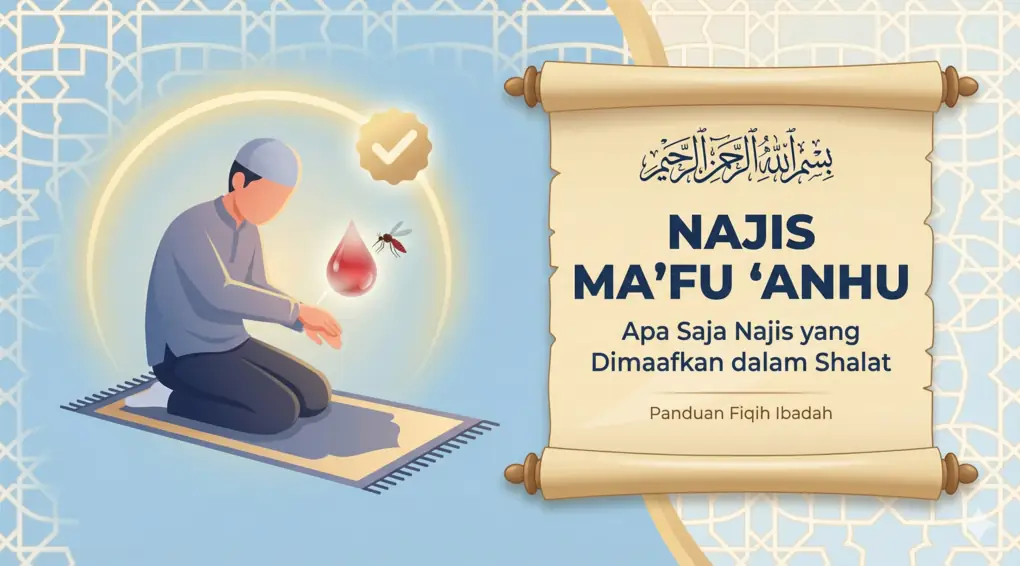
Have you ever felt anxious right before praying because you noticed a tiny bloodstain from a mosquito bite on your sleeve? Or perhaps a pimple on your face popped unexpectedly during Wudu, leaving you confused about whether you must wash your entire face again or simply ignore it?
In the study of Fiqh, specifically within the Shafi’i school, we recognize the concept of excused najis (Najis Ma’fu ‘Anhu). This refers to a category of impurity that the Shari’ah pardons. Consequently, the presence of this excused najis does not invalidate your prayer. This concept manifests Allah’s profound mercy, ensuring that religious obligations do not overly burden His servants.
However, not every impurity is automatically pardoned. We must understand specific limits, conditions, and details to ensure we meet the conditions for a valid prayer. Let us examine these explanations based on the classical text Al-Iqna’ fi Halli Alfazi Abi Shuja’ by Al-Khatib al-Shirbini.
The Basic Concept of Excused Najis
Before delving into the specifics, we need to establish the foundational rules. Generally, any substance exiting from the two private pathways is considered impure. The same ruling applies to blood and pus. However, scholars recognize various classifications—such as severe, medium, and light impurity (Najis Mukhaffafah)—and further categorize them by visual detection:
- Visible Impurities (Macroscopic): The default ruling is that they are not excused unless a specific textual evidence provides an exception.
- Invisible Impurities (Microscopic): These are impurities so minuscule that normal vision cannot detect them. The Shari’ah pardons this type of impurity absolutely.
The Original Reference from Al-Iqna’
To establish a solid academic foundation, let us examine the original Arabic text from Al-Iqna’ (Vol. 1, pp. 90-91):
القَوْل فِي النَّجَاسَات المعفو عَنْهَا (وَلَا يُعْفَى عَن شَيْء من النَّجَاسَات) كلهَا مِمَّا يُدْرِكهُ الْبَصَر (إِلَّا الْيَسِير) فِي الْعرف (من الدَّم والقيح) الأجنبيين سَوَاء أَكَانَ من نَفسه كَأَن انْفَصل مِنْهُ ثمَّ عَاد إِلَيْهِ أَو من غَيره غير دم الْكَلْب وَالْخِنْزِير وَفرع أَحدهمَا لِأَن جنس الدَّم يتَطَرَّق إِلَيْهِ الْعَفو فَيَقَع الْقَلِيل مِنْهُ فِي مَحل الْمُسَامحَة
The explanation of the text above affirms that there is no tolerance for visible impurities, except for a small amount of blood and pus according to general custom (‘Urf).
Detailed Rulings on Blood: What Constitutes Excused Najis?
Based on the detailed explanation by Al-Khatib al-Shirbini, the ruling on blood divides into several specific conditions. Recording these details is crucial to avoid misunderstandings in our daily worship.
1. Blood from One’s Own Body (Unseparated)
This is the most frequently encountered scenario. Common examples include blood originating from:
- Boils or pimples.
- Scabbed wounds.
- Cupping (Hijama) or phlebotomy marks.
The Ruling: It is an excused najis, regardless of whether the amount is small or large. Why is a large amount pardoned? This occurs because such bleeding is naturally difficult to avoid. As long as the blood flows naturally and we do not intentionally squeeze or spread it to other body parts, the prayer remains valid. The classical text even specifies that if the blood spreads due to natural sweat, the Shari’ah still excuses it.
2. “Ajnabi” (Foreign or Separated) Blood
Ajnabi blood refers to another person’s blood that stains our clothing, or our own blood that has completely separated (dripped away) and then stained our clothes again.
The Ruling: It is only excused if the quantity is minor. If the amount is large according to general perception, you must wash it. The standard for measuring “minor” or “large” quantities returns to the customary assessment (‘Urf) of the local society.
3. Blood from Mosquitoes, Fleas, and Insects



We frequently swat mosquitoes during prayer, leaving a bloodstain on our hands or clothes. What is the Islamic ruling on this?
The book Al-Iqna’ states:
ويعفى عَن دم البراغيث وَالْقمل والبق وونيم الذُّبَاب … لِأَن ذَلِك مِمَّا تعم بِهِ الْبلوى ويشق الِاحْتِرَاز عَنهُ
This means that the blood of dog fleas, head lice, bedbugs, fly excrement, and similar insects falls under excused najis. The underlying reason is Umum al-Balwa—a widespread condition that is extremely difficult to avoid. Forcing individuals to wash their garments every time they encounter a tiny mosquito bloodstain would cause severe and unnecessary hardship.
4. Invisible Impurities
What is the ruling on urine splashes that are too fine to see? Or microscopic traces of dog saliva? Fortunately, the text explains:
وَأما مَا لَا يُدْرِكهُ الْبَصَر فيعفى عَنهُ وَلَو من النَّجَاسَة الْمُغَلَّظَة لمَشَقَّة الِاحْتِرَاز عَن ذَلِك
The Shari’ah pardons anything that normal vision cannot detect, even if it originates from a severe impurity (Najis Mughallazah). Islam does not burden us to inspect our surroundings with a microscope.
Exceptions: When is Blood No Longer Excused?
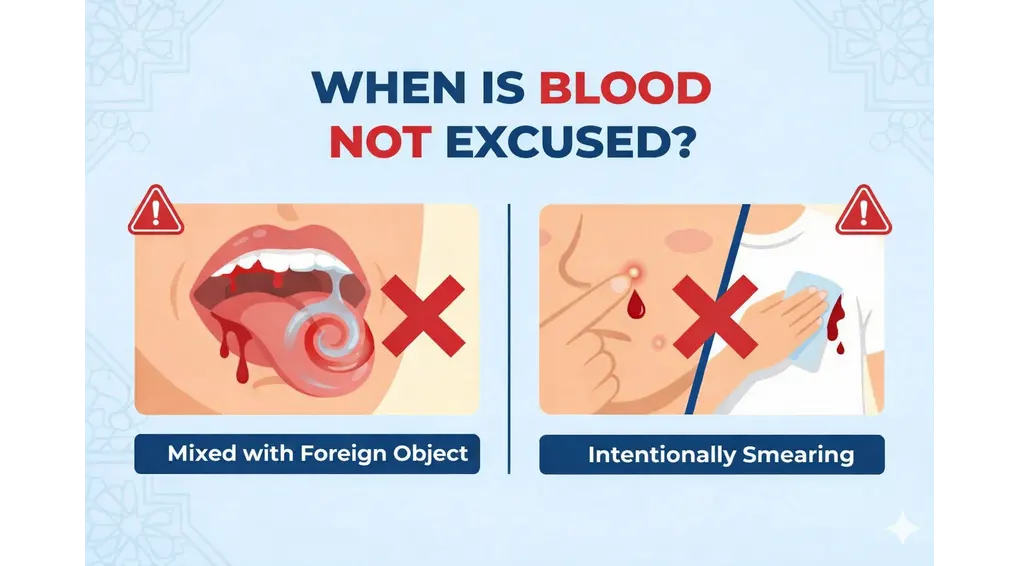
Exercise caution, as the “excused” status can disappear. Although Islamic law provides leniency, strict boundaries exist. Blood that was initially an excused najis transforms into a mandatory-to-wash impurity under the following conditions:
Mixing with Foreign Substances
The primary condition for blood (such as bleeding gums or boils) to remain excused is its purity from other mixed substances. Case examples:
- Gum Bleeding: If gums bleed, and the blood mixes with saliva and is swallowed or flows outside the lips, the impurity is no longer excused.
- Eye Bleeding: If an eye bleeds and the blood mixes with flowing tears, it loses its excused status.
However, a concession exists if the mixing agent is purely purifying water (water for Wudu or Ghusl) or natural sweat. If blood on the face accidentally mixes with ablution water, the Shari’ah still pardons it.
Intentional Smearing (Tadammukh)
If an individual intentionally pops a pimple and smears the blood onto their shirt without medical necessity, or deliberately catches a mosquito to rub its blood on themselves, no tolerance applies. The ruling becomes strict impurity that requires washing, as there is an element of deliberately playing with filth.
What About Clothes Stained with Sweat?
Al-Iqna’ contains a fascinating discussion regarding a person who wears a garment stained with flea or mosquito blood while their body is wet.
- If the wetness is due to sweat or ablution water: The majority of scholars rule that it is permissible and excused. This is because sweating and performing ablution are unavoidable necessities.
- If the wetness is due to playing with water (without a Shari’i purpose): Some scholars, such as Sheikh Abu Ali al-Sinji, argue it is impermissible because the person soiled their body without an urgent need.
Conclusion
Understanding the jurisprudence of excused najis grants us profound peace of mind during our worship. We do not need to succumb to paranoia or excessive doubts (Waswasah).
If an acne lesion on your back ruptures and stains your undershirt during prayer, continue your prayer; the Shari’ah pardons it. If you notice a mosquito’s bloodstain on your prayer garment, it remains an excused najis. However, if you suffer a clear, wet lick from a dog, you must purify it immediately.
Islam is a religion of ease and facilitation. These regulations on impurities exist not to complicate our lives, but to preserve both our physical cleanliness and our psychological well-being during worship. As long as we do not take matters too lightly nor act excessively, our prayers remain valid by the will of Allah.
Frequently Asked Questions (FAQ)
1. Does a small amount of acne blood invalidate my Wudu or prayer?
No, it does not. According to the Shafi’i school, blood from your own acne or boils is considered an excused najis (Najis Ma’fu ‘Anhu), provided you do not intentionally squeeze and smear it outside its natural area.
2. What if I find out about a mosquito bloodstain on my clothes after finishing my prayer?
Your prayer remains perfectly valid. Insect blood, such as that from mosquitoes or fleas, falls under the category of widespread hardship (Umum al-Balwa) and is fully pardoned in Islamic jurisprudence.
3. Are microscopic impurities from severe sources like dogs also pardoned?
Yes. Classical texts like Al-Iqna’ clearly state that any impurity completely undetectable by the naked human eye is pardoned, even if it originates from a severe source, due to the extreme difficulty of avoiding it.
Reference
ash-Shirbīnī, Muḥammad ibn Aḥmad al-Khaṭīb. al-Iqnāʿ fī Ḥall Alfāẓ Abī Shujāʿ. Edited by Maktab al-Buḥūth wa ad-Dirāsāt. Beirut: Dār al-Fikr, n.d.


