
Have you ever experienced the frustrating moment when an impure substance (najis) falls into your water bucket or bathtub? This is especially troubling when we desperately need that water. In the jurisprudence (fiqh) of the Shafi’i School, a small volume of water (less than two qullahs) is indeed highly sensitive. The moment it comes into contact with najis, even if there is no change in its color, smell, or taste, the water is immediately legally judged as mutanajjis (contaminated with impurity) and cannot be used for purification. If you are unfamiliar with the foundational concepts, you might want to start by understanding the definition of fiqh.
However, do not rush to throw that water away. Fiqh scholars have provided a brilliant solution to restore the legal status of that water back to being pure (suci). One of the authoritative references discussing how to purify najis water is the classical text Asna al-Mathalib by Shaykh al-Islam Zakariyya al-Ansari.
Let us thoroughly examine the mechanism, the necessary conditions, and the original text from this book so that we can better comprehend the ruling of water reaching two qullahs.
The Original Text and Translation from Asna al-Mathalib
Before delving into the technical explanations, let us examine the textual foundation found in Asna al-Mathalib, Volume 1, page 16. This text addresses a specific scenario: submerging a vessel containing impure water into another body of water.
The Book’s Text:
قوله: (ولو غمس كوز ماء، واسع الرأس في ماء كمله قلتين، وساواه) بأن كان الإناء ممتلئا أو امتلأ بدخول الماء فيه (ومكث قدرا يزول فيه تغير لو كان) ، وأحد الماءين نجس أو مستعمل (طهر) لأن تقوي أحد الماءين بالآخر إنما يحصل بذلك
Translation:
(And if a pitcher containing water, which has a wide mouth, is submerged into water that [when combined] completes its volume to two qullahs, and its surface levels out) meaning the vessel was already full or became full due to water entering it, (and it remains [submerged] for a duration in which any alteration [in the water’s properties] would disappear if there were any), while one of the two waters is impure (najis) or used (musta’mal), (then [the water] becomes pure). This is because the strengthening of one water by the other only occurs through this [unification].
The Fundamental Concept: Strengthening the Water (At-Taqwiyah)
The primary key to this issue is the concept of “uniting strength.” A small amount of water is weak, making it easily defeated by impurity. However, when that water is combined with other water until its volume reaches the minimum threshold of strength—which is two qullahs—the water becomes strong.
In fiqh terminology, water that reaches two qullahs possesses the capability to repel impurity (daf’u al-najasah), provided there is no physical alteration (in smell, taste, or color). Therefore, the method to purify najis water or used water (musta’mal) is by increasing its volume until it meets this specific measure. For a broader context, you can explore the various types of water in Islam and their usage.
4 Conditions for Impure Water to Become Pure Again
Based on the explanation by Shaykh Zakariyya al-Ansari above, merely combining the water is insufficient. There are technical details that must be fulfilled for this purification process to be valid. If even one is missed, the water remains legally impure.
1. The Vessel Must Have a Wide Mouth (Wasi’ur Ra’si)
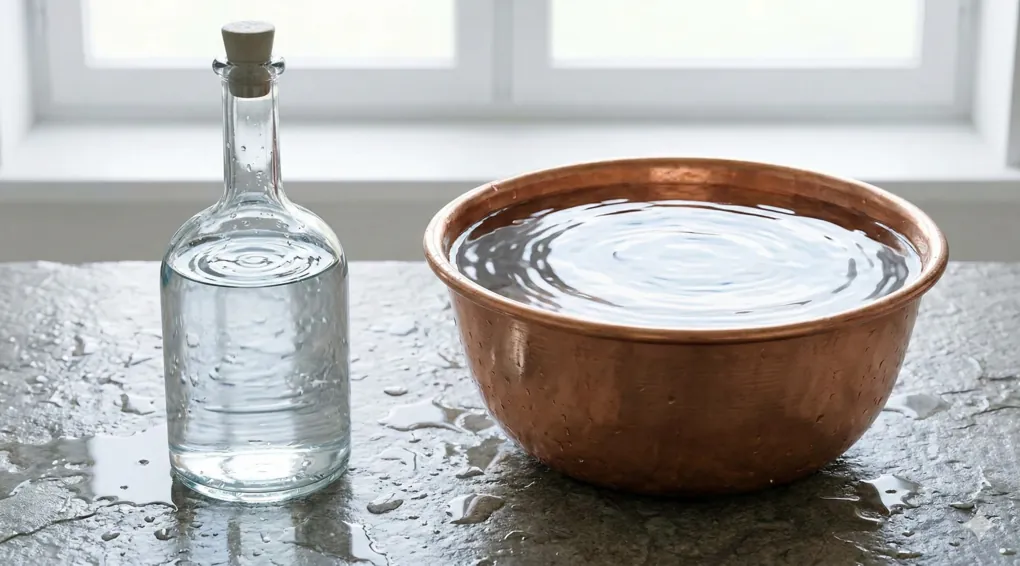
This is a crucial physical condition. If you submerge a narrow-necked bottle containing impure water into a large tub, the water inside the bottle might not become pure. Why? Because the water circulation does not flow freely. A wide-mouthed vessel (like a bucket, a pot, or a large pitcher) allows the water inside and outside to mix completely, forming a single, new body of water.
2. The Total Volume Must Reach Two Qullahs
This is an absolute requirement. The combined volume of the water inside the vessel and the water outside it must reach a minimum of two qullahs.
How many liters is two qullahs? Contemporary scholars differ in the exact conversion, but the safe range is approximately 216 to 270 liters. If your bathtub measures 60x60x60 cm and is full, that is more than enough.
3. The Water Surface Must Be Level and Calm (Musawah)


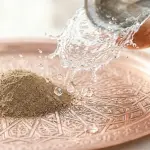
The text of the book states “and its surface levels out.” This means the process of filling or mixing must be complete.
- If you plunge a bucket into a tub, and the water is still bubbling or flowing in, it is not yet considered pure.
- You must wait until the water surface inside the bucket is at the same height as the water outside (level water). This level condition signifies that the unification is perfect.
4. Remain Still for a Moment (Makatsa Qadran)
After the water has united and its surface is level, do not lift it immediately. Leave it for a moment. How long? The measurement is an estimation: approximately the time needed to eliminate any alteration in the water’s properties (if the water had changed in color or smell). Even if your water is clear (unaltered), this time delay remains obligatory as a precaution (ihtiyath) to ensure the impurity is completely neutralized.
When Does This Purification Process Fail?
The book Asna al-Mathalib also explains the opposing conditions (mafhum mukhalafah). Consider the following excerpt:
قوله: (وإلا) بأن كان ضيق الرأس أو، واسعه بحيث يتحرك ما فيه بتحرك الآخر تحركا عنيفا لكن لم يكمل الماء قلتين… (فلا) يطهر
Translation: (And if it is otherwise), such as the mouth of the vessel is narrow… (then it does not) become pure.
Here are scenarios that cause the water to FAIL to become pure:
- Narrow Mouth: Water in a narrow bottle submerged in a large pool remains impure because it does not mix perfectly.
- Insufficient Volume: You combine two buckets of impure water, but the total has not reached 216 liters. Therefore, both remain impure.
- Rushed: Lifting it immediately upon submerging, before the water has had time to settle and unite.
- Still Flowing: Water is still pouring into the vessel, and its surface is not yet level.
Summary Table of Rulings
To make it easier to understand the rules from this classical text, review the following table:
| Condition | Initial Status of Water | Action Taken | Final Result |
| Wide-Mouth Pitcher | Impure / Used | Submerged into other water until total ≥ 2 Qullahs + Remained still | PURE & PURIFYING |
| Narrow-Neck Bottle | Impure / Used | Submerged into other water until total ≥ 2 Qullahs | REMAINS IMPURE |
| Large Bucket | Impure | Added water until total < 2 Qullahs | REMAINS IMPURE |
| Large Bottle | Impure | Submerged in abundant water, but lifted immediately (not still) | REMAINS IMPURE |
Relevance in Daily Life
Case Study: Two bathtubs connected by a large channel are considered a single body of water. If their total volume reaches two qullahs, then the water is strong enough to repel impurity.
Understanding this classical text is incredibly helpful for us today. Often, we have bathtubs that are not very large. If a small child urinates in it, we do not need to drain and throw away all the water (which is wasteful).
Simply run water from the tap into the tub. Let the water continue to fill until it overflows and you are certain its volume reaches two qullahs (or the new water dominates and flushes out the old water). Once deemed sufficient, turn off the tap and let the water settle for a moment. If there is no smell of urine or change in color, then all the water in the bathtub becomes pure again and is valid to be used for ablution (wudhu) or the complete procedure of obligatory bath (janabah) in Shafi’i fiqh. Understanding these rules is also essential when considering the etiquette and rulings of entering a public bathhouse (hammam). For a specific scenario regarding well water, you can read about how to purify well water.
Alternatively, imagine someone has two adjacent bathrooms, each with a bathtub, and the total volume of water in both exceeds two qullahs. The two tubs are connected through a sufficiently large hole, so when the water in the first tub is moved, the water in the second tub also moves. In this case, if impurity falls into the first bathtub and there is no alteration in its properties, the water remains legally pure, because the two tubs are counted as a single unit with a volume of two qullahs.
FAQ: Common Questions About Two Qullahs of Water
Can this purified water be used for drinking?
The legal ruling of “pure” in fiqh relates to the validity of worship (ablution/bathing). Whether it is fit to drink or not is a matter of health. If the water is physically dirty even though it is legally pure, it is best not to drink it. Conversely, if the water is impure (najis) even if it looks crystal clear, it is strictly forbidden (haram) to drink.
What if the water smells like soap?
If used water (musta’mal) is mixed until it reaches two qullahs and the smell of soap disappears, it becomes pure and purifying. However, if after reaching two qullahs, the smell of soap is still very overpowering to the point that it changes the character of the water (becoming soapy water, not absolute water), then it is pure but cannot be used for purification rituals.
Does this rule apply to all types of impurities?
This rule applies generally as long as the impurity does not alter the color, taste, or smell of the water once the volume reaches two qullahs. If the alteration persists despite reaching the required volume, the water remains impure.
Conclusion
We hope this review of the book Asna al-Mathalib helps you feel more at ease in maintaining the purity of water in your home. Islamic jurisprudence (fiqh) exists not to complicate matters, but to provide systematic solutions for our daily problems.
Referensi
Zakariyā al-Anṣārī, Asnā al-Maṭālib fī Sharḥ Rawḍ al-Ṭālib, with the ḥāshiyah by Aḥmad al-Ramlī, edited by Muḥammad al-Zuhrī al-Ghamrāwī (Cairo: al-Maṭbaʿah al-Maymānīyah, 1313 H; repr. Dār al-Kitāb al-Islāmī), vol. 1, p. 16.


