

Motherhood is a profoundly rewarding journey of continuous worship. However, amidst the joy of caring for a newborn, confusion often arises regarding acts of worship, particularly concerning ritual purity (thaharah). One of the most frequent questions haunting young mothers is: “Are my clothes impure (najis) because of baby spit-up?” or “Is my prayer valid if I do not wash my breast after nursing a baby who just vomited?”
These concerns are entirely valid. In the Shafi’i school of jurisprudence, maintaining the purity of one’s body, clothing, and place of prayer is an uncompromising condition for a valid prayer. Meanwhile, infants have natural, uncontrollable habits such as spitting up, vomiting, and drooling.
This article will comprehensively explore the thaharah for nursing mothers, specifically regarding infant impurities and the legal dispensations (rukhsah) granted to them. This analysis is grounded in authoritative classical literature, namely the text Fathul Mu’in by Shaykh Zainuddin Al-Malibari and its commentary I’anah at-Talibin by Sayyid Bakri Shata.
Understanding Baby Impurities: Spit-up and Vomit
Before delving into the legal solutions, we must clarify the status of baby vomit. In Islamic jurisprudence, anything expelled from the stomach through the mouth that has altered in its fundamental properties (smell, taste, or color) from its original state is legally classified as vomit (qay’). According to the Shafi’i school, vomit is categorically impure, regardless of whether it originates from an adult or an infant.
Society often distinguishes between “spit-up” (a small amount of milk) and “vomit” (a larger volume). However, the foundational definition of najis looks at a different parameter: “Did the fluid reach the stomach and undergo a chemical change?” If it did, its legal status is impure.
The primary dilemma arises when an infant experiences a phase of frequent spitting up. The baby’s mouth becomes an impure area (mutanajjis). If this impure mouth latches onto the mother to nurse, basic logical deduction suggests the mother’s nipple also becomes impure. Must the mother then wash her breast before every subsequent feeding or before every prayer? Naturally, this would cause severe hardship (masyaqqah).
This is precisely where the Islamic Sharia manifests its inherent ease and practicality, as elucidated in the following classical references.
The Ruling on a Mother’s Breast Exposed to a Baby’s Mouth
In the book Fathul Mu’in, Shaykh Zainuddin Al-Malibari cites a pivotal fatwa from his teacher, Ibn Hajar Al-Haytami. This legal verdict is a breath of fresh air for nursing mothers whose babies frequently suffer from digestive issues or reflux.
The original Arabic text from Fathul Mu’in states:
وأفتى شيخنا أن الصبي إذا ابتلي بتتابع القئ عفي عن ثدي أمه الداخل في فيه، لا عن مقبله أو مماسه
Meaning: “And our Shaykh (Ibn Hajar al-Haytami) issued a fatwa: That if an infant is tested with frequent vomiting, the impurity is excused (ma’fu) on the mother’s breast that enters his mouth, but it is not excused for the one who kisses or touches it.”
Crucial Takeaways from this Fatwa:
- The Condition of “Frequent Vomiting” (Tatabu’ al-Qay’i): This dispensation applies specifically if the baby vomits frequently. If the baby vomits only once a month, the original ruling applies (washing is obligatory). However, since infants generally spit up often, this condition is typically met.
- The Excused Area (Ma’fu): The legal tolerance for impurity is strictly limited to the area of the nipple or breast that enters the baby’s mouth. This is because this specific area constitutes a vital necessity (hajat) in the breastfeeding process.
- The Unexcused Areas: The fatwa establishes firm boundaries. Other parts of the mother’s body, such as the lips that kiss the baby’s mouth (muqabbil) or the hands and clothes that touch the baby’s mouth (mumass) after vomiting, are not excused. If a mother’s cheek is smeared with the baby’s impure saliva, she must wash it before praying.
This nuanced ruling is derived from the core principles found within the 4 sources of Islamic law, specifically the legal maxim: Al-Masyaqqah Tajlibut Taysir (Hardship begets ease). Mandating a mother to wash her breast constantly would hinder the provision of breast milk and inflict undue distress upon her.
Expanding the Ruling on a Baby’s Mouth (I’anah at-Talibin)
The explanation provided in Fathul Mu’in is further enriched in its commentary, I’anah at-Talibin. Sayyid Bakri Syatha quotes the complete context of the fatwa, broadening our understanding of the meaning of fiqh regarding the Sharia’s extensive tolerance in childcare.
In I’anah at-Talibin (Vol. 1, p. 102), it is stated:
قوله: (وأفتى شيخنا أن الصبي إلخ) عبارة فتاويه: وسئل رضي الله عنه: هل يعفى عما يصيب ثدي المرضعة من ريق الرضيع المتنجس بقئ أو ابتلاع نجاسة أم لا? فأجاب رضي الله عنه: ويعفى عن فم الصغير وإن تحققت نجاسته.
Meaning: “(The Author’s statement: And our Shaykh issued a fatwa…) The wording in his collection of fatwas is: He (Ibn Hajar) was asked: ‘Is the impurity excused when it affects the breast of a nursing mother from the saliva of an infant that has become impure due to vomiting or swallowing an impure substance, or not?’ He replied: ‘And it is excused regarding the mouth of the small child, even if its impurity is absolutely certain.'”
This text clarifies that the source of the impurity is not limited to vomit; it also includes scenarios where the baby might have swallowed something impure (like putting a dirty object in their mouth). The legal pivot rests entirely on the status of the small child’s mouth.
Theological Grounds from Ibn as-Salah and Imam az-Zarkashi
The text of I’anah at-Talibin fortifies this argument by quoting other prominent scholars:
كما صرح به ابن الصلاح فقال: يعفى عما اتصل به شئ من أفواه الصبيان مع تحقق نجاستها. وألحق بها غيرها من أفواه المجانين. وجزم به الزركشي.
Meaning: “As explicitly stated by Ibn as-Salah, who said: ‘Whatever comes into contact with the mouths of children is excused, even with the certainty of the impurity of their mouths.’ And he analogized it with the mouths of the insane. And Imam az-Zarkashi affirmed this.”
Practical Fiqh Analysis for a Mother’s Daily Life
Drawing from these authoritative texts, we can establish practical guidelines for the daily routine of maintaining ritual purity:
- Status of Saliva Mixed with Vomit: An infant’s saliva mixed with the remnants of vomit is impure. However, due to the sheer difficulty of avoiding it (Umumul Balwa), the Sharia grants it the status of Ma’fu ‘Anhu (an excused impurity).
- Analogy to the Insane (Majanin): Interestingly, the legal texts equate the infant with an insane person. The shared rationale is the lack of intellect and the inability to maintain one’s own oral hygiene. This demonstrates that the ruling revolves around the legal subject’s helplessness.
- Peace of Mind: Mothers do not need to obsessively check their baby’s mouth every second. If you are certain there is an impurity, clean what is visibly apparent. Invisible or hard-to-remove traces fall under the excused category.
Summary Table: Impure vs. Excused (Ma’fu)
To simplify the rulings from Fathul Mu’in and I’anah at-Talibin, refer to the classification table below:
| Case / Incident | Mother’s Body Area | Legal Status | Reference Explanation |
| Baby vomits, then immediately nurses | Breast / Nipple | Excused (Ma’fu) | Due to necessity (hajat) and frequent occurrence (Fathul Mu’in). |
| Baby vomits, then mother kisses their mouth | Mother’s Lips / Face | Not Excused (Must Wash) | Kissing a baby’s mouth is not an urgent necessity (Fathul Mu’in). |
| Baby touches their vomit, then grabs mother’s clothes | Mother’s Clothes | Not Excused (Must Wash) | Falls under the category of touching (mumass) in a non-essential area. |
| Normal baby saliva (no vomit) | Clothes / Skin | Pure (Suci) | Saliva is inherently pure in its natural state. |
| Baby’s mouth is known to be impure | Object entering their mouth | Excused (Ma’fu) | Opinion of Ibn as-Salah in I’anah at-Talibin. |
Practical Worship Tips for Mothers with a “Happy Spitter”
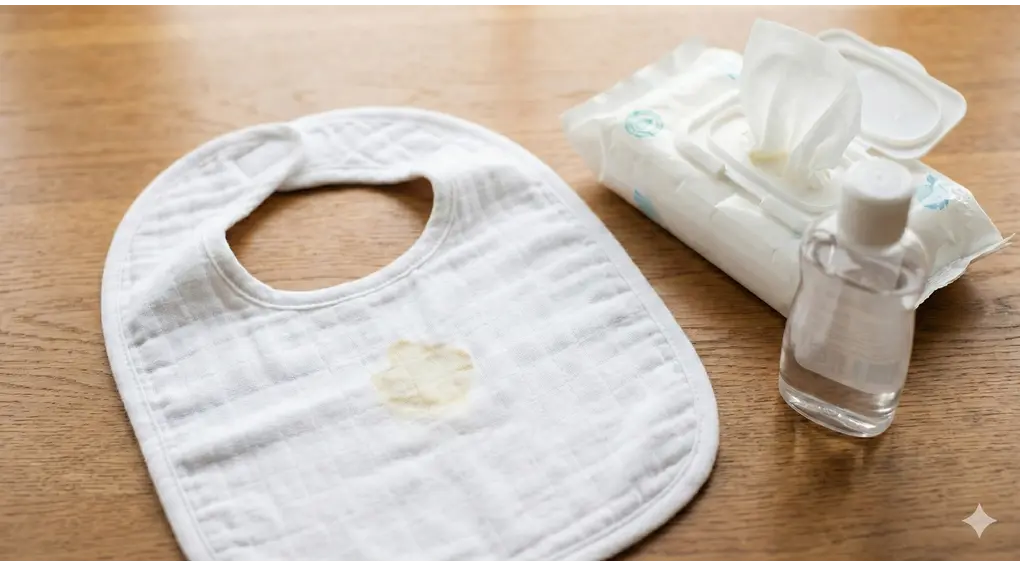
Babies who spit up frequently often soil clothing, raising questions about whether those garments are suitable for performing obligatory and recommended prayers. Having a baby who spits up is not a barrier to maintaining the quality of your prayers. Based on the evidence above, here are practical steps you can apply:
1. Separate Prayer Clothes from Nursing Clothes


Although dispensations exist, the most cautious approach (ihtiyat) is to have a dedicated prayer garment (mukena) or specific clothes solely for praying.
- Wear comfortable house clothes while carrying and nursing the baby.
- If your house clothes are exposed to spit-up or touched by the baby’s impure hands (mumass), change them immediately before praying.
- If only your breast is exposed (during nursing), you are not obligated to wash it every time you pray if the baby vomits continuously, according to Ibn Hajar’s fatwa. However, washing it occasionally when you have the time is highly recommended.
2. Keep Wet Wipes or a Clean Cloth Handy
According to the text of Fathul Mu’in, the unexcused individuals are the “muqabbil” (the one who kisses the baby’s mouth) and the “mumass” (the one whose body touches the impure mouth).
- If the baby kisses your cheek after spitting up, wipe it immediately with water or a wet wipe.
- Ensure the physical traces of the impurity (smell, color, taste) are completely removed.
3. Manage Your Heart and Doubts
Satan often whispers intrusive doubts (was-was). “Did the baby just vomit? Is their mouth pure?” In fiqh, there is a golden maxim regarding the validity conditions of prayer: “Certainty is not overruled by doubt.”
- If you did not explicitly see the baby vomit, the default ruling is that the baby’s mouth is PURE.
- Do not declare something impure based solely on suspicion.
- The ma’fu (excused) ruling discussed by Ibn Hajar applies when the impurity is certain (tahaqquq najasatiha) but excused due to unavoidable hardship. If you are merely doubting the presence of impurity, the default state remains pure.
Conclusion
Islam profoundly understands the rigorous conditions a mother faces. The theological evidence from Fathul Mu’in and I’anah at-Talibin presented above is a tangible manifestation of Allah’s mercy through His Sharia.
The core of this guide highlights that a nursing mother’s breast is excused (ma’fu) from being washed continuously if her baby frequently vomits. However, this leniency is not absolute across the entire body; cheeks (from kissing) and clothes (from touching) exposed to vomit must still be purified. The general principle relies on the fact that the difficulty in maintaining the oral hygiene of an infant warrants special legal tolerance in fiqh.
May this explanation bring peace to mothers as they balance their worship with caring for their little ones. We must not make the religion harder than the scholars have outlined. Allahu a’lam bish-shawab.
FAQ: Islamic Jurisprudence on Baby Impurities
Is baby saliva considered impure (najis)?
Fundamentally, a baby’s saliva is pure (suci). Saliva only becomes impure (mutanajjis) IF it mixes with vomit/spit-up that has originated from the stomach, or if the baby has just eaten an impure substance.
What is the difference between regurgitation and vomiting in Islamic law?
Medically it may be distinguished, but in fiqh, the benchmark is “does the fluid come from the stomach and change its properties?”. If milk comes out and its smell is sour/changed, it is considered vomit (impure). If it is newly consumed and comes out again in a fresh condition (like pure milk) and has not yet reached the stomach, then it is considered pure.
Can I pray while carrying a baby wearing an impure diaper?
The requirements for a valid prayer are purity of the body, clothing, and place, as well as being free from “carrying” impurity. If a baby is wearing a diaper containing impurity (urine/feces), and you carry them while praying, then the prayer is invalid because you are considered to be bearing the impurity (hamilun najasah).
What if my clothes have a tiny splash of dried spit-up?
Since spit-up is impure, the impurity does not disappear simply because it dries. It must be washed with pure, flowing water until the color, smell, and taste are gone. The only exception is if the impurity is microscopic and invisible to the naked eye (la yudrikuhut tarfu), in which case it is excused (ma’fu).
Reference
Abū Bakr (al-Mashhūr bi-al-Bakrī) ʿUthmān ibn Muḥammad Shaṭṭā ad-Dimyāṭī ash-Shāfiʿī, Iʿānat aṭ-Ṭālibīn ʿalā Ḥall Alfāẓ Fatḥ al-Muʿīn (Commentary on Fatḥ al-Muʿīn with the Explanation of Qurrat al-ʿAyn concerning the Essentials of Religion), 1st ed. (Beirut: Dār al-Fikr, 1997), 1:102.


