

Engaging in various Ramadhan worship practices is a profound means for Muslims to purify their souls and draw closer to Allah ﷻ. As the culmination of all worship in this sacred month, Islamic law mandates the payment of Zakat Fitrah. This financial worship (maliyah) is not merely a tradition of sharing; it is an integral part of completing the pillars of Islam.
However, a fundamental question often arises as Eid approaches: who exactly are the Zakat Fitrah dependents of a family head? Are all blood relatives automatically covered by a father or husband?
Based on the understanding of Islamic jurisprudence within the Shafi’i school, the boundaries of this obligation are highly systematic and logical. The primary reference for this ruling is the classical text Asna al-Matalib by Sheikh Zakariya al-Ansari, which details the legal status of each family member based on the obligation of financial maintenance (nafaqah).
Financial Maintenance Determines Zakat Fitrah Dependents
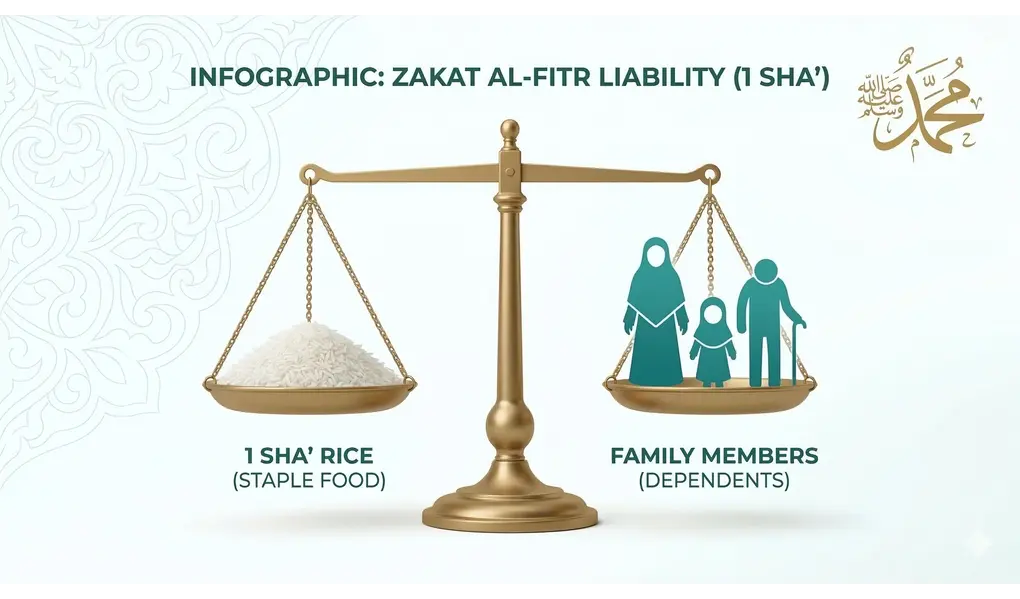
In the Islamic scholarly tradition, the rule for determining Zakat Fitrah dependents is strictly tied to the obligation of financial maintenance. If the Shari’ah compels an individual to cover the living expenses (nafaqah) of another person, they are automatically obligated to pay that person’s Zakat Fitrah on Eid.
Sheikh Zakariya al-Ansari formulates this golden rule with precise wording:
كل من وجبت نفقته (على غيره) بزوجية أو ملك أو قرابة وجبت فطرته عليه
This means that anyone whose financial maintenance is the obligation of another—whether due to marriage (zaujiyyah), ownership (milk), or kinship (qarabah)—their Zakat Fitrah must be borne by that obligated person.
This duty is finalized upon the due date for Zakat Fitrah at the end of Ramadan, requiring the head of the household to prepare the accurate measure of 1 sha’ of staple food for every soul under their care.
However, a strict exception applies. If the relative or family member is a non-Muslim, the Zakat obligation is lifted from the family head, even if the financial maintenance remains obligatory.
لكن لا تجب عليه لكافر
Zakat is an act of spiritual purification (thaharah), and non-Muslims are not subject to this specific ritual purification. Therefore, a Muslim child is not required to pay Zakat Fitrah for a non-Muslim father.
Zakat Fitrah for the Wife (Including Revocable Divorce)
As the head of the family, a husband bears the absolute obligation to pay his wife’s Zakat Fitrah. This is a logical consequence of the marriage bond, which mandates the husband to provide both physical and emotional maintenance.
But what is the status of a wife who is in her waiting period (‘iddah) due to divorce? Shafi’i fiqh addresses this objectively:
وتجب لرجعية وكذا بائن حامل
The husband is still obligated to pay Zakat Fitrah for a wife undergoing a revocable divorce (talak raj’i—the first or second divorce during the waiting period). The reasoning is that the marital tie in a revocable divorce is not completely severed, keeping her financial rights under his responsibility.
The same rule applies to a wife who has been irrevocably divorced (talak ba’in) but is pregnant (ba’in hamil). Because a pregnant woman is entitled to financial support for the sake of the unborn child, the husband must pay her Zakat Fitrah. Conversely, an irrevocably divorced wife who is not pregnant no longer receives maintenance from her ex-husband; thus, her Zakat Fitrah becomes her own responsibility or that of her blood relatives.
Zakat Fitrah for Children: Minors vs. Adults
A child’s status as a dependent for Zakat Fitrah is categorized based on their age and financial capacity. Not all children remain a permanent financial burden on their father.
1. Minors Unable to Work
A father is strictly obligated to pay the Zakat Fitrah for his young children who do not possess their own wealth.
2. Minors with Wealth or Ability to Work
An interesting detail in Asna al-Matalib states that the father’s obligation ceases if the child possesses enough personal wealth to feed themselves on the day and night of Eid, or if the child is capable of earning a decent living.
قوله: (ولا تجب) على الأب (فطرة ولد) له (ملك قوت يوم العيد وليلته فقط) أو قدر على كسبه (ولو صغيرا) لسقوط نفقته عنه بذلك
The father’s duty falls away because the child’s maintenance is covered by their own assets. In this scenario, the guardian (father) may pay the Zakat Fitrah by taking it directly from the child’s personal wealth.
وتسقط عن ولده الصغير الغني بإخراجه لها عنه من مال نفسه
3. Adult Children (Baligh)




Once a son or daughter reaches adulthood and independence, the father is no longer legally required to maintain them. Consequently, the burden of Zakat Fitrah is lifted from the father’s shoulders. It is not valid for a father to pay on behalf of his adult child unless the child has given explicit permission (idzn) or delegated the father as an agent. You can learn more about the signs of reaching puberty (baligh) to understand this legal transition.
لا عن ولد كبير له إلا بإذنه
This is because an adult has full authority over their wealth and is considered fully capable of making their own ritual intentions.
Zakat Fitrah for Elderly Parents

The flow of financial responsibility does not only go downwards to children; it also goes upwards to parents. If a father or mother is elderly, impoverished, or no longer able to earn a living, the obligation to meet their needs transfers to their capable child. As a result, the child also becomes responsible for their parents’ Zakat Fitrah.
The Order of Priority for Dependents
What happens if the head of the family faces financial hardship? Suppose the food or money they possess on the eve of Eid is only enough for a few people. The Shari’ah provides a clear hierarchy of priority:
فإن اجتمعوا بدأ بفطرة نفسه… ثم زوجته… ثم ولده الصغير… ثم الأب… ثم الأم كذلك
If financial capacity is limited, the family head must start with himself, followed by his wife, and then his minor child. If there is a surplus, he proceeds to his father, then his mother, and finally his adult child (who is disabled or unable to earn), and so forth. This hierarchy ensures fairness in fulfilling rights according to the degree of kinship and primary responsibility.
The Disobedient Wife (Nushuz)
Islamic law beautifully balances rights and responsibilities within a household. A wife is entitled to financial maintenance and Zakat Fitrah coverage because she devotes herself obediently to her husband.
However, if a wife commits nushuz—meaning she becomes disobedient, leaves the marital home without permission, or rejects obligations mandated by the Shari’ah—she forfeits her right to financial maintenance.
Does this affect her Zakat Fitrah? Shafi’i scholars answer decisively:
قوله: (و) فطرة (الناشزة عليها) لا على الزوج لسقوط نفقتها عنه
The Zakat Fitrah of a disobedient wife becomes her own burden, not her husband’s. This is purely because his obligation to maintain her has been nullified. Should she return to obedience and repent before sunset on the last day of Ramadan, her right to maintenance is restored, and the husband is once again obligated to pay her Zakat Fitrah.
Conclusion
Understanding exactly who your Zakat Fitrah dependents are protects the head of the household from procedural errors that could invalidate their worship. The core principle is highly systematic: the obligation of Zakat Fitrah goes hand-in-hand with the obligation of financial maintenance. A husband covers his wife, a father covers his dependent minor children, and a financially capable child covers their impoverished parents.
By adhering to these legal boundaries derived from Asna al-Matalib, a Muslim executes the Shari’ah with precision and robust religious knowledge. For further reading, consult the comprehensive Shafi’i Zakat Fitrah guide.
Summary Table of Zakat Fitrah Dependents
| Family Member | Zakat Fitrah Responsibility | Terms & Conditions |
| Obedient Wife | Borne by Husband | Valid marriage bond; wife is not disobedient. |
| Disobedient Wife (Nushuz) | Self-Responsibility | Husband’s duty for maintenance and Zakat is nullified. |
| Wife in Revocable Divorce / Pregnant | Borne by Husband | Still entitled to financial support during the ‘iddah period. |
| Minor Child | Borne by Father | Provided the child does not possess personal wealth. |
| Adult / Working Child | Self-Responsibility | Father may pay it if granted permission (wakalah). |
| Impoverished/Elderly Parents | Borne by Capable Child | Capable children are obligated to maintain impoverished parents. |
Frequently Asked Questions (FAQ)
Can a working adult child pay the Zakat Fitrah for their entire family?
Yes, it is permissible and valid, provided the child acts with the permission or delegation (wakalah) of the father. The child voluntarily takes on the father’s burden, and the reward for such goodness is immense. The intention must align with this delegation.
Who is responsible for the Zakat Fitrah of an orphan?
For an orphan who has no inherited wealth, the Zakat Fitrah is borne by the closest relative who has taken over their guardianship and provides for their daily maintenance (such as a grandfather or a paternal uncle).
Is an employer obligated to pay the Zakat Fitrah for their domestic worker?
If the domestic worker is employed under a salary system (monthly wage), their Zakat Fitrah is their personal obligation, not the employer’s. However, if the employer wishes to give charity by paying the Zakat Fitrah on behalf of the worker with their permission, it is entirely permissible and counted as a highly rewarded righteous deed.
Reference
Zakariyā al-Anṣārī, Asnā al-Maṭālib fī Sharḥ Rawḍ al-Ṭālib, with a ḥāshiyah by Aḥmad al-Ramlī, edited by Muḥammad al-Zuhrī al-Ghamrāwī (Cairo: al-Maṭbaʿah al-Maymānīyah, 1313 AH; repr. Dār al-Kitāb al-Islāmī), vol. 1, p. 388.


