
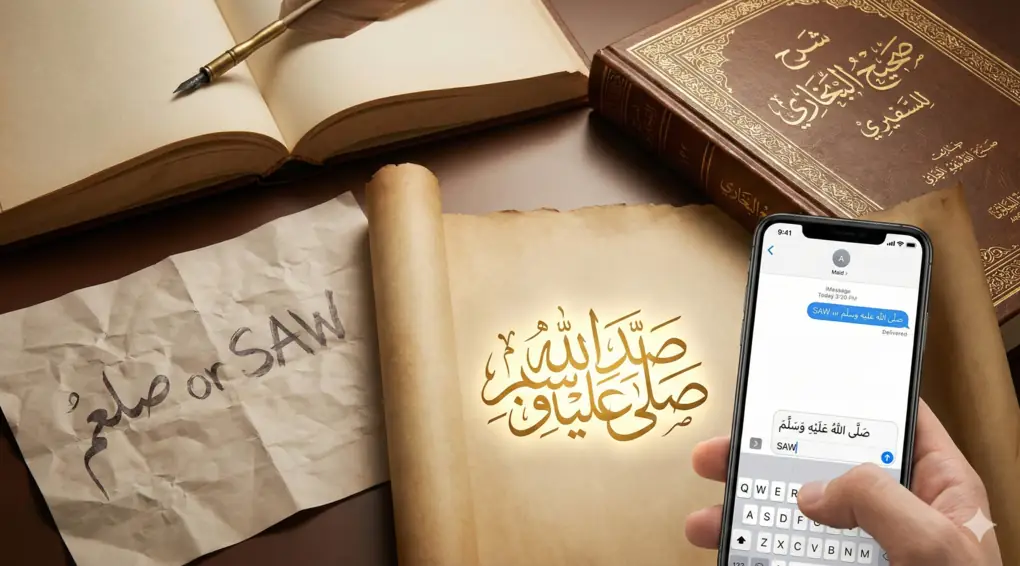
Have you ever found yourself in a rush while taking study notes or replying to a message, resorting to abbreviating the Salawat upon Prophet Muhammad ﷺ to “SAW,” “PBUH,” or simply “S.A.W”? This habit seems trivial and has become widespread in our society. The reason is usually simple: to save time and character counts.
However, are you aware that classical Islamic scholars paid exceptionally close attention to this matter? In fact, there are stern warnings for those who neglect writing Sallallahu ‘alayhi wa sallam in its entirety. Exploring the ruling on abbreviating SAW reveals a profound intersection of Islamic jurisprudence (Fiqh) and spiritual etiquette (Adab).
One of the most compelling references discussing this is the commentary on Sahih Al-Bukhari by Imam al-Saffiri. He quotes the profound advice of Ibn al-Salah, a renowned Hadith master, regarding the spiritual detriment of shortening the Salawat. Let us examine what the scholars have stated about this abbreviation phenomenon and how we should properly conduct ourselves.
A Stern Warning from Imam al-Saffiri
In his esteemed work, Imam al-Saffiri issued a striking admonition directed at seekers of knowledge and writers who habitually abbreviate the Salawat. The term used for such abbreviations in classical times was “Sal’am” (an acronym of the Arabic letters), which is functionally equivalent to the modern practice of abbreviating SAW or PBUH.
Here is the original text from the manuscript:
وكما قال ابن الصلاح ينبغي أن يحافظ على كتابة الصلاة والسلام على رسول الله – صلى الله عليه وسلم – عند ذكره , ولا يسأم من تكرير ذلك عند تكرره , فإن ذلك من أكبر الفوائد التي يتعجلها طلبة الحديث وكتبته , ومن أغفل ذلك مرة حرم حظا عظيما . ويتجنب أن يكتب “ صلعم ” مكان – صلى الله عليه وسلم – كما يفعله الكسالى والجهلة وعوام الطلبة , يأخذون من كل كلمة حرفا الصاد من صلي , واللام من الله , والعين من عليه , والميم من وسلم , ويجمعونها “ صلعم ” .
Translation and Core Message: “And as Ibn al-Salah stated: One should diligently maintain the writing of the Salawat and Salam upon the Messenger of Allah ﷺ whenever he is mentioned. One must not grow weary of repeating it when his name is repeatedly mentioned. Verily, this is among the greatest immediate benefits attained by students of Hadith and its scribes. Whoever neglects this even once is deprived of a magnificent fortune.
And one should avoid writing the abbreviation ‘Sal’am’ (صلعم) in place of Sallallahu ‘alayhi wa sallam, as is the practice of the lazy, the ignorant, and lay students. They extract a single letter from each word: Shad from Shalla, Lam from Allah, ‘Ain from ‘Alaihi, and Mim from Wa Sallam, combining them into ‘Sal’am’.” (Sharh Sahih Al-Bukhari li As-Saffiri, Vol. 1, p. 80)
The Phenomenon of “Sal’am” and Abbreviating SAW
The term “Sal’am” might sound foreign to modern ears. Historically, Arabic manuscript scribes frequently abbreviated the phrase as (ص ل ع م) to expedite their transcription work. In the modern era, particularly in Latin script, we recognize this as “SAW” or “PBUH.” While the linguistic forms differ, the core issue remains the same: truncating a supplication (Du’a).
Why Is It Considered the Habit of the Lazy?
Imam al-Saffiri utilized rather severe terminology, specifically Al-Kasala (the lazy) and Al-Jahalah (the ignorant). Why such strong condemnation?
Writing the Salawat is fundamentally an act of supplication. Imagine praying for your parents or loved ones; would it be respectful to reduce your heartfelt prayer into a mere acronym? Naturally, it feels inappropriate. The same standard of Adab applies to the Messenger of Allah ﷺ. When we understand the true essence of Salawat, we realize that it is an explicit invocation. Allowing laziness to prevent us from typing a few extra letters strips the supplication of its profound meaning.
Losing a Magnificent Fortune
A crucial point that frequently escapes our attention is the spiritual consequence. Ibn al-Salah emphasized that writing the complete Salawat is the “greatest immediate benefit.”
Classical scholars hold the conviction that as long as the written Salawat remains on paper, in a book, or even on a blog post or social media update, the angels will continuously seek forgiveness for the writer. Understanding our belief in angels reminds us that their supplications are pure and readily answered. If we reduce it to SAW, the phrase is no longer a complete Du’a. Consequently, we disconnect ourselves from an ongoing source of divine reward.
Etiquette of Writing the Prophet’s Name in the Digital Age
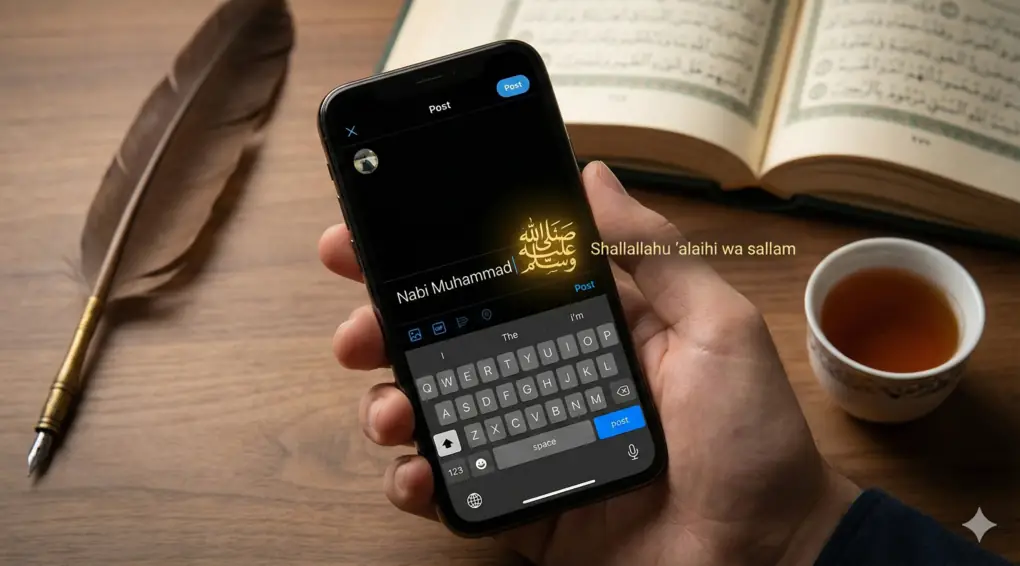
We live in a fast-paced digital era where people want to type messages at lightning speed. However, when it comes to the Prophet’s name, we must exercise mindful restraint. Implementing proper Adab on social media involves writing the complete Salawat or utilizing the ﷺ symbol instead of settling for acronyms.
Here are practical tips to ensure your writing remains blessed and respectful:
- Write the Full Transliteration: Type Sallallahu ‘alayhi wa sallam. It requires slightly more effort, but consider it a physical act of sending blessings through your fingertips.
- Utilize Autotext Features: On your Android or iPhone, create a keyboard shortcut. For instance, program your device so that typing “saw” automatically expands to the Arabic ﷺ or the full Latin phrase. This is a smart solution: highly efficient yet perfectly respectful.
- Maintain Consistency Without Fatigue: Even if the Prophet’s name appears ten times in a single article or caption, write it completely or use the ﷺ symbol every time. Do not view it as repetitive, for every iteration is an independent prayer.
Comparison: Recommended vs. Disliked Writing Practices
To simplify this concept, refer to the comparison table below. You can use this as a practical guideline for content creation or academic writing.
| Type of Writing | Example | Legal Status (Hukm) / Etiquette | Rationale |
| Highly Recommended | ﷺ (Arabic symbol) | Primary / Excellent | Original phrasing, complete prayer, visually concise yet whole in meaning. |
| Recommended | Sallallahu ‘alayhi wa sallam | Good | Complete prayer in transliteration, readable by all audiences. |
| Disliked (Makruh) | SAW, PBUH, S.A.W | Poor Etiquette (Su’ al-Adab) | Truncates the prayer; considered a sign of laziness by classical scholars like Imam al-Saffiri. |
| Strictly Avoided | 1000 SAW, Prophet S | Highly Inappropriate | Completely removes the essence of respect and veneration. |
Frequently Asked Questions (FAQ)
Technical questions frequently arise regarding this writing etiquette, especially among content writers and academics. Here is a brief summary:
1. Is it a sin if I have already written SAW in my past texts?
The majority of scholars classify abbreviating the Salawat as Makruh (disliked and better left abandoned) rather than Haram (a major sin). However, it is fundamentally a matter of Su’ al-Adab (poor etiquette) towards the Prophet ﷺ. If you have done it previously, simply intend to correct the practice in your future writing.
2. How should I handle character limits on platforms like Twitter (X)?
If space is strictly limited, utilizing the single-character Arabic symbol (ﷺ) is the optimal solution. It consumes only one character space but is read as a complete sentence. If that is not possible, it is far better to edit out other less important words than to truncate the Salawat.
3. Is the term “Sal’am” still used today?
While the specific term “Sal’am” is rarely used in non-Arabic speaking regions today, the underlying habit has merely shape-shifted into abbreviations like SAW or PBUH. Therefore, Imam al-Saffiri’s classical warning remains incredibly relevant to our contemporary context.
Conclusion: A Small Step for a Massive Reward
Breaking an ingrained habit requires conscious effort. Initially, typing out the full phrase might feel cumbersome or excessively lengthy. Yet, we must recall Imam al-Saffiri’s wisdom: we should never allow ourselves to be deprived of a massive spiritual fortune simply because we were too lazy to type for an extra few seconds.
Starting today, let us cultivate the habit of writing Sallallahu ‘alayhi wa sallam or using the ﷺ symbol in all our correspondence and publications. Beyond being a profound manifestation of love for the Prophet ﷺ, it serves as a long-term spiritual investment whose rewards we will reap in the Hereafter.
Reference
Shams al-Dīn Muḥammad ibn ʿUmar ibn Aḥmad al-Saffīrī, al-Majālis al-Waʿẓiyyah fī Sharḥ Aḥādīth Khayr al-Bariyyah min Ṣaḥīḥ al-Imām al-Bukhārī, vol. 1, edited by Aḥmad Fatḥī ʿAbd al-Raḥmān (Beirut: Dār al-Kutub al-ʿIlmiyyah, 2004), p. 80.


