
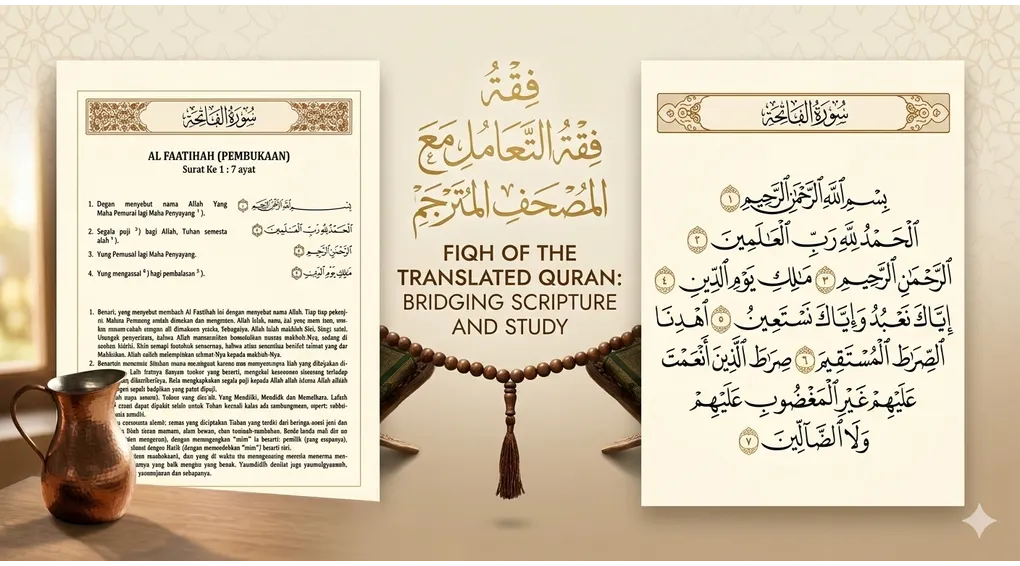
In the daily lives of Muslims, reading the words of Allah Subhanahu wa Ta’ala is a noble act of worship. The Prophet Muhammad ﷺ highly encouraged his Ummah to consistently interact with this holy book. Contemporary practices show a widespread use of books that place the Quranic verses alongside their translations in local languages or Latin transliterations. This condition gives rise to a specific branch of Islamic jurisprudence (fiqh): what is the ruling on touching a translated Quran while in a state of ritual impurity (hadath), whether minor (due to breaking wudu) or major (such as junub)?
Scholars of the Shafi’i school have established standard parameters regarding the ruling of touching a pure mushaf (the Arabic Quran) versus a book of tafsir (exegesis). If a book holds the status of a pure mushaf, it is strictly forbidden (haram) for a person in a state of impurity to touch or carry it.
This prohibition serves as a profound manifestation of reverence (ta’dhim) for the word of Allah. Therefore, a Muslim must purify themselves first. If you are currently in a state of major impurity, please learn the complete guide to the obligatory bath (ghusl) to adequately restore your ritual purity. However, if the book is classified as a book of tafsir, it becomes permissible (halal) to touch it.
The challenge arises when we evaluate the physical form of modern translated Qurans. Their layout typically centers the intact Arabic verses, surrounded by translations in the margins or between the lines. This specific format closely resembles what early scholars termed a Mushaf Muhashsha (a mushaf endowed with marginal notes).
The Status of Translated Mushafs According to Shafi’i Scholars
To dissect this issue, we must refer to the authoritative (mu’tamad) literature within the Shafi’i school. There is a nuanced divergence of opinion between two late masters of Shafi’i fiqh: Imam Ibn Hajar al-Haytami and Imam Shamsuddin al-Ramli. Both formulated strict criteria to determine whether a printed text is judged as a pure mushaf or a book of tafsir. The foundational reference for this distinction is excellently recorded in the book Tuhfat al-Muhtaj, volume 1, page 151.
The original Arabic text states:
وفي الكردي ما نصه قال الشارح في حاشية فتح الجواد ليس منه مصحف حشي من تفسير أو تفاسير، وإن ملئت حواشيه وأجنابه وما بين سطوره؛ لأنه لا يسمى تفسيرا بوجه بل اسم المصحف باق له مع ذلك وغاية ما يقال له مصحف محشي اهـ. وفي فتاوى الجمال الرملي أنه كالتفسير وفي الإيعاب الحل، وإن لم يسم كتاب تفسير أو قصد به القرآن وحده أو تميز بنحو حمرة على الأصح وفي شرح الإرشاد للشارح المراد فيما يظهر التفسير وما يتبعه مما يذكر معه ولو استطرادا، وإن لم يكن له مناسبة به والكثرة من حيث الحروف لفظا لا رسما ومن حيث الجملة فتمحض إحدى الورقات من أحدهما لا عبرة به اهـ وكذا في فتح الجواد والإيعاب انتهى كلام الكردي. اه تحفة المحتاج ج 1 ص ١٥١
The View of Imam Ibn Hajar al-Haytami: It Remains a Mushaf
Referring to the text above, Ash-Sharih (Imam Ibn Hajar) in Hashiyah Fath al-Jawad argues that a mushaf filled with marginalia (mushaf muhashsha) containing tafsir does not consequently transform into a book of tafsir. Even if all its margins, edges, and interlinear spaces are densely packed with translated text or exegesis, it is by no means designated as a book of tafsir.
He evaluates the object from the perspective of formal nomenclature and the essence of its creation. The name “Mushaf” remains firmly attached to the physical book. The utmost designation for such a book is merely “a mushaf provided with marginal notes.”
For adherents of this view, the ruling on touching a translated Quran without ritual purity is haram. A person in a state of major impurity is absolutely prohibited from holding it, as detailed extensively in the prohibitions for a person in a state of junub according to Shafi’i fiqh, because, in substance, the book is still judged as a pure mushaf. This regulation aligns perfectly with the obligation to strictly maintain a state of purity before interacting with the Divine Speech.
The View of Imam Shamsuddin al-Ramli: Equated with a Book of Tafsir
Conversely, the text also cites the perspective from Fatawa al-Jamal al-Ramli. He articulates that a book with such a format is considered equivalent in status to a book of tafsir. This explanation is reinforced in the book Al-I’ab, which affirms the permissibility of touching it.
Imam al-Ramli emphasizes the reality of its physical condition. Even if the item was not initially intended as a book of tafsir, or was deliberately printed with the intention of making the Quran its primary text, it may be touched by a person in a state of impurity, provided that the volume of the translated text is more dominant. In fact, this permissibility remains applicable according to the stronger opinion (al-ashah), even if the Quranic text is deliberately distinguished with red ink to make it stand out.
For students, santris, or university scholars who frequently interact with translations while possessing a barrier to purification, this opinion offers a legislated convenience. Naturally, a solid understanding of the boundaries of ritual purity is still required, especially in deeply understanding the definition of wudu linguistically and terminologically so we know exactly when an act of worship or interaction with a mushaf is considered valid.
Guidelines for Calculating the Volume of Tafsir and Quranic Text
If we act upon the accommodating view of Imam al-Ramli, there is an absolute condition that must be met: the volume of the letters in the tafsir or translation must numerically exceed the letters of the Quranic text.
How is this calculated? The text from Syarh al-Irshad provides a highly precise calculation framework:
- Scope of Text: The volume assessment encompasses all explanatory text. This includes instances where the author deliberately inserts stories, Arabic grammatical rules, or tangential discussions (istithrad). All additional Latin or translated text within the translated mushaf counts toward this dominating tally.
- Calculation Based on Pronunciation (Lafal): The benchmark for counted letters refers to the spoken pronunciation, not the written script (rasm). For example, a letter with a tashdid (doubling mark) is counted as two letters, even though it is written as one.
- Calculated in Totality: The dominance of the text is evaluated cumulatively over the entire volume of the book. Supposing there are one or two pages containing purely verses without a single thread of translation, this does not nullify its overall status as a book of tafsir, provided the book as a whole remains dominated by the translated text. This leniency greatly assists the Ummah, considering the strict criteria in the Sharia regarding which acts of worship require wudu before their execution.
Comparison of the Views of Ibn Hajar and al-Ramli


To facilitate understanding of the differences between these two grandmasters, here is a comparative table regarding the status of a translated mushaf:
| Aspect of Assessment | View of Imam Ibn Hajar al-Haytami | View of Imam al-Ramli |
| Status of the Book | Remains a pure Mushaf (Mushaf Muhashsha) | Transforms into a Book of Tafsir |
| Focus of Assessment | Initial printing intent and original name | Physical reality and dominance of letter count |
| Ruling on Touching in Hadath | Haram (Forbidden) to touch and carry | Halal (Permissible) to touch and carry |
| Condition for Permissibility | None (Purification is strictly obligatory) | The volume of translated text must be greater |
FAQ: Touching a Translated Quran
Is a person in a state of junub allowed to hold a translated Quran?
It depends on which scholarly view is followed. According to Ibn Hajar, it is not permissible. According to al-Ramli, it is permissible with the absolute condition that the translated letters (in Latin/local language) exceed the number of letters of the Quranic verses throughout the entire book.
What is the safest way to navigate this difference of opinion?
The path of highest etiquette and precaution (ihtiyat) is to always habituate oneself to performing wudu before touching a translated mushaf, in alignment with the fatwa of Ibn Hajar. However, for religious teachers, menstruating women who are reviewing their memorization (muraja’ah), or students in a classroom where maintaining wudu is difficult, adopting the view of Imam al-Ramli is a valid form of Sharia facilitation.
Does this ruling apply to Fiqh books?
By the consensus (ijma’) of Shafi’i scholars, fiqh books may be touched by individuals in a state of impurity because the Quranic texts within them are very minimal and are utilized solely as supporting evidence.
Conclusion
The rich literature of the Shafi’i school paves the way for ease without eradicating the attitude of supreme reverence toward the Quran. Choosing which Shafi’i fiqh opinion to follow regarding touching a translated Quran should be tailored to the urgency and specific conditions of each individual, all while maintaining perfect etiquette (adab) before the words of Allah.
Reference
al-Haitamī, Aḥmad bin Muḥammad bin ʿAlī bin Ḥajar. Tuḥfat al-Muḥtāj fī Syarḥ al-Minhāj. Egypt: al-Maktabah al-Tijārīyah al-Kubrā, 1357 AH/1983 CE; subsequently reprinted in Beirut: Dār Iḥyāʾ al-Turāth al-ʿArabī, 10 volumes. (Accompanied by Ḥāshiyah ʿAbd al-Ḥamīd al-Syarwānī and Ḥāshiyah Aḥmad bin Qāsim al-ʿAbbādī).


