

Amidst the vibrant contemporary theological discussions, one topic that frequently ignites fierce debate is the concept of Tawassul in Islam, particularly when practiced near the resting places of the Prophets or the Awliya (Saints) of Allah.
Certain groups hastily hurl severe accusations: “That is shirk (polytheism)!”, “That is grave worship!”, or “You are supplicating to corpses!” Naturally, these profound accusations distress many Muslims who have historically practiced tawassul as a profound expression of love and reverence for the righteous predecessors.
In reality, the practice of tawassul (seeking an intermediary in supplication) is an integral component of the Ahl al-Sunnah wal Jama’ah tradition, firmly grounded in robust scriptural evidence. However, in this exposition, we will not merely debate using textual proofs (dalil naqli). Instead, we will employ a refreshingly rational and indisputable logical approach.
This approach is renowned as the “Elephant and Gold Logic.” This brilliant argument was popularized by the great scholar, Shaykh Sayyid Zaky Ibrahim, in his remarkable magnum opus, Al-Ifham wa al-Ifham. Let us meticulously dissect this logic to rectify the misconception that performing tawassul equates to worshipping the physical grave.
Understanding the Core Accusation: “Worshipping the Physical”
The fundamental root of the accusation of polytheism (shirk) directed at those who perform tawassul at graves is the sheer assumption that they are requesting from and venerating the physical object before them. The accusers erroneously presume that the supplication is directed at the soil, the tombstone, or the buried physical remains.
They assume the supplicant believes that the lifeless corpse itself will fulfill their requests. If this assumption were factually accurate, it would undoubtedly constitute manifest polytheism.
However, is that truly the theological conviction of the person performing tawassul? This is precisely where the “Elephant and Gold Logic” enters to entirely dismantle that flawed assumption.
Dissecting the “Elephant and Gold Logic” (A Rational Argument)
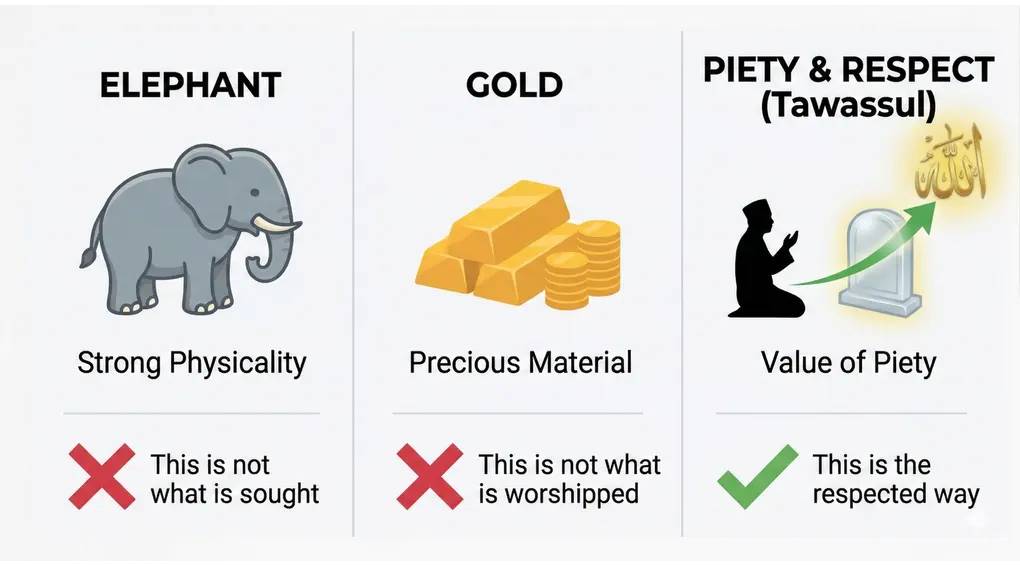
Shaykh Sayyid Zaky Ibrahim invites us to think with crystalline clarity. If it were true that the reverence and supplication at a tomb were predicated upon the worship of the physical entity, the material, or the corpse, humanity should logically choose other objects that are physically vastly superior to a deceased human body.
Here is the meticulous breakdown of the logic:
1. If Worshipping the Physical, the Elephant is More Deserving
Let us discuss physical size and brute strength. The human body, especially one that has passed away, is a frail, diminutive entity that will eventually disintegrate into the earth.
If our ultimate objective were to worship physical strength, why do we not simply worship the Elephant? Physically, an elephant is exponentially larger, stronger, and more majestic than any human anatomy. Yet, factually, no Muslim goes to a zoo to perform tawassul or supplicate before an elephant enclosure. This empirically proves that physical size or strength is absolutely not the rationale behind our reverence for the Awliya.
2. If Worshipping the Material, Gold is More Deserving
Let us discuss material or intrinsic monetary value. The human corpse consists of flesh and bones that possess zero commercial value and will ultimately undergo decomposition.
If the objective of tawassul were to venerate precious materials, why do we not worship a solid block of Gold or a diamond? Materially, gold is astronomically more expensive, perpetually radiant, and infinitely more durable than human skeletal remains. Yet, we never witness a pious person placing a block of gold in front of themselves and praying to seek intercession from it.
The Crucial Point: The indisputable fact that we do not worship the elephant (which is physically powerful) and we do not venerate gold (which is materially priceless), logically proves that our reverence at the tomb of a Prophet or Saint has absolutely zero correlation with the worship of their physical or material remains.
The accusation of “grave worship” collapses instantaneously under the weight of this simple, rational logic.
What Are We Truly Seeking When Performing Tawassul?
If we are not seeking the physical prowess of the elephant nor the material wealth of gold, then what exactly are we seeking? Why do we specifically visit the graves of the righteous, whose physical bodies may have already merged with the earth?
The definitive answer is that we are seeking Ma’na al-Khalid (The Eternal Value). We are actively seeking the spiritual blessings (barakah) from an individual who possessed an intimate, profound proximity to Allah. In the science of Tasawwuf (Islamic spirituality), this proximity is recognized as the concept of a Rabbani servant, a spiritual station (maqam) that ensures their supplications are never rejected by the Divine.
We are not venerating the mound of dirt. We are profoundly honoring the “content” or the soul that once resided there. We are honoring the eternal values inherently attached to the Saint during their earthly life, namely:
- Unshakeable Faith (Iman) and Piety (Taqwa).
- Their profound proximity (qurbah) to Allah SWT.
- Their Jihad and relentless struggle for the sake of Islam.
It is these spiritual values that will never perish, unlike the physical body that disintegrates. When we perform tawassul, we are utilizing their beloved proximity to Allah as an intermediary medium (wasilah) so that our own supplications—which are often stained with sins—are heard more rapidly by Allah SWT.
We honor the “vessel” (the tomb/body) simply because it was once occupied by such a magnificent “content” (a pure soul).
The Strict Distinction Between Tawassul and Shirk
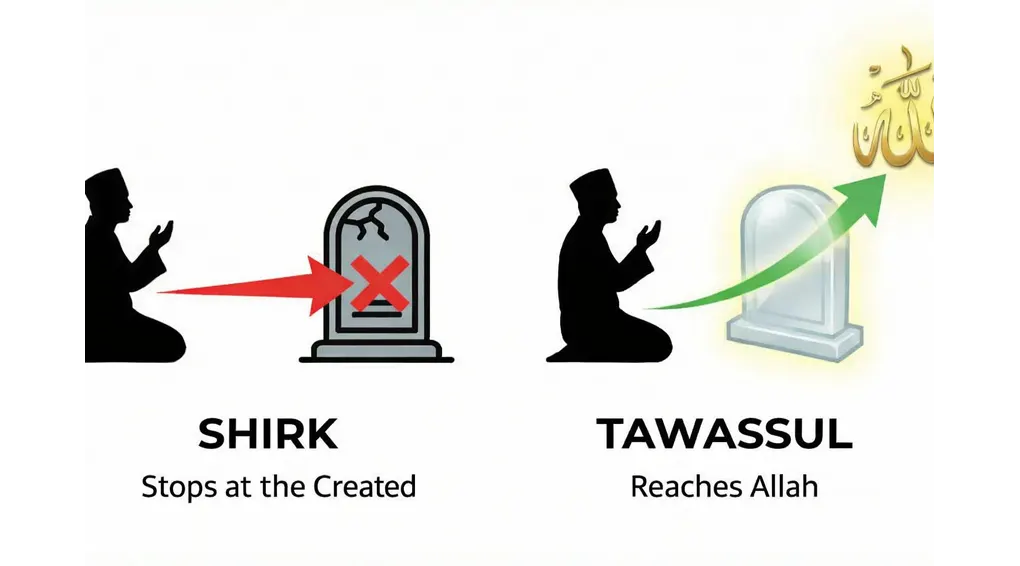
To ensure absolute clarity and eradicate any lingering doubts, let us examine the fundamental theological differences between the Islamic practice of tawassul and the polytheistic practices of idol worshippers.
Observe the following comparative table:
| Distinguishing Aspect | Tawassul (Islamic Teaching) | Shirk (Idol Worship) |
| Ultimate Destination of Dua | Exclusively to Allah SWT alone. | To the idol or deity being worshipped. |
| Position of the Object | As a Wasilah (intermediary/channel) beloved by Allah. | As an Arbab (rival lord) possessing independent power. |
| Conviction of the Heart | Firm belief that the Prophet/Saint has no independent power to grant prayers. Only Allah grants them. | Firm belief that the idol/deity possesses autonomous power to grant benefit or inflict harm. |
| Example of Utterance | “O Allah, I ask You by the blessing/honor of Your Prophet…” | “O Latta/Uzza, grant me provision…” |
From the table above, it is radiantly clear that tawassul is the exact antithesis of shirk. On the contrary, the individual performing tawassul is actively affirming Tawhid (Monotheism), because they acutely recognize their own weakness and their desperate need for a spiritual “connection” from a servant who is vastly closer to Allah, the Almighty.
Frequently Asked Questions (FAQ) About Tawassul
Here are some frequently asked questions regarding this topic:
Is Allah not All-Hearing? Why must one go to the grave of a Saint to pray? Why not just pray at home?
Indeed, Allah is All-Hearing everywhere. However, Allah has also designated specific locations that possess unique blessings (amakin mubarakah) where His mercy descends more abundantly. Prominent examples include the Masjid al-Haram in Mecca or the Rawdah in Medina. The same principle applies near the resting places of His beloved servants. Praying there is not because Allah is only present there, but to seek a more profoundly focused spiritual atmosphere (khushu’) and to acquire blessings (tabarruk) from a location frequently visited by Allah’s divine mercy.
Can the deceased actually hear our prayers or greetings?
Yes. According to the established creed of Ahl al-Sunnah wal Jama’ah, the souls of the deceased, particularly the Prophets and the Awliya, remain alive in the realm of the Barzakh and can indeed hear. The Messenger of Allah ﷺ himself stated when addressing the dead polytheists at the Battle of Badr: “You do not hear what I say any better than they do.” (Narrated by Bukhari & Muslim).
Is this Elephant and Gold logic grounded in scholarly texts?
Yes, this logical framework is explicitly detailed by Shaykh Sayyid Zaky Ibrahim, a highly respected Al-Azhar scholar, in his authoritative book Al-Ifham wa al-Ifham. This is not a random fabrication, but rather the rigorous jurisprudential reasoning (ijtihad) of a scholar aiming to educate the Ummah through a highly rational and irrefutable methodology.
Conclusion
The volatile accusation that Tawassul in Islam equates to grave worship frequently stems from a superficial misunderstanding of the outward practice, completely ignoring the pure intention and theological conviction residing within the practitioner’s heart.
Guided by the Elephant and Gold Logic, we comprehensively understand that our reverence for the tombs of the Awliya is absolutely not a primitive form of physical worship. It is a profound, sophisticated expression of love and respect for eternal values of piety.
We do not worship the massive elephant, we do not venerate expensive gold, and we certainly do not worship graves. We exclusively worship Allah SWT, and we deeply love whomever He loves.
This logical exposition is merely one of the countless proofs verifying the validity of this practice. To explore the textual proofs (dalil naqli) from the Quran and Hadith in intricate detail, please read our comprehensive guide on the comprehensive definition and authentic proofs of Tawassul.
Referensi
Ibrahim, Muhammad Zaki. Al-Ifhām and Al-Ifḥām: Issues of Intermediaries and Graves in the Light of Islamic Tolerance.


