How to Control Anger While Fasting: The Meaning of “Inni Shaim”

A Muslim man smiling patiently, placing his hand on his chest as a symbol of restraining his anger and saying 'Inni Saim' (I am fasting).

The worship of fasting (al-ṣawm) is a spiritual discipline that trains a believer to restrain their desires. Sharia guidance establishes that fasting is not merely restraining the stomach and genitals from dawn to sunset. More than that, fasting is a process of tazkiyatun nafs (purification of the soul) that demands its practitioners to guard their … Read more
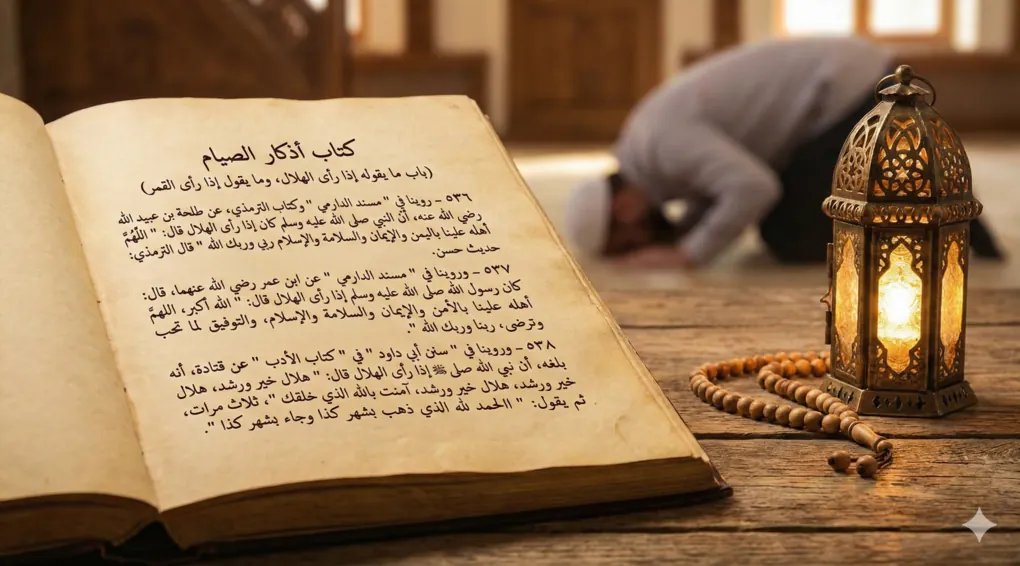
Complete Ramadan Fasting Duas & Dhikr Guide (Al-Adhkar)

A Muslim prostrates with deep reverence (khushoo) during the qiyam al-layl night prayer, immersed in the brightly lit and serene ambiance of a mosque on a Ramadan night.

The holy month of Ramadan and the worship of fasting in general hold a high position in Islamic faith. In order for this worship to reach a degree of perfection, a servant needs to adorn their tongue with remembrance and supplication based on the Sunnah of the Prophet Muhammad shallallahu ‘alaihi wa sallam. This article … Read more

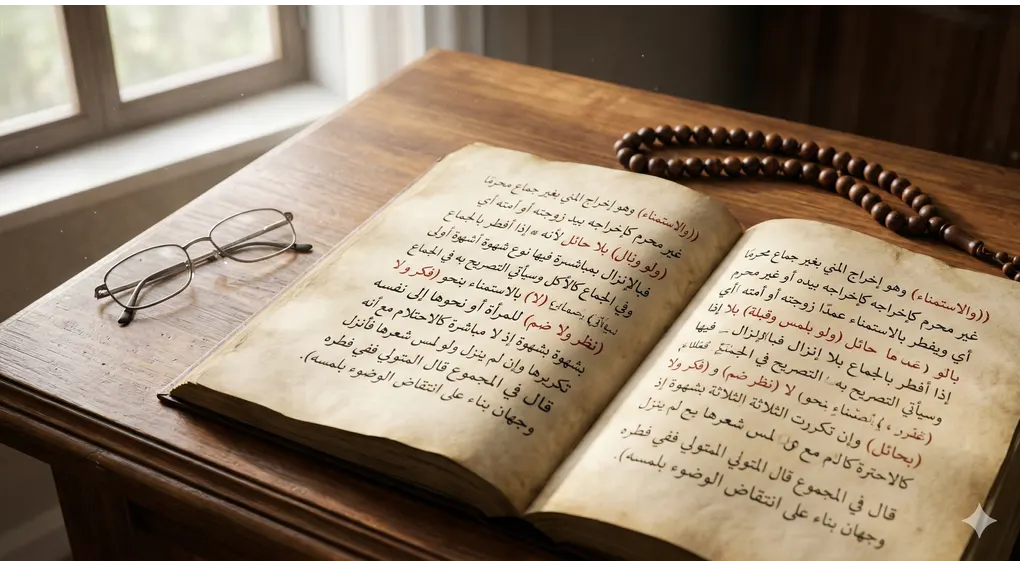
Emission of Semen Without Touch While Fasting: An Analysis of Asna al-Matalib

Open classical Arabic Fiqh manuscript on a carved wooden book stand with reading glasses and wooden prayer beads on a clean wooden desk. Natural daylight window in the background.

In performing the worship of fasting (al-ṣawm) during the holy month of Ramadan, a believer is tested not only by enduring hunger and thirst but also by controlling the surges of biological desires. The very essence of fasting is al-imsāk, a total effort of restraining oneself from all invalidators from the break of dawn until … Read more

The Jurisprudential Ruling on Masturbation While Fasting and Limits of Physical Contact

An open antique Arabic fiqh manuscript resting on a wooden rehal stand, positioned in front of a mashrabiya patterned window with natural daylight. Classic calligraphy fills the pages.

In the rigorous performance of the fast (al-Ṣawm), a believer is summoned not merely to endure hunger and thirst but to exert profound discipline over their base desires. The spiritual essence of fasting lies in al-Imsāk—a mechanism of comprehensive self-restraint from everything that invalidates the fast, extending from the precise moment of dawn until sunset. … Read more

The Fiqh of Ramadan Fasting: History, Evidence, and Determining the New Moon

An illustration of the classical book Fathul Mu'in lying open on a wooden table, set against a background of a mosque window, a crescent moon, and dates, symbolizing the discussion of Fiqh and the laws of Ramadan fasting.

Every year, the question “how many days until Ramadan?” sparks widespread excitement and discussion. For Muslims worldwide, this month is not merely an annual routine, but a highly anticipated sacred period. However, beneath this enthusiasm, have we truly comprehended how the Fiqh of Ramadan Fasting governs our worship? From the methodology of sighting the crescent … Read more

Complete Guide to the Ramadan Fasting Intention and Its Meanings: Arabic, Transliteration, and Fiqh Rulings

The closed Asna al-Matalib book on a rehal next to a lit fanoos lantern, against a backdrop of a crescent moon and night sky, symbolizing the night intention for fasting.

The holy month is fast approaching. For Muslims, ensuring that their acts of worship are legally valid is a primary priority. One of the most fundamental pillars of fasting in Ramadan is the intention (niyyah). Without the correct intention, a person’s fast may be deemed invalid, reducing their effort to merely enduring hunger and thirst. … Read more

How Many Pillars of Fasting Are There? A Complete Guide According to Safinatun Naja (Shafi’i Fiqh)

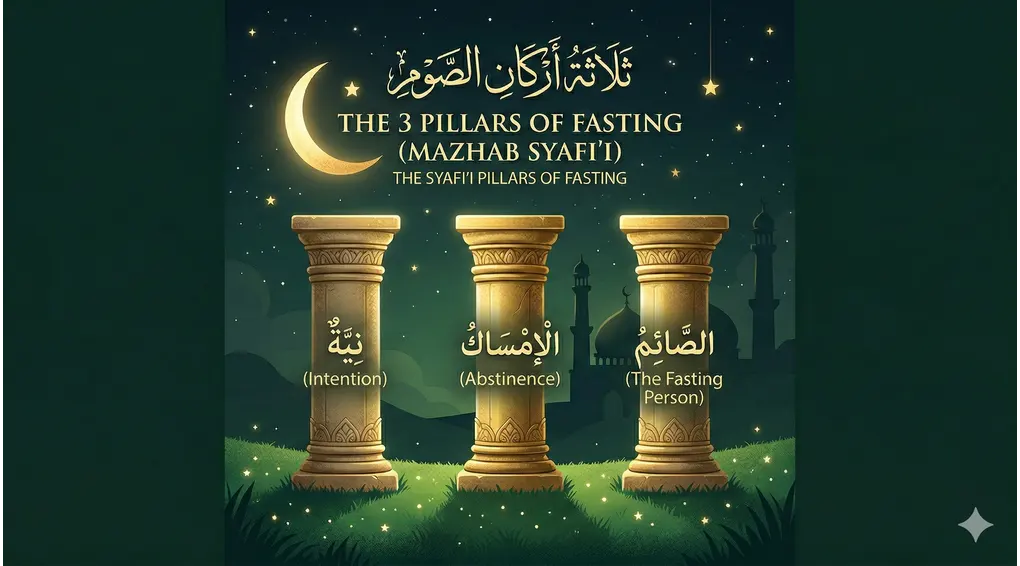
An illustrated scene under a starry night sky with a mosque silhouette. Three golden classical pillars stand in a green field. Arabic text at the top says "ثَلاَثَةُ أَرْكَانِ الصَّوْمِ" with English translation: "THE 3 PILLARS OF FASTING (MAZHAB SYAFI'I)". Each pillar is labeled with Arabic text and an Indonesian translation in parentheses: (Niat), (Menahan Diri), (Orang yang Berpuasa). Smaller text says "Rukun Puasa Syafi'i".

The holy month of Ramadan or days of voluntary fasting often raise fundamental questions for us: exactly how many pillars of fasting are there? Is it enough simply to endure hunger and thirst? Or are there other foundational elements that determine the validity of our worship? Many people assume there are only two pillars of … Read more

Salah or Fasting: Which is the Best Physical Worship According to Fiqh?

Illustration comparing prayer and fasting as acts of worship in Islamic jurisprudence, symbolized by a balance scale with the Quran and dates.

Have you ever wondered, when you have free time, whether it is better to perform more voluntary prayers or observe more voluntary fasting? When seeking closeness to Allah, many believers wonder what constitutes the best physical worship. This question frequently arises in the minds of those who wish to elevate their spiritual rank but feel … Read more

Sexual Intercourse During Ramadan: Fiqh Ruling & Kaffarah (Asna al-Matalib)

An analog wall clock shows the time for **Fajr** in front of a window with soft bluish dawn light, with an open fiqh book and prayer beads resting on a wooden table.

In the Islamic Jurisprudence (Fiqh) and Spirituality, fasting (al-Ṣawm) is not merely abstaining from food and drink. Its essence is al-Imsāk, a strict mechanism of self-control from everything that invalidates it, including biological desires. Among the many things that invalidate a fast, the legal ruling regarding sexual intercourse while fasting or having sexual relations during … Read more

The Fiqh Ruling on Intercourse, Masturbation, and Kissing While Fasting

Pasangan suami istri Muslim duduk berjarak membaca Al-Qur'an di ruang tamu yang terang pada siang hari bulan Ramadhan, simbol menahan diri.

Observing the fast is not merely about enduring hunger and thirst. For many individuals, the most formidable challenge lies in the ability to control their desires and carnal lust (shahwah). Questions frequently arise, particularly among young married couples: “To what extent is physical intimacy permissible during the day?”, “Does unintentionally looking at the opposite sex … Read more