
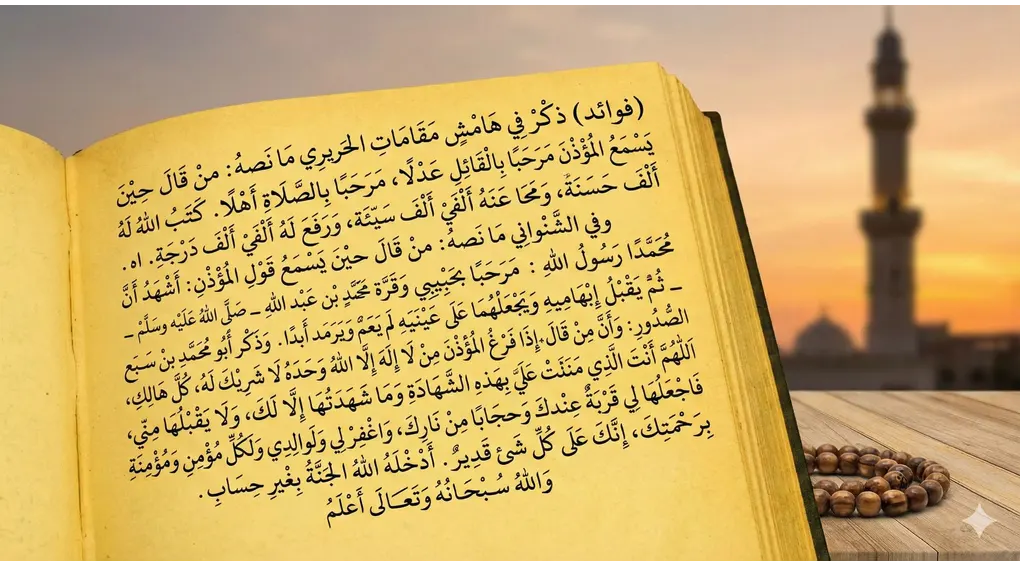
The resounding echo of the call to prayer is not merely a daily marker that prayer time has arrived. For Muslims who deeply comprehend the meaning of the Adhan and Iqamah, the moment it reverberates is a highly precious spiritual opportunity. During this time, the gates of heaven are opened, and Allah’s mercy descends, making it one of the mustajab times for prayer.
However, many of us are only familiar with the standard method of answering the Adhan according to the Sunnah—which involves repeating the words of the caller. In reality, there are profound, extraordinary practices to perform when hearing the Adhan that possess immense virtues (fada’il) but remain largely unknown to the general public.
The primary reference for these practices among traditional scholars and Islamic institutions in the archipelago is the classical text I’anat al-Talibin. In this monumental work, Shaykh Abu Bakr Shata al-Dimyati cites several crucial narrations regarding specific supplications during the Adhan, offering virtues ranging from maintaining eye health to the ultimate guarantee of entering Paradise.
This article will thoroughly explore the original Arabic texts, the methods of application, and the profound theological explanations found in I’anat al-Talibin (Volume 1, page 281).
The Importance of Referring to Authoritative Classical Texts
Before delving into the core practices, we must understand the academic weight of this reference. I’anat al-Talibin is an authoritative commentary (sharh) on the book Fath al-Mu’in, serving as a mandatory curriculum in almost all traditional Islamic boarding schools (pesantren).
The contents of this book are not mere personal opinions; they are meticulous transmissions from preceding grand scholars. In the chapter concerning the Adhan, the author inserts “Benefits” (Fawa’id) in the margins, containing supplementary spiritual practices (fada’il al-a’mal). While scholars of Hadith might discuss the specific transmission chains of some of these acts, the vast majority of Fiqh and Tasawwuf scholars agree on their implementation under the framework of fada’il al-a’mal (virtuous deeds) and as a manifestation of profound love (mahabbah) for the Prophet Muhammad ﷺ.
Here are the three primary practices mentioned in this esteemed reference when hearing the Adhan.
1. Welcoming the Call with “Marhaban” (A Joyous Reception)
The first practice teaches us not just to listen passively, but to actively welcome the sound of the Adhan with spiritual joy. Often, we feel burdened or interrupted by the Adhan because we are preoccupied with worldly work. This practice trains the heart to feel genuine happiness when summoned by the Creator.
The Original Text
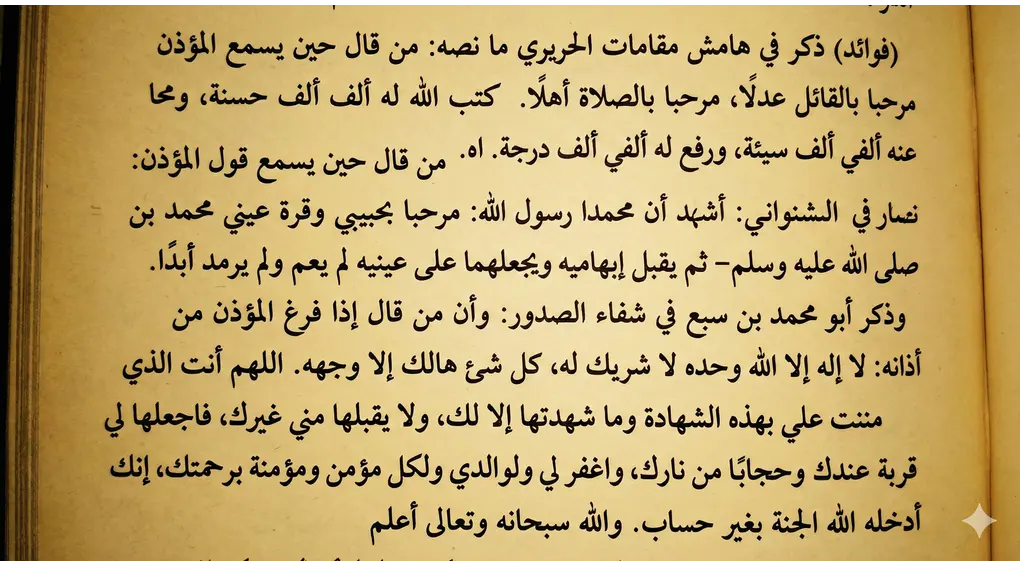
The reference mentions that this narration is found in the marginalia (hamish) of Maqamat al-Hariri:
( فوائد ) ذكر في هامش مقامات الحريري ما نصه : من قال حين يسمع المؤذن مرحبا بالقائل عدلا , مرحبا بالصلاة أهلا . كتب الله له ألف ألف حسنة , ومحا عنه ألفي ألف سيئة , ورفع له ألفي ألف درجة
Transliteration and Meaning
When you hear the caller (who must meet the conditions for a valid Mu’adhdhin), it is recommended to say:
- Latin: Marhaban bi al-qa’ili ‘adlan, marhaban bi al-salati ahlan.
- Meaning: “Welcome, O utterer of justice (truth); welcome, O prayer, as family (a part of us).”
Explanation and Virtues The word “Marhaban” implies a spacious, warm welcome. Uttering this means we are opening our chests to accept Allah’s call. According to the text, the virtues of this simple recitation are astronomically high:
- One million good deeds are recorded (alfa alfi hasanah).
- Two million bad deeds are erased (alfay alfi sayyi’ah).
- One is elevated by two million degrees/ranks (alfay alfi darajah).
In classical Arabic, the phrase “a thousand thousands” (alfu alfin) is frequently used to denote a multitude or an infinite, uncountable abundance. This illustrates Allah’s immense appreciation for a servant who welcomes the call to prayer with a cheerful heart rather than a grumble.
2. The Secret of Kissing the Thumbs (Taqbil al-Ibham) for Eye Health

The tradition of kissing the thumbs (taqbil al-ibham) upon hearing the name of the Prophet Muhammad ﷺ during the Adhan is widely believed to be a means (wasilah) for preserving eye health. This practice is highly popular among practitioners of Sufi orders (Tariqah). Its foundation is explicitly written in I’anat al-Talibin, which quotes from the book of al-Shanawani.
This act is performed specifically when the mu’adhdhin recites the testimony of the Messenger: “Ashhadu anna Muhammadan Rasulullah” (I bear witness that Muhammad is the Messenger of Allah).
The Original Text and Method




وفي الشنواني ما نصه : من قال حين يسمع قول المؤذن : أشهد أن محمدا رسول الله : مرحبا بحبيبي وقرة عيني محمد بن عبد الله – صلى الله عليه وسلم -. ثم يقبل إبهاميه ويجعلهما على عينيه لم يعم ولم يرمد أبدا
Transliteration
Marhaban bi habibi wa qurrati ‘ayni Muhammad ibn ‘Abdillah — sallallahu ‘alayhi wa sallam.
Meaning: “Welcome, my beloved and the coolness of my eyes, Muhammad bin Abdullah — may the peace and blessings of Allah be upon him.”
The Procedure (Kayfiyyah)
Based on the text “thumma yuqabbilu ibhamayhi wa yaj’aluhuma ‘ala ‘aynayhi”:
Gently rub both thumbs over the eyelids.
Recite the supplication above upon hearing the Shahadah for the Prophet.
Kiss both thumbs (typically the nail area).
The Virtue (Khasiyyah)
The text promises: “Lam ya’ma wa lam yarmad abadan”. This translates to: whoever routinely practices this will never go blind and will never suffer from eye diseases forever. This is a profound form of tabarruk (seeking divine blessing) through the name of the Prophet ﷺ. We wipe the eyes we use to view the world with the blessed name of Allah’s beloved, praying they remain physically healthy and spiritually guarded against looking at sinful things.
3. A Special Supplication for Paradise Without Reckoning
This third practice is perhaps the least known among the laity. Usually, we only recite the standard post-Adhan prayer (Allahumma rabba hadhihi al-da’wati al-tammah…). However, Abu Muhammad ibn Sab’, in his book Shifa’ al-Sudur, provides an additional supplication carrying a soul-stirring guarantee.
The Original Text
This formulation beautifully encapsulates the deepest aspects of Tawhid (Islamic monotheism), reinforcing the very core of our pillars of faith:
وذكر أبو محمد بن سبع في شفاء الصدور : وأن من قال إذا فرغ المؤذن من أذانه : لا إله إلا الله وحده لا شريك له ، كل شئ هالك إلا وجهه . اللهم أنت الذي مننت علي بهذه الشهادة وما شهدتها إلا لك ، ولا يقبلها مني غيرك ، فاجعلها لي قربة عندك وحجابا من نارك ، واغفر لي ولوالدي ولكل مؤمن ومؤمنة برحمتك ، إنك على كل شئ قدير
Complete Transliteration
This prayer is recited immediately after the mu’adhdhin completely finishes the Adhan.
La ilaha illallahu wahdahu la sharika lah, kullu shay’in halikun illa wajhah. Allahumma anta al-ladhi mananta ‘alayya bi hadhihi al-shahadah, wa ma shahidtuha illa lak, wa la yaqbaluha minni ghayruk, fa ij’alha li qurbatan ‘indaka wa hijaban min narik, wa ighfir li wa li walidayya wa li kulli mu’minin wa mu’minatin bi rahmatik, innaka ‘ala kulli shay’in qadir.
Translation per Segment
- “There is no deity worthy of worship but Allah alone, having no partners. Everything will perish except His Face (His Essence).”
- “O Allah, You are the One who has bestowed upon me the blessing of this testimony (Shahadah).”
- “And I do not testify except for You alone, and no one can accept it from me other than You.”
- “So make this testimony a means of closeness (qurbah) to You and a veil (hijab) from Your Hellfire.”
- “And forgive me, my parents, and every believing man and woman by Your mercy.”
- “Verily, You are capable of all things.”
The Ultimate Virtue
The reference states: “Adkhalahu Allahu al-jannata bi ghayri hisab”. Meaning: Allah will admit him into Paradise without reckoning (without accounting for his deeds). This signifies total surrender, acknowledging that our faith is a pure gift from Allah, not merely the result of our own efforts. We pray that this faith is safeguarded until death as our ultimate ticket to Paradise.
Summary Table of Adhan Practices in I’anat al-Talibin
To facilitate memorization and daily application, here is a summary table:
| No | Time of Execution | Key Recitation (Latin) | Specific Physical Action | Primary Virtue |
| 1 | Upon hearing the mu’adhdhin’s first call | Marhaban bi al-qa’ili ‘adlan… | None | Erases sins, elevates spiritual ranks |
| 2 | When the Mu’adhdhin says Ashhadu anna Muhammadan Rasulullah | Marhaban bi habibi wa qurrati ‘ayni… | Kissing the thumbs & wiping the eyelids | Preserves eye health, prevents blindness |
| 3 | After the Adhan completely finishes | Allahumma anta al-ladhi mananta ‘alayya… | Raising hands (in supplication) | Admission to Paradise without reckoning |
Further Explanation Regarding “‘Adlan” and “Ahlan”
Perhaps some may ask about the meaning of the words in the first prayer. Why is the mu’adhin (caller to Adhān) called the proclaimer of justice?
The word “‘Adlan” ( عدلا ) here refers to absolute truth. The mu’adhin proclaims the kalimat at-tauhid and the call to Adhān, which is the most essential truth in this world. We welcome that sound as a sound of truth, not a sound of disturbance.
Whereas the word “Ahlan” ( أهلا ) means family or group. When we greet the prayer with the word “Ahlan”, we consider the prayer to be a part of ourselves, a part of our spiritual family that we long for, not a burden that weighs down our backs.
Strategies for Daily Implementation
Combining the three practices above may seem like a lot for beginners. However, once you get used to it, it will become a beautiful spiritual reflex. Here are some tips to make this practice a routine:
- Memorize One by One: Start with the shortest, which is responding with “Marhaban” when you hear the Adhān for the first time.
- Paste the Prayer Texts: You can print the prayers above and paste them on the wall near where you usually pray or in your workspace.
- Intend to Follow (Ittiba’): Intend with your heart to follow in the footsteps of the righteous scholars who have practiced this for centuries.
Practicing the contents of classical Islamic texts like this is also part of preserving the Islamic scholarly tradition which possesses a clear sanad (chain of transmission). We do not only worship physically, but also connect our spirituality with the authors of these books, such as Sheikh Zainuddin al-Malibari (author of Fathul Mu’in) and Sheikh Abu Bakar Syatha (author of I’anah at-Thalibin).
Frequently Asked Questions (FAQ)
To clarify understanding regarding practices when hearing the Adhān, here are some frequently asked questions:
Is the practice of kissing thumbs an innovation (bid’ah)?
Within the framework of Ahl al-Sunnah wa al-Jama’ah (particularly the Shafi’i school), this falls under the category of fada’il al-a’mal (virtuous deeds). Its basis stems from the practices (athar) and spiritual experiences (tajribah) of the righteous predecessors. As long as it is not deemed a mandatory pillar of prayer or a strict Sharia obligation, but rather an expression of profound love (mahabbah) for the Prophet ﷺ, it is highly recommended. The authoritative reference clearly exists in classical texts like I’anat al-Talibin.
2. Do these prayers replace the usual Adhān prayer?
No. The standard prayer (Allahumma rabba hadhihi al-da’wati al-tammah…) originates from an authentic Hadith narrated by Bukhari and carries the specific virtue of attaining the Prophet’s intercession (shafa’ah). The prayers from I’anat al-Talibin act as additions (ziyadah) to perfect the moment and multiply the rewards. You should recite them after completing the standard Adhan prayer.
3. What if I am in the bathroom when the Adhān is called?
If you are in the bathroom or toilet, it is strictly forbidden to verbalize the names of Allah or sacred verses. You should simply listen and reply internally within your heart. Once you exit the bathroom, you may verbally recite the prayers, provided too much time has not elapsed since the Adhan finished.
4. Where exactly is this text located in the book I’anah at-Thalibin?
According to references, this text is located in Volume 1, Page 281 (common print of the yellow book). Its location is in the discussion of the chapter on the Adhān and Iqamah, often at the bottom or middle of the page depending on the publisher (such as Toha Putra, Beirut: Dār al-Fikr or Darul Ilmi).
Closing
The classical text I’anat al-Talibin unveils magnificent spiritual treasures regarding the secret practices to perform when hearing the Adhan. By implementing these three acts—welcoming the call with marhaban, kissing the thumbs during the testimony of the Prophet, and reciting the special supplication for Paradise—we open ourselves to comprehensive divine blessings. We ask Allah to grant us physical health in this world to gaze upon the Quran and the faces of the scholars, and to grant us Paradise without reckoning in the Hereafter through the intercession of the Prophet Muhammad ﷺ.
Do not let the call to prayer pass by as mere background noise. Transform every echo into a fertile field for harvesting eternal rewards.
Wallahu a’lam bi al-sawab.
Reference
Abū Bakr (al-mashhūr bi-al-Bakrī) ‘Uthmān ibn Muḥammad Shaṭṭā al-Dimyāṭī al-Shāfi‘ī. I‘ānat al-Ṭālibīn ‘alā Ḥall Alfāẓ Fatḥ al-Mu‘īn (ḥāshiyah ‘alā Fatḥ al-Mu‘īn bi-Sharḥ Qurrat al-‘Ayn bi-Muhimmat al-Dīn). 1st ed. Beirut: Dār al-Fikr, 1997. Vol. 1, p. 281.


