
Every Muslim woman strives for her worship to be valid and accepted by Allah ﷻ. One of the fundamental requirements to resume worship after a menstrual period is purification. However, doubts often arise: Is the mandatory bath we perform after menstruation actually valid? Has the water truly reached every required part of the body?
Performing a correct ritual bath (ghusl) after menstruation is not simply about wetting the body. There are specific rules and pillars that must be fulfilled to attain the legal status of being “pure.” Based on classical Islamic jurisprudence (Fiqh) texts such as Fatḥ al-Qarīb al-Mujīb and Al-‘Azīz Sharḥ al-Wajīz, we will detail the correct procedure in a clear and accessible manner.
What is Ghusl Haid (Post-Menstrual Purification)?
In Islam, menstruation is considered a state of major ritual impurity (ḥadath akbar). To lift this impurity and return to a state of Thaharah (Purification), a woman must perform ghusl, which is a full-body ritual bath. The obligatory ghusl is defined legally as flowing water over the entire body accompanied by a specific intention.
Many assume this bath requires complicated rituals. In reality, the essence of ghusl rests on two things: the intention and the thoroughness of the water reaching all skin and hair. If these two conditions are met, the bath is valid. Let’s break down these rules one by one.
The Pillars (Arkān) of Ghusl: The Key to Valid Worship
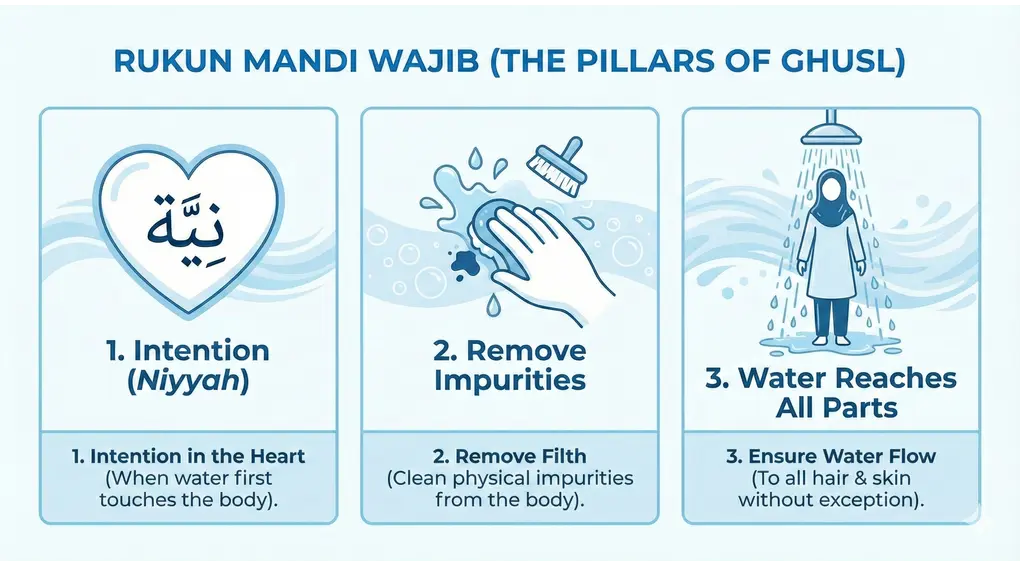
Based on the book Fatḥ al-Qarīb, there are three mandatory elements (Arkān) that must be present during the ghusl. If any of these are missed, the bath is deemed invalid, meaning you cannot yet perform Salah (Obligatory Prayer).
1. The Intention (Niyyah) and Its Timing
The first pillar is the intention (Niyyah). For the obligatory post-menstrual bath, the intention must be formulated in the heart. This serves to differentiate a regular bath (meant for hygiene) from an act of worship.
The author of Fatḥ al-Qarīb states:
قوله: (وفرائض الغسل ثلاثة أشياء): أحدها (النية)، فينوي الجنب رفع الجنابة أو الحدث الأكبر ونحو ذلك، وتنوي الحائض والنفساء رفع حدث الحيض أو النفاس. وتكون النية مقرونة بأول الفرض، وهو أول ما يغسل من أعلى البدن أو أسفله؛ فلو نوى بعد غسل جزء وجبت إعادته.
Meaning: “(The obligatory components of Ghusl are three things): The first is (Intention)… a menstruating or postpartum woman intends to lift the state of menstruation or postnatal bleeding. The intention must be simultaneous (muqāranah) with the beginning of the obligatory act, which is the very first part washed from the top or bottom of the body. If one intends after washing a part, that part must be rewashed.”
The intention for ghusl after menstruation to be recited in the heart is: Nawaitul ghusla li raf’il ḥadathil ḥaiḍi lillāhi ta’ālā. (“I intend to perform ghusl to remove the major ritual impurity of menstruation for the sake of Allah Ta’ala.”)
2. Removing Physical Impurities (Najis)
Before pouring water over the entire body, you must ensure no physical impurities are attached to the skin. To understand what constitutes impurity, review the definition of Najis in Islam.
Fatḥ al-Qarīb highlights a nuanced difference of opinion between the two greatest pillars of the Shafi’i school regarding this:
قوله: (وإزالة النجاسة إن كانت على بدنه) أي المغتسل. وهذا ما رجحه الرافعي؛ وعليه فلا يكفي غسلة واحدة عن الحدث والنجاسة ورجح النووي الاكتفاء بغسلة واحدة عنهما. ومحله ما إذا كانت النجاسة حكمية؛ أما إذا كانت النجاسة عينية وجب غسلتان عنهما.
Meaning: “(And removing najis if it is on the body) of the one bathing. This is the preferred opinion of Al-Rafi’i; therefore, a single wash is not sufficient for both the ritual impurity and the physical impurity. However, Al-Nawawi preferred that a single wash suffices for both, provided the impurity is ḥukmiyyah (invisible/without physical trace). If the impurity is ‘ainiyyah (has a physical form), two washes are obligatory.”
To ensure absolute perfection, it is highly recommended to first wash away any remaining menstrual blood completely before initiating the ghusl.
3. Flowing Water Over All Hair and Skin
The final pillar is ensuring that purifying water completely covers every millimeter of hair and skin. No part should remain dry. For a guide on valid water, read about the types of water in Islam and their usage.
Fatḥ al-Qarīb details the strictness of this thoroughness:
قوله: (وإيصال الماء إلى جميع الشعر والبشرة)… ولا فرق بين شعر الرأس وغيره، ولا بين الخفيف منه والكثيف. والشعر المضفور إن لم يصل الماء إلى باطنه إلا بالنقض وجب نقضه… ويجب إيصال الماء إلى… ما يبدو من فرج المرأة عند قعودها لقضاء حاجتها. ومما يجب غسله المسربة، لأنها تظهر في وقت قضاء الحاجة
Meaning: “(And causing water to reach all hair and skin)… there is no difference between head hair and other hair, nor between thin and thick hair. Braided hair, if water cannot reach its interior except by undoing it, must be undone… And water must reach… what appears of a woman’s genitalia when she squats to relieve herself. And among what must be washed is the masrabah (the anal ring), because it appears during the time of relieving oneself.”
Step-by-Step Guide on How to Perform Ghusl




While the ghusl for menstruation and janabah share similar procedures, they differ in intention. Before entering the bathroom, recite the Du’a for entering and leaving the bathroom.
Here is a step-by-step guide combining the mandatory pillars and highly recommended Sunnah practices:
- Washing Both Hands: Wash hands three times before dipping them into a water basin.
- Cleansing the Private Parts: Use the left hand to thoroughly cleanse the genital area of any blood. (Note: While water is the primary purifier, in extreme cases of water scarcity, one might study the conditions of Istinja with stones, though water must be used for the full ghusl).
- Ablution (Wudu): Perform a complete ablution just as you would prepare for prayer.
- Intention & Pouring Over the Head: Formulate the intention in your heart as you pour water over your head three times. Massage the scalp to ensure water reaches the roots.
- Washing the Right & Left Sides: Pour water over the entire right side of your body, followed by the left side.
- Rubbing the Body (Dalk): Actively rub your skin to ensure water penetrates past any dead skin or natural oils.
- Washing the Feet: Conclude the ghusl by washing both feet.
The Sunnah of Using Perfume (Tatabbu’ Atsar ad-Dam)
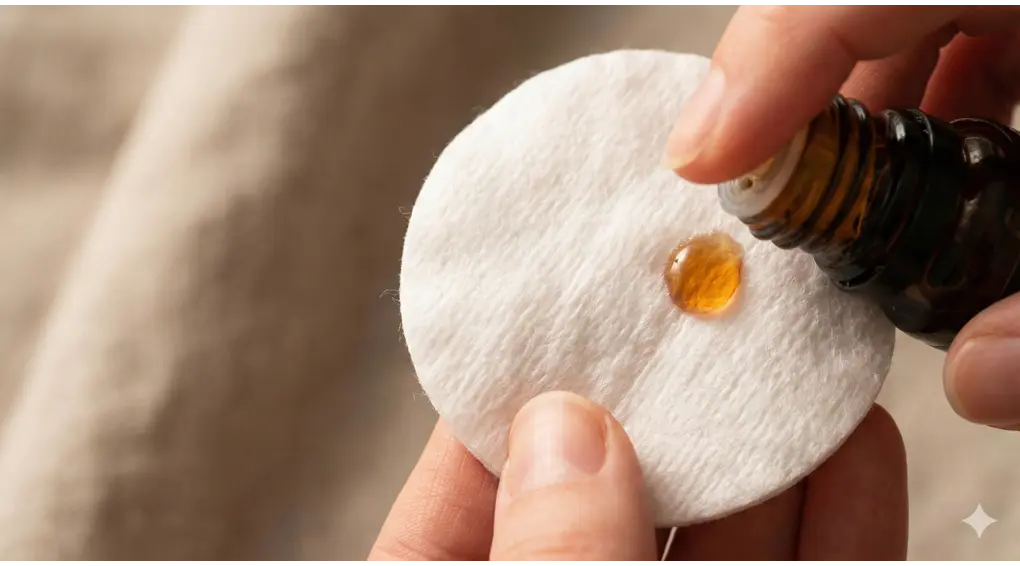
There is a beautiful Sunnah specifically for menstruating and postpartum women detailed by Imam al-Rāfi’ī in Al-‘Azīz Syarḥ al-Wajīz. After the bath, it is highly recommended to perform tatabbu’ atsar ad-dam (tracing the remnants of the blood’s odor).
Imam al-Rāfi’ī records the Hadith and its application:
السابع: إذا اغتسلت الحائض تتعهد أثر الدم بمسك أو طيب آخر، بأن تجعله على قطنة وتدخلها في فرجها، روى عن عائشة أن امرأة جاءت إلى رسول الله -صلى الله عليه وسلم- تسأله عن الغسل من الحيض، فقال: “خذي فرصة من مسك فتطهري بها”… قال العراقيين: الفرصة القطعة من الصوف أو القطن، فالأولى المسك، فإن لم تجده استعملت طيبا آخر، فإن لم تجد فطينا لقطع الرائحة الكريهة، فإن لم تجد كفى الماء، والنفساء كالحائض في ذلك.
Meaning: “Seventh: When a menstruating woman performs Ghusl, she should trace the effect of the blood with musk or another perfume, by placing it on a piece of cotton and inserting it (slightly) into her private part. It is narrated from Aisha that a woman asked the Messenger of Allah ﷺ about Ghusl from menstruation, and he said: ‘Take a piece of cotton with musk and purify yourself with it’… The Iraqis said: ‘Firshah’ is a piece of wool or cotton. The best is musk. If she cannot find it, she uses another perfume. If not, then clay (or soap) to cut the bad odor. If not, water suffices. A postpartum woman is the same as a menstruating woman in this regard.”
This purpose is to eliminate any lingering odor, profoundly reflecting how Islam values the cleanliness, dignity, and comfort of women.
Conclusion
Performing the ghusl correctly after menstruation is a profound act of obedience to Allah ﷻ. By understanding these guidelines derived from trusted classical texts like Fatḥ al-Qarīb and Al-‘Azīz, we not only fulfill a strict obligation but also earn the immense rewards of practicing the Sunnah. Ensure your intention is sincere, verify that water reaches every fold of your body, and embrace the beautiful Sunnah of fragrance to emerge completely fresh and pure.
References
- Muḥammad bin Qāsim al-Ghazzī, Fatḥ al-Qarīb al-Mujīb fī Syarḥ Alfāẓ al-Taqrīb, ed. Basmān ‘Abd al-Wahhāb al-Jābī (Beirut: al-Jaffān wa al-Jābī li al-Ṭibā‘ah wa al-Nasyr; Dār Ibn Ḥazm, 1st ed., 1425 AH / 2005 CE), pp. 42-43.
- ‘Abd al-Karīm bin Muḥammad al-Rāfi‘ī al-Qazwīnī, Al-‘Azīz Syarḥ al-Wajīz, verified by ‘Alī Muḥammad ‘Awaḍ and ‘Ādil Aḥmad ‘Abd al-Maujūd (Beirut: Dār al-Kutub al-‘Ilmiyyah, 1st ed., 1417 AH / 1997 CE), vol. 1, pp. 193-194.


