

The worship of fasting (al-ṣawm) is a spiritual discipline that trains a believer to restrain their desires. Sharia guidance establishes that fasting is not merely restraining the stomach and genitals from dawn to sunset. More than that, fasting is a process of tazkiyatun nafs (purification of the soul) that demands its practitioners to guard their tongue and heart from reprehensible traits.
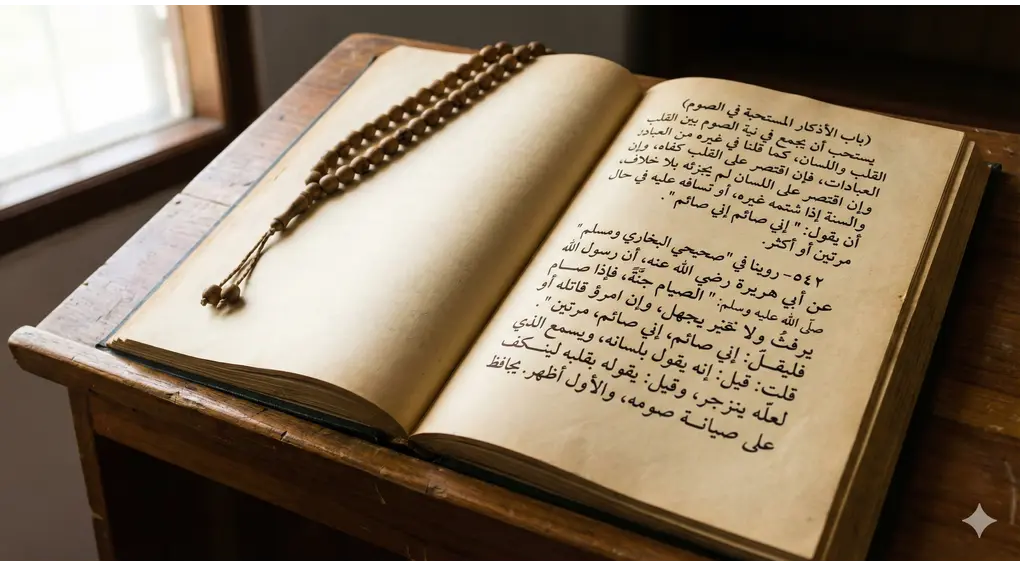
Armed with reference to Hadith No. 542 as contained in a complete guide to remembrance and supplication concerning fasting according to Imam An-Nawawi, we will dissect two fundamental aspects of fasting: the procedure for rectifying intention and social ethics when facing provocation. A complete understanding of these two things will lead our fast from merely an outward routine to a Maqām (spiritual level) that is pleasing to Allah ﷻ.
The Ruling of Fasting Intention: Synergy Between the Heart and the Tongue

Every act of worship is founded upon intention. Without sincerity and a correct intention, an act of worship is at risk of being invalidated. In the scholarly tradition of the Shafi’i school, intention is an act of the heart (qashd), but verbalizing it has its own merit.
The scholars of the Shafi’i school explain that the ruling of fasting intention is fundamentally obligatory to be made in the heart at night (before dawn), precisely since the determination of the beginning of the Hijri month through hilal monitoring. However, combining the intention in the heart with utterance on the tongue (talaffudzh) is highly recommended (sunnah).
This view is based on the principle of precaution:
النِّيَّةُ مَحَلُّهَا الْقَلْبُ، وَيُسَنُّ التَّلَفُّظُ بِهَا لِيُسَاعِدَ اللِّسَانُ الْقَلْبَ
Meaning: “Intention resides in the heart, and it is recommended to verbalize it so that the tongue can assist (the sincerity) of the heart.”
This combination of speech and heart functions as an inner shield. As the tongue utters, the heart becomes more focused and protected from waswas (whispers of doubt) or satanic interference which often leads to feelings of Futur (spiritual lethargy). Thus, the uttered intention serves as the first reminder to oneself that tomorrow we will be in a state of “restraint” for the sake of Allah ﷻ.
How to Control Anger While Fasting: Social Ethics Strategies
Interacting with people while in a state of hunger and thirst is prone to stirring up emotions. It is not uncommon for someone to face provocation, insults, or mischievous acts from others. Islamic Sharia provides precise guidance on how to control anger while fasting through the words of the Prophet Muhammad ﷺ.
If a fasting believer is provoked or invited to argue, Islamic ethics strongly condemn responding to the abuse. The Prophetic strategy taught is to utter a declaration of inner resilience:
فَإِنْ سَابَّهُ أَحَدٌ أَوْ قَاتَلَهُ فَلْيَقُلْ : إِنِّي صَائِمٌ
Meaning: “So if anyone insults him or invites him to fight, let him say: ‘Indeed, I am fasting.'”
Delving into the Meaning of “Inni Shaim”
The literal meaning of “inni shaim” is “Indeed, I am fasting.” However, its philosophical meaning is much deeper. This sentence is a psychological shield. When this sentence is uttered, the person uttering it is reminding themselves of the bond of their promise to Allah ﷻ to maintain proper conduct. At the same time, this sentence is a subtle rebuke to the provocateur that the hostility will not be entertained because the honor of worship is being preserved.
Imam Nawawi’s Analysis: Pronounced Aloud or Inwardly?
An interesting discourse arises from the encouragement to say “Inni Shaim.” Is it sufficient to recite this sentence in one’s heart as self-counsel, or must it be uttered aloud to be heard by the interlocutor?
Imam Nawawi, an expert in Ḥadīth and a central figure in the Shafi’i school of thought, provided a sharp analysis regarding this matter. He examined various possibilities and investigated which approach was the most straightforward.
According to Imam Nawawi’s analysis, the opinion of Al-Azhar (the stronger and more apparent opinion within the school of thought) is that it should be pronounced or uttered aloud so that it is heard by the one who is reviling.
He explained this through the principle:
وَالْأَظْهَرُ أَنَّهُ يَقُولُهُ بِلِسَانِهِ لِيُسْمِعَ شَاتِمَهُ فَيَنْزَجِرَ
Meaning: “And the stronger opinion (al-Azhhar) is that he utters it with his tongue so that it is heard by the one who reviles him, so that the latter stops (becomes aware).”
There are two fundamental reasons behind this Azhhar opinion:
- Conflict Resolution: If kept within oneself, an angry person will not know the reason for our silence. By expressing it, that person will usually feel hesitant, ashamed, or realize that they are disrupting the sanctity of worship, thus the dispute subsides.
- Clarification of Attitude: Our silence is not due to fear, weakness, or cowardice, but rather due to absolute obedience to the principles of Sharia.
The Challenge of Sufism: Avoiding Riyā’
Publicly declaring one’s fasting status (especially in the case of voluntary fasting) often raises concerns about falling into the characteristic of Riyā’ (desire for praise from others).
Sufi scholars offer a way out of this dilemma. The benefit of preventing disputes is far more prioritized. A servant is obliged to organize their heart, renew their intention, and rely on Sincerity. Restraining anger for the sake of Allah ﷻ, even if the status of their fast is known to others, is a form of True Repentance (Tawbah Naṣūḥā) from the selfish traits that stain the soul.
Summary Table: Management of Intention and Speech
To facilitate understanding the management of the heart and tongue during worship, please refer to the following table:
| Aspect of Practice | Action of the Heart | Action of the Tongue | Purpose / Wisdom |
| Intention of Fasting | Presenting Qashd and Ikhlāṣ at night. | Sunnah: Pronouncing the intention. | Avoiding whispers of doubt (waswas) and strengthening inner resolve. |
| Facing Provocation | Restraining anger, not harboring resentment. | Clearly uttering “Inni Shaim”. | Dampening conflict (inzijar) and explaining the position that silence is a form of obedience, not weakness. |
FAQ: Etiquette of Fasting Amidst Social Interactions
Is a person’s fast valid if they forget to verbalize their intention, but their heart has already made the intention?
The fast is valid. The ruling on the intention for fasting relies on the heart. Verbalizing the intention is sunnah (recommended) in the Shafi’i school of thought to aid in the sincerity of the heart, but not an absolute requirement for the validity of the fast.
If I respond to someone’s abuse while fasting, does my fast become invalid?
In fiqh, your fast is not invalidated (does not need to be made up). However, the reward of your fast is potentially greatly lost or drastically reduced. You will only experience hunger and thirst.
Saying “Inni Shaim” (I am fasting) while observing a voluntary fast out of fear of triggering Riyā’ (showing off). What is the solution?
The opinion of the Azhhar scholars still encourages addressing it to stop the provocation. The feeling of fear of Riyā’ must be countered by continuously straightening the heart towards Allah ﷻ. If you remain silent and allow the person to continue reviling, it could actually trigger a greater sin for that person.
Conclusion
The perfection of fasting can only be achieved if a servant succeeds in aligning the intention in the heart with the actions of their tongue. Starting from verbalizing the intention at night to strengthen the heart, to using the tongue as a shield for emotions during the day through the utterance “Inni Shaim”.
May Allah ﷻ grant clarity of heart so that we are able to safeguard every act of worship that we perform. If a servant has succeeded in restraining their tongue throughout the day, it is highly recommended for them to perfect this worship by reciting a valid supplication for breaking the fast when the Maghrib Adhān sounds.
And Allah knows best.
Referensi
Yaḥyā ibn Sharaf al-Nawawī, al-Adhkār, ed. ʿAbd al-Qādir al-Arnaʾūṭ (Beirut: Dār al-Fikr, 1994), 189.


