
Within the vast ocean of Islamic knowledge, there is one particular narration that stands as the foundational “mother” of all religious teachings. Scholars revere it as Ummus Sunnah (The Mother of the Sunnah). This monumental narration is universally known as Hadith Jibril.
Why is this specific hadith so extraordinarily significant? Because within a single, concise dialogue between the Angel Jibril (Gabriel) and the Messenger of Allah (ﷺ), the entire roadmap of a Muslim’s life is unfurled. It encompasses physical actions (Shariah/Islam), internal convictions (Aqidah/Iman), spiritual excellence (Tasawwuf/Ihsan), and vigilant awareness of the end times (Eschatology).
However, simply reading the translation of this hadith is insufficient to grasp its magnitude. Beneath its surface lie intricate layers of meaning, profound jurisprudential (fiqh) rulings, and critical theological debates. In this article, we will academically dissect this hadith, drawing directly from the authoritative commentary Al-Fath Al-Mubin bi Syarhi Al-Arba’in authored by the eminent Shafi’i scholar, Shaykh Ibn Hajar Al-Haytami (pages 139-187).
We will explore its nuances, cite the scholars using their original texts, and uncover its profound relevance for us today. For a deeper dive into the specific themes, you can explore the overarching mystery of the man in white in Hadith Jibril.
The Complete Text of Hadith Jibril and Its Meaning
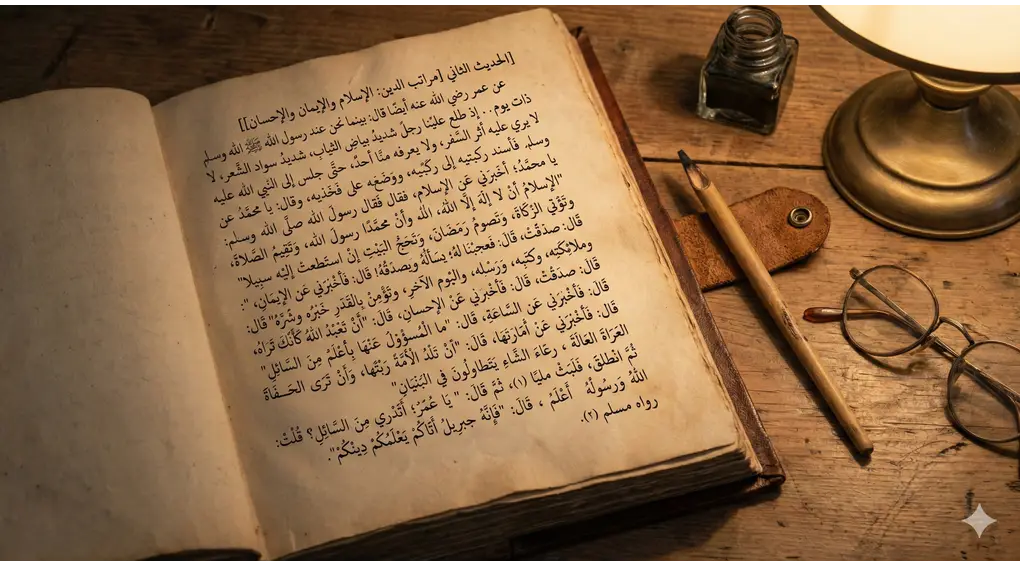
Before embarking on our deep analysis, let us review the original text narrated by Imam Muslim on the authority of Amir al-Mu’minin, Umar ibn al-Khattab (may Allah be pleased with him):
عن عمر رضي الله عنه أيضا قال: بينما نحن عند رسول الله صلى الله عليه وسلم ذات يوم. . إذ طلع علينا رجل شديد بياض الثياب، شديد سواد الشعر، لا يري عليه أثر السفر، ولا يعرفه منا أحد، حتى جلس إلى النبي صلى الله عليه وسلم، فأسند ركبتيه إلى ركبتيه، ووضع كفيه على فخذيه، وقال: يا محمد؛ أخبرني عن الإسلام…
(From Umar, may Allah be pleased with him, who said: One day while we were sitting with the Messenger of Allah ﷺ, there appeared before us a man whose clothes were exceedingly white and whose hair was exceedingly black; no signs of travel were to be seen on him, and none of us knew him. He walked up and sat down by the Prophet ﷺ. Resting his knees against his and placing the palms of his hands on his thighs, he said: “O Muhammad, tell me about Islam…”) — (Sahih Muslim).
Chapter 1: The Mystery of the Questioner and the Etiquette of Seeking Knowledge (Asbab al-Wurud)
The initial segment of this hadith is far more than mere atmospheric description. Before unraveling the pillars of religion, classical scholars specifically analyzed the identity of the man in white and the secrets behind his physical manifestation. Shaykh Ibn Hajar Al-Haytami in Al-Fath Al-Mubin (pp. 139-142) extracts invaluable lessons regarding the etiquette (adab) of a student of knowledge from Jibril’s conduct.
1. Physical Appearance Reflects Inner Readiness
Jibril did not arrive in his true angelic form possessing 600 wings; rather, he assumed the form (tamaththul) of a human being. Yet, his appearance presented a striking contrast:
- Exceedingly white clothes (syadid bayad ats-tsiyab).
- Exceedingly black hair (syadid sawad asy-sya’r).
- No trace of travel (la yura ‘alaihi atsar as-safar).
The companions were bewildered. If he were a local resident of Madinah, they would have recognized him. If he were a traveler, his clothes should have been dusty and his hair disheveled. From this profound paradox, Shaykh Ibn Hajar deduces a recommended (sunnah) ruling for seekers of knowledge:
ففيه ندب تنظيف الثياب، وتحسين الهيئة بإزالة ما يؤخذ للفطرة، وتطييب الرائحة عند الدخول للمسجد
(Thus, it contains the recommendation to clean one’s clothes, improve one’s appearance by removing what is required by fitrah, and wear perfume when entering the mosque).
This powerfully refutes the misconception held by some that piety is synonymous with wearing shabby, unkempt clothing. Shaykh Ibn Hajar asserts that the angel explicitly demonstrated the sunnah clothing for seekers of knowledge, emphasizing cleanliness, the wearing of white, and pleasant fragrance when presenting oneself before Allah or attending gatherings of knowledge.
2. Jibril’s Sitting Posture: A Symbol of Earnestness
Observe precisely how Jibril positioned himself. He did not sit at a distance; he brought his knees to touch the Prophet’s knees.
فأسند ركبتيه إلى ركبتيه.. صريح في أنه جلس بين يديه دون جانبه، وهي جلسة المتعلم، لكنه بالغ في القرب
(He rested his knees against his knees… this explicitly indicates he sat directly in front of him, not beside him. This is the sitting posture of a learner, though he exaggerated the proximity).
This intimate posture teaches that knowledge must be actively pursued, and that physical proximity (within the bounds of respect) coupled with spiritual closeness to the teacher are the keys to attaining the blessings (barakah) of knowledge.
3. Why Did He Call Out “O Muhammad”?



Jibril addressed the Prophet directly by saying “Ya Muhammad,” rather than the customary “Ya Rasulullah” (O Messenger of Allah). According to Al-Fath Al-Mubin, there are two primary explanations:
- To perfectly conceal his identity, adopting the persona of a Bedouin (desert Arab) who typically addressed people directly by their names.
- This event occurred prior to the revelation of the Quranic verse forbidding the believers from addressing the Prophet merely by his name (La taj’alu du’a ar-rasuli bainakum…).
Chapter 2: Islam (The Foundation of Outward Actions)
Jibril’s first inquiry was regarding Islam. The Prophet responded by delineating the five pillars of Islam. However, let us delve deeper into the jurisprudential perspective and its precise definition according to this commentary.
The Definition of Islam: Physical Submission
What distinguishes Islam from Iman? Al-Fath Al-Mubin (p. 144) provides a precise definition:
الإسلام هو لغة: الطاعة والانقياد، وشرعا: الانقياد إلى الأعمال الظاهرة
(Islam linguistically means: obedience and submission. In the Shari’ah, it means: submission to outward, manifest actions).
Therefore, the domain of Islam is the physical realm. An individual is legally judged as a Muslim if they perform the outward Shari’ah injunctions, even if their heart may lack absolute certainty (as seen in the case of hypocrites, who are legally treated as Muslims in worldly affairs).
Critical Analysis of the Pillars of Islam
1. The Shahadah: The Polemic Over the Word “Ashhadu”
The Messenger of Allah said:
الإسلام أن تشهد أن لا إله إلا الله
(Islam is that you testify…)
An intriguing discussion arises on page 144: What if a person embraces Islam not by using the word “Ashhadu” (I testify/bear witness), but instead uses “A’lamu” (I know)?
Shaykh Ibn Hajar cites the scholarly debate:
فلو قال: (أعلم) بدل: (أشهد)… لم يكن مسلما.. ويؤيده أن الشارع تعبد بلفظ: (أشهد) في أداء الشهادة
(If he says, “I know” instead of “I testify”… he is not considered a Muslim. This is supported by the fact that the Lawgiver [Allah] made the specific utterance of “I testify” an act of worship [ta’abbudi] when delivering the testimony).
However, the author subsequently explains the stronger, relied-upon opinion (mu’tamad) within the school: the essence lies in the meaning. If an individual genuinely states “There is no God but Allah” without explicitly saying “Ashhadu,” their entry into Islam remains valid, aiming to preserve public interest (maslahah) and facilitate conversion to the religion of Allah.
2. Prayer, Zakat, Fasting, and Hajj
The author provides crucial annotations regarding these pillars:
- Prayer (Salah): The phrasing used is Tuqimas Shalah (to establish the prayer), not merely to perform it. This necessitates observing all its conditions, pillars, and maintaining deep reverence (khushu’).
- Zakat: Denying its obligation constitutes disbelief (kufr), as it is among the matters known by necessity in the religion (ma’lum minad-din bidh-dharurah).
- Hajj: This obligation is strictly tied to the condition of capability (Istitha’ah), which comprehensively includes provisions, transportation, and route safety.
Chapter 3: Iman (The Essence of Ahlussunnah Creed)
This represents the most dense and critical section within Al-Fath Al-Mubin (pp. 149-173). Here, we learn to distinguish between genuine faith and a mere verbal claim. To fully grasp this, one must understand the six pillars of faith and their profound implications, such as the meaning of faith in the angels.
The Definition of Iman: Is the Heart Sufficient?
Jibril asked about Iman, and the Prophet responded with the 6 Pillars of Faith. But what is the true essence of Iman? Must it be verbalized?
وشرعا: التصديق بالقلب فقط؛ أي: قبوله وإذعانه لما علم بالضرورة أنه من دين محمد صلى الله عليه وسلم
(In the Shari’ah [Iman is]: Affirmation with the heart alone; meaning its acceptance and submission to whatever is necessarily known to be from the religion of Muhammad ﷺ).
According to the majority of Ash’ari theologians, Iman is valid in the sight of Allah solely through Tashdiq bil Qalb (affirmation of the heart). Verbally uttering the Shahadah is merely a condition for applying worldly Islamic rulings (such as inheritance and marriage laws), not a strict condition for the validity of faith in the Hereafter.
Theological Debate: Does Iman Increase or Remain Static?
Can your faith fluctuate? A major theological divergence exists between Imam Abu Hanifa and the majority of scholars (Shafi’is and the Muhaddithin).
- Abu Hanifa’s View: Iman neither increases nor decreases. His reasoning: Iman is Tashdiq (absolute belief). Belief cannot be fractional; you either believe 100% or you do not believe at all.
- The Majority View (Shafi’iyah): Iman increases with acts of obedience and decreases with sins. Their evidence is the Quranic verse: Li-yazdaadu iimanan (“That they may increase in faith”).
Imam Ibn Hajar provides a brilliant synthesis: The difference is merely a matter of perspective. Those who state Iman is static are looking at the core essence of conviction. Those who state it fluctuates are observing the fruits of faith (actions) and the varying intensity of the light of conviction.
Is It Permissible to Say “I am a Believer, Insha’Allah”?
This is a sensitive issue frequently misunderstood. In theological terminology, it is called Istitsna’ fil Iman (Making an exception in Faith).
- If you say, “I am a believer, Insha’Allah (if Allah wills),” because you are experiencing doubt (syakk) regarding Allah’s existence, this is strictly Haram and constitutes disbelief.
- However, the majority of Shafi’i scholars permit, and even recommend, this utterance when driven by different intentions.
إما للتبرك، أو للجهل بالخاتمة
(It is permissible, either for the purpose of seeking blessings [tabarruk] through Allah’s name, or due to ignorance of one’s final end [whether one will die upon a good ending or not]).
Therefore, saying “Insha’Allah” in this specific context is an expression of deep humility and a servant’s fear (khauf) concerning their ultimate fate, not a manifestation of doubt in their Lord.
Is the Faith of a Blind Follower (Muqallid) Valid?
Many laypeople believe simply because they follow their parents or teachers, lacking knowledge of complex philosophical proofs for God’s existence. Is their faith valid?
Shaykh Ibn Hajar emphatically asserts (pp. 163-164) a strong refutation against those who obligate laypeople to study complex theological arguments (‘ilm al-kalam):
والمختار الذي عليه السلف، وأئمة الفتوى من الخلف، وعامة الفقهاء: صحة إيمان المقلد
(The chosen opinion, held by the Salaf, the leading muftis of the Khalaf, and the generality of jurists is: The validity of the faith of a muqallid [a blind follower]).
As long as their heart holds absolute, unshakeable certainty (Jazim) that Allah is One, their faith is completely valid, even if they are unable to articulate formal logical proofs regarding God’s existence and eternality.
Chapter 4: Ihsan (The Pinnacle of Spirituality & Tasawwuf)
After discussing Islam (the physical) and Iman (the intellect/heart), Jibril inquired about Ihsan. The Prophet ﷺ responded with an exceptionally poetic and profound statement:
أن تعبد الله كأنك تراه، فإن لم تكن تراه. . فإنه يراك
(That you worship Allah as if you see Him, for if you do not see Him, then truly He sees you).
According to Al-Fath Al-Mubin (pp. 174-175), this definition categorizes humanity into two distinct spiritual stations (Maqam):
1. Maqam Musyahadah (The Higher Station)
This is the state of كأنك تراه (As if you see Him).
This represents the exalted station of the intensely truthful (Shiddiqin) and the knowers of Allah (Arifin). Their hearts are so saturated with divine light that during worship, it is as if the veils are lifted, and they “witness” the majesty of Allah with their inner eye (bashirah). Their worship is entirely driven by overwhelming Love (Mahabbah) and profound longing.
غالب عليه مشاهدة الحق
(The witnessing of Al-Haqq [Allah] is dominant over him).
2. Maqam Muraqabah (The Intermediate Station)
This is the state of فإن لم تكن تراه.. فإنه يراك (If you do not see Him, He sees you).
If we have not yet developed the capacity to reach the first level, we must at least maintain the acute awareness that we are constantly under the watchful eye of the “Divine CCTV”. This station is primarily driven by reverence, Fear (Khauf), and deep Modesty (Haya’) before Allah.
مشيرا إلى أنه ينبغي للعبد أن يكون حاله مع فرض عدم عيانه لربه سبحانه وتعالى كهو مع عيانه؛ لأنه سبحانه وتعالى مطلع عليه
(Indicating that the state of a servant—even assuming he does not witness his Lord, Glorified and Exalted be He—should be exactly as it would be if he were witnessing Him; because He, Glorified and Exalted be He, is ever-observant of him).
Shaykh Ibn Hajar emphasizes that Ihsan is the very soul of action. Without Ihsan, prayer is merely gymnastics, and fasting is nothing more than a starvation diet.
Chapter 5: The Signs of the Hour (Social Eschatology)
The final section of the hadith addresses As-Sa’ah (The Hour/Day of Judgment). When asked exactly when it would occur, the Prophet provided an answer that exemplifies profound humility:
ما المسؤول عنها بأعلم من السائل
(The one questioned about it knows no better than the questioner).
This signifies that knowledge of the exact timing of the Hour is the absolute, exclusive prerogative of Allah. Even the greatest Prophet and the greatest Angel were unaware of it. However, the Prophet mentioned two distinct signs (Amarah), the interpretations of which are staggeringly relevant when observing the modern era.
Sign 1: The Slave Girl Giving Birth to Her Master
أن تلد الأمة ربتها
(That the slave girl gives birth to her mistress).
Shaykh Ibn Hajar offers several interpretations in Al-Fath Al-Mubin (pp. 179-180), and one particular explanation resonates deeply with the moral crisis facing the modern family:
أو عن كثرة عقوق الأولاد لأمهاتهم، فيعاملونهم معاملة السيد أمته من الإهانة والسب
(Or [it is a metaphor] for the abundance of children’s disobedience to their mothers, treating them with the same humiliation and verbal abuse that a master directs at his slave girl).
When a child commands their mother, yells at her, and effectively reduces her to a servant serving their ambitions, this, according to this exegesis, is a stark sign that the Hour is imminent.
Sign 2: Competing in Constructing Tall Buildings
وأن ترى الحفاة العراة العالة رعاء الشاء يتطاولون في البنيان
(And that you will see the barefooted, naked, destitute herdsmen competing in constructing tall buildings).
This is an incredibly sharp sociological prediction. The Prophet described phenomena akin to aggressive social climbing and social inversion. Individuals who were formerly ignorant, marginalized, and uneducated (ru’aa asy-syaa’) suddenly seize immense economic power.
وهذا كناية عن كون الأسافل يصيرون ملوكا أو كالملوك… فتفرق هممهم إلى تشييد المباني
(This is a metonymy [kinayah] for the lowest of people becoming kings or resembling kings… resulting in their ambitions being entirely diverted toward the construction of grandiose buildings).
Rather than utilizing their sudden wealth for the advancement of knowledge or religion, they engage in fierce competition to erect skyscrapers (tathawul fil bunyan) purely as monuments to their social status.
Summary Table: Differentiating Islam, Iman, and Ihsan
To facilitate your comprehension, the following table summarizes the core concepts based on the commentary’s explanations:
| Aspect | Islam | Iman | Ihsan |
| Primary Focus | Outward Actions (Physical) | Inward Actions (Heart) | Spiritual Quality (Feeling) |
| Definition in Text | Al-Inqiyad (Submission) | At-Tashdiq (Affirmation) | Muraqabah (Vigilant Awareness) |
| Worldly Ruling | Protects blood & wealth | Hidden from human sight | A secret between servant & God |
| Hereafter Ruling | Insufficient for salvation alone | Prerequisite for entering Paradise | Determines the level within Paradise |
Conclusion
Hadith Jibril profoundly teaches us that the Islamic religion is a comprehensive, integrated system. We cannot merely adopt Islam (the outward Shariah) while neglecting Iman (inner conviction), for that constitutes hypocrisy. Conversely, we cannot solely claim Iman while abandoning Islam, for that is blatant transgression (fasiq). Furthermore, both will feel utterly barren without the animating presence of Ihsan (the spiritual soul).
As the Prophet ﷺ beautifully concluded in this very hadith:
فإنه جبريل أتاكم يعلمكم دينكم
(Indeed, he was Jibril; he came to you to teach you your RELIGION).
May this academic guide enable us to comprehend our religion not merely superficially, but down to its deepest roots. Wallahu a’lam bish-shawab (And Allah knows best).
Frequently Asked Questions (FAQ)
Why did Jibril teach the religion by asking questions?
This represents a highly sophisticated teaching method of the Prophet. Occasionally, a teacher or a dispatched angel will deliberately ask a question—not out of ignorance—but specifically to capture the students’ (the companions’) attention. This ensures that the authoritative answer emanating from the Prophet’s lips penetrates their hearts more deeply, without causing any awkwardness.
Is the Islam of someone who never prays considered valid?
Based on the strict definition of Islam in this text (submission through outward actions), a person who completely abandons prayer is in grave peril. However, as long as they firmly believe in the obligation of prayer (possessing Iman), they are considered a transgressing Muslim (fasiq / major sinner), but not an outright disbeliever (kafir), according to the consensus of the Ahlussunnah school.
What does “Iman increases and decreases” mean in practical terms?
This refers to the fluctuating quality of one’s conviction and righteous deeds. When we are diligent in worship, our faith feels vibrant and strong (it increases). When we engage in sin, our faith feels weak and obscured (it decreases).
Primary Reference:
Aḥmad ibn Muḥammad Ibn Ḥajar al-Haytamī, al-Fatḥ al-Mubīn bi-Sharḥ al-Arbaʿīn, ed. Aḥmad Jāsim Muḥammad al-Muḥammad, Quṣayy Muḥammad Nūrūs al-Ḥallāq, and Anwar al-Shaykhī al-Dāghistānī, 1st ed. (Jeddah: Dār al-Minhāj, 2008), 139-187.


