

Have you ever felt conflicted when a WhatsApp notification chimes, displaying a message that reads “Assalamualaikum”? A quiet voice in your head might wonder whether you should reply with typed text, a voice note, or if simply answering silently in your heart is sufficient. Or perhaps you have found yourself in the perplexing situation where a friend says, “So-and-so sends their regards (salam),” and you are completely baffled regarding the legally correct way to respond according to Islamic jurisprudence.
In Islam, the Salam is profoundly more than a mere, casual “hi” or “hello.” It constitutes a powerful supplication (dua), a binding guarantee of safety, and the strongest knot tying the brotherhood of believers together. However, we frequently find ourselves ensnared in daily routines without genuinely comprehending the governing rules. Is initiating the greeting actually obligatory? What are the severe consequences if we deliberately ignore it?
Welcome to the comprehensive guide on the fiqh of salam. To truly appreciate this, one must first grasp the broader definition of fiqh as the practical application of Islamic law. This article will meticulously dissect the rulings based directly on the authoritative Shafi’i texts Asna al-Matalib and Hashiyat al-Bujayrimi. We will thoroughly discuss everything from the strict ruling on replying to salam, the modern etiquette on social media, down to the intricate rules regarding “relayed greetings” that are so frequently misunderstood. Let us begin.
The Ruling on Initiating Salam: A Frequently Neglected Sunnah
First and foremost, we must establish the jurisprudential baseline. What is the precise legal ruling on initiating a greeting to a fellow Muslim?
The esteemed Shafi’i scholars vividly explain in the book Asna al-Matalib that the ruling on initiating the Salam is a highly recommended Sunnah. However, this specific sunnah status possesses deeply fascinating sub-categories:
- Sunnah ‘Ain (Individual): If you are walking entirely alone and cross paths with a fellow Muslim, then for you specifically, initiating the Salam is a Sunnah ‘Ain. You accrue immense spiritual reward if you greet them, but you absolutely do not incur a sin if you remain silent (although it is highly regrettable).
- Sunnah Kifayah (Communal): Imagine you are walking alongside a group of five friends. When your group crosses paths with another individual, it is absolutely unnecessary for all five of you to loudly chorus “Assalamualaikum.” If merely one single person from your group initiates the greeting representing the rest, the sunnah obligation is entirely fulfilled for the entire group.
The foundational bedrock for this practice is the direct command of Allah in the Quran (Surah An-Nur, verse 61) and numerous prophetic hadiths encouraging us to actively broadcast peace. One of the most prominent is the statement of the Prophet ﷺ:
“You will not enter Paradise until you believe, and you will not believe until you love one another. Shall I not direct you to something which, if you do it, will foster love among you? Spread the greeting of peace (Salam) among yourselves.” (Narrated by Muslim)
Therefore, the ruling on initiating the Salam is an incredibly strong encouragement. It serves as the master key unlocking the doors of sustenance and profound social intimacy.
The Ruling on Replying to Salam: Beware of Incurring Sin!
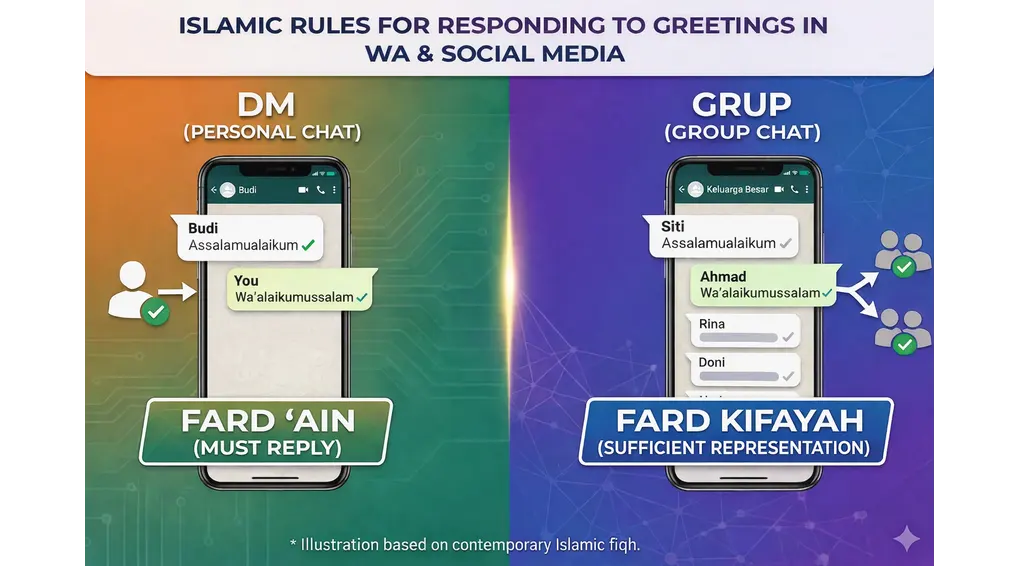
In stark contrast to initiating the greeting, the position of the receiver carries a significantly heavier legal burden within the fiqh of salam. The ruling on replying to salam is strictly Obligatory (Fard).
Mirroring the initiation, this strict obligation is identically divided into two distinct categories:
- Fard ‘Ain (Individual Obligation): If a friend specifically greets you personally (whether face-to-face or via a private, direct chat), then the heavy ruling of replying falls squarely and entirely upon your shoulders. It is strictly obligatory to answer audibly or via a typed response. If you deliberately remain silent, you are unequivocally committing a sin.
- Fard Kifayah (Communal Obligation): If a greeting is broadcasted to a crowd or a group chat, and merely one single person has already replied, then your personal obligation is immediately lifted. However, for the sake of impeccable manners and maximizing reward, it is vastly superior if everyone participates in the reply.
Consequently, what is the specific ruling on replying if the person initiating the greeting is merely a young child? The text Asna al-Matalib firmly asserts: even if the initiator is a young child who has not yet reached puberty (baligh), we as legally responsible adults (mukallaf) remain strictly obligated to reply to them. Why? Because the Salam is a majestic symbol of Islam (syi’ar) and a profound supplication. Callously ignoring the greeting of a child can devastatingly extinguish their enthusiasm for performing acts of worship.
The Severe Consequence of Ignoring a Greeting
Whoever deliberately fails to reply to a greeting despite clearly hearing it, and possessing no valid Sharia-compliant excuse, directly bears the burden of a sin. The ruling concerning an individual who intentionally ignores a greeting without justification can escalate to absolute prohibition (Haram), primarily because the Salam constitutes a sacred, binding contract of safety and security.
The Rulings on Replying to Salam on WhatsApp and Social Media
This is unequivocally the million-dollar question of the modern age: What exactly is the ruling on replying to salam on WhatsApp or within the comment sections of Instagram or Facebook?
Contemporary Islamic scholars, strictly relying upon classical jurisprudential maxims, are in absolute agreement: “Writing holds the exact same legal status as verbal speech” (al-kitabah kal-khitab).
- Direct Message (Private Chat): If a direct message reading “Assalamualaikum” arrives in your inbox, intentionally failing to reply to it on WhatsApp is strictly haram and sinful. It constitutes a Fard ‘Ain. You are absolutely obligated to reply to it.
- Practical Tip: If you are intensely occupied with driving or embedded in a crucial meeting, you are permitted to answer silently in your heart temporarily, but you must strive to reply via text or a Salam sticker the moment you are free to perfectly discharge the obligation.
- WhatsApp Groups: If a greeting is broadcasted into a busy high school reunion group or a professional work group, the ruling on replying in that WhatsApp group is Fard Kifayah. Provided that at least one single person has already replied (typically the group admin or a highly active member), you absolutely do not incur a sin if you merely read the message. However, the atmosphere is undeniably warmer if you actively participate in the reply.
- Social Media Comments: If a content creator enthusiastically greets their audience with “Assalamualaikum friends” in a video or a caption, that is legally classified as a general greeting directed at the masses. Replying in the comment section is a commendable act of goodness, but it is definitively not a Fard ‘Ain upon every single follower.
The Polemic of “Relayed Greetings”: “Tell Budi I said Hi!”
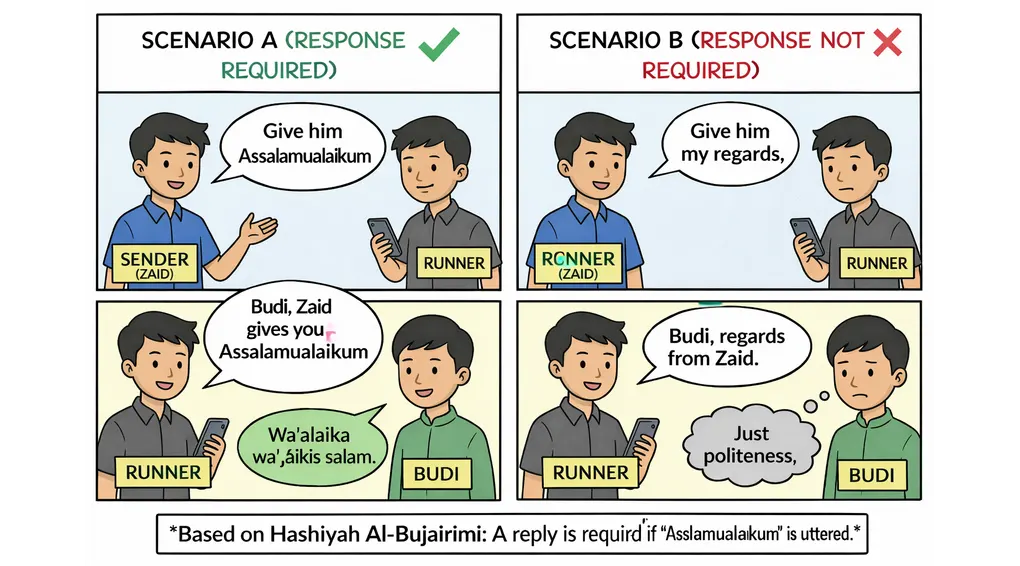
This specific section is incredibly frequently misunderstood. A massive number of people assume that conveying a relayed greeting is strictly obligatory, and the receiver is equally obligated to reply. Is this actually true?
Let us meticulously dissect this based on our secondary reference, Hashiyat Al-Bujayrimi. As it turns out, not absolutely every “relayed greeting” is legally mandated to be replied to according to fiqh. There are highly specific, strict conditions.
When is a Relayed Greeting Obligatory to Answer? It is strictly obligatory to answer ONLY IF a formal, recognized Salam phrasing (sighah) is utilized, specifically “Assalamualaikum.” This can practically occur in two distinct scenarios:
- The original sender states: “Please convey this to Budi: Assalamualaikum.”
- The courier (messenger) states: “Budi, Zaid says Assalamualaikum to you.”
If the sentence is structured in that precise manner, you (Budi) are strictly obligated to answer: “Alaika wa’alaihis salam wa rahmatullah wa barakatuh” (May peace, the mercy of Allah, and His blessings be upon you [the courier] and upon him [the sender]).
When is a Relayed Greeting NOT Obligatory to Answer? If the formal phrasing is entirely absent. For example:
- The original sender merely says: “Give my regards to Budi.” (This is a standard, casual command).
- The courier merely says: “Bud, Zaid sends his regards,” or “Zaid says hi.”
In this second scenario, according to the highly relied upon (mu’tamad) opinion of Imam Ar-Ramli, that specific relayed message is absolutely not considered a legally valid (syar’i) Salam that mandates a reply. It is merely classified as conveying news. Therefore, the ruling on answering this specific model of greeting is merely sunnah or an act of common courtesy, absolutely not a binding religious obligation that incurs a sin if abandoned.
3 Categories of People Who Are Not Obligated to Reply to Salam
Must we instinctively respond every single time we hear “Assalamualaikum”? No. There are highly specific conditions where deliberately not answering the greeting is actually strongly encouraged to maintain proper Islamic etiquette (adab).
Below are 3 distinct categories of individuals who are completely exempt from the obligation of replying (and for whom it is even deemed disliked or makruh to answer verbally) according to Asna al-Matalib:
- A Person Relieving Themselves: If an individual is actively inside the bathroom, a toilet, or actively relieving themselves, jurisprudentially, the act of not answering the greeting verbally is absolutely correct. It is entirely sufficient to answer silently within the heart. Answering verbally in a physically impure location is strictly makruh. Ensure you understand the proper supplications for entering and exiting the bathroom and after istinja to maintain purity.
- A Person Actively Eating (With a Full Mouth): Imagine having a mouth entirely stuffed with rice and then being forced to clearly articulate “Waalaikumussalam.” The person could easily choke, or food could violently spray out. Islam is a pragmatic religion that vigorously protects aesthetics and physical safety. If the mouth is actively full and chewing, do not answer verbally. Swallow first, or simply provide a polite hand gesture.
- A Person Actively Praying or Calling the Adhan: An individual actively engaged in performing the ritual prayer, including voluntary prayers such as Dhuha, is strictly prohibited from uttering any speech other than the specific recitations of the prayer. If greeted, it is entirely sufficient to provide a subtle gesture with the hand or finger. Similarly, one who meets the requirements for a valid mu’adhin should prioritize completing the act of calling the adhan and iqamah before responding.
Furthermore, an individual who is soundly asleep or overwhelmingly drowsy is also entirely unburdened by this specific obligation.
The Pillars and the Correct Method of Replying to Salam
To ensure our actions are not merely haphazard, meticulously observe the following etiquette so that the Islamic greeting we utter possesses perfect spiritual reward.
1. The Voice Must Be Audible (Isma’)
The fundamental condition for the absolute validity of a reply to a greeting is that it must be physically audible to the person who initiated the greeting. If you reply while merely whispering to the extent that the friend standing right next to you cannot hear it, the strict obligation has absolutely not been discharged, except exclusively in cases of relayed greetings or written text.
2. Immediate Response (Ittisal)




The answer must connect immediately. It must not be delayed. If a friend says “Assalamualaikum,” and you remain completely silent for 5 agonizing minutes before finally replying, that is absolutely not legally valid as a reply to a greeting (unless it is via a letter/chat where an inherent time delay is physically unavoidable).
3. The Complete Phrasing
- The Absolute Minimum: “Wa’alaikumussalam”.
- The Perfect Formulation: “Wa’alaikumussalam Warahmatullahi Wabarakatuh”. In this specific context, the hadith regarding answering greetings actively teaches us to vigorously reply with something significantly better, or at the absolute minimum, something identical.
4. Interaction with Non-Muslims
What exactly is the legal ruling on replying to salam from a non-Muslim? If they initiate the greeting first by stating “Assalamualaikum,” we must reply with a highly concise: “Wa’alaikum” or “Wa’alaika” (And upon you as well). We are absolutely not prohibited from exhibiting excellent, kind behavior, but concerning the specific matters of supplicating for eternal salvation in the Hereafter (mercy & blessings), Islam possesses its own highly specific theological boundaries.
Authentic Textual References
As a rigorous demonstration of academic integrity, below are the original, direct quotations from the authoritative reference books we utilized:
1. The Book Asna al-Matalib (Regarding Foundational Rulings)
فصل: ابتداء السلام على كل مسلم … سنة عين إن كان المسلم واحدا وسنة كفاية إن كان جماعة
(Chapter on Initiating Salam) to every Muslim… its ruling is Sunnah ‘Ain if alone, and Sunnah Kifayah if in a group.
ورده ولو كان المسلم صبيا فرض عين إن كان المسلم عليه واحدا مكلفا وفرض كفاية إن كان جماعة1
And replying to it—even if the one giving the greeting is a young child—is Fard ‘Ain if the receiver is a single legally responsible person (mukallaf), and Fard Kifayah if the receiver is a group.
2. Hashiyat Al-Bujayrimi (Regarding Relayed Greetings)
وَحَاصِلُهُ: أَنَّهُ لَا بُدَّ فِي الِاعْتِدَادِ بِهِ وَوُجُوبُ الرَّدِّ مِنْ صِيغَةٍ مِنْ الْمُرْسِلِ أَوْ الرَّسُولِ… كَأَنْ قَالَ الْمُرْسِلُ سَلِّمْ لِي عَلَى فُلَانٍ فَقَالَ لِفُلَانٍ زَيْدٌ يُسَلِّمُ عَلَيْك فَلَا اعْتِدَادَ بِهِ وَلَا يَجِبُ الرَّدُّ2
The conclusion is: For it to be legally considered valid and for the reply to be obligatory, there must be a specific phrasing (sighah) from the sender or the messenger. If the sender merely says “Give my regards to so-and-so” and the messenger says “Zaid sends his regards,” then that is not legally considered (a syar’i salam) and it is absolutely not obligatory to reply.
Summary Table of Salam Rulings
To facilitate rapid, effortless comprehension, below is a concise summary of the legal rulings:
| The Specific Situation | Who Initiates (The Ruling) | Who Replies (The Ruling) |
| Meeting While Alone | Sunnah ‘Ain | Fard ‘Ain |
| Meeting as a Group | Sunnah Kifayah | Fard Kifayah |
| Private WhatsApp Chat | Sunnah ‘Ain | Fard ‘Ain (Type/Voice) |
| WhatsApp Group Chat | Sunnah Kifayah | Fard Kifayah |
| Actively Eating / In the Toilet | Makruh to Initiate | Not Obligatory Verbally (Sufficient in Heart) |
| Relayed Message Without “Assalamualaikum” | Permissible (Cultural Custom) | Not Obligatory (Merely Politeness) |
FAQ: Frequently Asked Questions
What is the ruling on initiating a greeting while simultaneously waving a hand?
It is entirely permissible, provided it is strictly accompanied by a verbal utterance. If one merely waves a hand in absolute silence despite being physically capable of speaking, the ruling is considered sub-optimal (khilaful awla) and it is absolutely not legally obligatory to reply. A hand gesture is exclusively useful if the physical distance is vast.
What exactly is the severe threat mentioned in the hadith for failing to reply to a greeting?
Callously ignoring the greeting of a fellow Muslim without a valid, Sharia-compliant excuse fundamentally constitutes an act of degrading the sacred rights of brotherhood. The Prophet ﷺ sternly reminded us that the undeniable rights of a Muslim over another Muslim are five (or six), and one of the most prominent is answering their greeting.
If I am deeply engrossed in reciting the Quran, am I still strictly obligated to answer a greeting?
According to the overwhelmingly strong opinion, you remain strictly obligated to reply. However, there is a minority of scholars who argue that it is makruh (disliked) to greet someone who is intensely engrossed in profound supplication or deeply reflecting (tadabbur) upon the Quran, as it could severely disrupt their acute spiritual concentration.
Conclusion
We fervently hope this exhaustive review regarding the fiqh of salam successfully rectifies our lingering doubts. Always remember, a seemingly simple greeting on WhatsApp or a brief interaction while crossing paths on the street can miraculously transform into a massive field of eternal reward, provided we thoroughly comprehend the sacred knowledge behind it.
Let us vigorously revive this beautiful Sunnah of the Prophet. Never allow a message of Salam on your phone to tragically terminate as a mere “blue tick” devoid of a reciprocating prayer. Actively spread the Salam; actively spread peace!
Reference
- Zakariyā al-Anṣārī, Asnā al-Maṭālib fī Sharḥ Rawḍ al-Ṭālib, with marginal notes (ḥāshiyah) by Aḥmad al-Ramlī, edited by Muḥammad az-Zuhrī al-Ghamrāwī (Cairo: al-Maṭbaʿah al-Maymānīyah, 1313 AH; reprinted by Dār al-Kitāb al-Islāmī), vol. 4, pp. 182–186. ↩︎
- Sulaimān ibn Muḥammad ibn ʿUmar al-Bujayrimī, Tuḥfat al-Ḥabīb ʿalā Sharḥ al-Khaṭīb (Ḥāshiyah al-Bujayrimī ʿalā al-Khaṭīb) (Beirut: Dār al-Fikr, n.p., 1415 AH/1995 CE), vol. 1, p. 425. ↩︎


