
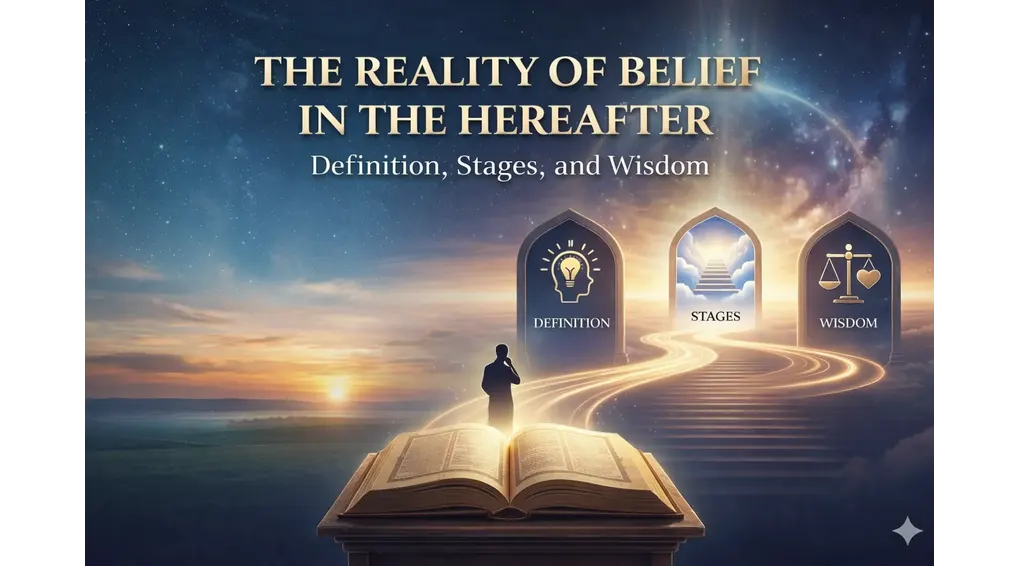
Many of us have memorized the articles of faith since childhood. We know that the belief in the Last Day constitutes the fifth pillar, a foundational concept you can explore further in the understanding and number of the pillars of faith. However, how profoundly do we understand what this belief truly entails? Is it merely the conviction that the physical world will eventually be destroyed?
In reality, the Last Day is much closer than we imagine.
In a classical commentary on the Forty Hadith of Imam al-Nawawi, specifically Al-Fath al-Mubin by the prominent Shafi’i scholar Sheikh Ibn Hajar al-Haytami, we find an incredibly detailed explanation that might differ slightly from the common understanding. Let us comprehensively examine the meaning of the Last Day, its sequential stages, and the profound wisdom of maintaining this faith in our daily lives.
Explaining the Meaning of Belief in the Last Day
In simple terms, belief in the Last Day means having absolute conviction in your heart that this worldly life is temporary and that an eternal life awaits thereafter. But how do classical scholars define the “Last Day” technically?
In Al-Fath al-Mubin, Sheikh Ibn Hajar al-Haytami explains that the Last Day is a continuous phase that begins from the moment of an individual’s death until the final culmination of events on the Day of Resurrection.
Therefore, if someone asks you to explain the meaning of the Last Day, the answer is not exclusively about the blowing of the cosmic trumpet. The moment the soul separates from the physical body, the Last Day has already begun for that specific individual. This reality makes the concept highly personal and urgent. We do not need to wait for the major apocalypse to experience this phase; our own death is its very first gateway.
Why Is It Called the “Last” Day?
Have you ever wondered why the Day of Judgment is referred to as the “Last” Day (Al-Yawm al-Akhir), considering that eternal life in Paradise or Hell follows it?
The linguistic and logical explanation is quite profound. The Arabic word for “Day” (Yawm) is typically used to denote a period of daylight that is subsequently followed by night. There is light, and then there is darkness. However, the resurrection is characterized as the “Last” because no night will ever follow it.
When that era arrives, the sun and the moon will no longer serve as measures of time. There will only be the eternal light of Paradise or the eternal darkness of Hell. Because no new day will ever replace it (there is no “tomorrow”), it is rightfully called the Last Day.
The Stages of the Last Day: Humanity’s Long Journey
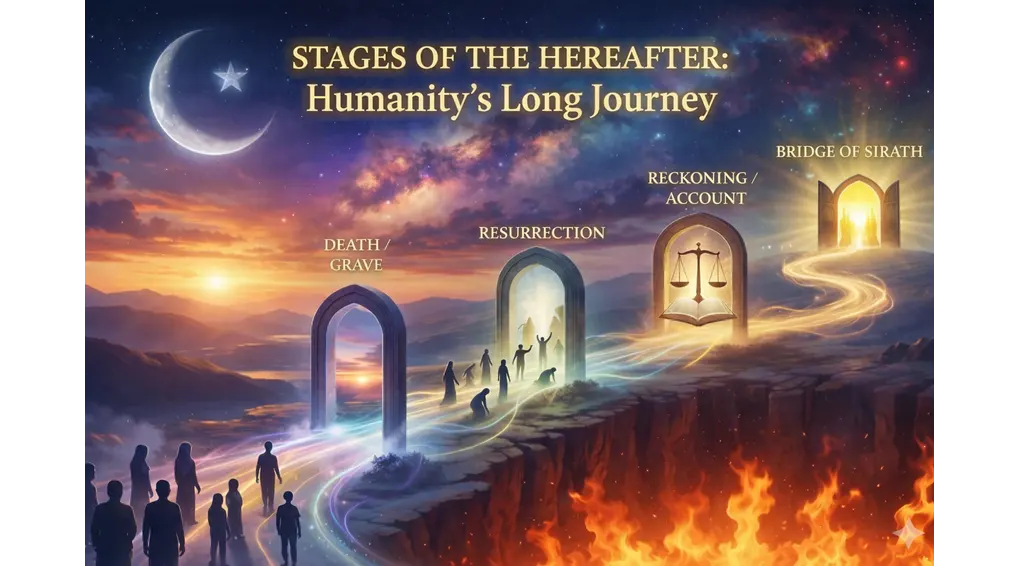
To truly understand how to implement belief in the Last Day, we must know the map of the journey. Having faith in this pillar means believing in the entire sequence of inevitable events.
Here are the chronological stages of the Hereafter that occur once the Last Day (after death) begins, as outlined in classical Islamic theology:
- The Realm of Barzakh (The Grave): This is the first station. Here, the trial of the grave occurs (the questioning by the angels), followed by either the bliss or the punishment of the grave. Understanding this requires a firm belief in angels and their assigned duties.
- Yawm al-Ba’th (The Day of Resurrection): When the angel appointed to blow the trumpet—one of the great names of angels known as Israfil—blows the second blast, all creations will be resurrected from their graves.
- Yawm al-Hashr (The Day of Gathering): Humanity will be gathered continuously on the vast plain of Mahshar.
- Yawm al-Hisab (The Day of Reckoning): Every single deed will be accounted for, without the slightest omission.
- Yawm al-Mizan (The Day of Weighing): The scale will weigh all good and evil deeds with absolute divine justice.
- As-Sirat (The Bridge): The bridge extending over Hellfire, leading towards Paradise.
- Paradise and Hellfire (Jannah and Nar): The final, eternal abodes.
The Cycle of Human Life and Death
One of the most compelling points from Al-Fath al-Mubin is the explanation regarding the cycle of “life and death” that humans undergo. Belief in the Last Day is fundamentally the belief that we will be brought back to life.
Here is a table detailing the human life cycle to simplify your understanding of the “Final Resurrection”:
| Phase | Status | Explanation |
| Beginning | Non-existence (First Death) | The condition before the soul is blown into the fetus. |
| The World | First Life | Our current, temporary existence in this physical world. |
| End of Life | Second Death | Physical death; the transition into the realm of Barzakh. |
| The Grave | Temporary Life | Being momentarily revived to answer the questions of the angels Munkar and Nakir. |
| Barzakh | Third Death | The soul rests, awaiting the final Hour (according to some theological narrations). |
| The Hereafter | Final Life | The eternal resurrection (Al-Ba’th al-Akhir). |
Original Reference from the Classical Text
To ensure the validity of these theological proofs, here is the original Arabic text from Al-Fath al-Mubin along with its translation:
قوله : ( واليوم الآخر ) وهو من الموت إلى آخر ما يقع يوم القيامة , وصف بذلك ; لأنه لا ليلَ بعده , ولا يقال : يومٌ إلا لما يعقبه ليلٌ ; أي : بوجوده … وفي رواية : ” والبعث الآخر ” (3), ووصفُه بالآخر إما تأكيدٌ كأمس الدابر , أو احترازٌ عن غير الآخر ; لأنه إحياءٌ بعد إماتةٍ …
Meaning:
(And in the Last Day): which is the period from death until the final events that occur on the Day of Resurrection. It is described as such because there is no night after it… In another narration, it is termed: “And the Last Resurrection”. Describing it with the word “Last” serves either as an emphasis, or as an exclusion of any resurrection other than the final one. Because resurrection is the act of giving life after causing death…
The Wisdom Behind Belief in the Last Day
After understanding the definition, we must ask: why must we hold this belief? What practical benefit does it bring to our current lives?
The wisdom behind belief in the Last Day serves as the ultimate self-control mechanism. Without this conviction, humans would live recklessly without fear of consequence. Here are the detailed benefits:
1. Increasing the Sense of Responsibility


The awareness of a supreme court in the Hereafter forces us to be cautious. This faith instills a profound sense of responsibility for every word spoken, action taken, and decision made. We realize that there is no surveillance more advanced and encompassing than the sight of Allah.
2. Motivation for Righteous Deeds
A highly positive impact of believing in the Hereafter is the unyielding motivation to accumulate good deeds. A farmer who is certain of tomorrow’s harvest will work tirelessly today to plant the seeds. Similarly, a believer will diligently perform acts of worship, knowing with absolute certainty that the divine reward is real.
3. Consoling the Heart During Calamities
One of the primary functions of this belief is serving as a spiritual consolation. The worldly life is often unjust; wicked individuals may live in luxury, while the righteous suffer. Through belief in the Last Day, we find peace knowing that ultimate, perfect justice will be established. Our patience in this world will be paid in full in the Hereafter.
Other Names for the Last Day in the Quran
Besides “The Last Day”, the Quran utilizes numerous other names to depict the magnitude and severity of these events. Some of the most prominent names include:
- Yawm al-Qiyamah: The Day of Resurrection (The day humanity stands before their Lord).
- Yawm al-Ba’th: The Day of Awakening.
- Yawm al-Mahshar: The Day of Gathering.
- Yawm al-Hisab: The Day of Reckoning.
- Yawm al-Jaza’: The Day of Recompense.
- Yawm al-Haqq: The Inevitable Day of Truth.
- Al-Qari’ah: The Striking Calamity.
Conclusion: The Importance of Belief in the Last Day
In conclusion, belief in the Last Day is an incredibly crucial fifth pillar of faith. It is not merely a bedtime story to frighten us, but an absolute future reality that every soul will inevitably face.
Classical scholars continuously remind us of this pillar so that we do not become negligent. The proofs of the Hereafter are scattered throughout the Quran to warn us to prepare. Remember the profound definition from Sheikh Ibn Hajar al-Haytami: your personal apocalypse begins the moment you die.
Are our provisions ready to face our own version of the “Last Day”?
FAQ: Questions About Belief in the Day of Judgement
Here are some frequently asked questions regarding this topic:
1. Which pillar of faith is the belief in the Last Day?
Belief in the Last Day is the 5th (fifth) pillar of faith in Islam. It follows the belief in Allah, the Angels, the Divine Books, and the Messengers.
2. Who is the angel responsible for blowing the trumpet on the Last Day?
The angel assigned to blow the cosmic trumpet is Angel Israfil. The first blast will cause all living creatures to die, and the second blast will resurrect them (Ba’th).
3. How do we apply the belief in the Last Day in our daily lives?
We apply it by constantly remembering death, increasing our righteous deeds, avoiding sins out of fear of the divine reckoning (Hisab), and maintaining absolute certainty in the eventual reward of Paradise and the punishment of Hellfire.
4. Does belief in the Last Day include the realm of the grave?
Yes. Because the Last Day technically begins at the moment of death, believing in the trials, punishments, and blessings of the grave (Barzakh) is an inseparable part of believing in the Last Day.
5. What is the technical definition of believing in the Last Day?
Technically, it means affirming with absolute certainty the occurrence of the apocalypse, the resurrection of humanity from the graves, the divine reckoning of deeds, and the final recompense in either Paradise or Hellfire.
Reference
Ibn Ḥajar al-Haytamī, Aḥmad ibn Muḥammad. al-Fatḥ al-Mubīn bi-Sharḥ al-Arbaʿīn. Edited by Aḥmad Jāsim Muḥammad al-Muḥammad, Quṣayy Muḥammad Nūrūs al-Ḥallāq, and Abū Ḥamzah Anwar ibn Abī Bakr al-Shaykhī al-Dāghistānī. 1st ed. Jeddah: Dār al-Minhāj, 2008.


