

Has your heart ever felt suffocated by the weight of past mistakes? Or perhaps a lingering worry whispers: Will Allah ever forgive the sins I have committed? Such feelings are entirely natural; in fact, they are a profound indicator that the light of faith still flickers within your heart.
In the journey of a Muslim’s life, we are never immune to errors and forgetfulness. However, the absolute best among those who err are those who swiftly return to Allah. This act of returning is what we call repentance (Taubah).
This article will comprehensively explore the true essence of repentance in Islam. It is not merely a verbal utterance but a rigorous process of spiritual purification governed by specific rules within Islamic jurisprudence (Fiqh). We will draw directly from the four sources of Islamic law, particularly the Quran, Hadith, and the authoritative explanations of classical scholars like Imam An-Nawawi, alongside foundational principles of Tazkiyatun Nafs (purification of the soul). Let us align our intentions and learn the authentic method of returning to Allah.
What is Taubah? Understanding the Legal Definition
We frequently hear the word “Taubah,” but what is its deep, technical meaning? According to authoritative (mu’tabar) texts, the definition is highly specific.
التوبة : رجوع عما كان مذموما في الشرع إلى ما هو محمود فيه
“Repentance is returning from that which is blameworthy according to the Sharīʿah to that which is praiseworthy within it.”
Therefore, the essence of repentance is not merely “feeling guilty.” It is a decisive migration. You are relocating from a state that Allah detests (disobedience/blameworthy) to a state that Allah loves (obedience/praiseworthy).
Furthermore, for those traversing the spiritual path (Salikin), repentance is the absolute first step. The text states:
وهي مبدأ طريق السالكين , ومفتاح سعادة المريدين , وشرط في صحة السير إلى الله تعالى
“It (repentance) is the beginning of the path for those traversing the hereafter, the key to happiness for seekers (muridin), and a necessary condition for the journey to Allah Ta’ala.”
Without repentance, our acts of worship may feel hollow because the heart remains stained. Taubah is the mandatory gateway.
The Obligation of Repentance: Proofs from the Quran and Hadith
Repentance is not a mere recommendation; it is a direct, binding command from Allah the Exalted. Allah has made repentance the primary cause for our ultimate success (falah) in both this world and the Hereafter.
Here are the foundational proofs we must believe in:
1. A Command for All Believers
Allah declares in Surah An-Nur, verse 31:
{وتُوبُوا إِلَى الله جَمِيعًا أَيُّهَا الْمُؤْمِنُونَ لَعَلَّكُمْ تُفْلِحُونَ}
“And turn to Allah in repentance, all of you, O believers, that you might succeed.”
The use of the imperative verb (Tubuu) indicates that repentance is obligatory for everyone—whether one feels burdened by many sins or considers their sins few.
2. The Command to Combine Istighfar and Taubah
In Surah Hud, verse 52, Allah commands the coupling of seeking forgiveness (Istighfar) with returning in obedience (Taubah):
{اِسْتَغْفِرُوا رَبَّكُمْ ثُمَّ تُوبُوا إِلَيْهِ}
“Ask forgiveness of your Lord and then repent to Him.”
3. The Command for Sincere Repentance (Taubah Nasuha)




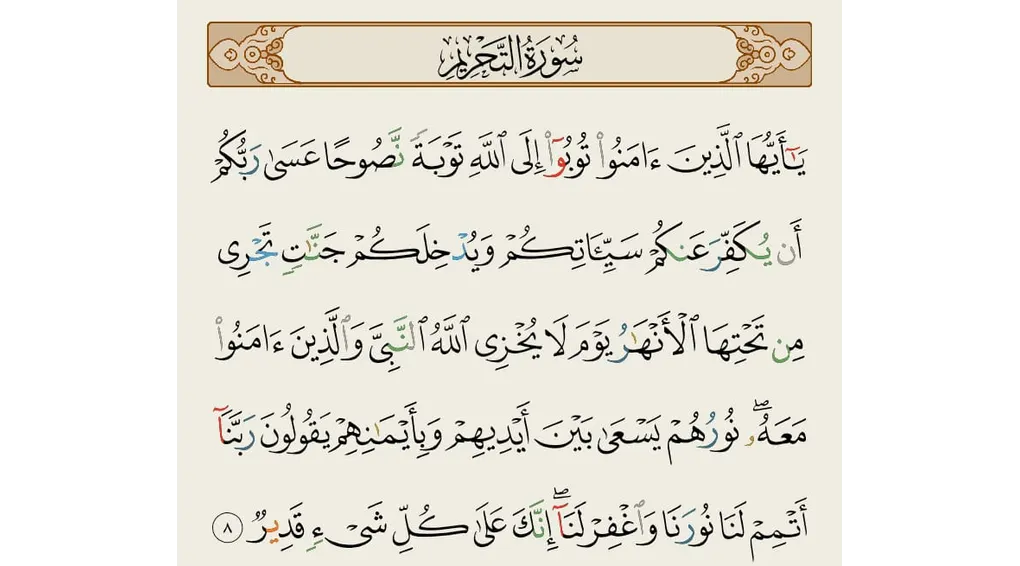
Allah specifically mandates an unadulterated form of repentance in Surah At-Tahrim, verse 8:
{يا أَيُّهَا الَّذِينَ آمَنُوا تُوبُوا إِلَى الله تَوْبَةً نَصُوحًا}
“O you who have faith, repent to Allah with sincere repentance (the purest of repentance).”
The Example of the Prophet ﷺ in Repentance
If the Prophet ﷺ—who was divinely protected from sin (ma’shum) and guaranteed Paradise—constantly repented, what about us? He performed this as a teaching (ta’lim) and to establish the law (tasyri’) for his Ummah.
From Al-Agharr bin Yasar Al-Muzani (may Allah be pleased with him), the Messenger of Allah ﷺ said:
«يا أيها الناس توبوا إلى الله واستغفروه، فإني أتوب في اليوم مائة مرة»
“O people, repent to Allah and seek His forgiveness, for indeed I repent a hundred times a day.” (Sahih Muslim)
This demonstrates that the essence of repentance is a daily necessity, not a seasonal activity reserved only for Ramadan or times of calamity.
Conditions for Valid Taubah Nasuha According to Imam Nawawi
You might ask, “Is my repentance accepted?” or “How do I repent from a major sin?”
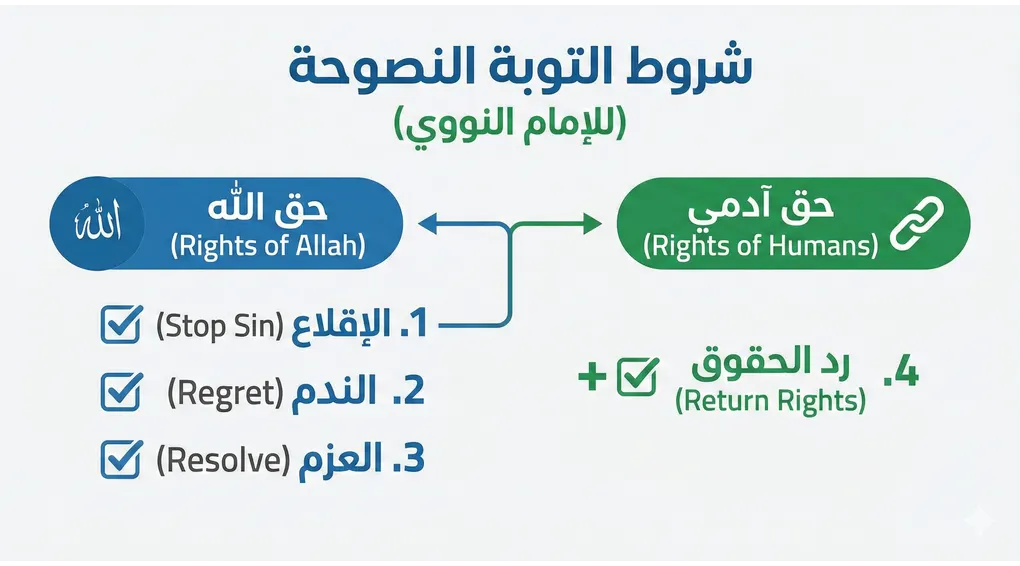
The scholars have formulated strict conditions for repentance to be deemed valid by Allah. Imam An-Nawawi (may Allah have mercy upon him) explained that repentance is obligatory for every single sin. He divided the conditions into two categories based on the nature of the transgression.
1. Sins Related Only to the Rights of Allah (No Human Involvement)
If the disobedience is a private matter between the servant and Allah (e.g., abandoning prayer, drinking alcohol, looking at the forbidden), there are three absolute conditions:
- Al-Iqla’ (Immediate Cessation): أن يقلع عن المعصية – You must completely and immediately halt the sinful act. It is not repentance if the tongue seeks forgiveness while the hands continue the sin.
- An-Nadam (Deep Remorse): أن يندم على فعلها – There must be an agonizing ache in the heart. Remorse is the very core of Taubah; a profound sadness for violating Allah’s prohibitions.
- Al-‘Azm (Firm Resolve): أن يعزم أن لا يعود إليها أبدا – You must possess an unbreakable inner resolve never to return to that specific sin again.
Crucial Note: Imam Nawawi strictly warns,
فإن فقد أحد الثلاثة لم تصح توبته
(If any one of these three conditions is missing, his repentance is not valid).
2. Sins Related to the Rights of Humans (Haqq al-Adami)
This is the category we most frequently underestimate. If the sin involves another person (e.g., stealing, breaking a heart, slandering), a fourth condition is added.
The fourth condition is:
وأن يبرأ من حق صاحبها
“And that he absolves himself from the right of its owner.”
The method of absolution is detailed as follows:
- Wealth/Material: If it involves wealth (stealing, corruption, unpaid debts), it must be returned to the rightful owner (فإن كانت مالا أو نحوه رده إليه).
- Punishment/Accusation (Qadzaf): If it involves a false accusation of zina (adultery) or an act requiring a prescribed punishment (Hadd), the perpetrator must submit themselves to the punishment or seek the victim’s pardon (مكّنه منه أو طلب عفوه).
- Ghibah (Backbiting): If it involves speaking ill of someone behind their back, one must seek their forgiveness and ask them to make it lawful (halal) for them (وإن كانت غيبة استحلّه منها). You can study further on what constitutes Ghibah or, if you have other human-related sins, refer to the detailed guide on how to repent and apologize for Haqqul Adami.
Summary Table of Repentance Conditions:
| Type of Sin | Condition 1 | Condition 2 | Condition 3 | Condition 4 |
| Only Allah’s Right | Stop Completely (Iqla’) | Deep Remorse (Nadam) | Resolve Not to Repeat | – |
| Human Rights | Stop Completely (Iqla’) | Deep Remorse (Nadam) | Resolve Not to Repeat | Return Right / Seek Forgiveness |
Environment: The Key Factor in Successful Repentance
Many individuals repent but repeatedly fall back into the exact same pit. Why? Often, it is because they fail to change their social environment.
Our classical references emphasize that a perfecting element of repentance is abandoning bad companionship (qurana’ as-su’). Wicked friends often make disobedience appear beautiful and induce laziness towards worship.
ترك قرناء السوء , وهجر الأصحاب الفسقة الذين يحببون للمرء المعصية , وينفرونه من الطاعة
“Abandoning evil companions, and forsaking wicked friends who make a person love disobedience and repel them from obedience.”
The solution is to integrate into communities of righteous people (الالتحاق بصحبة الصادقين الأخيار). Good friends serve as a protective fortress, preventing a relapse into a dark past.
Learning from the Killer of 100 Souls
There is a massive lesson in the authentic Hadith (Sahih Muslim) regarding the man who murdered 99 people and then completed it to 100. When he finally sought repentance, the most knowledgeable scholar of his time gave him a strict condition: “Go to such-and-such land, for there are people devoted to prayer and worship of Allah. Join them in worship, and do not come back to your land because it is an evil place.” This explicitly proves that migrating (Hijrah) from a toxic environment drastically impacts whether one’s repentance is accepted and sustained.
Levels of Repentance: Where Do You Stand?
In the view of Fiqh, Taubah is legally obligatory. However, in the view of Tasawwuf (spiritual purification), the depth of a person’s repentance varies based on their proximity to Allah.
A Sufi or a dedicated worshipper does not look at the smallness of the sin; they look at the immense majesty of the One they are disobeying. The Companion Anas bin Malik (may Allah be pleased with him) once remarked to the generation after him:
( إنكم لتعملون أعمالا هي أدق في أعينكم من الشعر إن كنا نعدّها على عهد رسول الله صلّى الله عليه وسلّم من الموبقات )
“You do deeds that are more insignificant in your eyes than a hair, while during the time of the Messenger of Allah ﷺ we used to consider them among the destructive sins.” (Sahih Al-Bukhari)
The great scholar Dhu an-Nun al-Misri divided repentance into two levels:
(توبة العوام من الذنوب، وتوبة الخواص من الغفلة)
- The Repentance of the Layperson: Repentance from sins (disobedience).
- The Repentance of the Special People (Khawwas): Repentance from Ghaflah (the heart’s negligence in remembering Allah).
The purer a person’s heart becomes, the more sensitive they are to blemishes. Even a momentary lapse of the heart in remembering Allah is considered a sin that requires repentance.
Accompanying Repentance with Righteous Deeds and Istighfar

After repenting, what is the next step? Do not remain stagnant. Fill your time with goodness.
In the Quran and Hadith, repentance is inextricably linked with Istighfar (seeking forgiveness). Constantly seeking forgiveness day and night is the hallmark of an honest servant who recognizes their severe shortcomings in servitude.
Allah promises extraordinary rewards for those who diligently practice Istighfar, as outlined in Surah Nuh (10-12) and Adh-Dhariyat (15-18):
- The descent of merciful rain.
- An increase in wealth and offspring.
- The provision of gardens and rivers (ultimate prosperity).
Beyond verbal Istighfar, the physical body must actively engage in good deeds. The Prophet ﷺ provided the ultimate prescription for erasing sins:
« وأتبع السيئة الحسنة تمحها »
“And follow up a bad deed with a good deed, it will wipe it out.” (Sunan At-Tirmidhi)
Therefore, if you previously used your eyes for disobedience, now use them to read the Quran. If you previously spent wealth on the unlawful (haram), now give in charity. This is the concrete method of “paying off” past mistakes.
The Sign of Accepted Repentance (Rule of Sheikh Ahmad Zarruq)
How do we know if our repentance is genuine or a delusion? Sheikh Ahmad Zarruq, in his Qawaid at-Tasawwuf, provides a razor-sharp metric:
فتوبة لا تتبعها تقوى باطلة
“A repentance that is not followed by piety (Taqwa) is void (futile).”
He explains that claims must be validated by results. The truth of one’s repentance is exposed when they are subsequently faced with something forbidden (haram).
- If they possess the spiritual strength to restrain themselves, their repentance was true.
- If they casually violate the law again when the opportunity arises, their initial claim of repentance is highly questionable.
Simply put: The essence of repentance is not merely crying while supplicating; it is the enduring ability to restrain oneself when the temptation of that sin returns in the future.
FAQ: Common Questions About Repentance
Simply put: Taubat (repentance) is not merely crying during prayer, but the ability to restrain oneself when the temptation of sin returns later on.
Can major sins be forgiven?
Yes, Allah is the Most Forgiving. As long as the soul has not reached the throat (the agony of death) and the sun has not risen from the west, the door of repentance is wide open for absolutely all types of sins, provided the strict conditions of Taubah Nasuha are met.
I have repented, but I committed the exact same sin again. Is my previous repentance invalidated?
Your first repentance was valid if the conditions were genuinely met at that specific time. If you fall again, you are obligated to repent again. Never grow tired of repenting until Satan grows tired of tempting you. Remember the Prophet ﷺ sought forgiveness 100 times a day.
How do I repent from the sin of Ghibah (backbiting) if the person has moved away or is impossible to meet?
The primary condition is to ask them to make it lawful (halal) for you. However, if this is impossible, or if informing them would cause a greater harm (mudharat) such as violent conflict, a significant body of scholars advises that you must sincerely pray for their forgiveness and actively speak well of them in gatherings to replace the evil you previously spread.
Closing and Hope
Dear reader, repentance is the most beautiful journey home. Do not procrastinate by saying, “I will repent when I am older.” We never know when our allotted time will expire.
Begin today. Perform ablution (wudu), and pour out your remorse before Allah. Cease the sin, regret it deeply, and resolve to emerge as a new individual. You may also want to read our comprehensive guide to learn the exact procedure and prayer for the prayer of repentance (Sholat Taubat).
Are you ready to start a new chapter? May Allah accept our repentance and purify our hearts.
Reference
ʿAbd al-Qādir ibn ʿAbd Allāh ibn Qāsim ibn Muḥammad ibn ʿĪsā ʿAzīzī al-Ḥalabī al-Syādhilī, Ḥaqāʾiq ʿan al-Taṣawwuf (Aleppo, Syria: Dār al-ʿIrfān, 16th ed., 1428 AH/2007 CE), pp. 231–234.


