

Every human being will inevitably experience their lowest point. A tightness in the chest, a clouded mind, or a series of problems often make us feel alone. In Islam, this condition is called Karb (severe hardship) or Gham (deep sorrow).
When logic is no longer able to find a solution, the only way is to knock on the door of heaven. The Prophet Muhammad SAW never allowed his ummah to face problems empty-handed. He left behind a powerful spiritual weapon in the form of special prayers to ease a heavy heart.
This article summarizes a complete guide to prayers for removing sadness and life’s difficulties, directly sourced from the book Al-Adhkar by Imam An-Nawawi (Chapter Du’a al-Karb, pages 121-122). Let’s learn them one by one so that the heart returns to peace.
Why is Supplication the Primary Solution for Anxiety?
Before desperately scrambling for technical, earthly solutions, the Messenger of Allah ﷺ taught us to rectify our internal, spiritual condition first. When massive problems afflicted him (hazabahu amr), he did not panic; instead, he immediately remembered Allah.
Psychologically and spiritually, reciting a heart-calming prayer is not a mere ritualistic vocalization. It is our method of “taking a deliberate pause” and surrendering the crushing burdens we cannot carry ourselves to the Almighty, the Most Strong.
Below is a systematic classification of highly efficacious (mustajab) supplications that you can practice according to your specific emotional or situational state.
1. The Dua of Tawhid: Magnifying Allah to Minimize Problems
In a hadith narrated by Bukhari and Muslim (No. 344), Ibn Abbas recounted that when the Messenger of Allah ﷺ experienced severe distress, he did not explicitly ask, “O Allah, solve my problem.” Instead, he profoundly praised the immense greatness of Allah.
Why is this psychological shift so effective? When our tongues actively praise Allah the Most Great (Al-‘Azhim) and the Most Forbearing (Al-Halim), our subconscious mind instantly realizes that our problems are microscopic in His majestic presence.
The Supplication Text:
لاَ إِلَهَ إِلاَّ اللهُ الْعَظِيْمُ الْحَلِيْمُ, لاَ إِلَهَ إِلاَّ اللهُ رَبُّ الْعَرْشِ الْعَظِيْمُ, لاَ إِلَهَ إِلاَّ اللهُ رَبُّ السَّمَاوَاتِ وَرَبُّ اْلأَرْضِ وَرَبُّ الْعَرْشِ الْكَرِيْمِ
Transliteration: La ilaha illallahu al-‘Azhimu al-Halim, la ilaha illallahu Rabbu al-‘arshi al-‘azhim, la ilaha illallahu Rabbu al-samawati wa Rabbu al-ardhi wa Rabbu al-‘arshi al-karim. Meaning: “There is no deity but Allah, the Most Great, the Most Forbearing. There is no deity but Allah, Lord of the Great Throne. There is no deity but Allah, Lord of the heavens and Lord of the earth, and Lord of the Noble Throne.”
2. Istighathah: The Prayer of Total Surrender
If you feel completely exhausted from fighting alone, this prayer is your definitive answer. In the narration of At-Tirmidhi (Nos. 345 & 346), as problems became increasingly complex, the Prophet ﷺ would raise his head to the sky and earnestly invoke the names of Allah, the Ever-Living (Al-Hayy) and the Self-Sustaining (Al-Qayyum).
There are two primary variations of this prayer you should recite:
A. The Prayer Seeking the Aid of His Mercy
يَا حَيُّ يَا قَيُّوْمُ بِرَحْمَتِكَ أَسْتَغِيْثُ
Transliteration: Ya Hayyu Ya Qayyum, bi rahmatika astaghith.
Meaning: “O Ever-Living One, O Self-Sustaining One, by Your mercy I seek assistance.” Explore the profound theological secrets of these divine names in our dedicated article: The Virtues of the Dhikr Ya Hayyu Ya Qayyum.
B. The Prayer for Flawless Guidance (Narration of Abu Bakrah)
This supplication (No. 349) is exceptionally beautiful because it is a brutal, honest confession that we are entirely incapable of managing ourselves, even for the blink of an eye.
اللَّهُمَّ رَحْمَتَكَ أَرْجُو فَلاَ تَكِلْنِي إِلَى نَفْسِي طَرْفَةَ عَيْنٍ, وَأَصْلِحْ لِي شَأْنِي كُلَّهُ, لاَ إِلَهَ إِلاَّ أَنْتَ
Transliteration: Allahumma rahmataka arju, fa la takilni ila nafsi tarfata ‘ayn, wa aslih li sha’ni kullahu, la ilaha illa Anta.
Meaning: “O Allah, it is Your mercy that I hope for, so do not leave me to myself even for the blink of an eye, and rectify for me all of my affairs. There is no deity except You.”
This hadith narrated by Abu Bakrah contains deep monotheistic (Tawhid) implications regarding the catastrophic danger of vanity (‘Ujub). Why did the Prophet strictly forbid us from relying on ourselves even for a millisecond? Discover the detailed explanation in our specific analysis: Exploring the Rahmataka Arju Dua by Abu Bakrah.
3. The Prayer of Prophet Yunus: The Key to Breaking Deadlocks

This is the ultimate, decisive prayer. Sa’d bin Abi Waqqash narrated (No. 352) that no Muslim ever supplicates with these words concerning any matter whatsoever except that Allah will unequivocally answer it.
This prayer was recited by Prophet Yunus (Jonah) AS when he was trapped in three impenetrable darknesses: the darkness of the whale’s belly, the darkness of the deep ocean, and the darkness of the night. If your life feels completely deadlocked without a single sliver of light, multiply the recitation of this prayer.
The Supplication Text:
لاَ إِلَهَ إِلاَّ أَنْتَ سُبْحَانَكَ إِنِّي كُنْتُ مِنَ الظَّالِمِينَ
Transliteration: La ilaha illa Anta subhanaka, inni kuntu min al-zhalimin.
Meaning: “There is no deity except You; exalted are You. Indeed, I have been of the wrongdoers.”
The secret of this prayer: It seamlessly merges absolute Monotheism (Tawhid), Glorification of Allah (Tasbih), and the Seeking of Forgiveness through the confession of sin (Istighfar). Allah immediately rescued Prophet Yunus not because Yunus protested his situation, but because he profoundly admitted his own fault.
This prayer is vehemently recommended for those who feel hopelessly trapped in problems without an exit. However, there are profound exegetical (tafsir) secrets as to why this prayer is so uniquely potent (mustajab). To comprehend the word-by-word meaning and the complete historical context, please read our dedicated article: The Prayer of Prophet Yunus Inside the Whale and Its Meaning.
4. The Sapu Jagat Prayer: The Universal Solution for Both Worlds
Frequently, we are so overwhelmed by a multitude of problems that we become confused about what exactly to ask for. In such cases, ask for “wholesale” goodness. Anas bin Malik recounted (No. 347) that this was the supplication most frequently uttered by the Prophet ﷺ.
اللَّهُمَّ آتِنَا فِي الدُّنْيَا حَسَنَةً وَفِي الآخِرَةِ حَسَنَةً وَقِنَا عَذَابَ النَّارِ
Transliteration: Allahumma atina fi al-dunya hasanatan, wa fi al-akhirati hasanatan, wa qina ‘adhaba al-nar.
Meaning: “O Allah, give us in this world [that which is] good and in the Hereafter [that which is] good and protect us from the punishment of the Fire.”
Read the comprehensive explanation of why this is called the all-encompassing prayer and the secrets of its virtues in the article: The Virtues of the Comprehensive Sapu Jagat Prayer (Rabbana Atina).
5. Specific Practice: Ruqyah and Family Protection

Besides praying for oneself, Imam al-Nawawi also included the narration of Abdullah bin Ja’far (No. 348), which teaches a magnificent prayer of protection for the family. He routinely recited this prayer over individuals suffering from severe fever (maw’uk) and meticulously taught it to his daughters who were traveling or marrying far away from home (mughtaribah). Study the practical guide on How to Perform Independent Ruqyah on Sick Family Members with Ayatul Kursi and Specific Dhikr.
This serves as an excellent daily practice for parents who are constantly anxious about their children’s well-being:
لاَ إِلَهَ إِلاَّ اللهُ الْكَرِيْمُ الْعَظِيْمُ, سُبْحَانَهُ, تَبَارَكَ اللهُ رَبُّ الْعَرْشِ الْعَظِيْمُ, الْحَمْدُ لِلهِ رَبِّ الْعَالَمِيْنَ
Transliteration: La ilaha illallahu al-Karimu al-‘Azhim, subhanahu, tabarakallahu Rabbul ‘arshi al-‘azhim, alhamdulillahi Rabbil ‘alamin.
Meaning: “There is no deity but Allah, the Most Generous, the Most Great. Glory be to Him. Blessed is Allah, Lord of the Great Throne. All praise is due to Allah, Lord of the worlds.”
Additional Tip: Combining Ayatul Kursi




In a hadith narrated by Ibn al-Sunni (No. 351), the immense virtue of reciting Ayatul Kursi alongside the final two verses of Surah Al-Baqarah when facing overwhelming difficulties is explicitly mentioned. The combination of these specific Quranic verses is firmly believed to drastically accelerate the arrival of Allah’s divine assistance.
Summary Table: Duas According to Your Condition
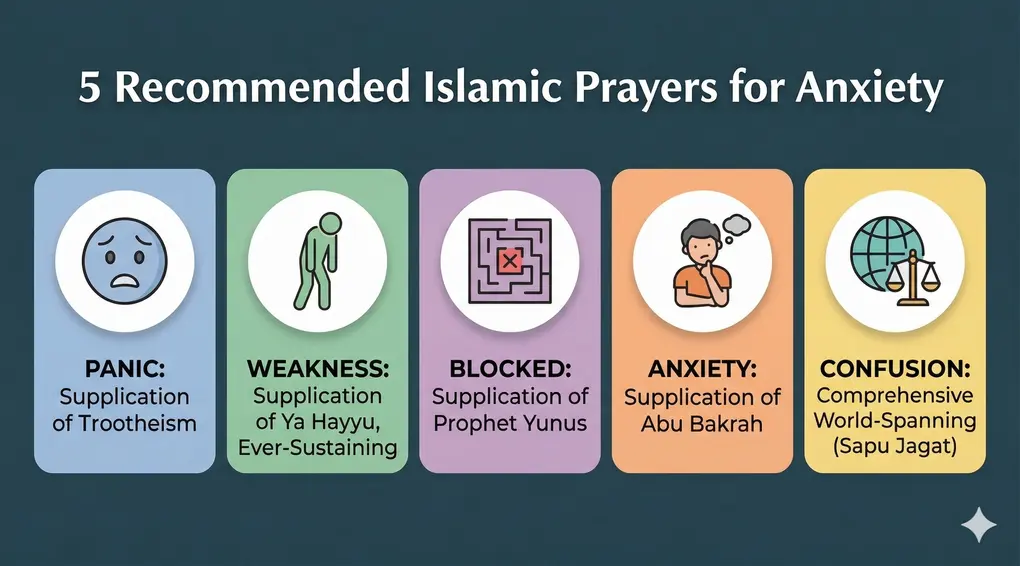
To make it easier to practice daily, here is a rapid-reference summary table of the prayers based on your specific emotional or situational state:
| Condition of the Heart | Recommended Dua | Primary Focus / Meaning |
| Panic / Massive Problems | Dua of Tawhid (Hadith 344) | Praising Allah’s greatness to calm the heart. |
| Feeling Weak / Exhausted | Ya Hayyu Ya Qayyum (Hadith 345) | Begging for Allah’s strength and immense mercy. |
| Deadlock / Hopelessness | Dua of Prophet Yunus (Hadith 352) | Confession of sin and begging for profound forgiveness. |
| Anxiety About the Future | Dua of Abu Bakrah (Hadith 349) | Total surrender; abandoning reliance on human logic. |
| Confused About What to Ask | The Sapu Jagat Prayer (Hadith 347) | Requesting a complete package of worldly and eternal goodness. |
| Sick / Traveling Family | Dua of Abdullah bin Ja’far (Hadith 348) | Seeking divine protection and physical healing. |
FAQ (Frequently Asked Questions)
When is the absolute best time to recite these prayers?
The Messenger of Allah ﷺ recited them exactly “when” (‘inda) the difficulty struck. Therefore, recite them immediately when your heart feels uneasy, anxious, or the very second a new problem emerges. Furthermore, highly efficacious (mustajab) times, such as the final third of the night or during your final prostration (sujud), are exceptionally recommended.
Is it permissible to read these prayers in English only?
Supplicating in any language is entirely permissible, and Allah is All-Knowing of every language. However, reciting the original Arabic formulations (ma’thur) exactly as uttered by the Prophet ﷺ possesses a unique, irreplaceable spiritual blessing (barakah).
Must I recite all of them at once?
No, it is not obligatory. Select one or two prayers that resonate most deeply with your heart’s current condition, and repeat them persistently (dawam) until your heart definitively feels tranquil and at peace.
Conclusion: Never Fall into Despair
The crushing difficulties of life are Allah’s profound method of calling us to draw closer to Him. By actively practicing the duas to remove sadness detailed above, we are not merely seeking a worldly solution to a transient problem; we are fundamentally repairing and elevating our eternal relationship with the Creator.
Always remember the core message of the Prophet in the narrations above: the master keys to divine assistance are absolute Monotheism (Tawhid), brutally honest self-confession, and total, unconditional surrender. We pray that Allah lifts every crushing burden from your shoulders and replaces it with unimaginable, enduring happiness.
Wallahu a’lam bish-shawab.
Reference
Al-Nawawī, Yaḥyā ibn Sharaf. Al-Adhkār. Edited by ʿAbd al-Qādir al-Arnaʾūṭ. New revised edition. Beirut: Dār al-Fikr, 1994.


