
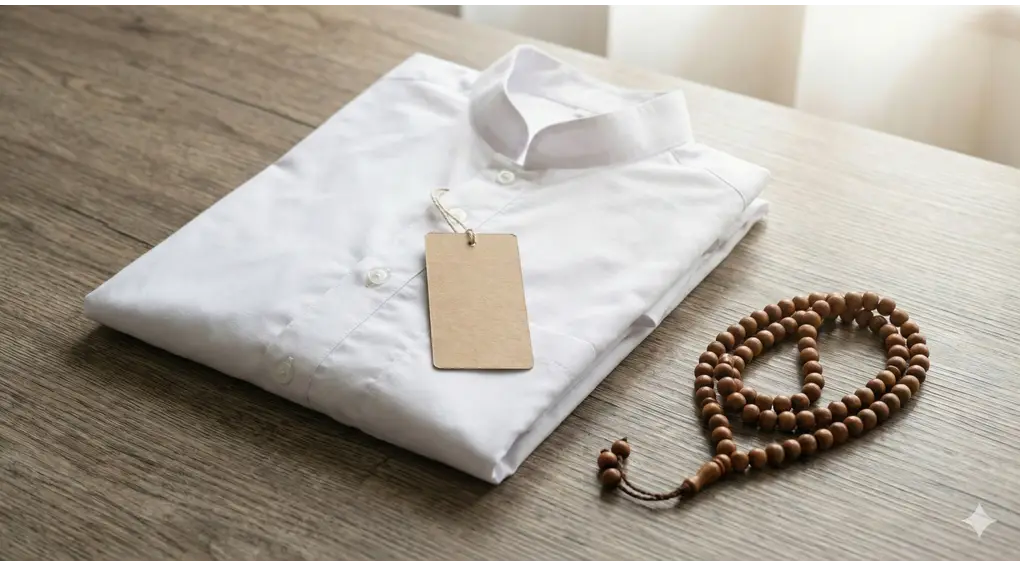
Have you ever imagined that a simple activity like putting on a new shirt or a festive Eid garment could be the reason for the shedding of our sins? Often, we consider dressing as merely a mundane daily routine. We busy ourselves with matching colors or looking in the mirror, but we forget to involve Allah in the process. Understanding the complete etiquette of dressing ensures that the reward for this everyday act is perfected.
In fact, in the classical text Al-Adhkar (page 20), Imam An-Nawawi cites a truly magnificent narration. It turns out that there is one short sentence—a sincere confession from a servant—which, if uttered when wearing new clothes, brings the reward of Allah’s forgiveness for past sins.
This phrase is the prayer: “Alhamdulillahilladhi kasani hadha…” Let us thoroughly discuss the secrets and virtues behind this prayer so that every thread resting on our bodies brings blessings.
The Secret Behind the Hadith of Mu’adh bin Anas
Imam An-Nawawi places this hadith in Chapter 44 of his book. This is not just any utterance, but a promise from the Messenger of Allah ﷺ for his Ummah who are adept at showing gratitude.
Here is the complete text of the hadith as written in Al-Adhkar:
وروينا فيه عن معاذ بن أنس رضي الله عنه أن رسول الله صلى الله عليه وسلم قال : ” من لبس ثوبا جديدا فقال : الحمد لله الذي كساني هذا ورزقنه من غير حول مني ولا قوة ، غفر الله له ما تقدم من ذنبه “
Meaning:
“‘Whoever wears a new garment and says: Al-ḥamdu li-llāhi alladhī kasānī hādhā wa razaqanīhi min ghayri ḥawlin minnī wa lā quwwah (All praise is due to Allah who has clothed me with this and provided it for me without any power or might from myself), Allah will forgive his past sins.’”
From the original text above, we can see that the conditions to attain this maghfirah (forgiveness) are incredibly light:
- Wearing a new garment (thawban jadīdan).
- Reciting this prayer of confession with utmost sincerity.
Why is This Prayer So “Powerful”?
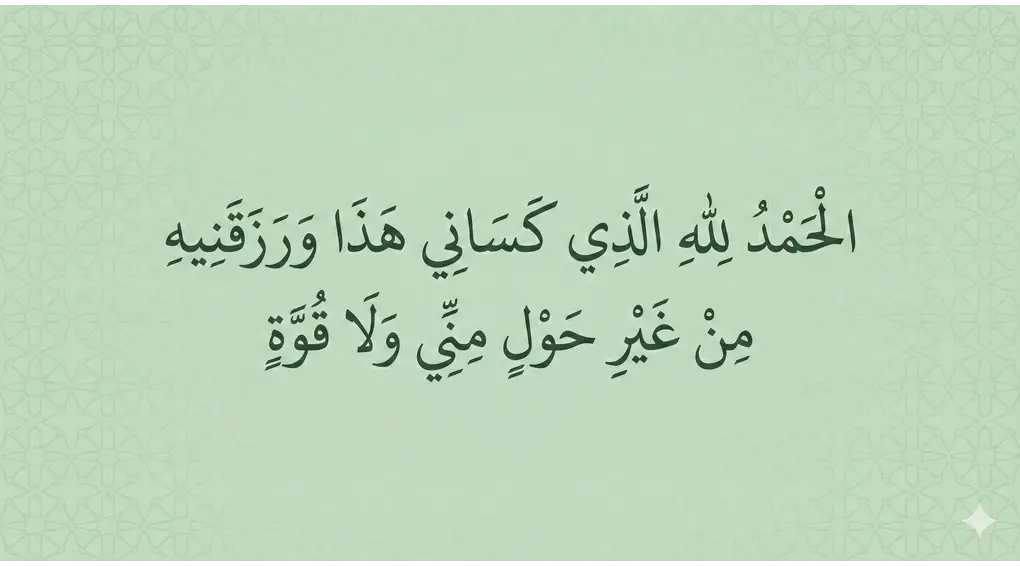
A question might arise in our minds: why can such a short prayer erase past sins? The answer lies in the profound meaning of Tawhid (Islamic monotheism) and absolute submission contained within it.
1. Total Acknowledgment of Allah’s Provision
The phrase Alhamdulillahilladhi kasani hadha (All praise is due to Allah who has clothed me with this) is the highest form of gratitude. We do not say, “This shirt is the result of my hard work,” or “This is because I have money.” No. We return the reality of the provision to Allah, acknowledging that He is the true Provider.
2. Stripping Away Arrogance
The most crucial point lies in the phrase:
من غير حول مني ولا قوة
Meaning: “Without any power or might from myself.”
This is a sentence that shatters ‘ujub (excessive self-pride). When wearing new clothes, which might be expensive or beautiful, humans tend to feel dashing and superior. With this prayer, we actively admit our profound weakness. We were able to purchase that clothing not merely because we are smart at earning money, but solely because Allah granted us the provision. It is this exact posture of humility before Allah that invites His divine forgiveness.
When is the Best Time to Practice It?
Based on the chapter title formulated by Imam An-Nawawi:
(Bab ma yaqulu idha labisa thawban jadidan aw na’lan aw shibhah) “Chapter on what is said when wearing a new garment, or sandals, or what resembles them.”
Therefore, this prayer is highly recommended to be recited during these specific moments:
- When trying on a newly purchased piece of clothing for the very first time.
- When wearing a new uniform, a new thawb, or a new dress.
- Including when wearing new sandals or shoes (aw na’lan), based on the qiyas (analogy) explicitly mentioned by Imam An-Nawawi.
However, do not forget the fundamental etiquette. Before reciting this longer prayer, Imam An-Nawawi reminds us at the beginning of the chapter (p. 20):
يستحب أن يقول : بسم الله , وكذلك تستحب التسمية في جميع الأعمال .
“It is recommended to say: Bismillah. Likewise, reciting the Tasmiyah is recommended in all actions.”
So the precise sequence is: Read the Basmalah when about to put the item on, then immediately follow up with Alhamdulillahilladhi kasani hadha… after the clothing is neatly worn.
Differences Between Prayers for New and Old Clothes
In Al-Adhkar, there are distinct variations in the prayers for everyday clothes versus brand new clothes. To avoid confusion, pay close attention to the following table:
| Category | Hadith Reference | Core Prayer Recitation | Primary Virtue |
| Everyday Clothes | Hadith No. 43 (Abu Sa’id Al-Khudri) | Allahumma inni as’aluka min khayrihi… (O Allah, I ask You for its goodness…) | Seeking protection from the evil of the clothing. |
| New Clothes | Hadith No. 44 (Mu’adh bin Anas) | Alhamdulillahilladhi kasani hadha wa razaqanihi… | Forgiveness of all past sins. |
| New Clothes (Option 2) | Hadith No. 45 (Abu Sa’id Al-Khudri) | Allahumma lakal hamdu anta kasawtanihi… | Expression of gratitude and supplication for goodness. |
Although there are several authentic versions, the narration of Mu’adh bin Anas (Hadith No. 44) is the one that specifically mentions the immense reward of the forgiveness of sins. To understand the nuances further, you can read our detailed review on the differences between prayers for everyday and new clothes.
Perfecting It by Donating Old Clothes

To truly complete our sense of gratitude, there is one more profound practice mentioned by Imam An-Nawawi in Hadith No. 46, narrated from Umar bin Khattab (may Allah be pleased with him).
The Messenger of Allah ﷺ said that whoever wears a new garment, then praises Allah (like the prayer above), and then takes his old garment that is still decent and donates it as charity, he will be:
في حفظ الله وفي كنف الله عز وجل , وفي سبيل الله حيا وميتا
“In the care of Allah, in the protection of Allah Azza wa Jalla, and in the path of Allah, both while living and when dead.”
This is the ultimate, complete package: Sins are forgiven because of the prayer, and life is divinely protected by Allah because of the charity.
Frequently Asked Questions (FAQ)
Is this prayer only for expensive clothes?
No. The word tsawban (clothing) in the ḥadīth is general. Whether it is expensive clothing or a cheap shirt, as long as it is “new” to you, then it is sunnah to recite this prayer.
What if I forget to recite it when wearing it?
You may recite it when you remember, even after you have finished donning Iḥrām. Gratitude and acknowledgement to Allah are not rigidly time-bound, although it is primarily uttered during the moment of wearing it.
Is it permissible to recite [prayers] for clothing that is not new (daily wear)?
It is permissible as a form of dhikr and gratitude. However, the specific promise of “forgiveness of past sins” in the hadith narrated by Mu’adh bin Anas is linked to the context of tsawban jadidan (new clothing).
Does this include socks and a skullcap?
Imam An-Nawawi titled the chapter with the addition “…or sandals or something resembling them.” Therefore, clothing accessories such as a peci (traditional Indonesian cap), headscarf, socks, or new shoes also fall within this recommendation.
Let us memorize this beautiful prayer. Do not let the moment of wearing new clothes pass by without it becoming a fertile field of immense reward for us. You can also read our Complete Guide to Dressing Prayers: From Wearing to Taking Off According to the Prophet’s Sunnah for further daily implementation.
Reference
Al-Nawawī, Yaḥyā ibn Sharaf. Al-Adhkār. Edited by ʿAbd al-Qādir al-Arnaʾūṭ. New revised edition. Beirut: Dār al-Fikr, 1994.


