
Spiritual and physical purity stands as a fundamental pillar in the performance of Islamic worship. Understanding the profound meaning of thaharah (purification) is the essential first step for every Muslim. One primary method of purifying oneself from major ritual impurity (hadats akbar) is through major ablution, widely known as Ghusl Janabah or mandi wajib. This purification process is not merely a routine of cleaning the body; rather, it is a sacred act of worship with specific pillars, conditions, and procedures meticulously outlined by classical jurisprudential scholars.
This foundational article presents a comprehensive guide to major ablution, sourced directly from the authoritative literature of the Shafi’i school, specifically the text Asna al-Matalib Syarh Rawd ash-Talib authored by Shaykh al-Islam Zakariyya al-Ansari (Volume 1, Pages 64-71). The following elucidation thoroughly examines the intention, the correct methodology, and the specific causes that obligate a Muslim to perform this ritual purification.
The Definition of Ghusl in Islamic Jurisprudence
Lexically and terminologically, Shaykh al-Islam Zakariyya al-Ansari details the meaning of the word ghusl with precise linguistic delineation:
قوله: (باب الغسل.) هو بفتح الغين مصدر غسل الشيء، وبمعنى الاغتسال كقوله «غسل يوم الجمعة سنة» وبضمها مشترك بينهما وبين الماء الذي يغتسل به… وهو بالمعنيين الأولين لغة سيلان الماء على الشيء وشرعا سيلانه على جميع البدن
Linguistically, the word can be read with a fathah on the letter ghayn (ghasl), which means the act of flowing water over something. When read with a dhammah (ghusl), the term is utilized by the majority of jurists to refer to the activity of bathing itself, as well as the water used for it. In terms of Shari’ah, major ablution is defined as the flowing of water over the entire body (evenly) accompanied by a specific intention.
Causes that Necessitate Ghusl Janabah (Mujibat al-Ghusl)
When is a person obligated to perform the major bath? Based on the text of Asna al-Matalib, there are five specific causes of ghusl (Mujibat al-Ghusl) that necessitate this purification.
1. Death (Mawt)
The first cause is the death of a Muslim who is not in a state of martyrdom (syahid).
قوله: (موت) لمسلم غير شهيد… والموت عدم الحياة ويعبر عنه بمفارقة الروح الجسد
Death is defined as the separation of the soul from the body. For a Muslim who passes away naturally (not martyred on the battlefield), it becomes a communal obligation (fardhu kifayah) for the living Muslims to wash the deceased body according to fiqh as a form of purification (tanzhifan) and honoring (ikraman).
2. Cessation of Menstruation and Postpartum Bleeding
For women, the discharge of menstrual (haid) or postpartum (nifas) blood necessitates major ablution. This obligation falls immediately after the bleeding completely ceases (inqitha’). For Muslim women requiring detailed, practical steps on this matter, you can study the specific guide on the correct method of major ablution for menstruation according to Islam.
قوله: (وخروج حيض أو نفاس بانقطاعه) أي معه لآية {فاعتزلوا النساء في المحيض} [البقرة: ٢٢٢]… وإذا أدبرت فاغسلي عنك الدم وصلي
The valid condition for a woman to resume establishing her daily prayers and other acts of worship is to perform major ablution after the blood has definitively stopped. Postpartum bleeding (nifas) is legally analogized (qiyas) to menstruation, as it is fundamentally menstrual blood that accumulates during pregnancy.
3. Childbirth (Wiladah)




The process of giving birth obligates a woman to perform major ablution, even if the delivery is not accompanied by postpartum bleeding.
قوله: (و) خروج (ولد ولو علقة ومضغة) و (بلا بلل) لأنه مني منعقد
The obligation to bathe remains applicable even if what is expelled from the womb is merely a blood clot (‘alaqah) or a lump of flesh (mudhghah), and even if the infant is born completely dry without any moisture or amniotic fluid (bila balal). This is based on the juristic argument that the fetus originally stems from coagulated seminal fluid.
4. Penetration (Jima’) Even with a Barrier
The state of janabah occurs through sexual intercourse, which is specifically defined as the penetration of the hasyafah (the glans of the male organ) into the farj (the female organ).
الأول بإدخال حشفة ولو من ذكر أشل… أو بحائل كخرقة لفها على ذكره ولو غليظة لخبر الصحيحين «إذا التقى الختانان فقد وجب الغسل» وفي رواية لمسلم «وإن لم ينزل»
The text above asserts strictly that major ablution is absolutely mandatory when the two circumcised parts meet (iltiqa’ al-khitanain), even if the intercourse:
- Is not accompanied by the emission of semen (in lam yunzil).
- Utilizes a barrier (ha’il) such as a wrapped cloth, or in a modern context, a condom, even if the cloth or protective barrier is thick (wa law ghalizhatan).
- Occurs without the presence of desire, or if the reproductive organ is paralyzed (asyal).
Note: Intercourse with an animal or a corpse (although a major sin and a forbidden deviation) technically still obligates the perpetrator to perform the major bath in Islamic jurisprudence.
5. Emission of Semen (Khuruj al-Mani)
The emission of semen mandates major ablution, whether it occurs in a state of wakefulness or during sleep (wet dream), and whether it is discharged from a man or a woman.
الأمر الثاني خروج المني أي مني الشخص نفسه الخارج أول مرة من رجل أو امرأة (ولو بعد غسل) من جنابة
If a person has already performed the major ablution, and then the remnants of their semen exit again, they are obliged to repeat their bath. This is based on the saying of the Prophet ﷺ: “Indeed, water (the major bath) is necessitated by water (semen).”
What, then, are the characteristics of semen that distinguish it from other fluids like madzi (pre-seminal fluid)? Knowing the difference between mani vs madzi is crucial for correct purification. The text of Asna al-Matalib mentions the following specific characteristics:
قوله: (ويعرف) المني (بتدفق)… (أو تلذذ) بخروجه… (أو ريح طلع أو عجين رطبا و) ريح (بياض بيض يابسا)
Characteristics of Semen (Mani):
- It exits by spurting or in successive bursts (tadaffuq).
- It is accompanied by a sensation of pleasure (taladhdhudh) upon its exit, followed by the flaccidity of the male organ.
- It possesses a distinct odor: similar to the smell of wet dough or palm pollen (‘ajin/tala’) when wet, and like the smell of dried egg whites (bayazh bayzh) when it has dried.
If an individual is in doubt as to whether the discharged fluid is semen or madzi, the ruling is returned to their own discretion:
قوله: (كمن شك هل الخارج من ذكره مني أو مذي) فإنه يخير بينهما (ويعمل بمقتضى اختياره) فإن جعله منيا اغتسل أو مذيا توضأ وغسل ما أصابه
The person in doubt is free to choose. If they consider it semen, they must perform the major bath. If they consider it madzi, they are not required to perform major ablution; rather, it is sufficient to wash the private parts, clean the clothing affected by the impure madhi, and perform the minor ablution (wudu).
Pillars and Valid Conditions of Ghusl
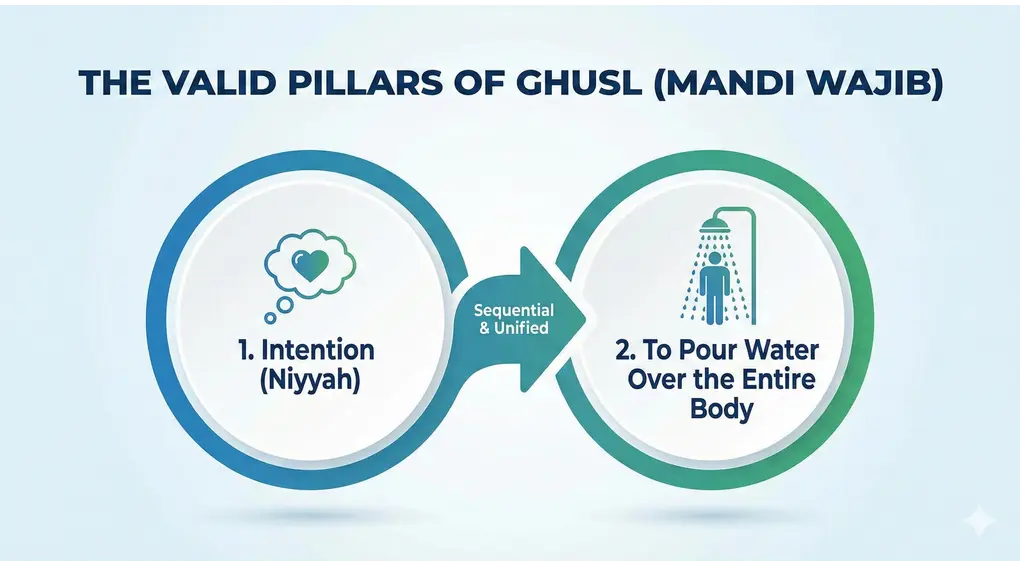
For the major bath to be deemed valid in the eyes of Islamic law, an individual must fulfill the following pillars (fundamental obligations):
1. The Intention to Lift Major Impurity
Intention (niyyah) is the first pillar. The intention in the heart must be present simultaneously with the very first washing of water on any part of the body.
(وأقل الغسل) شيئان أحدهما (نية رفع الجنابة) أو نية رفع الحدث عن جميع البدن… (ويجب قرنها) أي النية (بأول فرض)
To fulfill this foundational requirement, a person may internally formulate the intention for major ablution
by articulating in their heart: “I intend to lift the state of janabah” or “I intend to lift the major impurity from the entire body.” If someone intentionally aims only to lift a minor impurity (such as for Wudu) while they are in a state of janabah, their major impurity is not lifted. Crucially, this intention must absolutely coincide (muqaranah) with the exact moment the water first touches the surface of the skin or hair. If the intention is made before the water touches the body, and then the intention slips from the heart when the water is poured (‘uzub an-niyyah), the bath is invalid.
2. Washing the Entire Body (Ta’mim al-Badan)
The second pillar ensures that pure, absolute water touches all of human hair and outer skin.
قوله: (و) الشيء الثاني (تعميم البدن بالماء شعرا) وإن كثف (وبشرا) وما ظهر من صماخ وأنف مجدوع… وما تحت قلفة
Water must flow evenly to wet:
- The entire outer skin (basyaran).
- All hair, whether thin or thick/dense (sya’ran wa in katsufa).
- The outer portion of the ear canal (shimakh).
- The skin beneath the foreskin of an uncircumcised male (ma tahta qulfah).
- For women, the area that is visible when she sits to relieve herself (mima dzhahara min tsayyib qa’adat liqadha’ hajah).
Regarding braided or plaited hair, if water can reach its inner depths without needing to be untied, then untying the hair is not obligatory (wa la yajibu naqdhu dhufrin yashiluhu al-ma’). Rinsing the mouth and sniffing water into the nose (madhmadah wa istinsyaq) is not obligatory; rather, it is a recommended sunnah.
The Sunnah Method of Ghusl Janabah (Kaifiyah al-Ghusl)
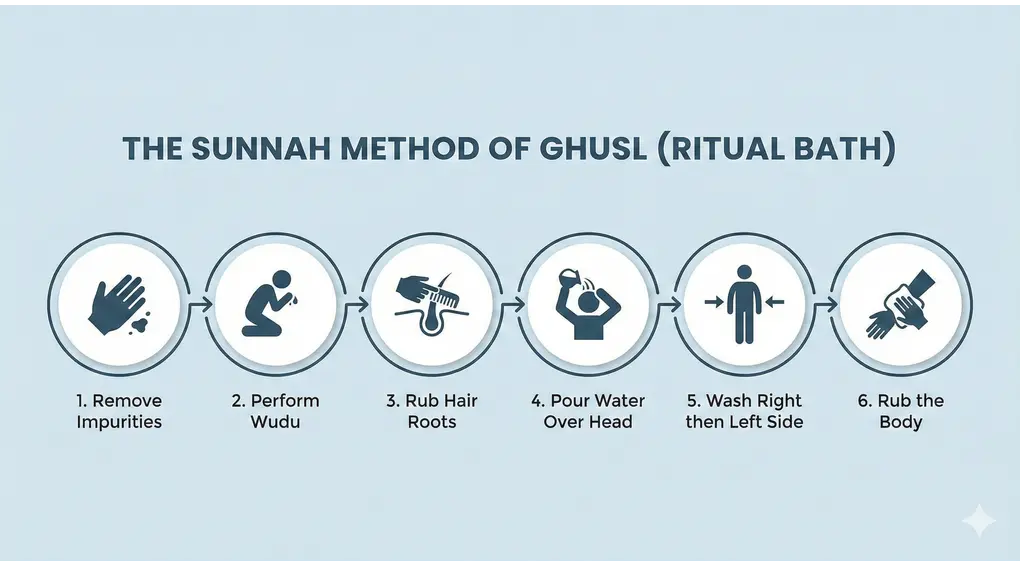
For a Muslim aspiring to achieve the highest degree of perfection in worship, one should not suffice with the pillars alone but should implement the methodology of major ablution according to the prophetic guidance of the Prophet ﷺ. The most perfect sequence (akmaluhu) for the bath is as follows:
- Removing Filth: First, clean any visible dirt or impurities on the body, such as remnants of semen or impure substances (izalah qadzarin wa najasin).
- Performing Wudu: Perform a complete minor ablution just as one would for prayer (tsumma al-wudhu’ kamilan).
- Rubbing the Crevices: Rub the folds of the body and run wet fingers through the roots of the hair (ta’ahhud ma’athif wa ushul sya’r).
- Pouring Water on the Head: Pour water over the head three times (tsumma yafidhu ‘ala ra’sihi).
- Washing the Right and Left Sides: Pour water over the right side of the body, followed by the left side. It is recommended to repeat each wash three times (tsumma syiqqahu al-ayman tsumma al-aysar bitatslits).
- Rubbing the Body: It is a sunnah to rub the limbs with the hands (dalk).
Regarding water volume, it is recommended that the water used for major ablution be no less than one Sha’ (approximately four Mudd, equivalent to the standard portion for the body size of the Prophet ﷺ). Bathing in a stagnant pool of water (ma’ rakid) is considered disliked (makruh); it is highly encouraged to scoop water with a dipper or container from such a source.
Specific Recommendations for Women After Menstruation
The book Asna al-Matalib provides specific guidance for women purifying themselves from menstruation and postpartum bleeding to use fragrance (misk) on the traces of blood.
وأتبعت… أثر الدم مسكا… وإلا فطيبا وإلا فطينا والماء كاف
It is recommended to use cotton lightly scented with musk (misk) on the private area to eliminate the unpleasant odor left by menstrual blood. If misk is unavailable, other perfumes may be used. If no perfume is available, washing with clean water alone is sufficient (wal ma’u kafin).
Prohibitions for Those in a State of Janabah and Menstruation
An individual bearing a major ritual impurity (janabah, menstruation, or postpartum bleeding) is bound by several Shari’ah regulations that prohibit specific activities.
Prohibition of Reciting the Quran
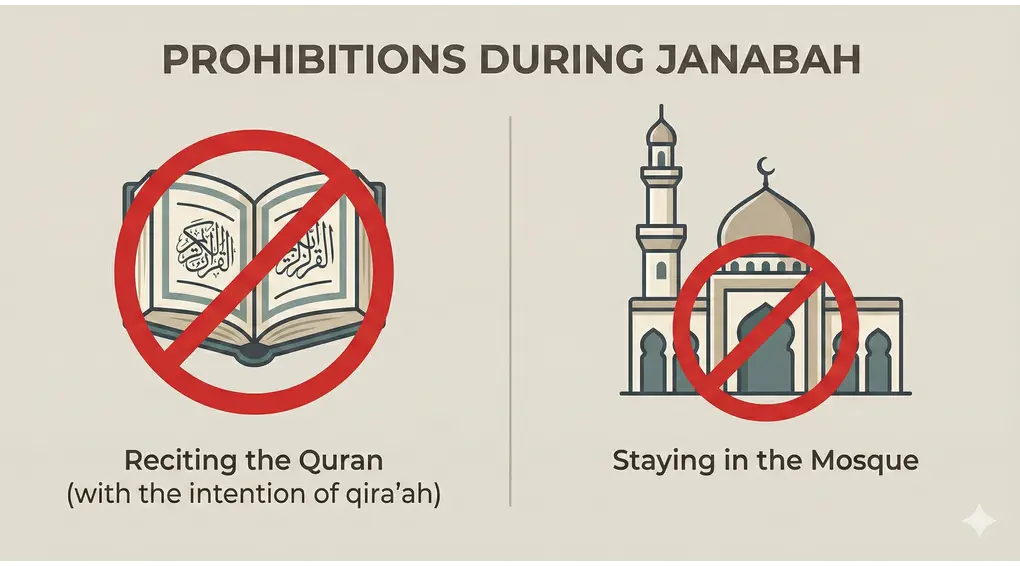
A person in a state of janabah is forbidden from reciting the Quran if they intentionally aim to recite the sacred verses (qishd al-qira’ah).
قوله: (يحرم على الجنب ما يحرم على المحدث وشيئان أحدهما القراءة) للقرآن (بقصدها ولو بعض آية)… (فلا يضر قراءة بنية الذكر) ك {سبحان الذي سخر لنا هذا} [الزخرف: ١٣] . الآية للركوب
This prohibition is highly strict, even if the recited verse is only a small fragment. However, this prohibition is waived if the recitation is intended absolutely as dhikr, a supplication, or a protective litany, rather than with the intent of reciting the Quran. For example, reciting the prayer for boarding a vehicle, the text of which is taken from Surah Az-Zukhruf verse 13, is permissible. A person in janabah is also permitted to recite the Quran internally in their heart, gaze upon the mushaf, or move their lips without producing sound (ihms).
Prohibition of Staying in the Mosque
Remaining or residing within the mosque area (mukts) is strictly prohibited for someone in a state of janabah.
قوله: (الثاني المكث والتردد في المسجد) لا عبوره لقوله تعالى {لا تقربوا الصلاة} [النساء: ٤٣] الآية قال ابن عباس وغيره أي لا تقربوا موضع الصلاة
Merely walking through the mosque or passing across it (‘ubur) is permitted if there is a pressing need, such as it being the shortest route, without it being disliked. However, settling inside the mosque is forbidden. Exceptions are made for individuals who are locked inside the mosque or fear a threat to their life or property if they exit. In this emergency state, they are obligated to perform tayammum utilizing the dust of the mosque (provided it is not strictly endowed dust).
As for sleeping in the mosque, it is fundamentally permissible (wa la ba’sa binaumin fihi) as long as it does not restrict space or disturb those praying. Yet, if one experiences a wet dream (ikhtilam) while sleeping in the mosque, they must immediately exit through the nearest door.
Etiquette Before Eating, Drinking, Sleeping, and Repeating Intercourse
For an individual who is in a state of janabah and intends to eat, drink, sleep, or repeat intercourse with their spouse, it is highly recommended to wash their private parts first and perform wudu exactly like the ablution for prayer.
قوله: (وسن) للجنب (غسل فرج ووضوء لجماع ولأكل وشرب ونوم كحائض بعد انقطاعه) أي الحيض
The wisdom behind this recommended wudu is to lighten the severity of the impurity on the body, maintain basic human hygiene, and provide physical refreshment and motivation so that they may promptly fulfill their obligation of major ablution.
Summary Table: Differences Between Mani and Madzi
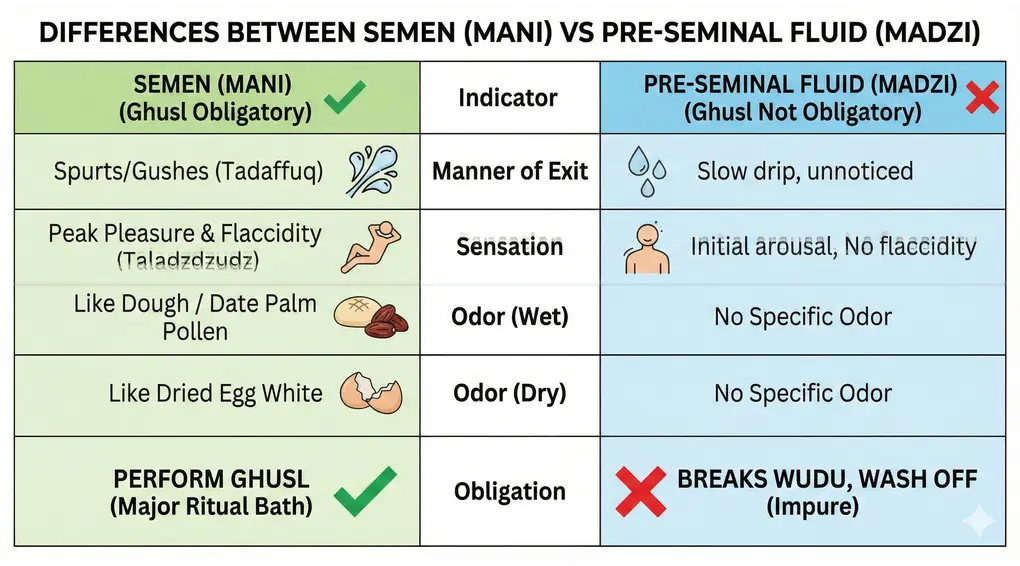
To facilitate the identification of fluids that necessitate Ghusl Janabah, here is a summary of the differences based on authoritative texts:
| Indicator | Semen / Mani (Necessitates Ghusl) | Pre-seminal Fluid / Madzi (No Ghusl Required) |
| Manner of Exit | Spurts or exits in successive bursts (Tadaffuq). | Exits smoothly, often without being noticed. |
| Sensation | Accompanied by peak sexual pleasure (Taladzdzudz), followed by flaccidity. | Exits when desire begins to rise, without resulting in flaccidity. |
| Odor (Wet) | Similar to wet dough or palm pollen (‘Ajin / Tala’). | Does not possess a specific, sharp odor. |
| Odor (Dry) | Similar to dried egg whites (Bayadh Baydh). | Does not possess a sharp odor. |
| Legal Obligation | Mandates Major Ablution / Ghusl Janabah. | Invalidates Wudu, must be washed off (impure/najis), but does not mandate Ghusl. |
Frequently Asked Questions (FAQ) About Ghusl Janabah
Below is a compilation of common jurisprudential issues regarding major ablution frequently asked within the community, answered purely based on the text of Asna al-Matalib:
Is ghusl (major ritual bath) obligatory after sexual intercourse if a condom is used?
The jurisprudential texts state that the obligation of major ablution falls when the head of the male organ (hasyafah) enters the female organ, even if it is enveloped by a cloth barrier or a thick coating (aw bi ha’ilin wa law ghalizhatan). This is because the condition for janabah is the meeting of the two circumcised parts (iltiqa’ al-khitanain), not merely skin-to-skin contact.
Must I formally intend to perform Wudu while doing Ghusl Janabah?
If the bath performed is aimed at lifting the state of janabah (major impurity) in its entirety, then within the Shafi’i school (according to the most authentic opinion), the minor impurity will automatically be lifted through inclusion (tadaakhul). Intentionally performing wudu before the bath is highly recommended to achieve perfection. If your ablution breaks (e.g., passing wind or urinating) in the middle of the major bath, you simply complete the remaining washing of the body for the bath, and then conclude by taking a separate wudu at the end.
What if I find dried semen on my clothes after performing prayer?
Based on the explanation of Shaykh al-Islam Zakariyya al-Ansari, whoever sees traces of semen on their clothes or bed and there is no possibility that the semen belongs to someone else, they must immediately perform Ghusl Janabah. Furthermore, they are obliged to make up (qadha) all the prayers they have performed since their last sleep period from which they believe they had not yet purified themselves.
Does the leftover water from someone performing major ablution become impure?
No. The text affirms: (وفضل ماء جنب وحائض طهور); the leftover water in a container used by someone in a state of janabah or menstruation retains its status as pure and purifying (Thahur). It is not disliked to use it, provided that the water is not classified as must’amal (used water that has already dripped from the body).
Conclusion
Maintaining purity through Ghusl Janabah is not merely cleansing the physical body, but rather a fundamental prerequisite for the acceptance of various acts of core worship (mahdah) such as the daily prayers and Tawaf. By adhering to the guidance of the text Asna al-Matalib within the Shafi’i school, we are directed to perform this worship with utmost precision—from rectifying the intention to ensuring water envelops the entire anatomy of the body. Practicing these procedures methodically according to the Sunnah not only fulfills the Shari’ah obligation but also brings inner tranquility and perfection of worship in the sight of Allah the Exalted.
Reference
Zakariyā al-Anṣārī, Asnā al-Maṭālib fī Sharḥ Rawḍ al-Ṭālib, with the ḥāshiyah by Aḥmad al-Ramlī, edited by Muḥammad az-Zuhrī al-Ghamrāwī (Cairo: al-Maṭbaʿah al-Maymānīyah, 1313 AH; repr. Dār al-Kitāb al-Islāmī), vol. 1, pp. 64–71.


