
The religion of Islam establishes Zakat as one of the fundamental pillars supporting the edifice of Shari’ah. This decree is not merely a moral encouragement to share wealth, but a binding legal obligation for every Muslim whose wealth meets specific criteria. To grasp the complete construction of this act of worship, you can refer to a comprehensive zakat guide.
This article outlines the basic rulings of zakat, the limits of its obligatory conditions, and the strict penalties for those who refuse to fulfill it. All explanations below rely on the authoritative literature of the Shafi’i school, specifically the book Asna al-Matalib Volume 1 by Shaykh Zakariyya al-Ansari, to maintain legal purity and accuracy. Comprehending these rules is a vital part of understanding the pillars of Islam.
Linguistic and Technical Meaning of Zakat
Islamic scholars consistently begin jurisprudence (fiqh) discussions by situating the meaning of a word from both a linguistic perspective and Shari’ah terminology. This methodology ensures the essence of the worship is understood correctly.
In the book Asna al-Matalib, Shaykh Zakariyya al-Ansari elaborates on this definition:
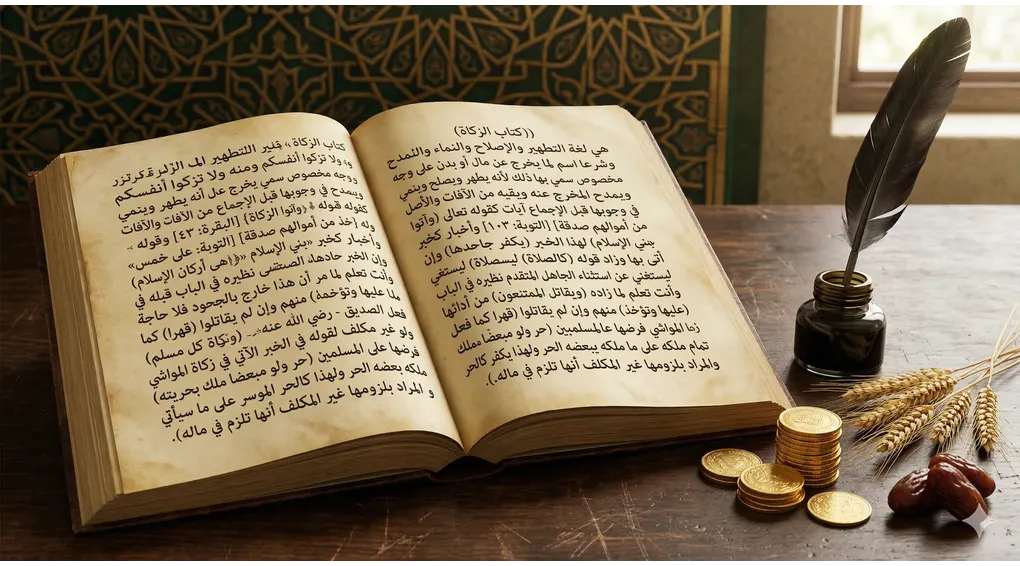
قوله: (كتاب الزكاة) هي لغة التطهير والإصلاح والنماء والمدح ومنه ولا تزكوا أنفسكم وشرعا اسم لما يخرج عن مال أو بدن على وجه مخصوص سمي بها ذلك لأنه يطهر ويصلح وينمي ويمدح المخرج عنه ويقيه من الآفات
Linguistically (lughatan), the word zakat encompasses four primary meanings:
- At-Tathir: Purification.
- Al-Islah: Improvement or rectification.
- An-Nama’: Growth or development.
- Al-Madh: Praise, as seen in the word of Allah ﷻ prohibiting self-praise (wa la tuzakku anfusakum).
In Shari’ah terminology (syar’an), zakat is the name for a specific portion extracted from wealth (mal) or the body (badan/fitrah) through a designated procedure.
The correlation between the linguistic and technical meanings is profound. The Shari’ah names this financial obligation “zakat” because the extracted wealth purifies the soul of its owner, improves their living conditions, fosters blessings in their remaining wealth, brings them praise in the sight of Allah ﷻ, and protects them from various calamities and evils (yaqihi min al-afat).
Conditions Establishing the Basic Rulings of Zakat
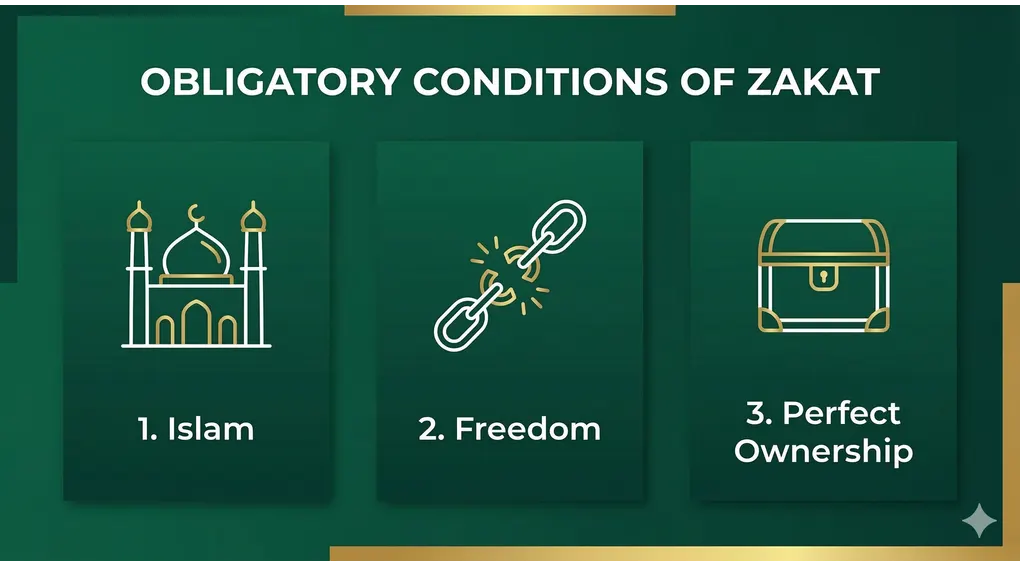
Islamic law binds the legal subject (mukallaf) based on specific criteria. Regarding the obligation of zakat, definitive boundaries determine who bears this Shari’ah responsibility. Based on the reference text, the obligatory conditions are established as follows:
قوله: (وتلزم الزكاة كل مسلم) ولو غير مكلف لقوله في الخبر الآتي في زكاة المواشي فرضها على المسلمين (حر ولو مبعضا ملك بحريته)
1. Being a Muslim
This obligation applies absolutely and exclusively to a Muslim. This ruling relies on the Hadith stating that the Messenger of Allah ﷺ obligated it upon the Muslims. Conversely, individuals outside the fold of Islam do not bear this obligation. The fiqh text asserts:
قوله: (ولا يلزم الكافر إخراجها) لا في الحال ولا بعد الإسلام كالصلاة والصوم
A non-believer is not obligated to pay it, neither during their state of disbelief nor after they embrace Islam. Past obligations are entirely voided, similar to the rulings on prayer and fasting.
2. Being Free (Not a Slave)
The second obligatory condition is the status of freedom (hurr). Slaves are exempt from this obligation because they lack the right to perfect wealth ownership (tamamul milk).
Interestingly, Shafi’i fiqh meticulously regulates the condition of a muba’adh slave (an individual who is partially free and partially enslaved). A muba’adh is obligated to pay zakat on the wealth they acquire through their labor during the days or times they hold a free status, as their ownership over that specific portion is considered perfect.
Summary Table of Zakat Conditions




| Primary Condition | Shafi’i Fiqh Explanation | Exemption Status |
| Islam | Being a Muslim is an absolute requirement. | Original non-believers are exempt and do not need to make it up (qadha) upon converting. |
| Freedom | Possessing complete personal freedom. | Slaves (qinn or mukatab) are exempt due to weak ownership rights. |
| Perfect Ownership | Wealth is under full, unrestricted control. | Borrowed goods, entrusted items, or lost wealth are not subject to zakat until returned. |
Zakat on the Wealth of Minors and the Insane
Some people assume that religious obligations only apply to those who have reached puberty (baligh) and possess a sound mind. This assumption is completely accurate for physical acts of worship (ibadah badaniyah) such as prayer and fasting. However, financial worship (ibadah maliyah) operates under different principles.
In Shafi’i fiqh, zakat must be extracted from the wealth of a minor (thifl) and an insane person (majnun). This obligation is attached directly to the wealth itself, not to the owner’s status of maturity.
قوله: (فعلى الولي إخراجها من مال الطفل) ولو مراهقا (والمجنون) كقيمة ما أتلفاه وغيرها من الحقوق الموجهة عليهما كنفقة القريب
This duty falls upon the guardian (wali). The guardian must extract the rights of the poor and needy from the minor’s wealth, even if the child is an infant or an adolescent (murahiq), as well as from the insane person’s wealth. The legal reasoning (‘illat) is that this constitutes a financial right directed at their assets, identical to the obligation to pay compensation if they damage someone else’s property, or the obligation to provide financial maintenance to dependent relatives.
The Legal Status of a Fetus’s Wealth
The Shari’ah is immensely just and logical. A fetus still resting in its mother’s womb (janin) is excluded from this obligation.
قوله: (لا الجنين) فلا زكاة في المال الموقوف لأنه لا ثقة بوجوده ولا بحياته فإن انفصل ميتا قال الإسنوي فيتجه أنها لا تلزم بقية الورثة لضعف ملكهم
Inheritance wealth suspended for a fetus is not yet subject to zakat. This is because there is no absolute certainty regarding the fetus’s existence and life upon birth. Imam Al-Isnawi argued that if the fetus is eventually stillborn, zakat is also not obligated upon the remaining heirs during that suspension period, due to the weakness of their ownership status at that time.
A Guardian’s Negligence in Paying Zakat

If a guardian neglects or intentionally delays the payment of zakat from the wealth of a minor or an insane person until the time limit expires, the obligation is by no means voided.
قوله: (فإن لم يخرجها) الولي من مال الطفل والمجنون (أخرجاه إن كملا) لأن الحق توجه إلى مالهما لكن الولي عصى بالتأخير فلا يسقط ما توجه إليهما
When the child reaches puberty or the insane person regains their sanity, they are both obligated to settle their past zakat arrears. The right of the poor remains firmly attached to that wealth. In this scenario, the guardian incurs a sin due to their negligence in delaying the duty, but the guardian’s sin does not erase the payment obligation from the actual wealth owner.
Threats and Penalties for Rejecting Zakat
Zakat constitutes the right of Allah ﷻ and the right of society entrusted within individual wealth. Refusing to pay it is a severe violation. The textual evidence establishing this obligation is abundantly clear, sourced from the Qur’an and Hadith.
والأصل في وجوبها قبل الإجماع آيات كقوله تعالى {وآتوا الزكاة} [البقرة: ٤٣] وقوله {خذ من أموالهم صدقة} [التوبة: ١٠٣] وأخبار كخبر «بني الإسلام على خمس» (هي أحد أركان الإسلام)
Qur’anic verses such as the words of Allah ﷻ, “And establish prayer and give zakat” (Al-Baqarah: 43) and “Take, [O, Muhammad], from their wealth a charity” (At-Tawbah: 103), along with the Prophet’s ﷺ Hadith stating that Islam is built upon five pillars, serve as the primary foundation for this ruling.
Shafi’i fiqh categorizes the act of rejecting zakat into two behavioral categories, each carrying vastly different penal consequences:
1. Rejecting through Denial (Jahid)
An individual who refuses to pay zakat because they do not believe it is obligatory, or they consider the Shari’ah ruling obsolete, is judged to have left the religion of Islam.
قوله: (يكفر جاحدها) وإن أتى بها
A person who denies its obligation (jahid) automatically commits disbelief (kufr). Furthermore, their status of disbelief remains even if they physically hand over their wealth. This occurs because denying a pillar of Islam constitutes a direct rejection and falsification of Allah ﷻ and His Messenger ﷺ.
2. Withholding out of Miserliness while Believing in the Obligation (Mumtani’)
The second category comprises individuals who firmly believe that zakat is religiously obligatory, yet they refuse to pay it due to greed or laziness. This person is not deemed a disbeliever, but they commit a major sin. The legitimate government holds full authority to take decisive action against them.
قوله: (ويقاتل الممتنعون) من أدائها (عليها وتؤخذ) منهم وإن لم يقاتلوا (قهرا) كما فعل الصديق – رضي الله عنه –
The state may rightfully combat those who withhold their wealth (mumtani’un) until they fulfill the obligation. Authorized officials have the right to confiscate the wealth forcefully (qahran), even if the individuals offer no physical resistance. The basis for this action is the historic policy executed by Caliph Abu Bakr al-Siddiq (may Allah be pleased with him) when he fought the factions rejecting zakat during his caliphate.
The Status of Zakat on an Apostate’s Wealth
What happens if a Muslim commits apostasy, and they possess wealth that reaches the hawl (one lunar year) during their period of apostasy? The rules of Shafi’i fiqh establish a binding ruling:
قوله: (ولا تسقط) الزكاة الواجبة في الإسلام (بالردة) مؤاخذة له بحكم الإسلام
Zakat that became obligatory while the person was still a Muslim is absolutely not nullified by their apostasy. They are still held accountable based on Islamic law.
If they die in a state of apostasy, their wealth is considered no longer theirs from the moment they apostatized. However, if they repent and return to Islam, they are strictly obligated to pay all the zakat on their wealth—both the zakat that became due before they apostatized and the zakat that accrued during their period of apostasy.
Conclusion
Knowing the foundational rules of zakat, along with its obligatory conditions and the severe penalties for rejecting it, is a crucial first step for every Muslim. Adherence to this Shari’ah law is not a mere routine but tangible proof of a servant’s submission to the Creator. Studying these regulations deeply connects a believer to the broader fiqh of worship, ensuring that physical and financial devotions are accepted by Allah ﷻ.
FAQ: Questions Around the Basic Rulings of Zakat
Is a person heavily in debt still subject to the obligatory conditions of zakat?
Yes. In Shafi’i fiqh, the existence of debt (dayn) does not prevent the obligation of zakat if the wealth currently in their possession has reached the minimum threshold (nisab) and passed one lunar year (hawl). The wealth owner is still required to extract the zakat.
If an orphan inherits a large amount of wealth, who pays the zakat?
The guardian (wali) or the person officially appointed to manage the orphan’s estate bears full responsibility for calculating and paying the zakat annually. These funds are extracted directly from the orphan’s inherited wealth, not the guardian’s personal money.
What is the difference in penalties between someone who rejects zakat and someone who rejects prayer?
Both are foundational pillars of Islam. A person who completely denies the obligation (jahid) of either is judged as a disbeliever. However, for those who believe in the obligation but abandon it out of laziness: the one abandoning prayer is demanded to repent, while the one withholding zakat will have their wealth forcefully taken by the government, as that wealth legally contains the material rights of the poor and destitute.
Reference
Zakariyya al-Ansari, Asna al-Matalib fi Sharh Rawd al-Talib, with marginalia (hashiyah) by Ahmad al-Ramli, edited by Muhammad az-Zuhri al-Ghamrawi (Cairo: al-Matba’ah al-Maymaniyyah, 1313 H; repr. Dar al-Kitab al-Islami), Vol. 1, p. 338.


