

The holy month of Ramadan or days of voluntary fasting often raise fundamental questions for us: exactly how many pillars of fasting are there? Is it enough simply to endure hunger and thirst? Or are there other foundational elements that determine the validity of our worship?
Many people assume there are only two pillars of fasting: the intention and abstaining from invalidators. However, if we delve into classical texts of Islamic jurisprudence (Fiqh), particularly within the Shafi’i school, the discussion is significantly more detailed. One of the primary references studied in traditional Islamic boarding schools (pesantren) is the book Safinatun Naja and its commentary, Nailur Raja’.
In this article, we will thoroughly explore the exact number of the pillars of fasting, the differences in intention between obligatory and voluntary fasts, and examine the original Arabic text to solidify our understanding of what fasting truly means.
Exactly How Many Pillars of Fasting Are There?
In the study of Islamic jurisprudence, specifically referring to the Shafi’i school in the book Nailur Raja’ Syarh Safinatun Naja, it is explicitly stated that there are exactly three pillars of fasting.
The author of the text explains:
“The pillars without which the true essence of fasting cannot be realized are three.”
Therefore, if you ask how many pillars of fasting there are, the authoritative answer according to this reference is three. These three elements are the supporting columns. If even one is missing, the fast is considered invalid or non-existent. Let us dissect each pillar and its detailed explanation.
A Detailed Explanation of the 3 Pillars of Fasting
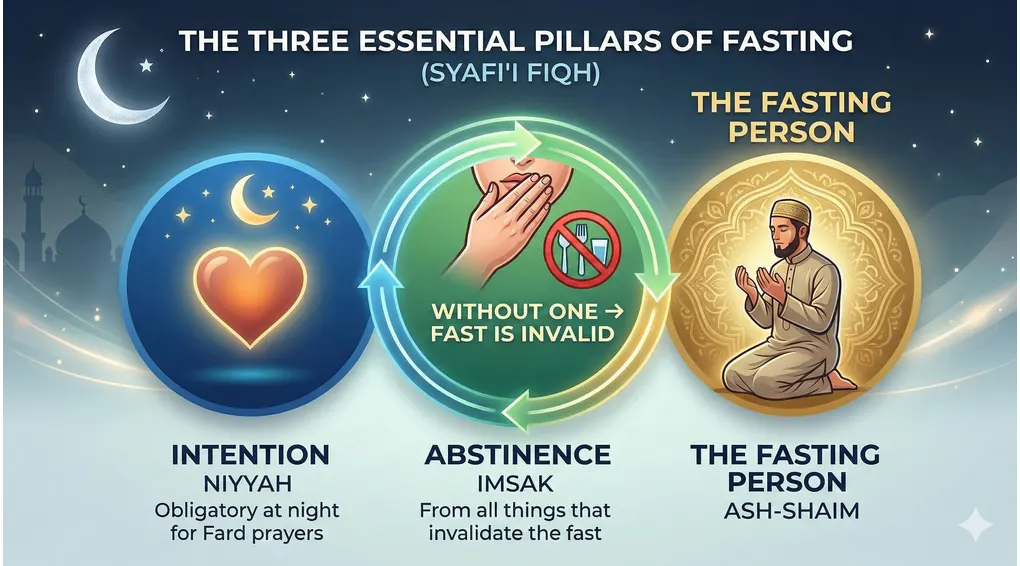
Here is an in-depth breakdown of the pillars of fasting based on the text Safinatun Naja:
1. The Intention (Niyyah) – The First Pillar
The first of the pillars of fasting is the intention (niyyah). Its position is crucial because it differentiates between an act of worship and a mere habit of starving (like a diet). However, there are different rules governing obligatory fasts (Ramadan) and voluntary fasts.
For obligatory fasts (Ramadan, make-up fasts, vows, expiations), the intention must be made during the night (Tabyit). The timeframe stretches from sunset (Maghrib) until the break of the true dawn (Subuh).
Key Points Regarding Intention:
- Obligatory Every Night: You must form the intention every single night for the following day’s fast.
- A Solution for Forgetting: The book Nailur Raja’ offers practical advice. On the first night of Ramadan, it is recommended to make a general intention to fast the entire month by following (taqlid) the opinion of Imam Malik. This acts as a “backup.” If you forget to intend on a specific night, your fast for that day remains valid according to the Maliki school, alleviating the need to make it up later.
- Flexibility for Voluntary Fasts: For voluntary fasting, the intention can be made during the day before noon (zawal), provided you have not committed any act that invalidates the fast (like eating or drinking) since dawn. This flexibility reflects the different levels of intention in worship.
2. Abstaining from Invalidators (Al-Imsak)
The second of the pillars of fasting is abstaining from all things that invalidate the fast. This includes eating, drinking, marital relations, or inserting substances into open body cavities.
However, not every violation immediately breaks the fast. The fiqh provides a highly just set of conditions. A person’s fast is only considered broken if they commit the act under three specific conditions:
- Remembering (Dzakiran): They must be consciously aware they are fasting. If someone eats out of genuine forgetfulness, their fast remains perfectly valid.
- By Choice (Mukhtaran): The action must not be forced. If someone is coerced into drinking under the threat of a weapon, their fast is not broken.
- Knowing the Ruling (‘Aliman): They must know that the action is forbidden while fasting.
What about someone who does not know the ruling? There is a concept called Jahil Ma’dzur (an excused ignorant person). Examples include a new convert to Islam or someone living in a remote area without access to scholars. If they eat because they genuinely did not know it was prohibited, their worship remains valid.
However, if you live in a city, have internet access, are near a mosque but are simply too lazy to learn, and then violate a rule because you “didn’t know,” that ignorance is not excused (ghairu ma’dzur), and your fast is invalid.
3. The Fasting Person (Ash-Shaim)




It might sound unusual to list the person themselves as a pillar. However, a pillar is an element that must exist for the act itself to manifest.
In the commentary Nailur Raja’, it is explained that fasting is negative in nature (‘adamiyyan); it is an act of omission. Fasting is “not eating” and “not drinking.” The act of “not doing” something has no physical, visible form.
Unlike prayer, which has physical movements like bowing and prostrating, fasting can only be comprehended if there is a practitioner (Ash-Shaim). Just like a business transaction cannot exist without a buyer and seller, the existence of the “Fasting Person”—who meets specific conditions (being Muslim, sane, and pure from menstruation or postpartum bleeding)—becomes the third essential pillar.
Table: Differences in Intention Between Obligatory and Voluntary Fasts
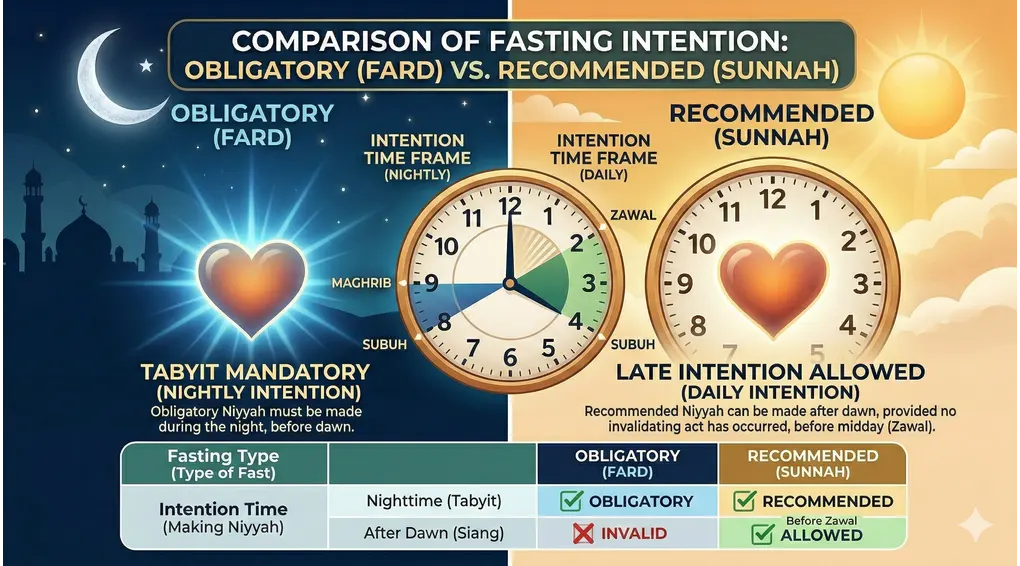
To clarify the technical differences regarding the intention pillar, review the table below:
| Aspect | Obligatory Fast (Ramadan, Qadha) | Voluntary Fast (Monday-Thursday, Arafah) |
| Timing of Intention | Must be at night (Maghrib – Subuh). | Can be at night, or during the day before noon. |
| Condition for Day Intention | Not applicable (invalid if made during the day). | Must not have committed any invalidators since dawn. |
| Renewal | Must be renewed every single night. | Sufficient to intend when deciding to fast. |
The Original Text from the Reference Book
For those studying Arabic texts or seeking authentic references regarding the Fiqh of Ramadan fasting, here is the original excerpt from Nailur Raja’ Syarh Safinatun Naja (pages 273-274):
فَصْلٌ : (أَرْكَانُهُ ثَلَاثَةٌ ) : المعنى : أَنَّ الأَركان التي لا تتحقق ماهية الصومِ إلا بها : ثلاثة ( نِيَّةٌ لَيْلاً لِكُلِّ يَوْمٍ فِي الْفَرْضِ )… ( وَتَرْكُ مُفَطَّرٍ ذَاكِراً مُخْتَاراً غَيْرَ جَاهِلِ مَعْذُورٍ )… ( وَصَائِمٌ ) المعنى : أَنَّ الرَّكْنَ الثَّالِثَ مِنْ أَركَانِ الصوم : الصَّائِمُ
This text affirms that the structure of the fasting worship is built upon these three specific pillars.
FAQ: Common Questions About the Pillars of Fasting
Why do some say there are only 2 pillars of fasting?
The opinion stating there are only two pillars (intention and abstention) is not entirely wrong. This view usually categorizes “the fasting person” as an obligatory condition (syarat wajib) or a condition of validity (syarat sah) rather than an independent pillar. However, in detailed Shafi’i fiqh, such as in Safinatun Naja, “the fasting person” is separated as the third pillar due to the abstract, philosophical nature of fasting.
Does eating out of forgetfulness break the pillars of fasting?
No. As explained above, one of the conditions for a violation to break the fast is Dzakiran (being in a state of remembrance). If you genuinely forget, your pillars of fasting are not ruined, and you should continue your fast.
What are the conditions for a valid intention for Ramadan fasting?
The primary conditions are Tabyit (making the intention at night) and Ta’yin (specifying the type of fast, e.g., “I intend to fast tomorrow to fulfill the obligation of Ramadan”).
Conclusion
Understanding the exact number of the pillars of fasting and their details is not mere theory; it is the key to ensuring our worship is accepted. By recognizing that the first pillar is a correct intention and comprehending the boundaries of abstention, we can perform our worship with greater peace and certainty. May this explanation from Safinatun Naja benefit your spiritual practice.
Reference
Aḥmad bin ‘Umar al-Syāṭirī, Nayl al-Rajā fī Syarḥ Safīnat al-Najā, (Jeddah: Dār al-Minhāj, n.d.), p. 273.


