
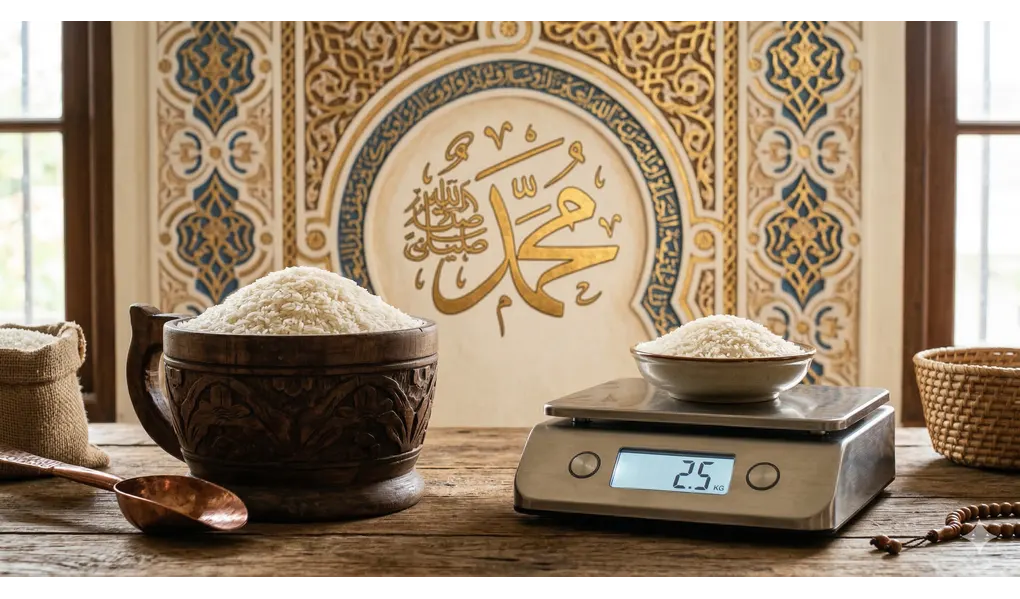
Fulfilling religious obligations at the end of Ramadan demands precision, particularly in determining the exact amount of wealth to be given to eligible recipients (mustahiq). Muslims frequently inquire about the mathematical specifics, such as the exact 1 Sha measurement or the precise conversion of 1 sha to kilograms of rice. Ascertaining this accurate measurement ensures that the worship is valid and compliant with Sharia directives.
This discussion relies on classical fiqh guidelines from the Shafi’i school, specifically the text Asna al-Matalib by Shaykh Zakariya al-Ansari. You can study the comprehensive framework of this obligation through a complete zakat guide or explore other legal details in the Shafi’i madhhab zakat fitrah guide. Should you need to know the final payment deadline, please refer to the article regarding the due date for zakat fitrah at the end of Ramadan. It is crucial to get these details right as part of understanding the pillars of Islam.
The 1 Sha Measurement Based on the Prophetic Era
The determination of the volume of foodstuff required for zakat originates directly from the hadith of the Prophet Muhammad ﷺ. In Shafi’i fiqh literature, the measurement parameter utilizes volume (capacity) rather than weight (mass). Shaykh Zakariya al-Ansari affirms this:
قوله: (فصل والواجب في الفطرة صاع) مما يأتي (لكل واحد)
Every Muslim individual is obligated to issue one sha’ of staple food. To ensure the validity of this measurement, scholars refer to the measuring tools prevalent in Medina during the lifetime of the Prophet ﷺ.
قوله: (والمعتبر) في ذلك (الكيل بالصاع النبوي)
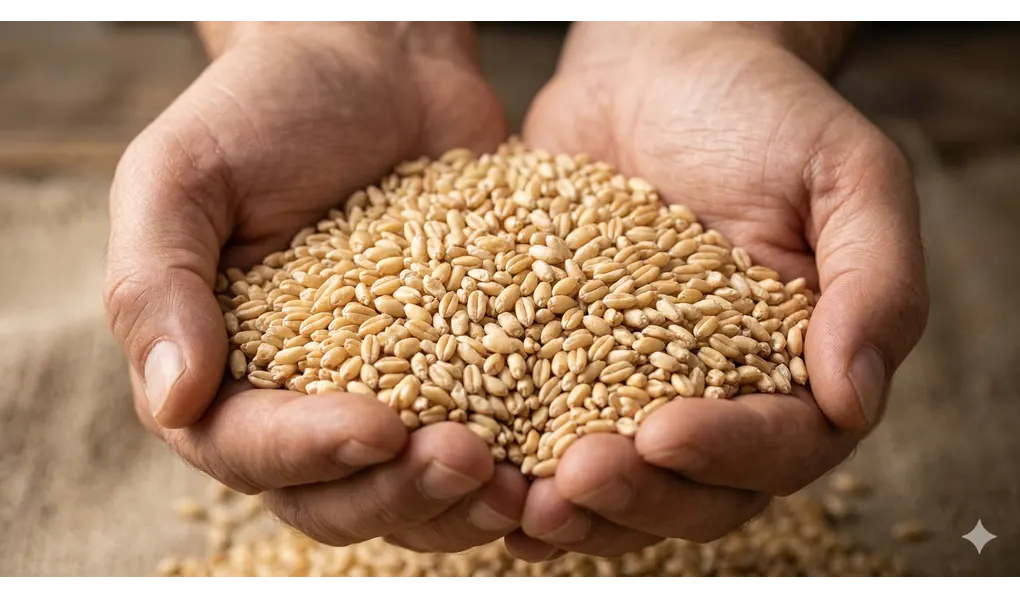
The recognized standard (al-mu’tabar) is measuring using the Prophetic sha’ (as-sha’ an-nabawi). Traditionally, scholars define the volume of one sha’ as equivalent to four mud. One mud is defined as the capacity of two cupped hands of an average-sized adult male.
وقال جماعة الصاع أربع حفنات بكفي رجل معتد لهما
This two-hand measurement method preserved the dimensions from generation to generation when formal measuring tools were unavailable.
Converting the 1 Sha Measurement to Liters and Kilograms
Modern society is accustomed to using units of weight (kilograms) or liters, prompting the question: how many kilograms of rice are in 1 sha? Converting the 1 Sha measurement (volume) to weight (kilograms) often yields variations because the density of different grains, such as rice, wheat, or dates, naturally varies.
Historical scholars projected these volume measurements into weight units for practical application. In Asna al-Matalib, it is stated:
قوله: (وهو خمسة أرطال وثلث) بالبغدادي
One sha’ is equivalent to five and a third (5 1/3) Baghdad ritl. Shafi’i scholars recognize that converting from volume to weight is an approximation. Therefore, Shaykh Zakariya al-Ansari provides a principle of precaution:
قوله: (وعياره) أي والحالة أن عياره (موجود فإن فقد فالوزن تقريب ويحتاط المخرج)
If an authentic sha’ measuring tool is lost or unavailable, utilizing weight is an approximation (taqrib). The person issuing the zakat must exercise precaution (yahtath).
Based on this principle of precaution, scholars in Indonesia convert the zakat fitrah measurement of rice to 2.5 kilograms up to 3.0 kilograms. Giving slightly more than the minimum limit is highly recommended to avoid the risk of a shortfall that would invalidate the zakat.
Estimation Table for Zakat Fitrah Conversion
| Classical Unit | Modern Volume Unit | Modern Weight Unit (Rice) |
| 1 Prophetic Sha’ | Approx. 3.1 – 3.5 Liters | ± 2.5 Kg – 3.0 Kg |
| 1 Mud (1/4 Sha’) | Approx. 0.7 – 0.8 Liters | ± 0.6 Kg – 0.75 Kg |
Criteria for Valid Rice or Wheat (Free from Weevils/Spoilage)
The Sharia regulates not only the 1 Sha measurement but also the quality of the staple food distributed. The objective is to ensure that the food is fit for consumption by the recipients (mustahiq). The primary rule is to issue the dominant staple food consumed by the local population.
(والواجب غالب قوت بلده المؤدى عنه)
An individual is obligated to issue the food that constitutes the staple diet of the majority in their city. In Southeast Asia, rice is the primary choice. Beyond the type, the quality of the issued rice must be free from defects.
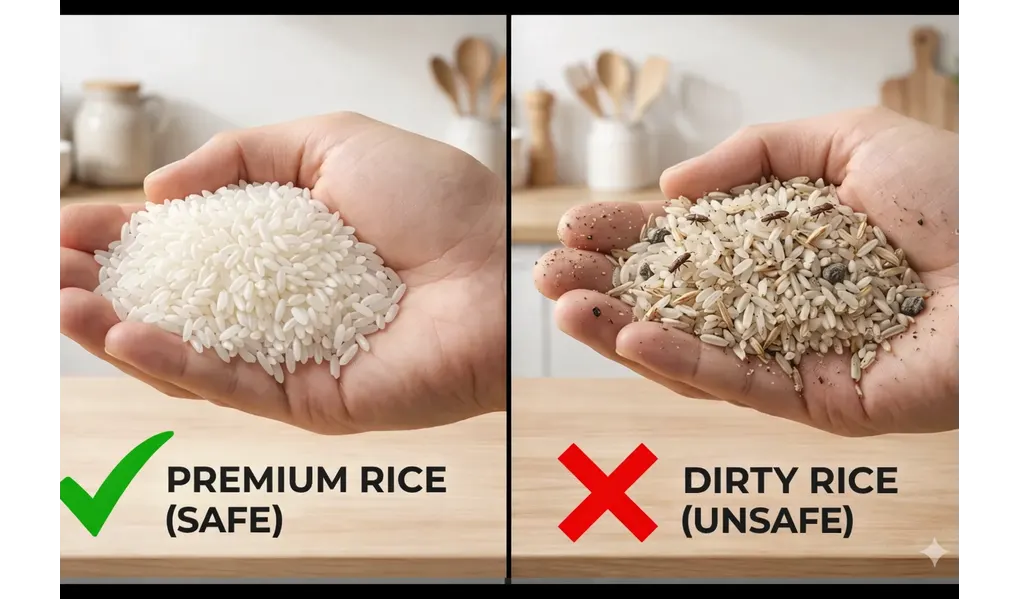
قوله: (لا يجزئ) حب (مسوس) … (ومعيب ودقيق)
Fiqh texts unequivocally state that grain infested with weevils (masus), defective grain (ma’ib), or grain milled into flour (daqiq) is invalid for this worship. Flour is invalid because its original form as a grain capable of long-term storage has been altered.
What about rice that has been stored for a long time?
قوله: (ويجزئ قديم غير متغير) طعمه أو لونه أو ريحه
Older stored rice or wheat remains valid for use, provided its taste, color, or smell has not changed. The quality of this food must be maintained out of respect for the rights of the poor and needy.
Paying Zakat Fitrah Using Money: The Strict Stance of the Shafi’i Madhhab
The debate regarding the validity of substituting staple food with money (qimah) surfaces every year. The Shafi’i madhhab holds a very firm stance on this issue. Zakat fitrah is viewed as an obligation directly tied to its physical form, namely food. The purpose is to provide direct food reserves for the impoverished on the day of Eid.
والفطرة زكاة البدن فوقع النظر فيها إلى ما هو غذاؤه وبه قوامه
The zakat of the body (fitrah) closely considers the aspect of food that physically sustains humans. Therefore, in the pure Shafi’i madhhab, fulfilling this obligation using cash is neither permitted nor valid. The hadith texts specifically mention the types of food (dates, wheat, raisins), so substituting them with money is considered contrary to the explicit textual evidence of the Sharia.
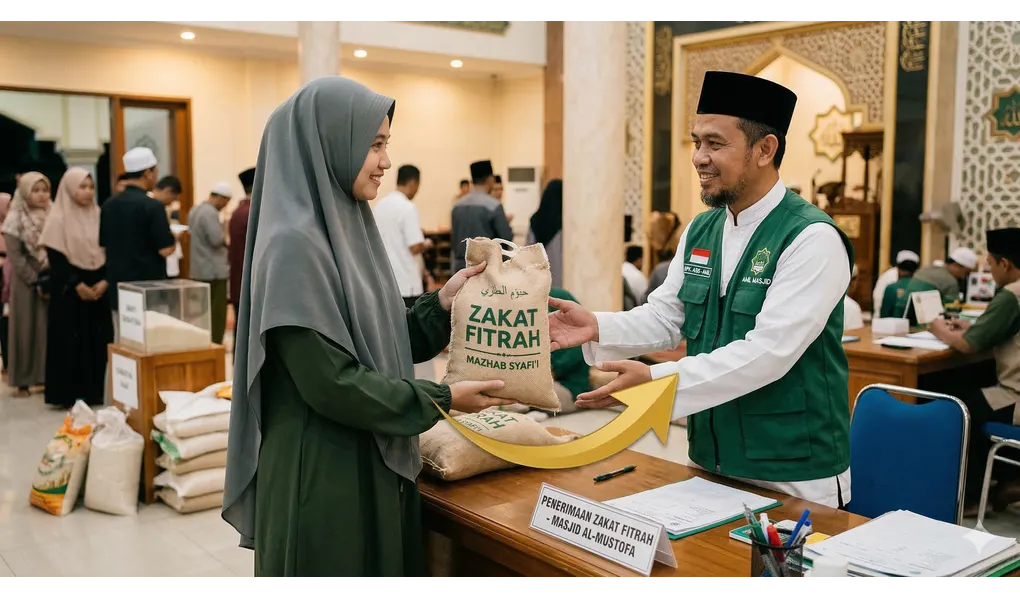
However, in modern state practices, many zakat committees (amil) in Indonesia accept cash. Academically, this practice typically relies on borrowing (taqlid) the opinion of the Hanafi madhhab, which permits the use of money, arguing it brings greater benefit (maslahah) to the poor in the contemporary era. If a Muslim wishes to adhere strictly to the Shafi’i madhhab, they must directly hand over rice according to the measurement previously detailed.
Conclusion
Understanding the accurate 1 Sha measurement for this worship safeguards a Muslim from negligence. The primary standard utilized is the Prophetic sha’ measurement based on volume. Because measuring the volume of grains can sometimes be challenging for modern society, scholars permit the conversion to weight (kilograms) applying the principle of precaution, specifically rounding up (e.g., 2.5 kg to 3.0 kg of rice). The rice quality must be excellent, free from weevils and musty odors. The Shafi’i madhhab’s stance remains consistent in maintaining the physical form of the staple food and does not validate payment using cash.
Frequently Asked Questions (FAQ)
If I eat premium quality rice, can I pay zakat using medium quality rice?
You are obligated to use medium quality rice if it is the standard consumption of the majority of the population in your city. However, if you use the premium quality rice you normally consume, it is highly recommended and superior (afdhal).
Is it valid to combine the rice measurement for an entire family into one large sack?
Yes, it is valid. If a head of a household provides for his wife and three children, he must issue 5 sha’ (approximately 12.5 kg to 15 kg). The rice may be combined into one large sack without having to be separated into five small individual bags when handed over to the amil.
Can I pay zakat fitrah using rice that has already been cooked into a meal?
No, it is invalid. The primary condition for the staple food is that it must be in the form of grains capable of being stored for a long period (al-qut al-muddakhar). Cooked rice spoils quickly and thus fails to meet this essential condition.
Reference
Zakariya al-Ansari, Asna al-Matalib fi Sharh Rawd al-Talib, with hashiyah by Ahmad al-Ramli, edited by Muhammad az-Zuhri al-Ghamrawi (Cairo: al-Matba’ah al-Maymaniyah, 1313 AH; repr. Dar al-Kitab al-Islami), vol. 1, p. 391.


