

Zakat is one of the foundational pillars of Islam that holds a profoundly significant position in the religion. It is not merely a standard voluntary charity (sadaqah), but rather a strict Shariah obligation carrying deep linguistic and terminological significance. Comprehending the true meaning of Zakat opens our perspective to the immense divine wisdom behind its legislation.
Many people may only recognize Zakat as the obligation to allocate a portion of their wealth to the poor. However, the essence of Zakat extends far beyond that basic understanding. For a complete guide to Zakat, let us delve deeper into its definition as elucidated in classical Islamic jurisprudence (fiqh) literature, specifically referencing the authoritative Shafi’i text, Al-Fiqh al-Manhaji ‘ala Madhhab al-Imam al-Shafi’i.
The Linguistic Meaning of Zakat (Etymology)

Etymologically, the word “Zakat” originates from the Arabic language. In the text Al-Fiqh al-Manhaji, the following excerpt is highlighted:
الزكاة: مأخوذة من زكا الشيء يزكو، أي زاد ونما، يقال: زكا الزرع وزكت التجارة، إذا زاد ونما كل منهما. كما أنها تستعمل بمعنى الطهارة، ومنه قوله تعالى: “قَدْ أَفْلَحَ مَن زَكَّاهَا ” (الشمس: 9) أي من طهرها ـ يعني النفس ـ من الأخلاق الرديئة
This passage explains that linguistically, the word “Zakat” is derived from the verb zaka yazku, which means to grow, increase, or develop (zad wa nama). The examples provided are the growth of crops (zaka az-zar’u) and the expansion of trade (zakatit tijarah). Both indicate the meaning of enhancement and multiplication.
Furthermore, the word Zakat also inherently contains the meaning of purity or cleansing (ath-thaharah). The textual evidence for this is the word of Allah SWT in Surah Ash-Shams, verse 9: “Qad aflaha man zakkaha” (He has succeeded who purifies it). In the context of this verse, the meaning of ‘purifying it’ refers to cleansing the soul or the self from despicable morals and bad traits.
Therefore, the linguistic meaning of Zakat encapsulates two primary, interconnected concepts: growth/development and purity/cleansing. This dual meaning parallels the linguistic and Shariah meaning of Islam, where language perfectly mirrors the physical act of worship.
The Definition of Zakat in Islamic Shariah
Having understood the linguistic roots, we transition to the definition of Zakat within the context of Islamic jurisprudence (Fiqh). Scholars define Zakat based on strict Shariah parameters. The excerpt from Fiqh Manhaji continues its explanation:
ثم استعملت الكلمة ـ في اصطلاح الشريعة الإسلامية ـ لقدر مخصوص من بعض أنواع المال، يجب صرفه لأصناف معينة من الناس، عند توفر شروط معينة سنتحدث عنها
In Shariah terminology, the word Zakat is used to denote “a specifically allocated amount (qadar makhshush) from certain types of wealth (ba’dhu anwa’ al-mal), which is obligatory to be distributed (yajibu sharfuhu) to specific categories of people (li-ashnafin mu’ayyanah min an-nas), when certain conditions are met (‘inda tawaffuri shurutin mu’ayyanah).”
This definition provides clear boundaries regarding the meaning of Zakat in the practice of worship:
- Specific Wealth: Not all types of wealth are subject to Zakat. There are specific categories mandated by Shariah, such as gold, silver, agricultural produce, trading commodities, livestock, and buried treasure (rikaz).
- Specific Measure: The obligatory amount to be disbursed is not arbitrary. It is a specific percentage or rate established by Shariah (the Nisab and the Zakat rate).
- Specific Recipients: The distribution of Zakat cannot be given to just anyone; it is strictly reserved for the categories designated in the Quran.
- Specific Conditions: The obligation of Zakat only manifests when specific criteria are met by both the owner of the wealth and the wealth itself.
Why is this Act of Worship Named Zakat?
Naming this financial obligation “Zakat” is not without profound reason. Scholars explain the wisdom behind utilizing a word that linguistically means growth, development, and purity. The Fiqh Manhaji text details this beautifully:
وسمي هذا المال زكاة، لأن المال الأصلي ينمو ببركة إخراجها ودعاء الآخذ لها، ولأنها تكون بمثابة تطهير لسائر المال الباقي من الشبهة، وتخليص له من الحقوق المتعلقة به، وبشكل خاص حقوق ذوي الحاجة والفاقة
This wealth is named Zakat due to the following impacts:
- Growth and Blessings: The principal wealth (al-mal al-ashli) will grow and be blessed (yanmu bi barakati ikhrajiha) because of the payment of Zakat and the prayers of those who receive it. Although the wealth physically decreases, its divine blessing (barakah) multiplies, bringing peace of mind, and Allah replaces it with better provisions.
- Purification of Wealth: Zakat functions as a purifier (tathhir) for the remaining wealth from doubtful matters (syubhat) and liberates it (takhlish lahu) from the rights attached to it—specifically, the rights of the needy and the destitute. Wealth from which Zakat has been paid becomes pure and clean from the rights of others mandated by Shariah.
- Purification of the Soul: Paying Zakat cleanses the soul of the payer (Muzakki) from the diseases of stinginess, greed, and excessive love for worldly possessions. Conversely, it cultivates generosity, empathy, and gratitude for Allah’s blessings.
The Eight Eligible Recipients of Zakat (Mustahiq)
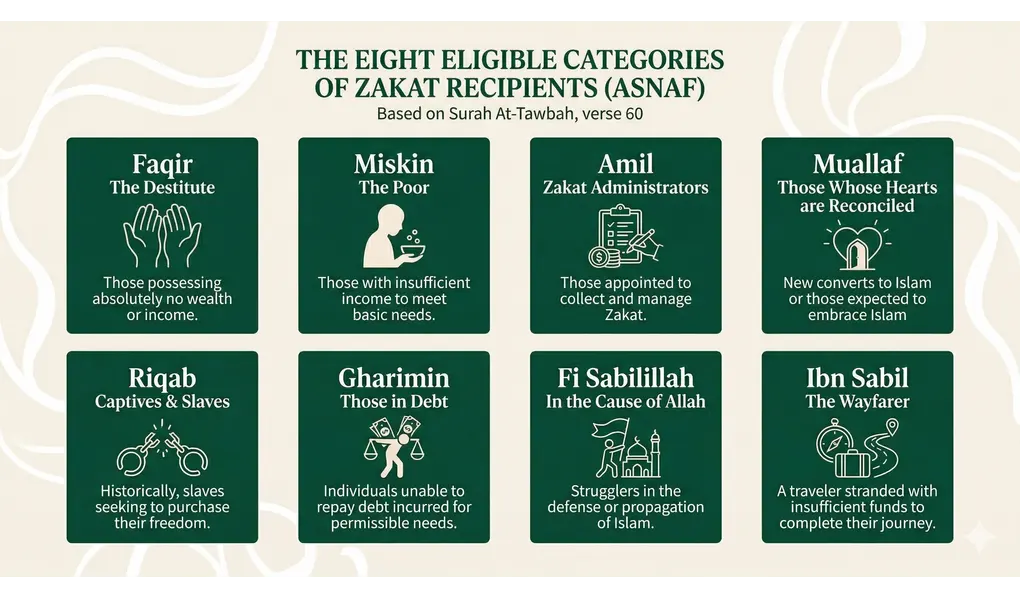
In Islam, the distribution of Zakat is highly regulated. Allah SWT has specifically decreed the 8 categories of Zakat recipients (Asnaf) in Surah At-Tawbah, verse 60:
“Zakat expenditures are only for the poor and for the needy and for those employed to collect [zakat] and for bringing hearts together [for Islam] and for freeing captives [or slaves] and for those in debt and for the cause of Allah and for the [stranded] traveler – an obligation [imposed] by Allah. And Allah is Knowing and Wise.”
Based on this noble verse, scholars categorize the eight groups entitled to receive Zakat as follows:
- Faqir (The Destitute): Individuals who possess absolutely no wealth or income to meet the basic needs of themselves and their families. They live in severe deprivation.
- Miskin (The Poor): Individuals who have some wealth or income, but it falls short of meeting even half of their basic needs. Their condition is slightly better than the Faqir, but they remain below the poverty line.
- Amil (Zakat Administrators): Individuals officially appointed by the Islamic authority to collect, distribute, and manage Zakat funds. They are entitled to a portion of the Zakat as compensation for their labor.
- Muallaf (Those Whose Hearts are Reconciled): Individuals who have recently embraced Islam, those expected to embrace Islam, or those whose faith is weak and needs strengthening.
- Riqab (Captives/Slaves): Historically, this referred to slaves seeking to purchase their freedom. Zakat funds can be utilized to help them pay their ransom.
- Gharimin (Those in Debt): Individuals who incur debt for permissible (halal) needs and are unable to repay it. This debt could be for basic necessities or medical treatment, but absolutely not for sinful acts or a lavish lifestyle.
- Fi Sabilillah (In the Cause of Allah): While interpretations vary among scholars, the most prominent Shafi’i view restricts this to those actively struggling in the defense of Islam (Jihad) who do not receive a regular state stipend.
- Ibn Sabil (The Wayfarer): A traveler undertaking a permissible journey who runs out of provisions and faces difficulty returning home, even if they are wealthy in their homeland.
Obligatory Conditions for Zakat
The mandate to pay Zakat does not apply unconditionally to every Muslim. For a comprehensive look at the fundamental rulings and conditions of Zakat, one must understand the specific criteria that trigger this obligation. The primary conditions include:
- Being a Muslim: Zakat is an act of worship exclusively obligatory for Muslims. Non-Muslims are not subject to Zakat, though they are universally encouraged to be charitable.
- Freedom (Al-Hurriyyah): Historically, this distinguished between free individuals and slaves. Slaves do not have full ownership of wealth, thus they are exempt.
- Complete Ownership (Milk Tam): The wealth subject to Zakat must be fully and legally owned by the individual or corporate entity, with the ability to freely dispose of it.
- Reaching the Minimum Threshold (Nisab): Nisab is the minimum amount of wealth an individual must possess before Zakat becomes obligatory. The Nisab varies depending on the asset. For example, the Nisab for gold is 85 grams of pure gold, while agricultural produce is 5 wasaq (approx. 653 kg). If the wealth falls below the Nisab, Zakat is not mandatory.
- Passing of One Lunar Year (Haul): This condition applies to specific assets like gold, silver, and trading commodities. The wealth must remain above the Nisab for one full Hijri year (approx. 354 days). If ownership falls short of a Haul, Zakat is not yet due, except for agricultural produce (due upon harvest) and buried treasure (due upon discovery). (Note: This applies to wealth Zakat, whereas the guide to Zakat al-Fitr involves a different set of timing conditions linked to the end of Ramadan).
A Brief History of Zakat Legislation
The excerpt from Fiqh Manhaji concludes its definition section by transitioning into the next sub-chapter: “3. The history of its legislation”. This indicates that the academic discussion proceeds to the historical timeline of when and how Zakat was mandated in Islamic law. The legislation of Zakat occurred in gradual stages during the Prophetic era, ultimately solidifying its place as a paramount pillar in the Islamic socio-economic system in Medina.
Conclusion
Understanding the meaning of Zakat profoundly teaches us that this act of worship is not a mere financial tax. Instead, it is a divine mechanism designed to purify both wealth and soul, while simultaneously fostering the multiplication of blessings and social empathy.
By fulfilling Zakat according to its obligatory conditions and distributing it exclusively to the eight eligible categories designated in the Quran, we do not just execute a religious duty; we actively contribute to the realization of justice and welfare within society. The very name “Zakat” radiates optimism for spiritual purity and economic growth, perfectly aligning with Islam’s noble objective of cultivating a righteous and prosperous civilization.
Frequently Asked Questions (FAQ)
What is the main difference between Zakat and regular charity (Sadaqah)?
Zakat is a mandatory obligation (Fard) for Muslims who meet specific criteria (Nisab and Haul), with fixed rates and specific recipients designated by Allah. Sadaqah, on the other hand, is entirely voluntary, has no minimum threshold, no fixed percentage, and can be given to anyone at any time.
Does Zakat only apply to money?
No. While fiat currency and savings are subject to Zakat, the obligation also applies to gold and silver, business inventory/trading commodities, specific agricultural produce, and certain types of livestock, provided they meet their respective Nisab.
Can I give my Zakat to my poor relatives?
Yes, and it is actually highly encouraged to give Zakat to poor relatives, as it fulfills two virtuous deeds: paying the Zakat and upholding family ties (silaturahim). However, you absolutely cannot give Zakat to dependents whose financial maintenance is already your legal obligation (such as your wife, your children, or your parents).
Reference
Al-Khin, Mustafa, Mustafa al-Bugha, and Ali al-Syarbaji. Al-Fiqh al-Manhaji ‘ala Madhhab al-Imam al-Shafi‘i. Vol. 2. Damascus: Dar al-Qalam, 1992, pp. 10–11.


