
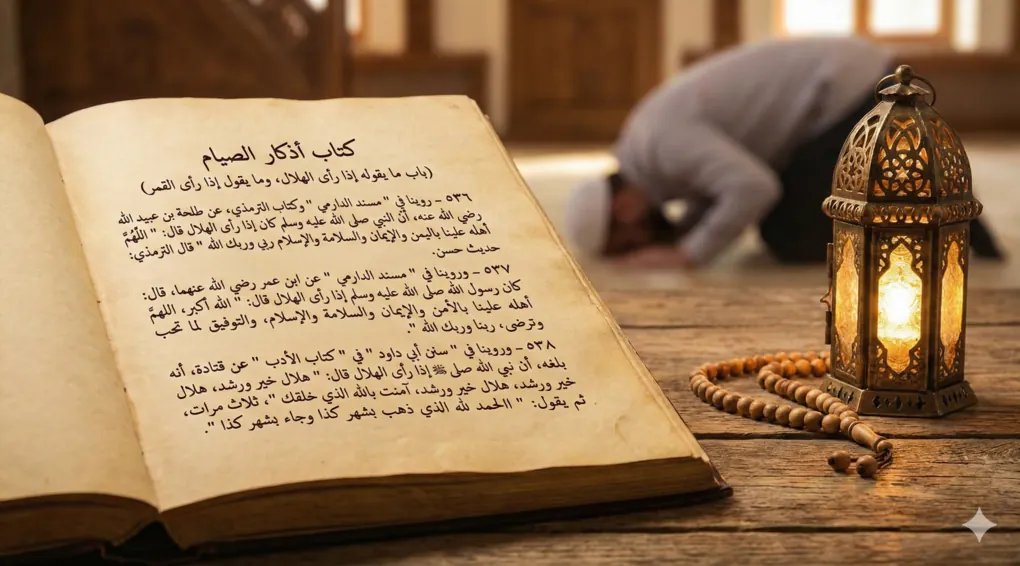
The holy month of Ramadan and the worship of fasting in general hold a high position in Islamic faith. In order for this worship to reach a degree of perfection, a servant needs to adorn their tongue with remembrance and supplication based on the Sunnah of the Prophet Muhammad shallallahu ‘alaihi wa sallam.
This article presents a complete guide to remembrance (dhikr) and supplication during fasting based on the primary reference of the Shafi’i school of thought, namely Kitab Al-Adhkar by Al-Imam Yahya bin Syaraf An-Nawawi rahimahullah, specifically on pages 188 to 191. The explanation below contains the original text, translation, and fiqh views of Imam An-Nawawi regarding the etiquette of fasting, starting from the procedure for welcoming the new moon to the supplication on the Night of Power (Lailatul Qadar).
Prayers and Remembrance in Welcoming the New Month (Sighting the Crescent Moon)

The journey of fasting begins with the sighting of the crescent moon (Hilal). The Messenger of Allah ﷺ taught his ummah to raise specific prayers upon sighting the new crescent moon and welcoming the Hijri month when seeing that sign of Allah’s greatness..
Imam An-Nawawi mentions several narrations regarding the prayer upon sighting the new crescent moon:
1. Prayer Upon Sighting the New Crescent Moon: Narrated by Thalhah bin Ubaidillah
In Musnad Ad-Darimi and Kitab At-Tirmidzi (Hadith No. 536), from Thalhah bin Ubaidillah radhiyallahu ‘anhu, that the Prophet shallallahu ‘alaihi wa sallam would say when he saw the new moon:
اللهم أهله علينا باليمن والإيمان والسلامة والإسلام ربي وربك الله
Allāhumma ahillahu ʿalaynā bil-yumni wal-īmān, was-salāmati wal-islām, rabbī wa-rabbuka Allāh.
Meaning: O Allah, bring this month to us with blessings, faith, safety, and Islam. My Lord and your Lord is Allah. (Imam At-Tirmidhi said: A good hadith).
2. Prayer Upon Sighting the New Moon: Reported by Ibn Umar
Another narration in Musnad Ad-Darimi from Ibn Umar radhiyallahu ‘anhuma (Hadith No. 537), the Messenger of Allah shallallahu ‘alaihi wa sallam uttered slightly different wording:
الله أكبر , اللهم أهله علينا بالأمن والإيمان والسلامة والإسلام , والتوفيق لما تحب وترضى , ربنا وربك الله
Allāhu akbar, Allāhumma ahillahu ʿalaynā bil-amni wal-īmān, was-salāmati wal-islām, wat-tawfīqi limā tuḥibbu wa-tarḍā, rabbunā wa-rabbuka Allāh.
Meaning: Allah is the Greatest. O Allah, bring this month to us with security, faith, safety, Islam, and guidance to that which You love and approve. Our Lord and your Lord is Allah.
3. Prayer Upon Sighting the New Moon: Narrated by Qatadah




In Sunan Abu Dawud in the Book of Adab (Hadith No. 538), there is a narration from Qatadah in a mursal form (the chain of narration is broken at the level of the Tabi’in/Companions), that the Prophet shallallahu ‘alaihi wa sallam recited the following supplication three times when seeing the crescent moon:
هلال خير ورشد، هلال خير ورشد، هلال خير ورشد، آمنت بالله الذي خلقك
Hilālu khayrin wa-rushd, hilālu khayrin wa-rushd, hilālu khayrin wa-rushd. Āmantu billāhil-ladzī khalaqak.
Meaning: Crescent of goodness and guidance, crescent of goodness and guidance, crescent of goodness and guidance. I believe in Allah who created you.
After saying that, he continued:
Al-ḥamdu lillāhil-ladzī dhahaba bi-shahri [kadhā] wa-jāʾa bi-shahri [kadhā].
“All praise is due to Allah who has completed this month and brought forth that one”
An example of applying this du’a is: If we are currently transitioning from the month of Rajab to the month of Sha’ban, the practical wording to recite would be: Al-ḥamdu lillāhil-ladzī dhahaba bi-shahri Rajab, wa-jāʾa bi-shahri Shaʿbān. (‘All praise is due to Allah, who has taken away the month of Rajab and brought the month of Sha’ban’).
Another narration mentions him turning his face away from the crescent moon after seeing it. Abu Dawud notes that in this chapter, there is no musnad (with a connected chain of narration) narration that is ṣaḥīḥ (authentic) from the Prophet ṣallallāhu ‘alaihi wa sallam.
Special Prayers for Entering the Month of Rajab
In preparation for welcoming the fasting month, Muslims are encouraged to pray starting from the month of Rajab. Imam An-Nawawi (Hadith No. 541) quoted a narration from Hilyatul Auliya and the book of Ibn Sinni from Anas radhiyallahu ‘anhu, that the Messenger of Allah shallallahu ‘alaihi wa sallam prayed:
اللهم بارك لنا في رجب وشعبان وبلغنا رمضان
Allāhumma bārik lanā fī Rajaba wa Shaʿbān, wa ballighnā Ramaḍān.
Meaning: O Allah, bless us in the months of Rajab and Sha’ban, and allow us to reach the month of Ramadan.
Prayer When Seeing the Crescent Moon (Qamar)
When the moon is seen growing larger (qamar), the Prophet ﷺ instructed to recite a prayer for protection based on (Hadith No. 540) from Aisyah radhiyallahu ‘anha:
تعوذي بالله من شر هذا الغاسق إذا وقب
“I seek refuge in Allah from the evil of the darkness of this night when it settles.”
Meaning: “Seek refuge in Allah (O ‘Aishah) from the evil of this pitch-black night as it enters.”
To practically implement this sunnah when looking at the moon, you can change the command form into a prayer for yourself by reciting the exact phrase above, or simply by reciting Surah Al-Falaq.
Etiquette and Recommended Dhikr (Remembrance of God) While Fasting
Imam An-Nawawi detailed several fundamental fiqh rulings, ranging from the management of intention to controlling anger and maintaining social etiquette while fasting, as recommended (mustahab) practices for those observing this noble worship.
1. The Fiqh of Aligning the Fasting Intention (Niyyah) in the Heart and Tongue
In the tradition of Islamic jurisprudence scholarship, the issue of intention occupies a central position. Imam An-Nawawi affirmed:
“It is recommended (mustahab) to combine the intention for fasting in both the heart and the tongue, as we have explained in other acts of worship. If someone suffices with the heart alone, that is sufficient. However, if he suffices with the tongue alone (without intending in the heart), then it is invalid – there is no disagreement (khilaf) on this matter.”
2. Social Etiquette During Fasting: Saying “Inni Shaim”
Fasting serves as a shield against evil deeds. A hadith narrated by Bukhari and Muslim (No. 542) from Abu Hurairah radhiyallahu ‘anhu explains the saying of the Prophet shallallahu ‘alaihi wa sallam:
الصيام جنة، فإذا صام أحدكم فلا يرفث ولا يجهل، وإن امرؤ قاتله أو شاتمه فليقل: إني صائم، إني صائم، مرتين
Meaning: Fasting is a shield. So when one of you is fasting, let him not speak foul language (rafats) and let him not act foolishly (yajhal). And if someone invites him to fight or insults him, let him say: ‘Indeed, I am fasting, indeed, I am fasting,’ twice.
Imam An-Nawawi’s Fiqh Perspective:
A question has arisen among scholars: is the phrase “Inni shaim” (Indeed, I am fasting) uttered aloud or is it sufficient to say it in one’s heart? Imam An-Nawawi explained two opinions:
- It must be uttered with one’s tongue so that it is heard by the one who is rebuking, so that they stop.
- Uttered with the heart alone to restrain oneself from foolish actions and maintain the sanctity of the fast.
According to Imam An-Nawawi, the first opinion is the stronger one (azhhar). He also added an explanation of the meaning of “syaatamahu” (reproaching him), namely that the person reproaches with the intention of provoking reciprocal reproaches.
3. The Virtue of the Supplication of a Fasting Person
Fasting is a time when a servant is close to their Lord. Quoting Hadith No. 534 (narrated by At-Tirmidhi and Ibn Majah), the Messenger of Allah shallallahu ‘alaihi wa sallam said that the supplication of a fasting person will not be rejected:
ثلاثة لا ترد دعوتهم : الصائم حتى يفطر , والإمام العادل , ودعوة المظلوم
Meaning: Three people whose prayers are never rejected: a fasting person until he breaks his fast, a just leader, and the prayer of the oppressed. (At-Tirmidhi said: A good hadith).
Imam An-Nawawi emphasized the word “until” written in the Ta’ mutsannah script above ( حتى ), indicating a continuous process from the beginning of the fast until the time of breaking the fast.
Various Supplications for Breaking the Fast According to Hadith Narrations

Regarding the authentic supplications for breaking the fast, differences of opinion often occur in society. Kitab Al-Adhkar provides a moderate and scholarly guideline by including various prayer texts along with the status of their narrations.
Comparison Table of Breaking Fast Prayers
| Hadith Narrative | Arabic Text | Hadith Status (According to the Book Al-Adhkar) |
| Ibn Umar (Sunan Abu Dawud & An-Nasa’i) | ذهب الظمأ ، وابتلت العروق ، وثبت الأجر إن شاء الله تعالى | Sahih / Accepted |
| Mu’adh bin Zuhrah (Sunan Abu Dawud) | اللهم لك صمت ، وعلى رزقك أفطرت | Mursal |
| Mu’adh bin Zuhrah (Ibn Sinni) | الحمد لله الذي أعانني فصمت ، ورزقني فأفطرت | Accepted as a variation of dhikr |
| Ibn Abbas (Ibn Sinni) | اللهم لك صمنا ، وعلى رزقك أفطرنا ، فتقبل منا إنك أنت السميع العليم | Accepted as a variation of dhikr |
1. Supplication for Breaking the Fast Based on a Sound Chain of Narrators (Dzahabadz Zhama-u)
Hadith No. 544 narrated by Ibn Umar radhiyallahu ‘anhuma states that the Prophet shallallahu ‘alaihi wa sallam recited:
ذهب الظمأ، وابتلت العروق، وثبت الأجر إن شاء الله تعالى
Dhahaba aẓ-ẓamaʾu, wabtallatil-ʿurūqu, wa-thabatal-ajru in shāʾa Allāhu taʿālā.
Meaning: Thirst has been quenched, the veins have been moistened, and the reward is established, by the grace of Allah Ta’ala.
Linguistic Correction from Imam An-Nawawi:
As a meticulous scholar, Imam An-Nawawi provided an explanation of Arabic grammar concerning the word Zhama-u. The word Az-Zhama’ is read short (maqshur) with a hamzah ending, which means thirst. He cited the verse of the Qur’an, Surah At-Taubah, verse 120:
( ذلك بأنهم لا يصيبهم ظمأ ).
He said: “I mention this even though it is already clear, because I see people who are confused in their understanding and then assume it is read with a lengthening (mamdud).”
2. The Well-Known Fast-Breaking Prayer (Allahumma Laka Shumtu)
The most widely practiced prayer among Muslims is found in Hadith No. 545 narrated by Mu’adz bin Zuhrah in a mursal manner:
,
اللهم لك صمت، وعلى رزقك أفطرت
Allāhumma laka ṣumtu, wa-ʿalā rizqika afṭartu.
Meaning: O Allah, for You I fast, and with Your provision I break my fast.
The fact that Imam An-Nawawi continued to include this narration in Kitab Al-Adhkar serves as a fiqh basis that reciting this supplication when breaking the fast is permissible, as it contains the meaning of acknowledging provision and the surrender of a servant to his Lord.
3. Prayer for Forgiveness Upon Breaking the Fast (The Prayer of Abdullah bin Amr)
Based on Hadith No. 548, there is a special time that is very responsive right at the moments of breaking the fast. The companion Abdullah bin Amr radhiyallahu ‘anhuma practiced the following prayer:
اللهم إني أسألك برحمتك التي وسعت كل شئ أن تغفر لي
Allāhumma innī asʾaluka bi-raḥmatika allatī wasiʿat kulla shayʾin an taghfira lī.
Meaning: O Allah, indeed I ask You by Your encompassing mercy to forgive me.
Etiquette and Prayers When Breaking the Fast at Another’s Home
Islam is a religion that prioritizes etiquette in social interactions. When someone is invited to attend an Iftar gathering, it is highly recommended to observe the etiquette of breaking the fast together and reciting the prayer for the host as a manifestation of gratitude.
In Hadith No. 549, it is narrated from Anas radhiyallahu ‘anhu, the Prophet shallallahu ‘alaihi wa sallam visited Sa’ad bin Ubadah. Sa’ad offered bread and dried grapes (raisins). He ate from the food and then prayed:
أفطر عندكم الصائمون، وأكل طعامكم الأبرار وصلت عليكم الملائكة
Afṭara ʿindakum aṣ-ṣāʾimūn, wa-akala ṭaʿāmakum al-abrār, wa-ṣallat ʿalaykum al-malāʾikah.
Meaning: Those who fast have broken their fast with you, the righteous (abrar) have eaten of your food, and the angels have sent blessings (asked for forgiveness) upon you.
Important Note (Transcription/Manuscript Correction):
Imam An-Nawawi provided critical notes on old manuscript copies of the book Al-Adhkar. Many manuscripts wrote that Sa’ad served bread and oil ( زيت – zait). However, Imam An-Nawawi affirmed that this was a tashif (copying error), and the historically correct text is bread and dried grapes/raisins ( زبيب – zabib).
Supplications Accepted on the Night of Lailatul Qadar
The spiritual climax of the fast lies in the search for Lailatul Qadar. In the narrations of At-Tirmidhi, An-Nasa’i, and Ibn Majah (Hadith No. 551), Sayyidah Aisyah radhiyallahu ‘anha asked the Messenger of Allah shallallahu ‘alaihi wa sallam about the most appropriate supplication to recite if one encounters that blessed night. He taught her:
اللهم إنك عفو تحب العفو فاعف عني
Allāhumma innaka ʿafuwwun tuḥibbul-ʿafwa faʿfu ʿannī.
Meaning: O Allah, indeed You are the Most Forgiving, You love forgiveness, so forgive me.
Imam At-Tirmidhi assessed this ḥadīth as Ḥasan Shahih (good and authentic).
Imam Ash-Shafi’i’s Fiqh Perspective on Lailatul Qadar
Scholars from the Shafi’i school of thought have reached a consensus (Ijmā’) on the desirability of increasing such supplications, while also increasing the recitation of the Qur’an and other forms of remembrance (dhikr).
Specifically, Imam An-Nawawi quoted the theological view of Imam Asy-Shafi’i rahimahullah:
“I like for a person’s earnestness during the day (on the Night of Power) to be the same as their earnestness during the night.”
An-Nawawi concludes this discussion with a beautiful exhortation: “It is recommended to increase supplication on that night for the interests of the Muslims, as this is the practice of the righteous and the knowing servants of Allah. And with Allah is success.”
FAQ: Questions About Dhikr and Supplications During Fasting
Is an intention for fasting valid if it is only uttered by the tongue without being believed in the heart?
Based on the explanation of Imam An-Nawawi, the intention for obligatory fasting must be in the heart. If one only vocalizes the intention with the tongue without any intention in the heart, the fast is considered invalid without any difference of opinion among scholars.
What should be done if someone provokes anger while fasting?
Say the phrase “Inni shaim” (I am fasting) two or more times. According to the strongest opinion within the school of thought, this phrase is uttered aloud so that the opposing party hears it and realizes their mistake.
Which supplication to break the fast is the most appropriate to recite?
All scholars acknowledge the authenticity of the supplication “Dzahabadz zhama-u…”. However, reciting “Allahumma laka shumtu…” is also a well-known practice authentically recorded in the book Al-Adhkar. Combining both is a good step.
Is it permissible to recite supplications in a language other than Arabic when breaking the fast?
Supplication ma’tsur (supplication directly taught with the wording from the Prophet shallallahu ‘alaihi wa sallam) is recited in Arabic. However, seeking forgiveness or personal needs at the time of breaking the fast (as was the practice of Abdullah bin Amr) can be done in one’s native language within the heart.
By adhering to the guidance of this Kitab Al-Adhkar, may our fasting worship be increasingly organized in accordance with Islamic Principles and leave a profound impact on the purity of the soul.
Referensi
Yaḥyā ibn Sharaf al-Nawawī, al-Adhkār, ed. ʿAbd al-Qādir al-Arnaʾūṭ (Beirut: Dār al-Fikr, 1994), 188-191.


