

In a servant’s (sālik) spiritual journey towards Allah SWT, human nature, prone to error, requires a path of return. This mechanism, in Islamic legal terminology, is known as repentance (taubat). Understanding the conditions for the validity of sincere repentance (taubat nasuha) is not merely theoretical knowledge, but an urgent need so that the process of spiritual purification (tazkiyatun nafs) proceeds on the correct path of the Sharia.
This article outlines the essence of repentance (taubat), the evidence for its obligation, and the details of its conditions based on the authority of the great scholar, Imam An-Nawawi rahimahullah, with direct reference to reliable classical texts.
Understanding Taubat: A Terminological Review
Etymologically, taubat means to return. However, in the more precise shar‘i definition as stipulated in primary references, taubat is defined as:
التوبة : رجوع عما كان مذموما في الشرع إلى ما هو محمود فيه
“Repentance is returning from that which is blameworthy according to Islamic law to that which is praiseworthy within it.”
This definition affirms that tawbah (repentance) is a transition of legal and spiritual status. It is a fundamental initial step. For those traversing the spiritual path, tawbah is the mabda’ (beginning) of the path of the sālikīn (travelers), the key to the happiness of the murīdīn (seekers of God’s will), and a valid requirement for the journey to Allah Ta‘ala. Without valid tawbah, the foundation of a servant’s spiritual edifice will be fragile.
The Urgency and Evidence of the Obligation of Repentance

The scholars unanimously agree that repenting from every sin is obligatory. This obligation is based on definitive (qath‘i) verses of the Qur’an. Allah SWT commands all believers collectively, without exception, to repent in order to achieve success (falāḥ).
Allah SWT states in Surah An-Nur, verse 31:
{ وتُوبُوا إِلَى الله جَمِيعًا أَيُّهَا الْمُؤْمِنُونَ لَعَلَّكُمْ تُفْلِحُونَ }
“And repent to Allah, O you who believe, that you may be successful.”
More specifically, Allah commands the highest quality of repentance, namely tawbah naṣūḥā (sincere/honest repentance), as in QS. At-Tahrim verse 8:
{ يا أَيُّهَا الَّذِينَ آمَنُوا تُوبُوا إِلَى الله تَوْبَةً نَصُوحًا }
“O you who have faith, repent to Allah with sincere repentance.”
The Messenger of Allah Muhammad صلى الله عليه وسلم , a figure who is ma‘shum (protected from sin), constantly renewed his repentance and sought forgiveness every day as a form of tasyri‘ (establishment of Islamic law) and teaching for his ummah.
He said: “O people, repent to Allah and seek His forgiveness, for indeed I repent to Allah a hundred times a day.” (Reported by Muslim).
Core Discussion: Details of the Conditions for the Validity of Taubat Nasuha
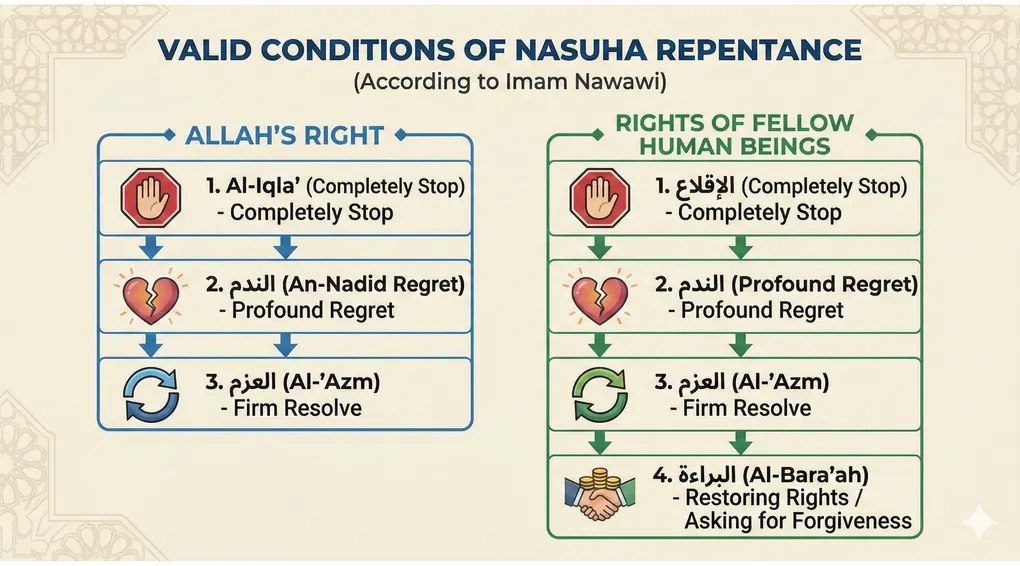
In order for a person’s repentance to be accepted by Allah and considered valid in fiqh, they must fulfill certain Arkān. Imam Nawawi rahimahullah classified the requirements of repentance based on the type of sin committed: sins related exclusively to the Rights of Allah (Huququllah) and sins that are related to the rights of other people (ḥaqqul ādamī).
1. The First Category: Sins Related to the Rights of Allah
If the sin occurs solely between a servant and Allah SWT and does not involve the rights of others (such as neglecting prayer, consuming khamr, or looking at what is Ḥarām), then there are three absolute requirements:
- First: Al-Iqlā‘ (Immediate Cessation of Sin) Namely: أن يقلع عن المعصية (He should abstain/completely stop from that sin). The repentance of a person is not valid if his tongue seeks forgiveness while his body continues to commit the sin.
- Second: An-Nadam (Deep Remorse) Namely: أن يندم على فعلها (Let him regret his actions). This is the most important internal pillar. Remorse is a painful feeling in the heart due to violating the prohibitions of Allah.
- Third: Al-‘Azm (Firm Resolve) Namely: أن يعزم أن لا يعود إليها أبدا (He should firmly resolve never to repeat the act). This is a future commitment.
Imam Nawawi affirmed:
فإن فقد أحد الثلاثة لم تصح توبته
(If one of these three conditions is missing, then the repentance is invalid).
After fulfilling the requirements of al-iqla‘ (ceasing sin) and resolving not to repeat it, increasing in seeking forgiveness (istighfar) and performing the repentance prayer (ṣalāt at-tawbah) is a spiritual step to calm a restless heart due to sin.
2. Second Category: Sins Related to the Rights of People
If the sin involves the rights of other people (such as stealing, ghibah, oppression, or debt issues), then the conditions increase to four. The three conditions above must be met, plus a fourth condition, namely:
- Fourth: Al-Barā’ah (Freeing Oneself from the Rights of Others) Namely: وأن يبرأ من حق صاحبها (He should free himself from the rights of its owner). This condition entails specific actions based on the nature of the violation:
- Property: If the right is material (money, stolen goods, etc.), it is obligatory to return it to its owner ( فإن كانت مالا أو نحوه رده إليه ).
- Punishment (Ḥadd): If the right is a false accusation (qadzaf) or something that requires bodily punishment, then he must surrender himself to be punished or seek forgiveness/pardon from the victim ( مكّنه منه أو طلب عفوه ).
- Ghibah (Backbiting): If it involves backbiting, then it is obligatory to seek forgiveness from the person being spoken about ( وإن كانت غيبة استحلّه منها ).
For a deeper understanding of sins involving other people, please read the following article: How to Restore Rights & Seek Forgiveness.
The Sufi Perspective and Supporting Factors of Repentance

In the Sufi perspective, the quality of one’s repentance is tiered according to their spiritual maqam (station). Dhun Nun al-Misri divided repentance into two types: the repentance of the common people is repentance from sins (dhunub), while the repentance of the khawwas (special circle) is repentance from ghaflah (the heart’s negligence in remembering Allah), even for a fleeting moment.
A Sufi does not see the smallness of sin, but rather the greatness of the Being who is disobeyed. This is in line with the statement from Anas bin Malik radhiyallahu ‘anhu who reminded the generations after the companions that they committed sins considered trivial like a hair, whereas in the time of the Messenger of Allah صلى الله عليه وسلم such things were considered destructive (al-mūbiqāt).
As a crucial supporting factor in maintaining the consistency of repentance, the scripture encourages leaving a negative environment. Among the requirements for the perfection of repentance are:
ترك قرناء السوء , وهجر الأصحاب الفسقة
(Leaving bad companions and avoiding wicked friends). This is taken from the lesson of the story of a murderer of 100 souls who was ordered by a scholar to migrate from his bad land to the environment of the righteous people.
Sheikh Ahmad Zarruq, in his Sufi principle, provides a parameter for the sincerity of repentance: “Repentance not followed by piety is void.” The truthfulness of one’s repentance is tested when they are confronted again with the object of sin they previously committed; if they are able to restrain themselves due to wara’ (caution), then their repentance is genuine.
For a sālik who wishes to improve their relationship with Allah, consistently reciting the supplication of repentance of Prophet Adam is one of the best ways to express humility and confess sins before Him.
FAQ (Frequently Asked Questions)




Is repentance valid if a person still remembers the pleasure of that sin?
The condition for validity is repentance (nadam). If the recollection is accompanied by hatred and regret, the repentance is valid. However, if the recollection is accompanied by a longing to repeat it, this violates the condition of resolve (‘azm).
What if a person repents, and then later slips and commits the same sin again?
The first repentance remains valid if its conditions were met at the time. A new sin requires a new repentance. A believer should not despair of continually renewing their repentance.
If the rights holder (ḥaqq al-ādami) has died or their whereabouts are unknown, what should be done?
If it is property, and efforts to find the heirs have been maximized but failed, then the property should be given in charity on behalf of the owner with the intention of being adh-dhamān (a guarantee if the heirs appear at a later time). If it is backbiting (ghibah), one should seek forgiveness (istighfar) for the person who was backbitten and mention their good qualities in the place where their bad qualities were mentioned.
And Allah knows best.
Reference
‘Abd al-Qādir bin ‘Abd Allāh bin Qāsim bin Muḥammad bin ‘Īsā ‘Azīzī al-Ḥalabī al-Syādhilī, Ḥaqā’iq ‘an al-Taṣawwuf (Aleppo, Syria: Dār al-‘Irfān, 16th ed., 1428 H/2007 CE).


