

We frequently hear the call to send blessings, especially whenever the name of Prophet Muhammad ﷺ is mentioned. For some, this might be perceived as a mere verbal routine or lip service. However, have you ever considered that this invocation carries profound legal weight in Islamic jurisprudence? Understanding the true meaning of Salawat is not just about spiritual enrichment; it is fundamentally tied to the validity of your daily worship.
A partial understanding of this topic can lead to fatal consequences for our spiritual life. On one hand, there is a severe prophetic warning for those who are “stingy” in sending blessings. On the other hand, there is a substantial risk that our obligatory prayers may not be accepted if we neglect the rights of the Messenger of Allah ﷺ.
Let us examine this matter down to its roots. We will explore the perspectives of eminent scholars from classical foundational texts (Kutub al-Mu’tamadah) such as Al-Hawi Al-Kabir by Imam al-Mawardi, Al-Kawkab Al-Wahhaj, and Imam al-Nawawi’s Al-Adhkar.
Clarifying the “Meaning of Salawat” from Allah
The most frequently recited verse regarding the Salawat is Surah Al-Ahzab, verse 56: “Indeed, Allah and His angels send blessings upon the Prophet…”
This raises an intriguing theological question: If we perform Salah to worship Allah, does Allah worship the Prophet when He sends Salawat? Absolutely not. This is a critical misunderstanding that must be rectified, as it pertains directly to our faith in the Messengers of Allah.
The commentary Al-Kawkab Al-Wahhaj fi Sharh Sahih Muslim explains this linguistic phenomenon with absolute clarity. In the verse, a single verb (yusalluna) applies to two distinct subjects: Allah and the angels. However, the reality of the action differs entirely. In Arabic rhetoric, this is known as ‘Umum al-Majaz (an inclusive metaphor).
Here is the detailed breakdown of the meaning of Salawat to prevent any misconception:
1. Salawat from Allah (Mercy and Honor)
When Allah sends Salawat upon Prophet Muhammad ﷺ, it signifies Tashrif (ennoblement) and Takrim (honoring). Allah provides tangible divine support (Ta’yid), guidance (Tawfiq), and elevates him to the Praised Station (Maqam Mahmud). Therefore, Allah is not praying; rather, He is bestowing a supreme divine grace.
2. Salawat from the Angels (Seeking Forgiveness)
The angels do not bestow divine mercy, as they do not possess such independent power. The supplication of the angels—whose nature we learn about when studying the names of angels in Islam—signifies a plea for the Prophet’s forgiveness and a prayer for the continuous elevation of his rank.
3. Salawat from Mankind (Supplication)




For humanity, sending Salawat is a request for the Prophet’s intercession (Shafa’ah), a testament of our love, and an acknowledgment of our profound need for a spiritual connection with him.
Did You Know? Allah Also Sends Salawat Upon Believers
Many assume that Allah’s Salawat is exclusively reserved for the Prophets. In reality, Allah also pours out His “Salawat” upon ordinary believers. Naturally, the purpose differs from the blessings bestowed upon the Prophet.
While the Salawat upon the Prophet signifies an elevation in rank, Allah’s Salawat upon us means bringing us out of darkness into the light and descending His mercy upon us during calamities. Here are two incredibly comforting Quranic proofs:
1. Salawat to Bring Us Out of Darkness (QS. Al-Ahzab: 43)
هُوَ ٱلَّذِي يُصَلِّي عَلَيۡكُمۡ وَمَلَائِكَتُهُۥ لِيُخۡرِجَكُم مِّنَ ٱلظُّلُمَٰتِ إِلَى ٱلنُّورِۚ
Meaning: “It is He who confers blessing upon you, and His angels [ask Him to do so] that He may bring you out from darknesses into the light…”
2. Salawat for the Patient Believers (QS. Al-Baqarah: 157)
Allah promises blessings upon those who are patient during trials.
Arabic Text:
أُوْلَئِكَ عَلَيۡهِمۡ صَلَوَٰتٞ مِّن رَّبِّهِمۡ وَرَحۡمَةٞۖ وَأُوْلَئِكَ هُمُ ٱلۡمُهۡتَدُونَ
Meaning: “Those are the ones upon whom are blessings from their Lord and mercy. And it is those who are the [rightly] guided.”
The Intense Debate: Is Salawat in Prayer Mandatory or Sunnah?
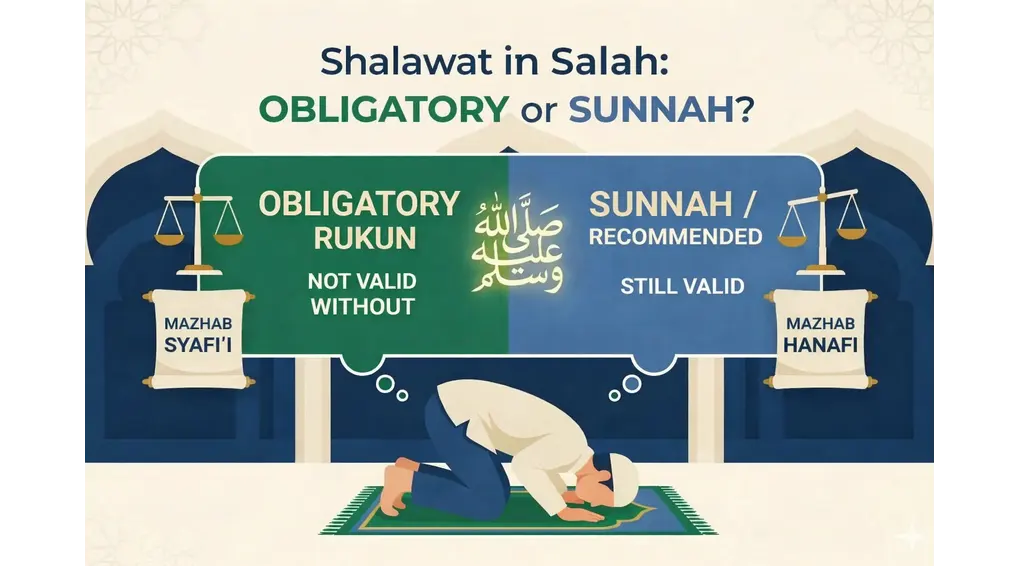
For the majority of Muslims in Southeast Asia who follow the Shafi’i school of thought, reciting the Salawat during the final sitting (Tashahhud) is a crucial element that determines the validity of the prayer. This is a core jurisprudential issue every Muslim must comprehend.
When exploring how many pillars of prayer exist, scholars debate the status of this recitation. In the book Al-Hawi Al-Kabir (Vol. 2, pp. 137-138), Imam al-Mawardi records a sharp divergence of opinions among the founders of the major schools of thought.
The Shafi’i School: Mandatory (A Pillar of Prayer)
Imam al-Shafi’i held a remarkably firm stance: “Sending Salawat upon the Prophet ﷺ is MANDATORY during the final Tashahhud.”
The consequence is severe: if a person omits it, whether intentionally or out of forgetfulness, their prayer is entirely invalid. Imam al-Shafi’i relied on robust evidence for this:
- The Quranic Command: The phrase “Sallu ‘alayhi” (Send blessings upon him) is an imperative command indicating an obligation. Since it is not an absolute obligation outside of prayer, the obligation must fall within the prayer itself.
- The Decisive Hadith: The Messenger of Allah ﷺ explicitly stated, “There is no prayer (it is invalid) for the one who does not send blessings upon me within it.” (Narrated by Ibn Majah).
- Logical Deduction (Qiyas): Just as the remembrance of Allah (Takbir, Tahmid) is mandatory in prayer, mentioning the name of the Messenger of Allah is equally mandatory during the Tashahhud.
The Hanafi & Maliki Schools: A Recommended Sunnah
Conversely, Imam Abu Hanifah and Imam Malik opined that reciting the Salawat in prayer is a Sunnah (highly recommended). The prayer remains valid without it, albeit less perfect. They rely on the Hadith of Ibn Mas’ud, where the Prophet ﷺ said after teaching the Tashahhud: “If you finish reciting this, you have completed your prayer.”
The Brilliant Shafi’i Rebuttal
In Al-Hawi, the Shafi’i scholars intelligently dismantled the Hanafi argument:
- The statement “If you finish reciting this…” is highly likely the personal addition of Ibn Mas’ud himself, not the direct words of the Prophet ﷺ.
- Even if it were a prophetic statement, it was uttered before the revelation of the Quranic verse commanding the Salawat. Once the verse was revealed, the ruling transitioned into a mandatory obligation.
The Danger of the “Dusty Nose”: Neglecting Salawat Outside Prayer
If abandoning it during prayer invalidates the worship (according to the Shafi’i school), what is the ruling on neglecting it outside of prayer?
Imam al-Nawawi, in his magnum opus Al-Adhkar, quotes a rather striking Hadith narrated by al-Tirmidhi: “Raghima anfu rajulin…” (May the nose of a man be rubbed in dust if my name is mentioned in his presence and he does not send blessings upon me.)
The idiom “having one’s nose rubbed in dust” represents the ultimate state of humiliation. A person who remains silent when the Prophet’s name is mentioned is labeled as the most profound loser. Simply because they are too lazy to move their tongue for a few seconds, they discard ten divine mercies and instead invite spiritual humiliation. Realizing this helps us truly grasp the immense virtue of sending Salawat.
Why Prophet Muhammad is Honored Above Prophet Adam
There is a fascinating theological point from Al-Kawkab Al-Wahhaj that often escapes our attention.
We know that Allah honored Prophet Adam AS by commanding the angels to prostrate to him—an event we often reflect upon when studying the supplication of Prophet Adam. Iblis refused and was consequently banished. However, notice the specific detail: Allah commanded the prostration, but Allah Himself did not prostrate.
Compare this to the honor bestowed upon Prophet Muhammad ﷺ. Allah commanded the believers to send Salawat, but Allah Himself initiated it, followed by the angels.
Allah’s direct, active participation in this ennoblement serves as the absolute proof that the spiritual station of the Messenger of Allah ﷺ represents the highest pinnacle above all other prophets.
Classical Arabic Text References
For students of knowledge seeking authentic classical references (Kitab Kuning), here are the original Arabic texts supporting this article.
1. The Ruling of Salawat in Prayer (Al-Hawi Al-Kabir):
مسألة : قال الشافعي رضي الله عنه : ” ثم يصلي على النبي – صلى الله عليه وسلم – ” وهذا كما قال الصلاة على النبي – صلى الله عليه وسلم – واجبة في الصلاة في التشهد الآخر … ودليلنا قوله عز وجل : { إن الله وملائكته يصلون على النبي يا أيها الذين آمنوا صلوا عليه وسلموا تسليما } قال الشافعي : فأوجب علينا أن نصلي على النبي – صلى الله عليه وسلم – وأولى الأحوال أن يكون في الصلاة … وروى سهل بن سعد الساعدي أن النبي – صلى الله عليه وسلم – قال : ” لا صلاة لمن لم يصل علي فيها “1.
2. The Hadith of the Humiliated Person (Al-Adhkar):
” رغم أنف رجل ذكرت عنده فلم يصل علي ” قال الترمذي : حديث حسن 2.
3. The Meaning of Salawat (Al-Kawkab Al-Wahhaj):
قوله : { إن الله } سبحانه وتعالى { وملائكته يصلون على النبي } … فقوله : { يصلون } محمول على عموم المجاز … وهذا التشريف الذي شرف الله به نبينا – صلى الله عليه وسلم – أتم من تشريف آدم عليه السلام 3.
Summary Table of Rulings and Meanings
To facilitate easier comprehension, here is a summary of the differing views and theological meanings:
| Aspect | Brief Explanation | Classical Reference |
| Meaning of Allah’s Salawat | Ennoblement (Tashrif), Special Mercy, & Divine Support. | Al-Kawkab Al-Wahhaj |
| Ruling in Prayer (Shafi’i) | Mandatory / Pillar (Rukun). The prayer is invalid without it. | Al-Hawi Al-Kabir |
| Ruling in Prayer (Hanafi) | Sunnah. The prayer remains valid without it. | Al-Hawi Al-Kabir |
| Ruling When Hearing His Name | Makruh (disliked) to remain silent; threatened with humiliation. | Al-Adhkar |
FAQ: Frequently Asked Questions
1. Is my prayer valid if I forget to read the Salawat during the final Tashahhud?
If you adhere to the Shafi’i school of thought, your prayer is invalid and must be repeated because reciting it in the final Tashahhud is a mandatory pillar (Rukun). However, according to the Hanafi school, the prayer remains valid. For the sake of spiritual precaution (Ihtiyat), you should never intentionally omit it.
2. What is the minimum wording of Salawat required for a valid prayer?
The shortest recitation that fulfills the mandatory pillar is “Allahumma salli ‘ala Muhammad”. However, the most superior and complete form is the Abrahamic Salawat (Al-Salawat al-Ibrahimiyyah).
3. Is it permissible to abbreviate the written Salawat as “SAW” or “PBUH”?
While it might be convenient for rapid typing, scholars strongly advise against it. Writing out the full Sallallahu ‘alayhi wa sallam acts as a permanent written supplication. Avoid letting your tongue or fingers become accustomed to taking shortcuts, a topic discussed further in the ruling on abbreviating SAW.
Conclusion
Guarding our tongue by constantly reciting the Salawat is not merely an exercise in accumulating rewards; it is fundamentally about ensuring the validity of our foundational worship. Never allow yourself to become the person whose “nose is rubbed in dust” or whose daily prayers are rendered futile simply because you underestimated the weight of these magnificent words.
References
- Abū al-Ḥasan ʿAlī ibn Muḥammad ibn Ḥabīb al-Māwardī, al-Ḥāwī al-Kabīr fī Fiqh Madhhab al-Imām al-Shāfiʿī wa Huwa Sharḥ Mukhtaṣar al-Muzanī, edited by ʿAlī Muḥammad Muʿawwaḍ and ʿĀdil Aḥmad ʿAbd al-Mawjūd, 1st ed. (Beirut: Dār al-Kutub al-ʿIlmiyyah, 1999), vol. 2, pp. 137–138. ↩︎
- Yaḥyā ibn Sharaf al-Nawawī, al-Adhkār, ed. ʿAbd al-Qādir al-Arnaʾūṭ (Beirut: Dār al-Fikr, 1994), 115. ↩︎
- Muḥammad al-Amīn al-Hararī, Al-Kawkab al-Wahhāj wa-al-Rawḍ al-Bahhāj fī Sharḥ Ṣaḥīḥ Muslim ibn al-Ḥajjāj, ed. Hāshim Muḥammad ʿAlī Mahdī, 1st ed. (Jeddah: Dār al-Minhāj, 2009), 23:99-100. ↩︎


