
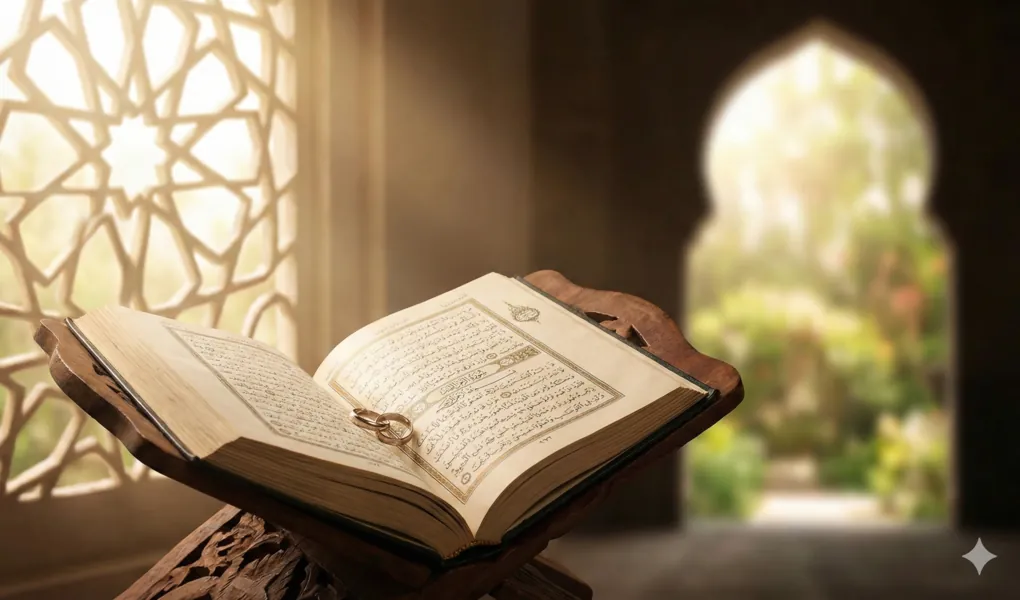
When discussing marriage in Islam, people frequently focus solely on the lavish wedding reception or the resulting social status. However, within the profound study and understanding of Islamic jurisprudence (fiqh), the matrimonial bond possesses a remarkably deep dimension. It heavily transcends mere worldly affairs, piercing directly into the eternal realities of the Hereafter.
One of the primary, highly authoritative references continuously studied in traditional Islamic boarding schools (pesantren) is the classical text I’anat at-Talibin, authored by the esteemed Shaykh Abu Bakr Shatta al-Dimyati. In this monumental book, he meticulously unravels the intricate details of fiqh al-munakahat (the jurisprudence of marriage), exploring everything from its linguistic definition and historical origins to the severe warnings issued against those who deliberately refuse to marry.
Let us comprehensively dissect the true essence of marriage in Islam based directly on the authentic Arabic text of this classical masterpiece.
Marriage: A Divine Law from Prophet Adam to Paradise
Numerous acts of worship that we diligently perform in this world will inevitably cease the moment we die. However, marriage is entirely different. Shaykh Abu Bakr Shatta profoundly explains:
والنكاح من الشرائع القديمة , فإنه شرع من لدن آدم عليه السلام واستمر حتى في الجنة
“And marriage is among the ancient divine laws (sharia). Verily, it was legislated since the era of Prophet Adam (peace be upon him) and continues unceasingly even into Paradise.”
The fascinating jurisprudential point here is that being married in Paradise is legally valid and entirely permissible. The joy of having a spouse is recognized as one of the ultimate, eternal bounties that is absolutely never severed by physical death. Because the marital bond extends infinitely into the Hereafter, maintaining a deeply harmonious relationship in this world is spiritually crucial; classical texts even vividly describe how the maidens of paradise become angry when a wife hurts her husband.
The 3 Primary Purposes of Marriage in Islam (Maqasid al-Nikah)
People frequently ask, what exactly is the fundamental purpose of getting married according to Islamic teachings? Classical scholars and historical medical experts (as explicitly cited in the text) formulated this into three primary, overarching objectives:
- Preserving Lineage (Hifz al-Nasl): Ensuring that the human race does not face extinction and that noble family lineages remain strictly protected.
- Physical Health: Releasing biological fluids that, if unnaturally suppressed for excessively long periods, could potentially cause physiological harm to the human body.
- Attaining Pleasure (Nail al-Ladzzah): Achieving profound spiritual, emotional, and biological satisfaction.
Uniquely, when believers enter Paradise, the first and second objectives are entirely eliminated. In Heaven, there is absolutely no more process of human reproduction, nor are there any illnesses caused by suppressed desires. The sole remaining objective is pure, unadulterated pleasure (Al-Ladzzah).
وهذه الثالثة هي التي تبقى في الجنة , إذ لا تناسل هناك ولا احتباس
“And this third objective is the one that remains in Paradise, because there is absolutely no reproduction there, nor any bodily retention.”
Comparison Table of Marriage Purposes: Worldly vs. Hereafter
| The Objective | In This World | In Paradise |
| Having Children / Lineage | Present | Absent |
| Physical Health Maintenance | Present | Absent |
| Pleasure and Joy | Present | Present & Eternal |
Scriptural Evidence and the Prophetic Sunnah
The legal foundation underpinning marriage is exceptionally robust. It is directly derived from the Quran, the Prophetic Hadith, and scholarly consensus (Ijma’), which represent the core foundation when studying the four primary sources of Islamic law.
1. The Holy Quran Allah clearly decrees in Surah An-Nisa, verse 3:
“…Then marry those that please you of [other] women, two or three or four…” Furthermore, Surah An-Nur, verse 32, contains a direct divine command to marry off the single individuals among the believers.
And Surah An-Nur, verse 32, concerning the command to marry those who are single.
2. The Hadith of the Prophet ﷺ
The Messenger of Allah ﷺ aggressively emphasized that marriage is an innate human disposition (fitrah) and a central pillar of his sunnah (prophetic way). He declared:
من أحب فطرتي فليستن بسنتي , ومن سنتي النكاح
“Whoever loves my natural disposition (fitrah), let him follow my sunnah, and among my sunnah is marriage.”
There is even a subtle, terrifying warning directed at those who “despise” or intentionally abandon this path without a valid Sharia-compliant reason, indicating that they will not be recognized as part of the Prophet’s group on the Day of Resurrection.
The Spiritual Dangers of Celibacy for the Capable
What exactly is the Islamic ruling regarding an individual who actively chooses to live a celibate life despite possessing full physical and financial capability? The book I’anat at-Talibin highlights this highly critical issue with a remarkably striking historical account.
A companion named ‘Ukkaf once approached the Prophet ﷺ. The Prophet inquired whether he had a wife or a concubine. ‘Ukkaf answered no, despite explicitly confirming that he was a wealthy, capable man (mussir). The Prophet’s ﷺ response was exceptionally stern:
قال أنت من إخوان الشياطين . لو كنت من النصارى كنت من رهبانهم
“He said: You are from the brothers of the devils. If you were from the Christians, you would undeniably be one of their monks.”
The Prophet ﷺ then continued with a severe declaration frequently quoted by Islamic preachers:
شراركم عزابكم , أراذل أمواتكم عزابكم
“The absolute worst among you are your bachelors, and the most despicable of your dead are the corpses of your bachelors.”
Why is Remaining Single Strongly Condemned?




It is absolutely not condemned simply because of the “single” status itself, but entirely due to its immense potential for sin. A person who refuses to marry despite being capable finds it exponentially more difficult to lower their gaze and guard their chastity. Satan finds it vastly easier to whisper to and tempt an isolated individual compared to someone who possesses a lawful (halal) spouse. This is precisely why it is universally stated: “Whoever marries has effectively perfected half of his religion.”
Defining the Marriage Contract: Linguistic and Fiqh Perspectives
A classical debate frequently occurs among students of knowledge: Does the term “nikah” fundamentally refer to the verbal contract itself, or does it refer to the physical intimacy?
Linguistic Definition (Lughatan) Linguistically, Nikah signifies Ad-Dhammu (to gather) and Al-Ijtima’ (to come together). The ancient Arabs utilized this specific term to vividly describe trees leaning into and intertwining with one another. Some linguists also define nikah literally as the act of sexual intercourse (wathi).
Sharia Definition (Istilah) According to the Shafi’i School of Jurisprudence, the definitive, technical definition of nikah is:
عقد يتضمن إباحة وطئ بلفظ إنكاح أو تزويج
“A contract that inherently includes the permissibility of sexual intercourse by specifically utilizing the explicit phrasing of ‘Inkah’ or ‘Tazwij’ (marrying or wedding).”
Therefore, the true essence of marriage in Islam is the verbal contract itself. The intimate relationship between husband and wife is merely the lawful consequence of that sacred contract.
There is a highly fascinating academic discussion regarding the exact nature of this contract:
- Contract of Ibahah: A contract whose fundamental nature is to “permit” the husband to enjoy the wife (this is considered the strongest and most valid opinion / awjah).
- Contract of Tamlik: A contract whose nature is to “own” the benefit of the wife’s physical body.
The legal distinction becomes visible in specific cases involving oaths. If a husband swears an oath stating, “I absolutely do not own anything,” he does not legally violate his oath even though he has a wife. This is because a wife is undeniably not an owned piece of property or merchandise; she is an honored partner who has been made “permissible” for him through a sacred covenant.
Frequently Asked Questions (FAQ)
Is it permissible to get married with the pure intention of worship even if one is not yet financially established?
Yes. The Prophet ﷺ warned: “Whoever abandons marriage due to the fear of poverty is not of me.” Islam strongly encourages marriage as a means to actively open the doors of divine sustenance, provided the individual is willing to work hard and strive (ikhtiar).
Will we be reunited with our spouses in Paradise?
Absolutely. Marriage is a divine law that continues unceasingly into Paradise. Righteous couples who die upon faith will be joyously reunited in the Hereafter.
What is the Islamic ruling on choosing to be “marriage-free” or “child-free” forever?
If the foundational reason is raghiban ‘an sunnati (actively hating or despising the Prophet’s sunnah), then it is strictly forbidden and the individual is labeled a “friend of Satan” in the aforementioned hadith. However, if there is a valid Sharia excuse (such as a severe, incurable illness or absolute biological impotence), the jurisprudential ruling is entirely different and widely excused.
Does marriage exist in Paradise?
Yes. As explained by Sheikh Abu Bakar Syatha, marriage is an act of worship that continues into Paradise, where believers will be reunited with their spouses or married to the pure ones (Hoor al-Ayn).
Conclusion
Understanding the reality of marriage in Islam reveals that it is absolutely not merely the physical union of two human beings. It is an incredibly long, spiritual act of worship whose ancient roots were firmly planted during the era of Prophet Adam, and whose magnificent fruits will continue to be harvested eternally in Paradise. For those of you who currently possess the capability, expediting your marriage is undeniably the greatest, most effective step to safeguard your personal honor and protect the integrity of your religion.
Reference
Shaṭṭā, ʿUthmān ibn Muḥammad, Abū Bakr (al-Mashhūr bi-al-Bakrī) ad-Dimyāṭī. Iʿānat aṭ-Ṭālibīn ʿalā Ḥall Alfāẓ Fatḥ al-Muʿīn (Ḥāshiyah ʿalā Fatḥ al-Muʿīn bi-Sharḥ Qurrat al-ʿAyn bi-Muhimmat ad-Dīn). 1st ed. Beirut: Dār al-Fikr, 1997.


