
Have you ever felt anxious while performing the Maghrib prayer, fearing that the time was running out? A common assumption circulates within society that the Maghrib time is incredibly narrow—only sufficient for the Adhan and Iqamah, ablution (wudu), performing five rak’ahs of prayer, and eating a quick bite. Once completed, the time is supposedly over.
Is this assumption accurate?
Within the intellectual tradition of Shafi’i Fiqh, the discussion regarding the end of Maghrib time is indeed extensive and fascinating. There are two major opinions frequently debated by students of knowledge (santri) and researchers of classical texts (kitab kuning). To address these uncertainties, let us open one of the most authoritative references in the Shafi’i Madhhab: Asna al-Matalib Sharh Rawd al-Talib by Shaykh al-Islam Zakariyya al-Ansari.
This article will comprehensively explore when the end of Maghrib time truly occurs, what Shafaq Ahmar (the red twilight) is, and how modern Islamic astronomy calculates it.
The Beginning of Maghrib Time: The Disappearance of the Solar Disk
Before discussing the “end,” we must first establish the “beginning.” Shaykh Zakariyya al-Ansari explains that Maghrib time begins precisely when the disk of the sun completely sets below the horizon.
In Asna al-Matalib, he states:
قوله : ( والمغرب ) أي وقته ( بسقوط قرص الشمس وإن بقي الشعاع )
“His statement: (And Maghrib) meaning its time (is with the dropping of the sun’s disk, even if the rays remain).”
This means that even if the light or rays are still visibly radiating in the sky, as long as the round disk of the sun has disappeared below the western horizon, Maghrib time has entered. In mountainous regions or cities with high-rise buildings, the sign is the disappearance of sunlight from the highest peaks of the buildings or hills.
Two Opinions of Shafi’i Scholars: Narrow Time vs. Extended Time
Here lies the core of the discussion. Within the Shafi’i Madhhab, there are two distinct narratives regarding the duration of Maghrib time.
1. The Opinion of a Narrow Time (Qawl Jadid)
There is an opinion stating that Maghrib time is “narrow.” This view is based on the Hadith of Jibril leading Prophet Muhammad SAW in prayer. In that Hadith, Jibril performed the Maghrib prayer at the exact same time for two consecutive days.
Shaykh Zakariyya al-Ansari details this opinion:
قوله: (ويبقى) وقت المغرب (قدر) زمن (أذانين) أي أذان وإقامة (وخمس ركعات وسطا)
“His statement: (And the time of Maghrib remains) the equivalent duration of (two adhans) meaning the Adhan and Iqamah (and five moderate rak’ahs).”
According to this view, Maghrib time only lasts for the duration needed to:
- Recite the Adhan and Iqamah.
- Purify oneself (wudu or ghusl) and cover the ‘awrah.
- Perform 5 rak’ahs of prayer (3 mandatory rak’ahs + 2 recommended sunnah ba’diyyah rak’ahs).
- Eat a small amount to break one’s hunger.
If the time to perform these actions elapses, Maghrib time is considered finished. This is known as the Qawl Jadid (New Opinion) of Imam al-Shafi’i. However, is this the opinion we practice today? As it turns out, it is not.
2. The Opinion of an Extended Time Until the Red Twilight Disappears (Qawl Qadim / Mu’tamad)
The second opinion—and this is the primary reliance (Mu’tamad) for the vast majority of Shafi’i scholars—states that Maghrib time extends until the disappearance of the Red Twilight.
The text of the book states:
قوله: (والقديم وهو المختار)… (امتداده) أي وقت المغرب (إلى مغيب الشفق الأحمر)
“His statement: (And the old opinion, which is the chosen one)… (its extension) meaning the time of Maghrib (is until the disappearance of the red twilight).”
Although termed the Qawl Qadim (Old Opinion), verifying scholars (muhaqqiqun) such as Imam al-Nawawi in Al-Majmu’ and Al-Minhaj actually chose this as the strongest (sahih) opinion.
The reasoning is highly robust:
- Stronger Hadith: There is a Hadith narrated by Muslim stating, “The time of Maghrib remains as long as the twilight (shafaq) has not disappeared.”
- Chronology of the Hadith: The Hadith mentioning the extended time (red twilight) was revealed in Madinah (later), whereas the Hadith of Jibril was revealed in Makkah (earlier).
- The Prophet’s Practice: The Prophet SAW once recited Surah Al-A’raf during the Maghrib prayer. This Surah is exceptionally long and would be impossible to complete if Maghrib time was only as brief as the duration of wudu and 5 rak’ahs.
Understanding Shafaq Ahmar (The Red Twilight)
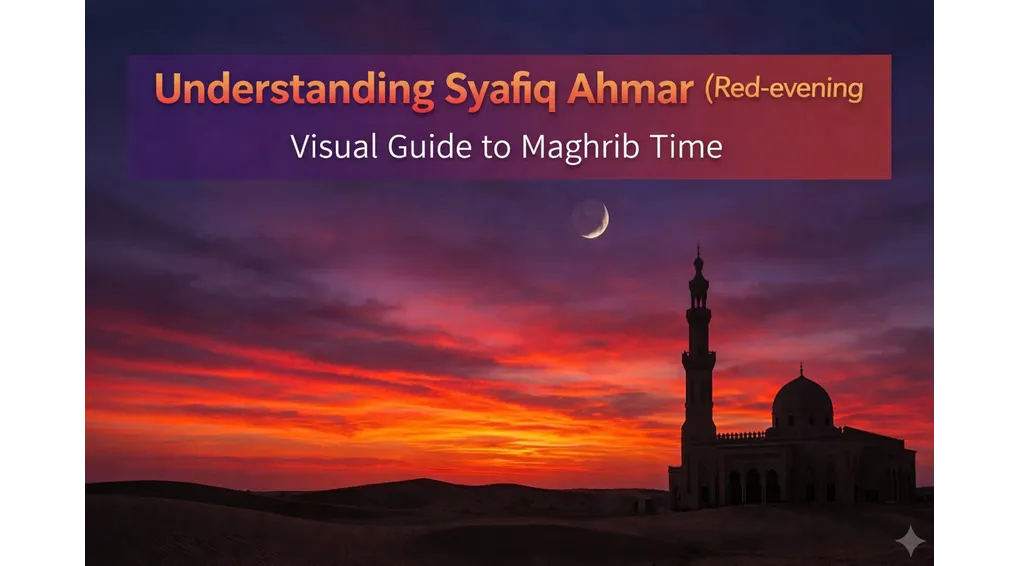
Therefore, our benchmark for the end of Maghrib time is Shafaq Ahmar. But what exactly is it?
Shafaq Ahmar is the reddish tinge of light that appears on the western horizon after the sun sets. It is the residual reflection of sunlight in the earth’s atmosphere.
The sequence of changes is as follows:
- Sunset: Entry of Maghrib time.
- Red Twilight (Shafaq Ahmar): The sky is reddish-orange. As long as this color remains, we are still within Maghrib time (the Time of Permissibility or Waqt Jawaz).
- White Twilight (Shafaq Abyad): After the red disappears, there is usually a faint residual white light.
- Total Darkness: Entry of Isha time.
Sheikh Zakaria affirmed:
قوله: (وذلك) أي مغيب الشفق الأحمر لا ما بعده من الأصفر ثم الأبيض
“His statement: (And that) is the disappearance of the red twilight, not what follows it of the yellow then the white.”
The absolute limit is the disappearance of the red color, not the yellow or white that follows it. Thus, as soon as the red color vanishes, Isha time has entered.
Astronomical Perspective: The -18 Degree Criterion
How do we apply this classical concept in the modern era without having to look at the sky every evening?
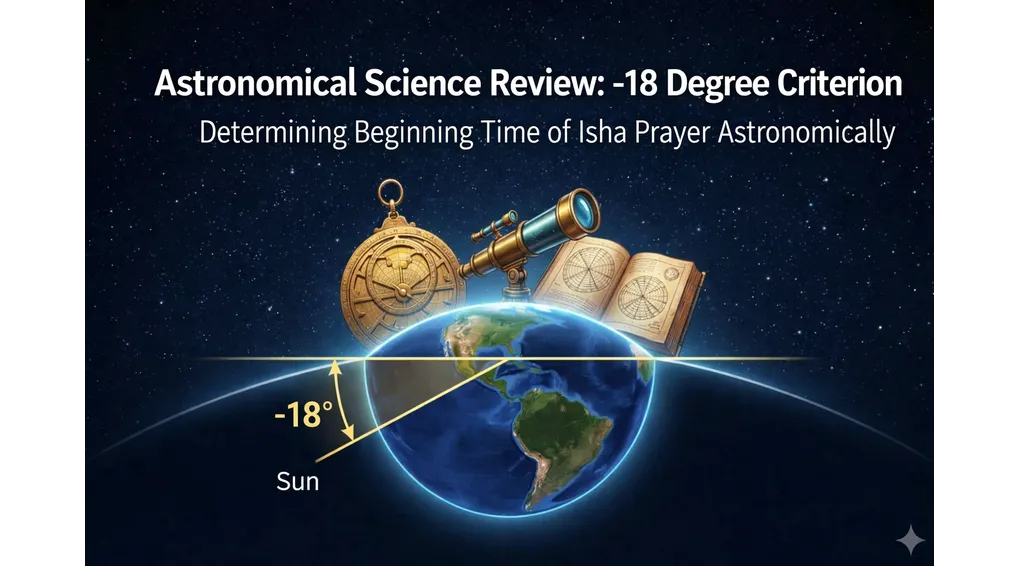
Islamic astronomers (ulama al-falak) have converted the phenomenon of the disappearing red twilight into calculations based on the sun’s position. As the sun descends further below the horizon, the sky darkens.
In Indonesia, the Ministry of Religious Affairs (Kemenag) and Islamic organizations like Muhammadiyah and Nahdlatul Ulama have agreed upon the following astronomical criterion:
- The beginning of Isha (the end of Maghrib time) occurs when the sun’s position reaches an altitude of -18 degrees below the horizon.
- This duration is approximately 70 to 80 minutes after the Maghrib adhan (depending on longitude and latitude).
Therefore, the global prayer schedules available on your mobile phone today utilize this -18 degree calculation, which is equivalent to the disappearance of Shafaq Ahmar. (Similarly, calculations are made for other prayers, such as determining the precise Asr prayer time).
The Original Text of Asna al-Matalib
For those wishing to reference the source directly or study the original text regarding the validity conditions of prayer, here is the complete excerpt from Asna al-Matalib Volume 1, pages 116-117:
[The Beginning of Maghrib Time]
[أول وقت المغرب]
قوله: (والمغرب) أي وقته (بسقوط قرص الشمس وإن بقي الشعاع)… (والقديم وهو المختار) في التحقيق وغيره والصواب في الروضة والأظهر في المنهاج والصحيح في المجموع وغيره (امتداده) أي وقت المغرب (إلى مغيب الشفق الأحمر) قال في المجموع بل هو الجديد أيضا… (وذلك) أي مغيب الشفق الأحمر لا ما بعده من الأصفر ثم الأبيض
Summary and Division of Time
Based on the explanations above, we can be assured that the end of Maghrib time is not as narrow as some people fear. However, this does not mean we should delay understanding prayer times and performing them promptly.
Imam al-Nawawi divides Maghrib time into three categories to simplify it for us:
- Time of Excellence (Waqt Fadhilah): At the very beginning of the time, immediately after the adhan. This is the best time.
- Time of Permissibility (Waqt Jawaz): Continues as long as the red twilight remains in the sky.
- Time of Excuse (Waqt ‘Udhz): The time of Isha for a traveler (musafir) who combines (jam’) their prayers.
Summary Table of Time Markers




| Natural Sign | Time Status | Description |
| Solar Disk Disappears | Beginning of Maghrib | Start praying, break fast. |
| Red Sky (Shafaq Ahmar) | Still Maghrib | Ample time (Jawaz). |
| Red Sky Disappears | End of Maghrib | Entry of Isha time (Sun at -18°). |
| White Sky Disappears | Already Isha | Sky is perfectly dark. |
FAQ (Frequently Asked Questions)
1. Is Maghrib time really only 15 minutes long?
No. Although there is an opinion of a “narrow time” (Qawl Jadid), the relied-upon opinion (Mu’tamad) held by the majority of scholars is that Maghrib time extends until the disappearance of the red twilight, usually lasting around 60 to 75 minutes.
2. Can I eat dinner before praying Maghrib?
It is highly recommended if the food is already served and you are very hungry. The text of Asna al-Matalib references a Prophetic Hadith advising against rushing to leave dinner merely for prayer, so that the prayer can be performed with focus and presence of heart (khushu’), without the distraction of thinking about food.
3. What is the difference between Shafaq Ahmar and Shafaq Abyad?
Shafaq Ahmar is the red twilight (the sign that we are still in Maghrib). Shafaq Abyad is the faint white light remaining after the red has vanished. The Shafi’i Madhhab relies on the disappearance of the red color as the definitive sign for the entry of Isha.
4. What if I pray Maghrib 5 minutes before Isha begins?
Your prayer remains valid as a current performance (ada’an), provided it is completed before the Isha adhan sounds. However, delaying it without a valid Shari’ah reason until the time is severely constrained is disliked (makruh), or it can become forbidden (haram) if there isn’t enough time left to complete the required rak’ahs.
Do not hesitate to perform your Maghrib prayer with tranquility (tuma’ninah). If you just arrived home from work and see that the scheduled time for Isha has not yet entered, rest assured that you still have a valid window for the Maghrib prayer according to the strongest opinion in the Shafi’i Madhhab.
References
Zakariyā al-Anṣārī, Asnā al-Maṭālib fī Sharḥ Rawḍ al-Ṭālib, with a ḥāshiyah by Aḥmad al-Ramlī, edited by Muḥammad az-Zuhrī al-Ghamrāwī (Cairo: al-Maṭbaʿah al-Maymānīyah, 1313 AH; repr. Dār al-Kitāb al-Islāmī), volume 1, pages 116-117.


