
Many of us seek tranquility of the heart and smooth sustenance amidst our busy daily routines. One of the “heavenly paths” taught by the Prophet Muhammad ﷺ is performing the Duha prayer. This highly recommended voluntary act of worship is often regarded as a key to unlocking provisions and is equivalent to giving charity for every joint in the human body.
However, practical questions frequently arise: What is the optimum time for Duha? Can we perform it at 6:30 AM? Furthermore, what is the correct intention and supplication according to the established scholars?
In this comprehensive Duha prayer guide, we will thoroughly examine the rulings based on authoritative classical Islamic jurisprudence (fiqh) texts, specifically Fath al-Mu’in by Shaykh Zainuddin al-Malibari and its commentary, I’anah al-Talibin. By understanding the meaning of prayer deeply, we can elevate our spiritual practice.
What is the Duha Prayer?
Put simply, the Duha prayer is a voluntary (sunnah) prayer performed in the morning, starting from when the sun has risen to a certain height until just before the noon time (zawal). As part of the broader comprehensive guide to voluntary prayers, Fath al-Mu’in highlights its prestigious status:
ويسن ( الضحى ) لقوله تعالى : * ( يسبحن بالعشي والاشراق ) * قال ابن عباس : صلاة الاشراق صلاة الضحى
“And the (Duha) prayer is recommended based on the statement of Allah the Exalted: ‘They exalt Him in the evening and at sunrise (Ishraq).’ Ibn Abbas said: ‘The prayer of Ishraq is the Duha prayer.'”
This indicates that the benefits of the Duha prayer are immense, placed remarkably high within the hierarchy of voluntary prayers, even paralleling the glorification of the universe itself.
The Time for Duha Prayer: When Does it Begin and End?
Knowing the precise timeframe for Duha is essential to ensure our worship is legally valid. Based on I’anah al-Talibin, there are two phases of time you need to understand.
1. The Beginning and the Time Limit
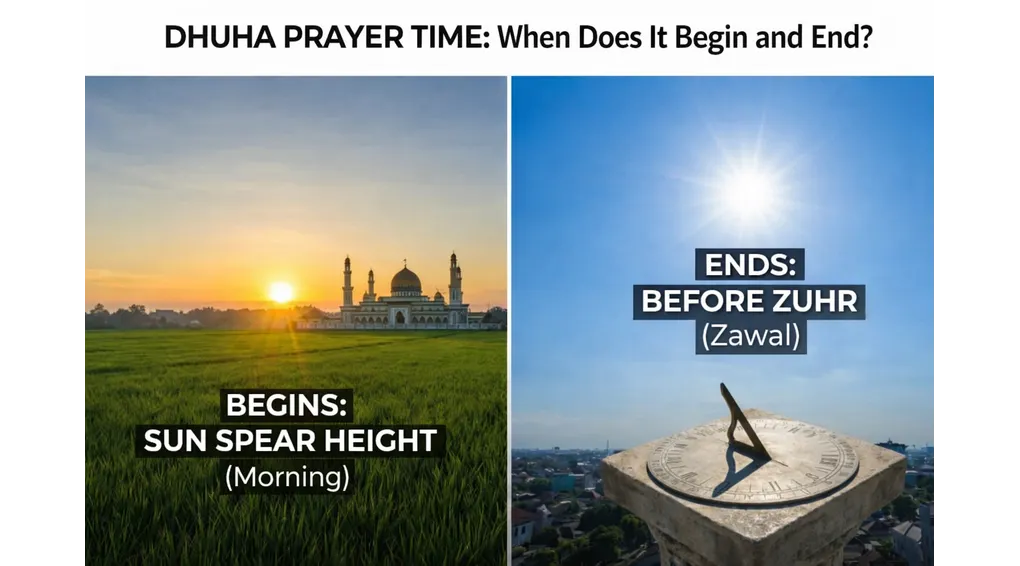
The time for Duha begins when the sun rises to the height of a spear (approximately 15 to 20 minutes after sunrise/ syuruq).
Can you perform the Duha prayer at 6:00 AM? If the sun has just breached the horizon at 6:00 AM, it is best to wait a moment until the sun has visibly risen (around 6:15 or 6:30 AM, depending on your geographic location and the season) to avoid the reprehensible (makruh) time of prayer.
The permissible time for Duha extends until the sun reaches its zenith and begins to decline, which immediately precedes the limits of Dhuhr prayer time.
2. The Optimum Time (Waqt al-Ikhtiyar)
Although it is permissible to perform it early in the morning, there is a most preferred or optimum time (waqt al-ikhtiyar).
والاختيار فعلها عند مضي ربع النهار لحديث صحيح فيه
“The chosen (optimum) time is to perform it when one-quarter of the day has passed, based on an authentic hadith regarding it.”
Therefore, the most virtuous time to perform the Duha prayer is approximately between 9:00 AM and 10:00 AM. The Prophet (PBUH) referred to this specific window as the Salat al-Awwabin (the prayer of those who constantly return to Allah in repentance), marked by the time when the hooves of young camels begin to burn from the heat of the sun.
The Number of Rak’ahs for Duha Prayer
How many rak’ahs (units of prayer) should we perform?
- Minimum: 2 rak’ahs.
- Maximum: The majority of scholars state 8 rak’ahs based on the hadith below, though there is an opinion in Imam al-Nawawi’s Al-Rawdah permitting up to 12 rak’ahs.
According to a narration by Abu Dawud:
صلى سبحة الضحى ثماني ركعات , وسلم من كل ركعتين
Meaning:
“The Prophet ﷺ performed the Duha prayer as eight rak’ahs, concluding with a taslim (salam) after every two rak’ahs.”
The Method of Performing a 4-Rak’ah Duha Prayer
If you intend to perform 4 rak’ahs or more, the correct method is to perform 2 rak’ahs followed by the concluding salam, and then perform another 2 rak’ahs followed by a salam. This is because the Sunnah dictates separating every two rak’ahs with a salam, as established in the aforementioned hadith. Keep in mind the understanding the fundamental components of prayer to ensure each cycle is performed perfectly.
The Intention and Procedure for Duha Prayer
Below is the complete procedure, beginning with the correct intention.
1. The Recitation of the Intention




For those wanting to perform the prayer individually, whether doing 2 rak’ahs or 8 rak’ahs, the initial intention remains the same for each 2-rak’ah set. Since prayers exceeding 2 rak’ahs are performed in sets of two, you must renew your intention during the opening takbir for every new set. Grasping the essence of intention and the various levels of intention in prayer ensures your heart is correctly aligned.
Arabic:
أُصَلِّيْ سُنَّةَ الضُّحَى رَكْعَتَيْنِ لِلهِ تَعَالَى
Transliteration:
Uṣallī sunnata al-ḍuḥā rakʿatayni li-llāhi taʿālā.
“I intend to perform the two-rak’ah voluntary Duha prayer for Allah the Exalted.”
2. Reciting the Short Surahs
I’anah al-Talibin outlines strategies for reciting Quranic Surahs to attain maximum virtue:
- The General Method: Recite Surah Ash-Shams in the first rak’ah and Surah Ad-Duha in the second.
- Imam al-Ramli’s Method: Recite Surah Al-Kafirun in the first rak’ah and Surah Al-Ikhlas in the second (as their rewards are equivalent to 1/4 and 1/3 of the Quran, respectively).
- The Most Superior Method (Combined):
- Rak’ah 1: Recite Surah Ash-Shams followed by Surah Al-Kafirun.
- Rak’ah 2: Recite Surah Ad-Duha followed by Surah Al-Ikhlas.
Duha Prayer Supplication (Du’a) and Its Meaning
After finishing the prayer, it is highly recommended to read the Dhuha prayer. Here is the well-known prayer after the Dhuha prayer which is recorded in the book I’anah at-Talibin (Volume 1 Page 295):
1. The Primary Du’a for Duha Prayer
ويسن ( الضحى ) … ( فائدة ) إذا فرغ من صلاتها دعا بهذا الدعاء
Arabic:
اللَّهُمَّ إِنَّ الضُّحَاءَ ضُحَاؤُكَ , وَالْبَهَاءَ بَهَاؤُكَ , وَالْجَمَالَ جَمَالُكَ , وَالْقُوَّةَ قُوَّتُكَ , وَالْقُدْرَةَ قُدْرَتُكَ , وَالْعِصْمَةَ عِصْمَتُكَ . اللَّهُمَّ إِنْ كَانَ رِزْقِيْ فِي السَّمَاءِ فَأَنْزِلْهُ , وَإِنْ كَانَ فِي الْأَرْضِ فَأَخْرِجْهُ , وَإِنْ كَانَ مُعْسِرًا فَيَسِّرْهُ , وَإِنْ كَانَ حَرَامًا فَطَهِّرْهُ , وَإِنْ كَانَ بَعِيْدًا فَقَرِّبْهُ , بِحَقِّ ضُحَائِكَ وَبَهَائِكَ وَجَمَالِكَ وَقُوَّتِكَ وَقُدْرَتِكَ , آتِنِيْ مَا آتَيْتَ عِبَادَكَ الصَّالِحِيْنَ
Transliteration:
Allāhumma inna al-ḍuḥā’a ḍuḥā’uka, wa al-bahā’a bahā’uka, wa al-jamāla jamāluka, wa al-quwwata quwwatuka, wa al-qudrata qudratuka, wa al-‘iṣmata ‘iṣmatuka.
Allāhumma in kāna rizqī fī al-samā’i fa-anzilhu, wa in kāna fī al-arḍi fa-akhrijhu, wa in kāna mu‘siran fa-yassirhu, wa in kāna ḥarāman fa-ṭahhirhu, wa in kāna ba‘īdan faqarribhu, bi-ḥaqqi ḍuḥā’ika wa bahā’ika wa jamālika wa quwwatika wa qudratika, ātinī mā ātayta ‘ibādaka al-ṣāliḥīn.
Meaning: “O Allah, indeed the morning light is Your morning light, the brilliance is Your brilliance, the beauty is Your beauty, the strength is Your strength, the power is Your power, and the protection is Your protection. O Allah, if my sustenance is in the sky, bring it down; if it is in the earth, bring it forth; if it is difficult, make it easy; if it is unlawful, purify it; if it is far, bring it near. By the right of Your morning light, Your brilliance, Your beauty, Your strength, and Your power, grant me what You have granted Your righteous servants.”
2. Additional Readings After the Dhuha Prayer
Besides the prayer above, the book I’anah at-Talibin also suggests adding the following prayer to strengthen our requests:
Arabic:
اللَّهُمَّ بِكَ أُصَاوِلُ , وَبِكَ أُحَاوِلُ , وَبِكَ أُقَاتِلُ
Latin:
Allāhumma bika uṣāwilu, wa bika uḥāwilu, wa bika uqātilu.
Meaning:“O Allah, by Your help I attack, by Your help I strive, and by Your help I fight.”
Then concluded with istighfar (seeking forgiveness) 40 or 100 times:
Arabic:
رَبِّ اغْفِرْ لِيْ وَارْحَمْنِيْ وَتُبْ عَلَيَّ إِنَّكَ أَنْتَ التَّوَّابُ الرَّحِيْمُ
Latin:
Rabbi ighfir lī warḥamnī wa tub ‘alayya innaka anta al-tawwābu al-raḥīm.
Meaning: “O my Lord, forgive me, have mercy upon me, and accept my repentance; indeed, You are the Acceptor of Repentance, the Most Merciful.”
Summary Table for the Duha Prayer Guide
| Time Description | Approximate Time | Legal Status |
| Sunrise (Syuruq) | 05:30 – 05:45 AM | Prohibited/Makruh (Must Wait) |
| Beginning of Duha | 06:00 – 06:30 AM | Permissible (Sun at spear’s height) |
| Optimum Time (Ikhtiyar) | 09:00 – 10:30 AM | Highly Recommended (1/4 of the day) |
| Ending Limit | 11:30 – 11:45 AM | Permissible (Just before Zawal) |
| Time of Zenith (Zawal) | 11:45 AM onwards | Prohibited (Sun exactly at its peak) |
The Virtues of Duha Prayer and Conclusion
The virtues of the Duha prayer extend far beyond merely facilitating material wealth. It stands as a profound expression of gratitude for the 360 healthy joints in our bodies. By establishing it as a routine, we integrate ourselves into the ranks of the Awwabin—the servants who continuously return to Allah in obedience.
There is no need to overburden yourself. You can initiate this practice with just a simple 2-rak’ah prayer before heading to work or during a brief office break. As your capacity and time allow, gradually increase it to 4 or 8 rak’ahs.
We hope this Duha prayer guide assists you in understanding the correct, authentic method of performing this beautiful sunnah. Let us transform the Duha prayer into a spiritual necessity rather than a mere obligatory burden.
FAQ (Frequently Asked Questions)
1. From what time to what time can the Duha prayer be performed?
The Duha prayer begins when the sun has risen to the height of a spear (roughly 15-20 minutes after actual sunrise) and concludes moments before the noon time (Zawal), which is about 15 minutes before the Dhuhr adhan.
2. Can I perform a 4-rak’ah Duha prayer continuously without a salam in between?
Although some minor opinions permit it, the most superior method—and the one strictly aligned with the Sunnah—is to perform a salam after every two rak’ahs (matsna-matsna), as explicitly detailed in the narration by Abu Dawud.
3. What should I recite during the Duha prayer if I have not memorized Surah Ad-Duha?
That is completely fine. You are permitted to recite any short Surah you have memorized, such as Surah Al-Kafirun or Surah Al-Ikhlas. In fact, according to several eminent Shafi’i scholars, reciting Al-Kafirun and Al-Ikhlas holds its own distinct and massive reward.
4. Is it permissible to perform the Duha prayer at 11:00 AM?
Yes, it is entirely permissible, provided that the prohibited time for prayer (when the sun is precisely at its zenith, known as Zawal) has not yet commenced. In most regions, 11:00 AM still safely falls within the permissible timeframe.
5. Is the Ishraq prayer the same as the Duha prayer?
According to authoritative texts like I’anah al-Talibin: “The strongest opinion is that the two rak’ahs of Ishraq are a part of the Duha prayer.” Therefore, praying Ishraq fulfills the sunnah of early Duha.
Reference
Shaṭṭā, ʿUthmān ibn Muḥammad, Abū Bakr (al-Mashhūr bi-al-Bakrī) ad-Dimyāṭī. Iʿānat aṭ-Ṭālibīn ʿalā Ḥall Alfāẓ Fatḥ al-Muʿīn (Commentary on Fatḥ al-Muʿīn with an explanation of Qurrat al-ʿAyn concerning the essentials of religion). 1st ed. Beirut: Dār al-Fikr, 1997.


