

Feeling anxious is entirely natural when we discover that a family member is ill. Our hearts are also frequently unsettled when we bid farewell to a child or relative traveling far away from home for work or studies. Physical distance and the uncertainty of our loved ones’ health conditions often cause our minds to wander into worry.
As Muslims, we are taught not to drown in anxiety. There is a “heavenly route” we can take to seek divine care and healing for them. The Prophet ﷺ has bequeathed to us magnificent supplications that function as spiritual fortresses and ultimate cures (shifa). This is why reciting Ayatul Kursi for protection is highly recommended during times of distress.
In the renowned book Al-Adhkar, Imam al-Nawawi summarizes several authentic narrations regarding what to recite when facing severe difficulties, including when our family is sick or far away. We will explore two primary spiritual weapons: Ayatul Kursi and a specific dhikr (remembrance) practiced by the Prophet’s companions for their children. Let us learn these practices so our hearts may find tranquility and our families remain under Allah’s divine protection.
1. The Virtue of Ayatul Kursi for Protection as a Spiritual Fortress
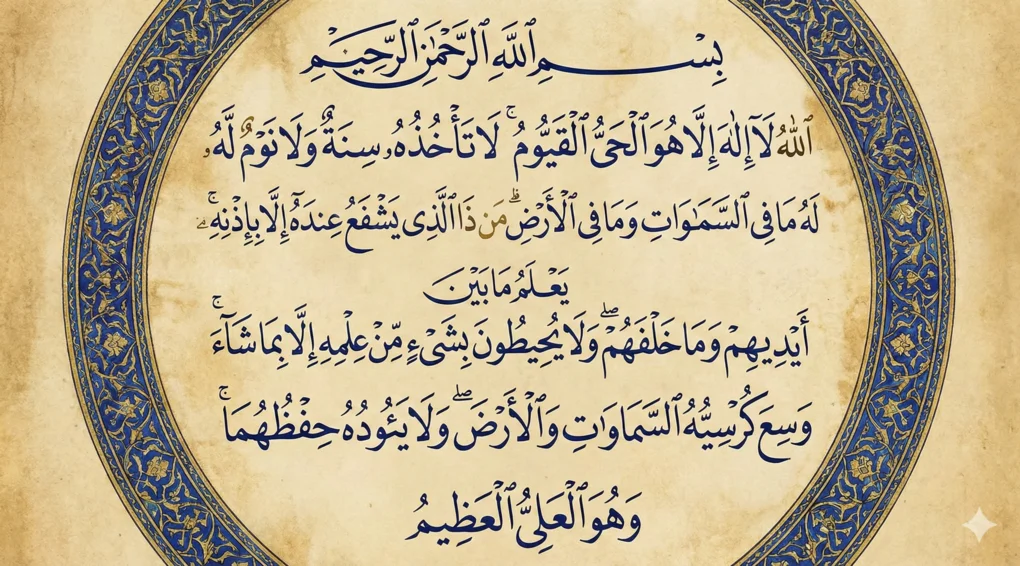
Who is not familiar with Ayatul Kursi? It is the most magnificent verse in the Holy Quran, serving as a primary fortress of protection for a Muslim against all forms of evil. Many of us actively seek the complete Ayatul Kursi to recite daily, whether as a practice after obligatory prayers or right before sleeping.
Why is Ayatul Kursi So Extraordinary?
The virtue of reciting Ayatul Kursi is immense because this verse contains the greatest names of Allah: Al-Hayy (The Ever-Living), Al-Qayyum (The Sustainer of existence), Al-‘Aliy (The Most High), and Al-‘Azhim (The Most Great). These are structurally profound, just like the names of Allah mentioned in the virtues of the Hauqalah phrase. Furthermore, the verse unequivocally explains the absolute attributes of Allah’s majesty, power, and flawless management over the entire universe.
Many spiritual scholars (‘arifin billah) state that the core power of Ayatul Kursi lies in these two magnificent names (Al-Hayy and Al-Qayyum). You can delve deeper into the immense power of these names in our article regarding the virtues of the dhikr Ya Hayyu Ya Qayyum.
A narration in the book of Ibn al-Sunni from the companion Qatadah (may Allah be pleased with him), recorded as Hadith no. 351 in the reference Al-Adhkar, mentions a powerful combination for overcoming extreme difficulties:
٣٥١ – وروينا في كتاب ابن السني, عن قتادة رضي الله عنه قال: قال رسول الله صلى الله عليه وسلم: ” من قرأ آية الكرسي وخواتيم سورة البقرة عند الكرب, أغاثه الله عز وجل
“Whoever recites Ayatul Kursi and the concluding verses of Surah Al-Baqarah during times of severe distress (karb), Allah Almighty will grant him relief.”
This demonstrates that the benefit of reciting Ayatul Kursi goes far beyond acquiring general rewards; it acts as a direct medium (wasilah) to invite Allah’s immediate help when we or our families are cornered by immense problems, including severe illnesses.
Complete Ayatul Kursi (Arabic, Transliteration, and Meaning)
For those who need the Arabic text and international transliteration to practice, here it is:
Arabic Text:
اللَّهُ لَا إِلَهَ إِلَّا هُوَ الْحَيُّ الْقَيُّومُ ۚ لَا تَأْخُذُهُ سِنَةٌ وَلَا نَوْمٌ ۚ لَهُ مَا فِي السَّمَاوَاتِ وَمَا فِي الْأَرْضِ ۗ مَنْ ذَا الَّذِي يَشْفَعُ عِنْدَهُ إِلَّا بِإِذْنِهِ ۚ يَعْلَمُ مَا بَيْنَ أَيْدِيهِمْ وَمَا خَلْفَهُمْ ۖ وَلَا يُحِيطُونَ بِشَيْءٍ مِنْ عِلْمِهِ إِلَّا بِمَا شَاءَ ۚ وَسِعَ كُرْسِيُّهُ السَّمَاوَاتِ وَالْأَرْضَ ۖ وَلَا يَئُودُهُ حِفْظُهُمَا ۚ وَهُوَ الْعَلِيُّ الْعَظِيمُ
Transliteration:
Allahu la ilaha illa Huwa, al-Hayyu al-Qayyum. La ta’khudhuhu sinatun wa la nawm. Lahu ma fi al-samawati wa ma fi al-ard. Man dha alladhi yashfa’u ‘indahu illa bi idhnihi. Ya’lamu ma bayna aydihim wa ma khalfahum. Wa la yuhituna bi shay’in min ‘ilmihi illa bima sha’a. Wasi’a kursiyyuhu al-samawati wa al-ard, wa la ya’uduhu hifzhuhuma, wa Huwa al-‘Aliyyu al-‘Azhim.
English Translation:
“Allah – there is no deity except Him, the Ever-Living, the Sustainer of [all] existence. Neither drowsiness overtakes Him nor sleep. To Him belongs whatever is in the heavens and whatever is on the earth. Who is it that can intercede with Him except by His permission? He knows what is [presently] before them and what will be after them, and they encompass not a thing of His knowledge except for what He wills. His Kursi extends over the heavens and the earth, and their preservation tires Him not. And He is the Most High, the Most Great.”
2. Independent Ruqyah Practice for a Sick Family Member
When a family member falls ill, alongside professional medical efforts, we are highly encouraged to perform ruqyah (spiritual healing) in accordance with the prophetic sunnah. You do not need to panic and search for an ustadh if the condition is urgent; you can perform an independent ruqyah for the sick person right at home.
There is a beautiful dhikr taught by the Prophet ﷺ to his cousin, Ali bin Abi Talib (may Allah be pleased with him). Interestingly, this specific dhikr was later routinely practiced by his son, Abdullah bin Ja’far, specifically to perform ruqyah on sick individuals.
The Prophet’s Dhikr for Comfort and Healing




In the narration documented by Imam al-Nawawi (Hadith no. 348), the following supplication is mentioned:
لاَ إِلَهَ إِلاَّ اللهُ الْكَرِيْمُ الْعَظِيْمُ, سُبْحَانَهُ, تَبَارَكَ اللهُ رَبُّ الْعَرْشِ الْعَظِيْمُ, الْحَمْدُ لِلهِ رَبِّ الْعَالَمِيْنَ
Transliteration: La ilaha illallahu al-Karimu al-‘Azhim, subhanahu, tabarakallahu Rabbul ‘arshi al-‘azhim, alhamdulillahi Rabbil ‘alamin.
Meaning: “There is no deity but Allah, the Most Generous, the Most Great. Glory be to Him. Blessed is Allah, Lord of the Great Throne. All praise is due to Allah, Lord of the worlds.”
How to Perform Ruqyah Using This Dhikr

How exactly do we perform ruqyah on a sick person using the recitation above? Imam al-Nawawi explains in his annotations of the narration that Abdullah bin Ja’far used to dictate (talqin) this prayer and gently blow (yanfuthu) it onto individuals suffering from fever (maw’uk).
Therefore, the practical steps for this ruqyah are:
- Sit closely to the sick family member (e.g., someone with a high fever).
- Recite the aforementioned dhikr with deep concentration (khushu’).
- Blow very gently (with a slight trace of breath/saliva) onto the affected area or over their entire body.
- Maintain absolute conviction (yaqin) that healing comes solely from Allah through the medium of His magnificent names contained within the dhikr.
This is a simple yet profoundly effective ruqyah method originating directly from the practices of the righteous predecessors (salaf).
3. Supplications for Traveling Family Members

Equip those who are about to travel or migrate not only with material wealth but also with the dhikr of Tawhid (Islamic monotheism), so that Allah may continuously guard them in foreign lands.
Sending off a daughter or family member to move far away (mughtaribah) frequently triggers severe anxiety. Will they be safe there? What if they face insurmountable problems entirely alone?
Fascinatingly, the exact same dhikr (mentioned in section 2 above) was also utilized by Abdullah bin Ja’far as a spiritual provision for his daughters when they were getting married and moving far away from the family. He meticulously taught them these magnificent phrases of Tawhid so his daughters would have a spiritual anchor when facing hardships in a foreign land. By routinely reciting this dhikr:
- La ilaha illallahu al-Karimu al-‘Azhim (Acknowledging Allah’s supreme greatness).
- Rabbul ‘arshi al-‘azhim (The Lord, Owner of the Great Throne).
The heart of the traveler will remain tranquil, fully aware that wherever they are, they remain under the watchful eye of the Most Great Lord, whose power infinitely exceeds any problem they might encounter abroad.
In addition to this protective dhikr, equip your traveling child with the virtues of the comprehensive prayer so they constantly ask for goodness in this world and the Hereafter, wherever they may reside.
Anxiety over sick or traveling family members is a specific form of distress (karb). Islam provides myriad solutions for various types of life’s hardships. For a complete guide on other powerful prayers, please read our main article: Collection of prayers to remove sadness and life’s difficulties.
Summary Table of Family Protection Practices
Below is a summary of when and how to utilize the practices discussed above, based on the reference Al-Adhkar:
| Practice / Recitation | Timing / Condition of Use | Method of Practice | Reference |
| Ayatul Kursi + End of Al-Baqarah | When facing severe distress, crises, or family emergencies. | Recited as a daily litany (wird) or during urgent situations. | Hadith of Qatadah (No. 351) |
| Dhikr: La ilaha illallahu al-Karimu al-‘Azhim… | 1. To perform ruqyah on sick family (especially for fevers). 2. As a spiritual provision for family migrating far away. | 1. Recite and blow gently onto the sick person. 2. Taught to be recited routinely by the traveler. | Hadith of Abdullah bin Ja’far (No. 348) |
Frequently Asked Questions (FAQ)
Is reading the English translation of Ayatul Kursi enough?
Reading the translation is excellent for comprehending its profound meaning. However, for the specific purposes of worship and ruqyah, it is highly recommended to recite the original Arabic Ayatul Kursi. This is because the Arabic text is Kalamullah (the literal speech of Allah), which possesses its own unique spiritual power (ruhiyyah). If you are not yet fluent, you may use the Latin transliteration as an aid while continuing to learn.
Can I perform independent ruqyah if the illness is severe?
Yes, performing ruqyah on severely ill individuals is still highly recommended as a crucial companion to modern medical treatment. The Prophet ﷺ and his companions seamlessly combined earthly medical efforts (berobat) with heavenly efforts (supplication/ruqyah). Recite the dhikr and Ayatul Kursi near them with absolute conviction. To understand deeper what should be done, read our article on the recommendations and etiquette of a sick person.
Where exactly is Ayatul Kursi located in the Quran?
Many people ask which verse number Ayatul Kursi is in Surah Al-Baqarah or which Juz it belongs to. The answer is that it is Verse 255 of Surah Al-Baqarah, located at the very beginning of Juz 3.
Is it permissible to recite Ayatul Kursi while lying down?
Yes, it is permissible. In fact, there is a strong scriptural recommendation to always engage in dhikr whether standing, sitting, or lying down. However, if you are in a state of major ritual impurity (janabah), you must refrain from reciting Ayatul Kursi or any other verses of the Quran until you have performed the obligatory bath.
In what chapter and verse is Ayat al-Kursi found?
The Verse of the Throne is located in Surah Al-Baqarah verse 255 and is included in juz 3 of the Qur’an.
Closing
Family is our most precious treasure. When human efforts feel severely limited in protecting them, that is precisely when the role of faith takes absolute control. The profound benefits of utilizing Ayatul Kursi for protection and the specific dhikr taught by the Prophet ﷺ and his noble companions are a direct manifestation of Allah’s mercy, ensuring we never fall into despair.
Practice these recitations with a pure and sincere intention. May Allah continually bestow abundant health upon our sick family members and grant impenetrable protection to those who are traveling far away from home. Ameen.
Reference
Al-Nawawī, Yaḥyā ibn Sharaf. Al-Adhkār. Edited by ʿAbd al-Qādir al-Arnaʾūṭ. New revised edition. Beirut: Dār al-Fikr, 1994.


