

Have you ever woken up during the daytime in Ramadan with a mucus-filled throat due to a cold? Or perhaps, after rinsing your mouth for ablution, you doubted whether the leftover moisture could be swallowed?
Issues surrounding the oral cavity and throat frequently cause confusion when we try to understand the true meaning of fasting. On one hand, introducing substances into the body cavity breaks the fast. On the other hand, the human body naturally produces saliva, making it nearly impossible to avoid. So, what is the exact ruling on swallowing saliva while fasting?
To resolve these doubts, we refer to a primary reference in Shafi’i jurisprudence (fiqh): Asna al-Matalib Syarh Rawd at-Talib by the illustrious Shaykh Zakariyya al-Ansari. In this classical text (Vol. 1, pp. 414-418), he meticulously dissects the legal distinctions between saliva, phlegm, and vomit. Let us explore these rulings step-by-step to ensure our fast is valid and our minds are at ease.
1. The Ruling on Swallowing Saliva (Spit)
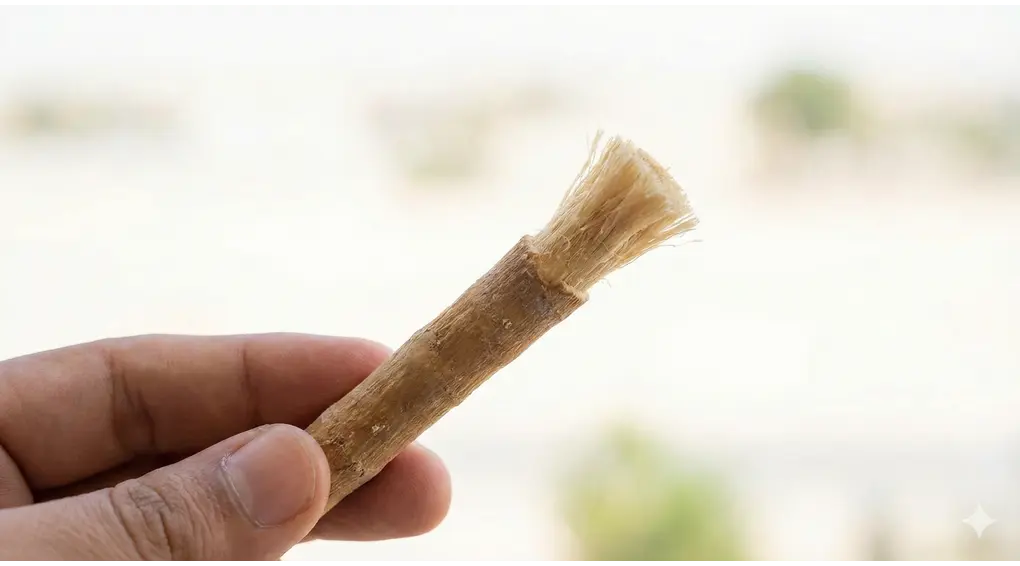
The foundational ruling on swallowing saliva while fasting is that it is PERMISSIBLE and does not invalidate the fast. This leniency is based on the inherent hardship of guarding against it (‘usr at-taharruz). Imagine if we were required to spit every time saliva accumulated; it would cause severe inconvenience and disrupt our daily lives.
However, Shaykh Zakariyya emphasizes that this permissibility comes with specific conditions.
a. Conditions for Permissible Saliva
According to Asna al-Matalib, swallowing saliva while fasting does not break the fast if it meets three criteria:
- Pure (Sarf): The saliva must be unadulterated, not mixed with any other substance.
- Ritually Clean (Tahir): The saliva must not be contaminated by impurities (najis).
- Has Not Exited the Mouth: The saliva must remain within the inner boundaries of the lips.
The text states:
فرع: لو (ابتلع ريقه الصرف) (لم يفطر) لعسر التحرز عنه
Meaning: “Note: If one swallows his pure saliva, he does not break his fast due to the difficulty of guarding against it.”
b. When Does Swallowing Saliva Break the Fast?
You must exercise caution, as saliva can invalidate your fast if its state changes:
- Mixed with Another Substance: For instance, if your gums bleed and the blood mixes with your saliva, swallowing it breaks the fast. Even if the saliva eventually looks clear again, you must rinse your mouth to remove the invisible traces of the foreign substance before swallowing.
- Has Exited the Mouth: If your saliva drips outside your lips, or if you intentionally wet a sewing thread with your mouth, pull it out, and then swallow the moisture remaining on your lips, your fast is broken. The saliva is considered “separated” from its source. However, if the saliva merely moves around on the surface of your tongue inside the oral cavity, it is perfectly fine to swallow.
2. The Problem of Phlegm (Nukhama): Between the Throat and Mouth
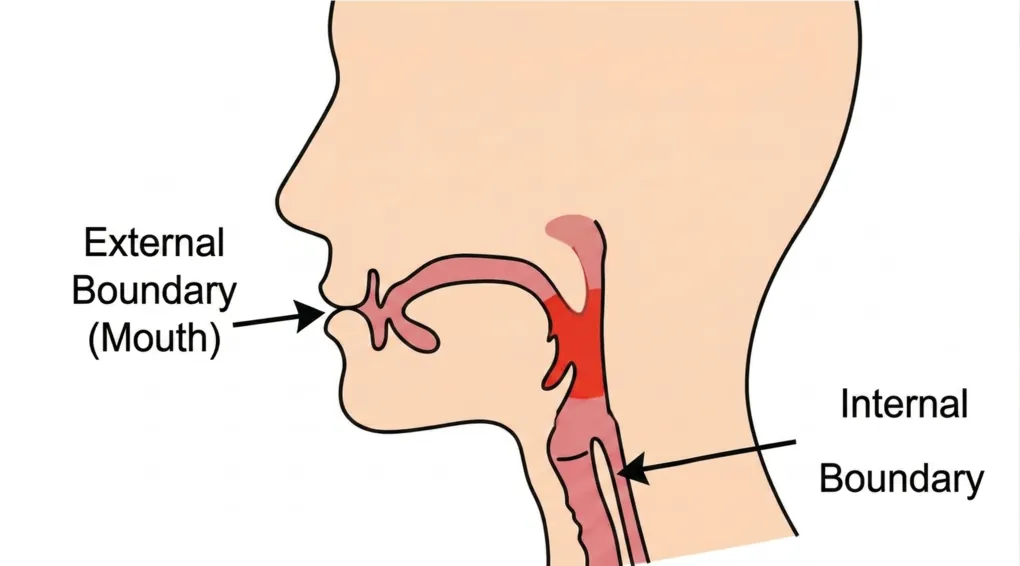
Unlike saliva, phlegm (nukhama) is a thick substance that comes from the chest or head cavity. The ruling on it is stricter than that on saliva.
To understand the law of phlegm, we must know the boundaries of the outer and inner throat.
(وحدد الظاهر بمخرج الحاء المهملة)
The “Outside” boundary is the articulation point (makhraj) of the letter Ha’ (ح).
a. If the Phlegm Remains Inside



As long as the phlegm remains in the inner throat (below the makhraj of Ha’) and has not ascended into the oral cavity, swallowing it back down does NOT break the fast.
b. If the Phlegm Reaches the Mouth
If the phlegm ascends to the exterior boundary (the oral cavity) and you possess the ability to expel it, you are OBLIGATED to spit it out. If it reaches your mouth and you intentionally swallow it back down despite being able to expel it, your fast is INVALIDATED.
قوله: (يفطر باستخراج القيء إليه وابتلاع النخامة منه سواء استدعاها) أي استقلعها إلى الفم والأنف (أم لا)
Meaning: “Fasting is invalidated by vomiting and swallowing phlegm from outside the mouth, whether intentionally induced or not.”
c. If You Are Unable to Expel It
What if the phlegm descends suddenly into the throat and is swallowed uncontrollably? Shaykh Zakariyya clarifies:
قوله: (فإن جرت بنفسها) من الفم أو الأنف ونزلت إلى جوفه (عاجزا عن المج) لها (فلا) يفطر للعذر
“If it flows by itself from the mouth or nose and descends into his cavity while he is unable to spit it out, he does not break his fast due to the excuse.”
The key principle is capability. If you can spit it out but swallow it = Invalid. If it is swallowed accidentally or you have no time to expel it = Valid.
3. The Ruling on Vomiting: Intentional vs. Unintentional

The ruling on vomiting is categorized into two primary conditions: whether it was self-induced or involuntary.
a. Intentional Vomiting (Istiqa’a)
Inducing vomit—such as inserting a finger into the throat due to nausea—strictly invalidates the fast. Even if you are absolutely certain that no vomit was swallowed back into the stomach, the mere act of self-inducing vomit breaks the fast.
قوله: (و) يفطر (باستدعاء القيء) وإن لم يعد شيء منه إلى جوفه مفطر لعينه
Meaning: “And fasting is invalidated by inducing vomiting, even if nothing returns to the throat, because vomiting itself invalidates it.”
b. Unintentional Vomiting (Ghalabah/Dhar’a)
If you suddenly feel extremely nauseous and then vomit unintentionally, your fast is NOT invalidated.
قوله: (لا إن ذرعه) القيء… فلا يفطر به
Requirements:
- Do not swallow back any vomit that remains in your mouth.
- Rinse your mouth immediately to clean it before swallowing saliva again.
This explanation also relates to the accidental entry of other objects into the body. Read the details of the medical rules in the article Do Injections, IVs, and Eye Drops Invalidate Fasting?
4. Food Residue and Water from Rinsing
These are minor issues that often trigger obsessive doubts (was-was). Here is the clarification based on Asna al-Matalib:
a. Food Residue Between the Teeth
If a tiny fragment of your pre-dawn meal (suhoor) is stuck between your teeth, carried by the flow of saliva, and swallowed unintentionally, does it break the fast?
- If the residue is microscopic, difficult to distinguish, and impossible to separate from the saliva, it is Excused (Valid).
- If the residue is substantial enough to be felt, can be separated, and can be spat out, but you consciously allow yourself to swallow it, your fast is Invalidated.
قوله: (ولا) يفطره… (جري الريق ببقايا طعام بين أسنانه لم يمكن تمييزه حسا)
b. Leftover Water from Rinsing (Wudhu)
After understanding the proper procedures of wudhu, you may notice a wet or cool sensation (atsar) remaining in your mouth. If this leftover moisture is swallowed naturally along with your saliva, it does NOT break the fast.
قوله: (ولا) جريه (بأثر ماء المضمضة) وإن أمكنه مجه لعسر التحرز عنه
However, this exception only applies to normal rinsing. If you rinse your mouth excessively (mubalaghah) during the daytime of Ramadan and water slips down your throat, your fast is broken.
Summary Table of Mouth & Throat Rulings
For quick reference, here is a summary of the Shafi’i rulings discussed:
| Action / Situation | Fasting Status | Conditions / Notes |
| Swallowing Saliva | Valid | Must be pure, clean, and has not exited the lips. |
| Swallowing Phlegm | Invalid | If it has reached the mouth cavity and can be expelled. |
| Unintentional Phlegm | Valid | If one is genuinely unable to hold or expel it. |
| Intentional Vomiting | Invalid | Even if nothing is swallowed back down. |
| Unintentional Vomiting | Valid | Obligatory to rinse the mouth immediately afterward. |
| Food Residue in Teeth | Valid | Only if it is microscopic and inseparable from saliva. |
| Leftover Rinsing Water | Valid | Provided the rinsing was not done excessively. |
FAQ: Common Questions on Swallowing Saliva While Fasting
Is it permissible to swallow saliva that has pooled in large quantities in the mouth?
Yes, it is permissible. Shaykh Zakariyya explicitly mentions “even after it is collected.” As long as the saliva remains pure, clean, and inside the oral cavity, accumulating and swallowing it does not harm the fast.
What should I do if my gums bleed continuously?
You are obligated to try your best to spit out the blood. If blood is swallowed along with your saliva, the fast is broken. However, if the bleeding is continuous and extraordinarily difficult to avoid (creating masyaqqah), some later scholars offer a dispensation (ma’fu). Nevertheless, the strict view in Asna al-Matalib emphasizes that the impurity of the blood invalidates the fast if swallowed.
Does brushing my teeth break my fast?
No, brushing your teeth does not break the fast, provided no water or toothpaste is swallowed. However, according to the official Shafi’i school, it is considered disliked (makruh) to brush teeth after midday (zawal), although some contemporary scholars permit it. You must simply exercise extreme caution not to swallow any foreign substances.
Conclusion
Understanding these intricate details regarding the mouth and throat liberates a Muslim from excessive anxiety while ensuring their concept of fasting aligns perfectly with the Sharia. By knowing the precise anatomical boundaries and conditions, we avoid underestimating minor actions that could compromise our worship.
To broaden your understanding of this topic, we highly recommend reading our comprehensive guide on the Things That Invalidate the Fast. Furthermore, fasting requires guarding not just the physical cavities, but also our desires; you can learn more about these boundaries in our article discussing the ruling on kissing a spouse while fasting.
May Allah Subhanahu Wa Ta’ala accept our fasting, and may the Prophet Muhammad ﷺ grant us his intercession. Wallahu a’lam bish-shawab (And Allah knows best).
Reference
al-Anṣārī, Zakariyā. Asnā al-Maṭālib fī Sharḥ Rawḍ al-Ṭālib. With commentary by Ahmad al-Ramli. Edited by Muhammad az-Zuhrī al-Ghamrawi. Cairo: al-Matba’ah al-Maymaniya, 1313 AH. Reprinted by Dar al-Kitab al-Islami.


