

In the course of life, we often feel tired, anxious, and powerless in the face of various challenges. In moments like these, a Muslim is encouraged to return to Allah SWT and strengthen their faith in Allah through remembrance (dhikr). One form of dhikr that possesses extraordinary power is the kalimat hauqolah.
This article will discuss in detail the recitation of Hauqolah, its meaning, as well as the various virtues and miracles contained within it. We will also explore how to practice this dhikr so that we can experience its profound benefits in our daily lives.
What is the Hauqolah Phrase?
You might be wondering, what exactly is hauqolah? Simply put, hauqolah is the term for a magnificent phrase of remembrance. The word originates from a linguistic process in Arabic called An-Naht, where a long phrase is condensed into a single verb. The Al-Ma’ani dictionary explains:
حَوْقَلَ فلانٌ : قال : لا حول ولا قوة إلا بالله
Meaning: “Hawqala Fulanun (Someone has uttered hauqalah)” means “he has said: La haula wa la quwwata illa billah”.
Therefore, hauqolah represents a sincere confession from a servant that there is no power to avoid evil and no strength to achieve goodness, except by the permission and help of Allah SWT. Due to its profound content, it is often referred to as the “phrase of the plants of Paradise” because it embodies total submission and a plea for strength from the Creator. It is a key to unlocking the awareness that we, as humans, are inherently weak and constantly in need of Allah.
La Haula Wala Quwwata Illa Billah: Arabic Script and Meaning
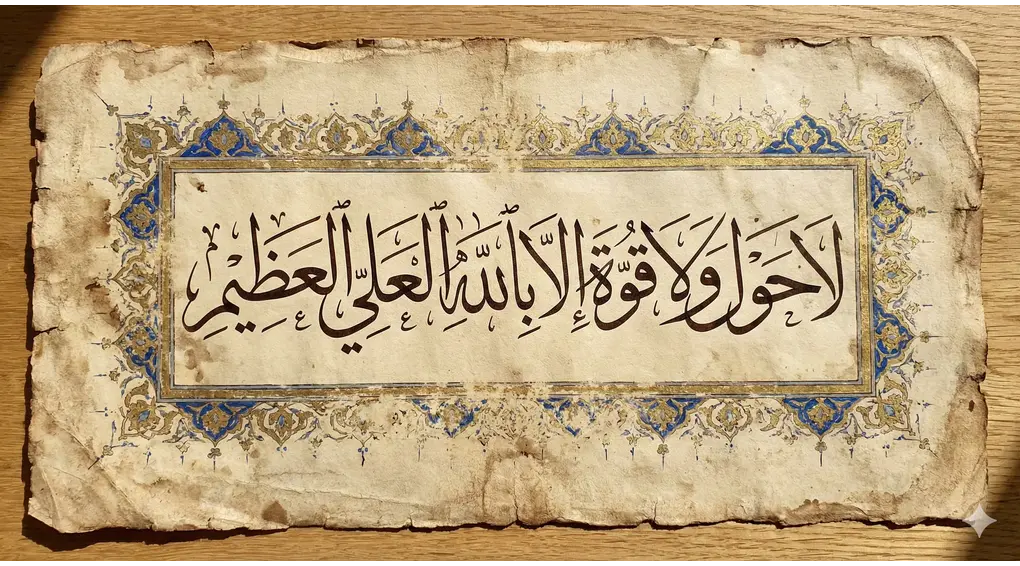
To practice it correctly, it is essential to know the proper Arabic text and its translation. Many seek to understand the exact meaning of la haula wala quwwata illa billah. Here is the explanation along with the most common Arabic spelling:
لَا حَوْلَ وَلَا قُوَّةَ إِلَّا بِاللهِ
Transliteration: “La haula wala quwwata illa billah”
Meaning: “There is no power and no strength except by the help of Allah.”
There is also a more complete and frequently recited version that adds two of Allah’s Beautiful Names (Asmaul Husna) at the end. Regarding this, the question often arises: what are the beautiful names of Allah mentioned in this extended phrase? The answer is Al-‘Aliy (The Most High) and Al-‘Azhim (The Most Great).
لَا حَوْلَ وَلَا قُوَّةَ إِلَّا بِاللهِ الْعَلِيِّ الْعَظِيمِ
Transliteration: “La haula wala quwwata illa billahil ‘aliyyil ‘azhim”
Meaning: “There is no power and no strength except with the help of Allah, the Most High and Most Great.”
The Virtues of the Kalimat Hauqolah

The virtues of the kalimat hauqolah are numerous, benefiting both our worldly affairs and our standing in the hereafter. One of its primary virtues is that it serves as the highest form of a servant’s sincerity. By uttering it, we effectively release all ego and arrogance, acknowledging that all human achievements are purely the result of His divine assistance.
It is important to note that a major cause of modern stress is the illusion that we must handle everything relying solely on our own capabilities. In fact, the Prophet Muhammad ﷺ taught a special prayer to help us surrender our burdens to Allah. You can read more about it here: A Prayer Not to Rely Solely on Logic.
In the classical book Kashifat as-Saja, Sheikh Nawawi al-Bantani explains that one of the virtues of the kalimat hauqolah is that it acts as a “plant of Paradise.” This is based on a narration from the miraculous event of Mi’raj, where Prophet Ibrahim (AS) advised Prophet Muhammad ﷺ:
“Command your people to increase the plants of Paradise, for its soil is fertile and vast.” The Messenger of Allah ﷺ asked: “What are the plants of Paradise?” Prophet Ibrahim (AS) answered: “La haula wa la quwwata illa billahil ‘aliyyil ‘azhim.”
This profound story demonstrates how valuable every utterance of this dhikr is in the sight of Allah, acting as an eternal investment for the afterlife.
The Miracles of Remembering La Haula Wala Quwwata Illa Billah

Beyond spiritual rewards, this dhikr also unlocks various miracles and practical benefits for worldly life. The secret behind the phrase lā ḥawla wa lā quwwata illā billāhil ‘alīyyil ‘aẓīm is that when a servant completely admits their absolute weakness, Allah bestows His limitless power to aid them.
Some of the virtues narrated by classical scholars include opening the doors of sustenance and providing miraculous solutions to hardships. The book Kashifat as-Saja mentions the following narration regarding its specific benefits:
“ومن خواصها ما في فوائد الشرجي قال ابن أبي الدنيا بسنده إلى النبي صلى الله عليه وسلّم أنه قال: من قال كل يوم لا حول ولا قوة إلا بالله العلي العظيم مائة مرة لم يصبه فقر أبداً. وروي في الخبر أيضاً: إذا نزل بالإنسان مهم وتلا لا حول ولا قوة إلا بالله العلي العظيم ثلاثمائة مرة فرج الله عنه”
From the excerpt above, we can extract two extraordinary guarantees:
- Protection from Poverty: Whoever recites it 100 times every day will never be afflicted by poverty.
- Providing a Way Out: If facing a major problem or an overwhelming matter, reciting it 300 times serves as a powerful means to invite Allah’s immediate relief.
How to Practice the Hauqolah Dhikr
Seeing the immense benefits of this dhikr, we certainly want to know how to practice it properly. Here are some practical guidelines:
- Say It When Feeling Weak: Make this phrase your first reflex when facing difficulties, feeling anxious, suppressing anger, or when about to start a daunting task.
- Practice Regularly: To obtain its full benefits, consistency is key. You can recite it after completing your obligatory prayers or during your free time.
- Dhikr 100 Times Daily: One of the recommended practices is to recite it 100 times every day, ideally in the morning or evening, to protect yourself from financial hardship and open the doors of sustenance.
- When Facing Crises: When life’s problems feel insurmountable, seclude yourself for a moment, perform ablution, and engage in this dhikr 300 times with full devotion, begging Allah for a way out.
- Internalize the Meaning: The most crucial element is not just the quantity, but the sincerity behind the words. Absorb its meaning into your heart, fully realizing that Allah is the sole source of true strength.
Conclusion
Ultimately, the kalimat hauqolah is much more than just a string of Arabic words. It is a profound declaration of faith, a pillar of surrender, and a believer’s ultimate weapon against the harshness of life.
By understanding that invoking the beautiful names of Allah within this phrase is the key to unlocking His divine help, we will find deep peace of mind. Let us keep our tongues moist with this great remembrance, praying that Allah SWT always grants us strength and eases all our affairs.
References:
- Al‑Maany Dictionary, entry “حوقلة,” Almaany.com, accessed July 3, 2025.
- Muhammad bin ʿUmar Nawawī al‑Jāwī al‑Bantānī, Kāshifat as‑Sajā fī Sharḥ Safīnat al‑Najā, digital version (Maktabah al‑Shāmilah ad‑Dzahabiyyah).


