
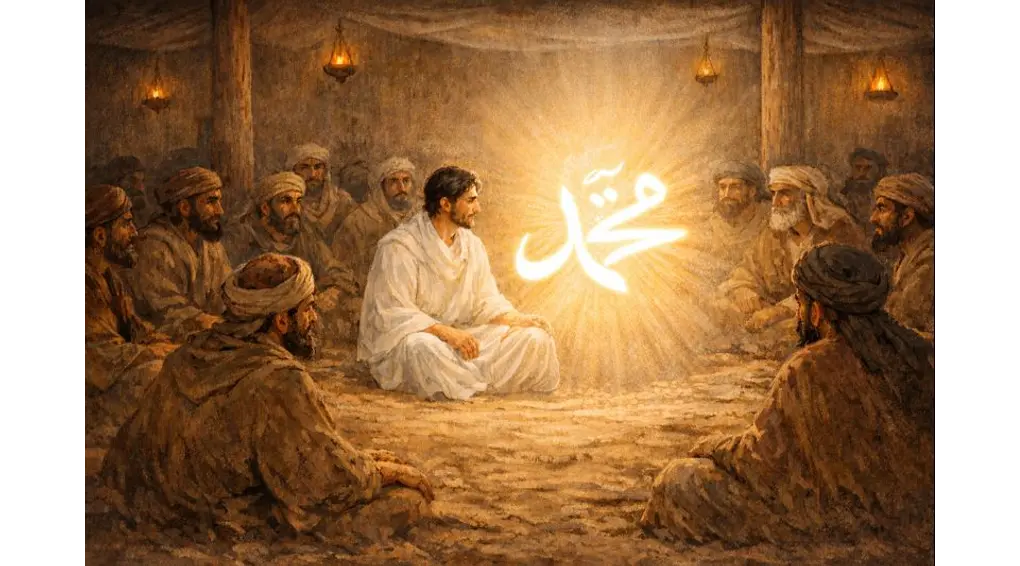
Have you ever imagined the serene atmosphere of sitting in a gathering of knowledge with the Prophet Muhammad ﷺ? One day, that tranquility was suddenly interrupted by a profoundly mysterious event, known today as the Hadith of Jibril. This was not merely an ordinary visit; it was a monumental moment when the heavens descended to earth to teach the fundamental tenets of the Islamic faith directly.
Narrated by the prominent companion Umar bin Khattab (may Allah be pleased with him), the story recounts how an unfamiliar man suddenly appeared among them. Yet, this was no ordinary guest. By the end of the gathering, the Prophet ﷺ revealed that this mysterious visitor was none other than the Angel Gabriel (Jibril).
A major question naturally arises: Why did the Angel Gabriel have to disguise himself as a human? Why not appear in his majestic original form? Let us explore the theological and pedagogical answers by referencing the classical Shafi’i text, Al-Fath Al-Mubin bi Syarhi Al-Arba’in An-Nawawiyah, authored by the esteemed scholar Shaykh Ibn Hajar Al-Haytami.
The Arrival of the Mysterious Guest
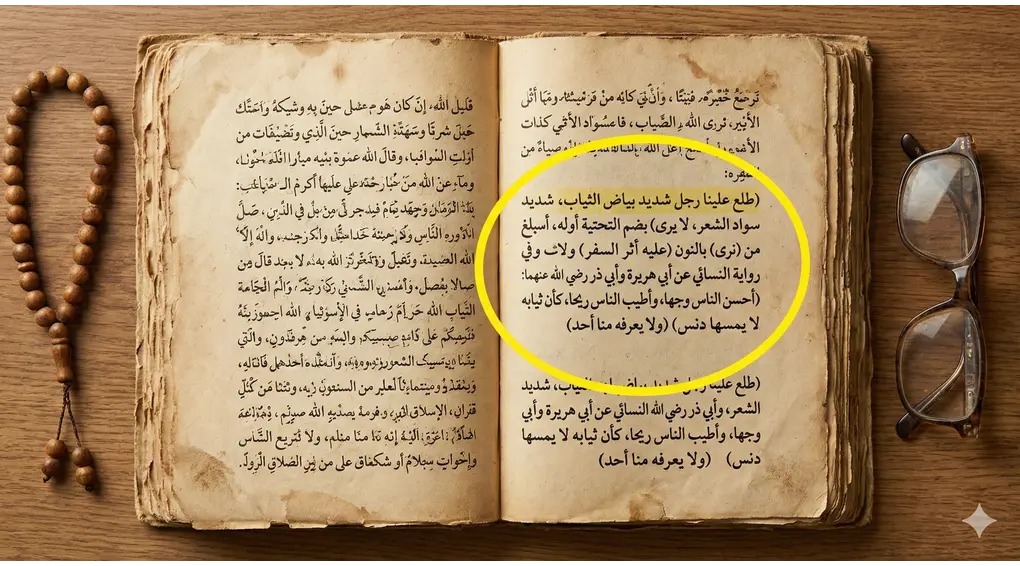
Umar bin Khattab described the arrival of this figure in vivid detail. While the companions were sitting casually with the Prophet ﷺ, a man with a highly contrasting appearance suddenly emerged.
In the text cited in Al-Fath Al-Mubin (p. 139), the narration states:
إذ طلع علينا رجل شديد بياض الثياب، شديد سواد الشعر، لا يري عليه أثر السفر، ولا يعرفه منا أحد
(Suddenly, there appeared before us a man with exceedingly white clothes and exceedingly black hair; no signs of travel were visible upon him, and none of us recognized him).
A Baffling Appearance for the Companions
The physical appearance of this guest caused immense bewilderment among the companions. On one hand, he was a total stranger (“none of us recognized him”). Logically, a stranger in Medina must have traveled from afar.
However, his appearance was impeccably neat and clean (“exceedingly white clothes, exceedingly black hair, no signs of travel”). In that era, traversing the desert invariably left travelers covered in dust with disheveled hair.
Shaykh Ibn Hajar explains in his commentary (p. 141) that this contradiction was intentional. It was designed to heighten curiosity and “increase the ambiguity” for the companions regarding the man’s identity. They witnessed him physically (ru’yah basariyah), proving this was a literal physical manifestation, not a mere spiritual vision.
Theological Reasons: The Angelic Ability to Shape-Shift
Why did Jibril not come in his original form? Authentic narrations inform us that Jibril’s true form is awe-inspiring and overwhelming, possessing hundreds of wings that cover the entire horizon. If he had appeared in his true state, the companions would not have been able to bear the sight and might have fainted out of sheer terror.
In Al-Fath Al-Mubin (p. 184), the true nature of angels is profoundly explained. There are deviant sects (hululiyah) who mistakenly use this event to claim that the Divine or a holy spirit can incarnate into a human body. Sunni scholars vehemently reject this.
The correct theological perspective of Ahlussunnah wal Jamaah is that angels are luminous bodies (jisim nurani)—beings created from pure light that are incredibly subtle. Because of this refined nature, they possess the ability to shape-shift (tasyakkul) and take on different physical forms.
Shaykh Ibn Hajar writes:
لأن جبريل جسم نوراني في غاية اللطافة، فقبلت ذاته التشكل والانخلاع من طور إلى طور
(Because Jibril is a luminous body of the utmost subtlety, his essence accepts taking on forms and transitioning from one state to another).
Often, Jibril would visit the Prophet ﷺ in the form of a remarkably handsome companion named Dihyah Al-Kalbi. However, in this specific event, he arrived as a completely unknown stranger. This ensured that the companions’ attention was entirely focused on the profound knowledge he was about to convey, rather than being distracted by the familiar face of Dihyah. The Prophet ﷺ himself only saw Jibril in his magnificent original form twice.
A Unique and Interactive Teaching Method
Another primary reason for Jibril’s human disguise was to facilitate a direct, interactive teaching method decreed by Allah. Jibril came to ask questions, not to deliver a monologue.
The mysterious guest sat with utmost respect before the Prophet ﷺ. His posture is detailed in the text (p. 139):
حتى جلس إلى النبي صلى الله عليه وسلم، فأسند ركبتيه إلى ركبتيه، ووضع كفيه على فخذيه
(Until he sat before the Prophet ﷺ, resting his knees against his [the Prophet’s] knees, and placing the palms of his hands on his thighs).
This is the quintessential posture of a dedicated student (jalsatul muta’allim), demonstrating closeness, humility, and seriousness in seeking knowledge.
He proceeded to ask about the core tenets of the faith, leading to a comprehensive explanation of the 3 levels of religion in the Hadith of Jibril: Islam, Iman, and Ihsan. He also inquired about the signs of the Last Hour, addressing the belief in the Last Day. Every time the Prophet ﷺ answered—such as when explaining and understanding the pillars of Islam—the guest would reply, “You have spoken the truth” (Shadaqta).
This further astonished the companions. How could someone ask a question like an ignorant person, yet validate the answer like a knowledgeable teacher testing his student?
Shaykh Ibn Hajar (p. 185) uncovers the wisdom behind this pedagogy. The companions naturally had many questions, but out of profound reverence and awe, they were often too shy or hesitant to ask the Prophet ﷺ directly. Therefore, Allah sent Jibril in human form to act as the “representative” of the companions, asking the most fundamental theological questions—such as the true belief in angels. Through this Q&A format, the Prophet ﷺ was able to lay out the structural foundation of the religion clearly.
At the conclusion of the hadith, the Prophet ﷺ stated:
فإنه جبريل أتاكم يعلمكم دينكم
(Indeed, that was Jibril; he came to you to teach you your religion).
Even though the Prophet ﷺ was the one answering, Jibril was credited with “teaching” because his precisely calculated questions were the catalyst that brought this essential knowledge to light.
Lessons in Etiquette (Adab) from the Angel
Beyond the doctrinal matters, Jibril’s pristine human appearance implicitly taught the companions the etiquette (adab) of seeking knowledge.
Al-Fath Al-Mubin (p. 141) highlights the significance of Jibril’s spotless white garments:
ففيه ندب تنظيف الثياب، وتحسين الهيئة… وتطييب الرائحة عند الدخول للمسجد
(Thus, in it, there is a recommendation to clean one’s clothes, improve one’s appearance… and apply pleasant fragrance when entering the mosque).
Jibril practically demonstrated that when attending a gathering of knowledge or sitting before a scholar, one must be clean, neat, and fragrant as a profound mark of respect for both the sacred knowledge and the teacher imparting it.
Summary Table: Outward Appearance vs. True Reality
To better understand the deliberate paradox of Jibril’s appearance that day, refer to this summary table:
| Aspect | Outward Appearance (Human Disguise) | True Reality (Angel Gabriel) |
| Status | An unknown stranger, a traveler. | The leader of the angels, an inhabitant of the heavens. |
| Physicality | Impeccably clean, neat, lacking travel dust. | A highly refined, luminous body of light (jisim nurani). |
| Behavior | Asked questions like an ignorant student in need. | The Emissary of Allah who already knew the answers. |
| Objective | Appeared to be learning from the Prophet ﷺ. | Taught the religion to the companions via the Socratic method. |
FAQ: Questions About the Arrival of Jibril
Did Jibril frequently appear in human form?
Yes, the Angel Gabriel often came to the Prophet ﷺ in human form. Most of the time, he took the appearance of a handsome companion named Dihyah Al-Kalbi. However, during the event of the “Hadith of Jibril,” he intentionally chose the form of an unrecognizable stranger.
Why did Jibril call the Prophet “O Muhammad” instead of “O Messenger of Allah”?
Shaykh Ibn Hajar explains in Al-Fath Al-Mubin (p. 143) that this was part of his disguise. Bedouin Arabs (ajlaf al-a’rab) typically addressed people directly by their first names without honorifics. By using “Ya Muhammad,” Jibril perfectly mimicked a desert dweller, further concealing his true celestial identity from the companions.
Did the companions realize the guest was an angel during the conversation?
No, they were completely unaware. They only learned his true identity after the guest departed and the Prophet ﷺ informed them. Umar bin Khattab noted that they sat in stunned silence for a long time after the man left before the Prophet ﷺ finally asked Umar if he knew who the questioner was.
Conclusion
The story of Jibril’s arrival is a breathtaking testament to the beautiful and deliberate ways Allah chose to teach this religion to His servants. Through a dramatic yet deeply respectful scenario, the foundational pillars of Islam, Iman, and Ihsan were firmly planted in the hearts of the companions, and subsequently preserved for us today. The Angel Gabriel’s transformation into a human was not merely a miracle of form, but a masterclass in pedagogy, humility, and the etiquette of seeking sacred knowledge.
Reference
Aḥmad ibn Muḥammad Ibn Ḥajar al-Haytamī, al-Fatḥ al-Mubīn bi-Sharḥ al-Arbaʿīn, ed. Aḥmad Jāsim Muḥammad al-Muḥammad, Quṣayy Muḥammad Nūrūs al-Ḥallāq, and Anwar al-Shaykhī al-Dāghistānī, 1st ed. (Jeddah: Dār al-Minhāj, 2008), 139-187.


