

The act of fasting (al-ṣawm) is a tangible manifestation of al-imsāk, which constitutes total restraint from all things that invalidate the fast from the break of dawn until sunset. This noble act of worship must, of course, be preceded by a sincere and correct intention for Ramadan fasting.
In the scholarly tradition of the Shafi’i school (madhhab), one of the most frequent invalidators of fasting, which requires a high degree of precision to understand, is the entering of a substance into the human body.
Juridical rules (qawā‘id fiqhiyyah) establish very precise boundaries regarding what invalidates the fast and what does not. Many laypeople feel uncertain when using eye drops, applying kohl (celak), or unintentionally inhaling road dust.
To address these doubts scientifically, we will dissect the fiqh rule based on the reference of the book Asnā al-Maṭālib Syarḥ Rawḍ aṭ-Ṭālib (Volume 1, pp. 415-416), the magnum opus of Shaykh al-Islām Zakariyyā al-Anṣārī. This analysis dissects three main pillars: the physical substance (al-‘ain), the destination cavity (al-jauf), and the entry route (al-manfadh).
Understanding the Concept of Substance (Al-‘Ain) and Excluding Trace Effects (Atsar)
The first condition that invalidates the fast is the entering of al-‘ain. The term al-‘ain refers to a physical object, no matter how minute its size, that possesses form (material) perceivable by the senses. Understanding the boundaries of this substance is crucial for us to fulfill the pillars of fasting perfectly.
Shaykh Zakariyyā al-Anṣārī affirms the foundational rule:
فرع: (يفطر) الصائم أيضا (بوصول عين) وإن قلت كسمسمة ولم تؤكل عادة كحصاة… وخرج بالعين الأثر كوصول الريح بالشم إلى دماغه والطعم بالذوق إلى حلقه
Translation: “Note: (The fast is invalidated) for the fasting person also (by the reaching of a physical substance/’ain) even if it is small like a sesame seed and is not customarily eaten like a pebble… And excluded from ‘physical substance’ is ‘trace/effect’ (atsar), such as the reaching of aroma through smelling to their brain, and taste (of food) through tasting to their throat.”
Shari’ah clearly distinguishes between a physical substance (‘ain) and a mere trace or effect (atsar). If what enters the body is merely an atsar—such as a sweet taste on the tongue, the aroma of cooking being smelled, or coldness—then such things absolutely do not invalidate the fast. The primary condition is that the object must possess physical material.
Dissecting the Definition of Body Cavity (Al-Jauf)
After confirming the nature of the substance, the second condition is that the substance must reach al-jauf. In Shafi’i fiqh anatomy, jauf is an internal body cavity.
The book Asnā al-Maṭālib provides parameters regarding this cavity:
قوله: (إلى ما يسمى جوفا)… (ولو لم يحل) الجوف (الطعام)
Translation: “(The substance reaches) to what is termed a cavity (jauf)… (even if) the cavity (cannot process) food.”
Based on this definition, jauf is not limited to the stomach or intestines that digest food, but also includes the cavity of the brain or head (kharithat al-dimagh), as well as the bladder and reproductive tract.
This is emphasized with examples of past medical procedures:
قوله: (فيفطر بوصول الدواء من الجائفة والمأمومة الجوف)… (و) يفطر (بالحقنة)
Translation: “(Thus the fast is invalidated) by the reaching of medicine from an abdominal wound (ja’ifah) and a head wound (ma’mumah) into the cavity… and (invalidated) by injection/enema (haqnah) (into the rear/front passage).”
Open Aperture (Manfadh Maftuh) vs. Pores (Masam)
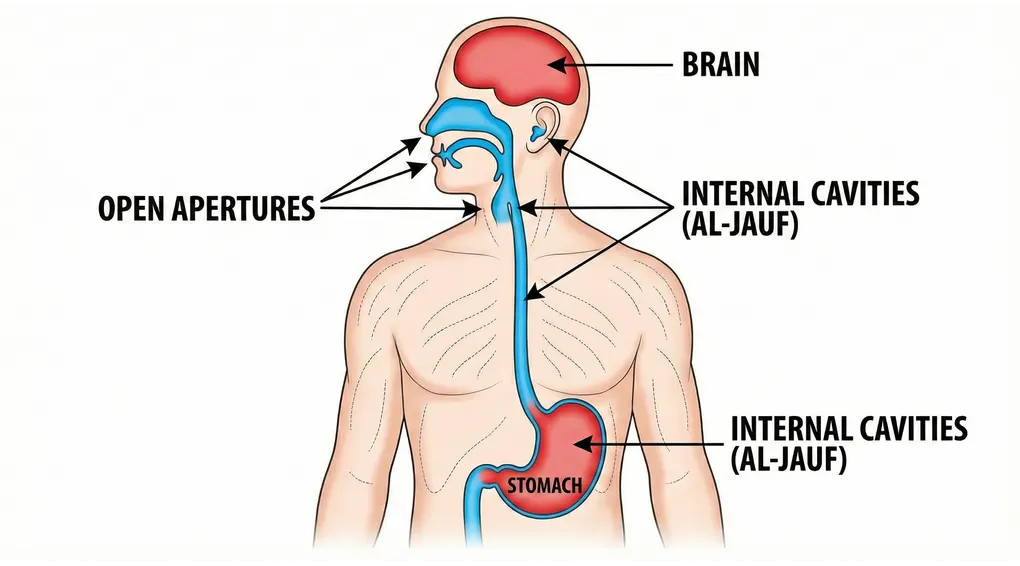
The third condition, which is no less crucial, is the entry route of the substance. Shari’ah stipulates that the physical substance must enter through a natural open route, or in fiqh terminology, it is called manfadh maftūḥ.
Shaykh Zakariyyā details the boundaries of this entry:
(من الظاهر في منفذ مفتوح عن قصد)
Translation: “(The substance enters) from the outer part (of the body) into an open aperture intentionally.”
The boundaries of “Outer” (Zhahir) and “Inner” (Batin) are very important to understand:
- Throat: Its outer boundary is the place where the letter Kha (خ) is emitted, while its inner boundary is the base of the throat (ghalshumah). Entry of a substance past this boundary invalidates the fast.
- Nose: Its outer boundary is up to the nasal bone (khaysyum). Introducing nasal drops (su’uth) past the khaysyum will invalidate the fast.
What if a physical substance enters the body but does not go through an open aperture? For example, applying eye drops or rubbing oil on the skin?
Shaykh Zakariyyā provides a legal opinion (fatwa) that serves as the foundation for modern medical issues:
قوله: (ولا) يفطر (بالكحل)… (وما) أي ولا بما (تشربته المسام) بتشديد الميم ثقب البدن… (وإن وصل إلى الجوف) لأنه لم يصل في منفذ مفتوح
Translation: “(And the fast is not) invalidated (by kohl/eye drops)… (And nor by) what is absorbed by the pores (masam)… (even if it reaches the inner cavity) because it did not arrive through an open aperture.”
This rule is a great relief for Muslims. The use of eye drops, skin ointments, pain relief patches, or rubbing oils does not invalidate the act of fasting. The reason is clear: the eye does not possess a direct open channel to the throat, and the skin absorbs through pores (masam), not through a manfadh maftūḥ. This understanding is also utilized by contemporary scholars to address medical questions such as whether injections, infusions, and eye drops invalidate the fast.
Excused Conditions for Substance Entry (Ma’fu)
Islam is a religion of mercy for all worlds (rahmatan lil ‘alamin) and does not burden His servants beyond their capacity (masyaqqah). There are conditions where a physical substance enters the body cavity through an open aperture, yet the fast is still considered valid.
قوله: (ولا يفطر بغبار الطريق وغربلة الدقيق) لعدم قصده لهما ولعسر تجنبهما
Translation: “(And the fast is not invalidated) by road dust and sifted flour (dust), due to the lack of intention for them and the difficulty of avoiding them.”
The entry of road dust, a fly flying in unintentionally, or smoke are included in things that are excused (ma’fu) due to the inability to avoid them (ghalabah).
Summary Table: Status of Substances Entering the Body
For those who need a quick guide, study the details of the following legal statuses based on the formulation of Asnā al-Maṭālib. For a more comprehensive list, you can also refer to things that invalidate the fast.
| Activity / Substance Name | Entry Route | Fasting Status | Fiqh Explanation |
| Intentional Eating/Drinking | Mouth (Manfadh) | Invalid | Physical substance enters the stomach cavity (jauf). |
| Inhaling Aroma (Perfume) | Nose (Manfadh) | Valid | What enters is only an effect/trace (Atsar), not a physical substance. |
| Nose/Ear Drops | Nose/Ear (Manfadh) | Invalid | Fluid/substance breaches the inner boundary of the head/stomach cavity. |
| Kohl / Eye Drops | Eye (Not Manfadh) | Valid | The eye does not possess an open channel (manfadh maftuh). |
| Skin Ointment / Rubbing Oil | Skin Pores (Masam) | Valid | Absorbed, not through a natural open aperture. |
| Swallowing Road Dust | Mouth/Nose (Manfadh) | Valid | Excused (Ma’fu) because it is difficult to avoid (unintentional). |
Conclusion
Knowing the boundaries of jauf and manfadh equips us with firm conviction in performing worship. Do not let doubt ruin the solemnity of your Ramadan days. Always refer to the literature of scholars who inherited the knowledge of Prophet Muhammad ﷺ.
FAQ: The Rule of Al-‘Ain and Al-Jauf
Does inhaling an inhaler for asthma invalidate the fast?
Yes. Unlike mere perfume aroma, an inhaler contains liquid medication particles that are nebulized (a physical substance/ain). These particles are intentionally introduced through the mouth or nose (manfadh maftūḥ) towards the lungs (jauf).
I gargled for wudhu, and some water was accidentally swallowed. Is it invalid or not?
If you gargled normally (according to the guidance of the shari’ah for wudhu) and water was accidentally swallowed, then the fast remains valid. However, if you gargled excessively (mubalaghah—which is legally disliked/makruh while fasting) and water was swallowed, then the fast becomes invalid because it arose from negligence.
What if leftover food between the teeth is swallowed?
If the food residue is carried by the flow of saliva naturally and you are unable to separate it (its size is very small), then it is excused (valid). But, if the food can be separated and expelled, but is intentionally swallowed instead, then the fast is invalid. If you have doubts regarding the ruling on saliva, you can deepen your understanding in the review about the ruling on swallowing saliva while fasting.
Reference
Zakariyā al-Anṣārī, Asnā al-Maṭālib fī Sharḥ Rawḍ al-Ṭālib, with the ḥāsyiyah of Aḥmad al-Ramlī, edited by Muḥammad az-Zuhrī al-Ghamrāwī (Cairo: al-Maṭbaʿah al-Maymānīyah, 1313 H; repr. Dār al-Kitāb al-Islāmī), vol. 1, pp. 415-416.


